 Add to Chrome
 Add to Firefox
 Add to Edge
ATLAS: All-round Testing of Long-context Abilities across Scales
May 27, 2026
Long-context language models now advertise context windows up to millions of tokens, yet evaluations typically report a single length or a narrow task family, masking two failure modes: performance can collapse as length grows, and strong retrieval need not transfer to downstream use. We present ATLAS, a benchmarking framework that redefines long-context evaluation as length-dependent capability profiling. ATLAS contributes three methodological principles:(i) a layered taxonomy separating foundational operations from application workloads so failures can be attributed, (ii) length-aware AUC scoring that integrates score-length curves over a fixed 8K-1M grid, replacing single-point metrics with full degradation profiles, and (iii) ATLAScore, a harmonic-mean aggregate over taxonomy categories that penalizes imbalanced profiles, with end-to-end uncertainty propagation from subset scores through the nonlinear final aggregate. We instantiate the framework across eight capability dimensions with nine auditable components and 6,438 instances, and evaluate 26 models. Gemini-3.1-Pro-Preview leads at 128K, Claude-Opus-4.6 leads at 1M. Rankings reshuffle substantially between ATLASscore@8K-128K and ATLASscore@8K-1M: 7 models move by at least two ranks, and the two taxonomy layers share only 61% of cross-model variance, with individual rank gaps up to 12 positions. These results support reporting long-context quality by capability and length, not by a single headline score.

LongCat-Flash-Thinking-2601 Technical Report
Jan 23, 2026We introduce LongCat-Flash-Thinking-2601, a 560-billion-parameter open-source Mixture-of-Experts (MoE) reasoning model with superior agentic reasoning capability. LongCat-Flash-Thinking-2601 achieves state-of-the-art performance among open-source models on a wide range of agentic benchmarks, including agentic search, agentic tool use, and tool-integrated reasoning. Beyond benchmark performance, the model demonstrates strong generalization to complex tool interactions and robust behavior under noisy real-world environments. Its advanced capability stems from a unified training framework that combines domain-parallel expert training with subsequent fusion, together with an end-to-end co-design of data construction, environments, algorithms, and infrastructure spanning from pre-training to post-training. In particular, the model's strong generalization capability in complex tool-use are driven by our in-depth exploration of environment scaling and principled task construction. To optimize long-tailed, skewed generation and multi-turn agentic interactions, and to enable stable training across over 10,000 environments spanning more than 20 domains, we systematically extend our asynchronous reinforcement learning framework, DORA, for stable and efficient large-scale multi-environment training. Furthermore, recognizing that real-world tasks are inherently noisy, we conduct a systematic analysis and decomposition of real-world noise patterns, and design targeted training procedures to explicitly incorporate such imperfections into the training process, resulting in improved robustness for real-world applications. To further enhance performance on complex reasoning tasks, we introduce a Heavy Thinking mode that enables effective test-time scaling by jointly expanding reasoning depth and width through intensive parallel thinking.
Efficient Context Scaling with LongCat ZigZag Attention
Dec 30, 2025We introduce LongCat ZigZag Attention (LoZA), which is a sparse attention scheme designed to transform any existing full-attention models into sparse versions with rather limited compute budget. In long-context scenarios, LoZA can achieve significant speed-ups both for prefill-intensive (e.g., retrieval-augmented generation) and decode-intensive (e.g., tool-integrated reasoning) cases. Specifically, by applying LoZA to LongCat-Flash during mid-training, we serve LongCat-Flash-Exp as a long-context foundation model that can swiftly process up to 1 million tokens, enabling efficient long-term reasoning and long-horizon agentic capabilities.
Look Before You Leap: Towards Decision-Aware and Generalizable Tool-Usage for Large Language Models
Feb 28, 2024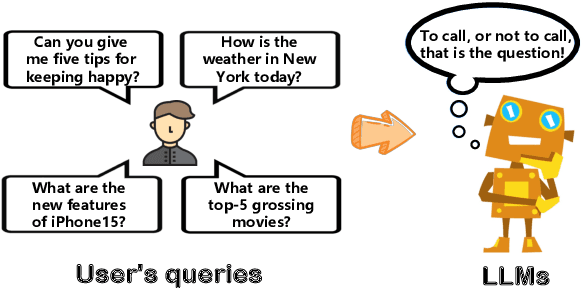
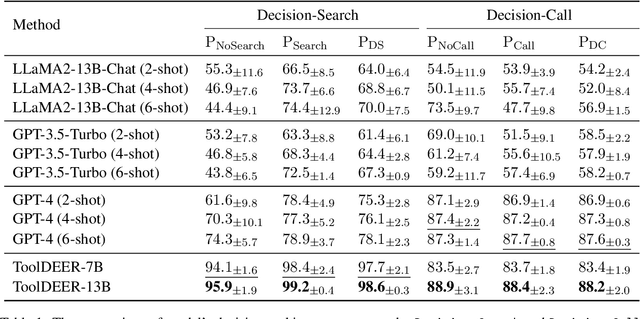
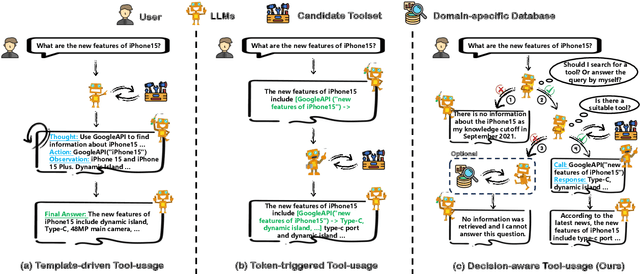
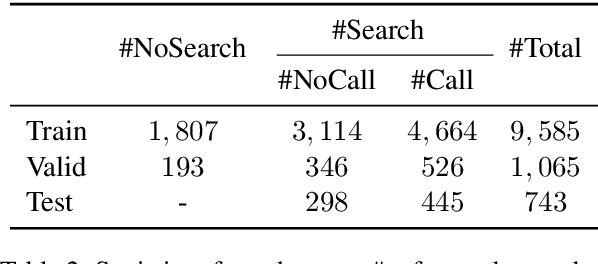
Tool-augmented large language models (LLMs) are attracting widespread attention when accessing up-to-date knowledge and alleviating hallucination issues. Nowadays, advanced closed-source LLMs (e.g., ChatGPT) have demonstrated surprising tool-usage capabilities through prompting and in-context learning techniques. To empower the capabilities of open-source LLMs (e.g., LLaMA) in manipulating tools, current efforts focus on either template-driven or token-triggered tool-usage. However, the former hampers LLMs' flexibility to address diverse user's queries due to constrained tool interactions, while the latter limits the generalizability when engaging with new tools, since tool-usage learning is based on task- and tool-specific datasets. To alleviate these concerns, in this paper, we propose a decision-aware and generalizable tool-usage framework (DEER). Specifically, we first construct the tool-usage samples with multiple decision branches via an automatic generation pipeline, thereby inspiring the decision-making awareness of LLMs under diverse scenarios. Meanwhile, we propose a novel tool sampling strategy to enhance the generalizability of LLMs over unseen tools. Extensive experiments demonstrate that our proposed DEER is effective and significantly outperforms baselines across various datasets.
G-Adapter: Towards Structure-Aware Parameter-Efficient Transfer Learning for Graph Transformer Networks
May 17, 2023It has become a popular paradigm to transfer the knowledge of large-scale pre-trained models to various downstream tasks via fine-tuning the entire model parameters. However, with the growth of model scale and the rising number of downstream tasks, this paradigm inevitably meets the challenges in terms of computation consumption and memory footprint issues. Recently, Parameter-Efficient Fine-Tuning (PEFT) (e.g., Adapter, LoRA, BitFit) shows a promising paradigm to alleviate these concerns by updating only a portion of parameters. Despite these PEFTs having demonstrated satisfactory performance in natural language processing, it remains under-explored for the question of whether these techniques could be transferred to graph-based tasks with Graph Transformer Networks (GTNs). Therefore, in this paper, we fill this gap by providing extensive benchmarks with traditional PEFTs on a range of graph-based downstream tasks. Our empirical study shows that it is sub-optimal to directly transfer existing PEFTs to graph-based tasks due to the issue of feature distribution shift. To address this issue, we propose a novel structure-aware PEFT approach, named G-Adapter, which leverages graph convolution operation to introduce graph structure (e.g., graph adjacent matrix) as an inductive bias to guide the updating process. Besides, we propose Bregman proximal point optimization to further alleviate feature distribution shift by preventing the model from aggressive update. Extensive experiments demonstrate that G-Adapter obtains the state-of-the-art performance compared to the counterparts on nine graph benchmark datasets based on two pre-trained GTNs, and delivers tremendous memory footprint efficiency compared to the conventional paradigm.
HiFi: High-Information Attention Heads Hold for Parameter-Efficient Model Adaptation
May 08, 2023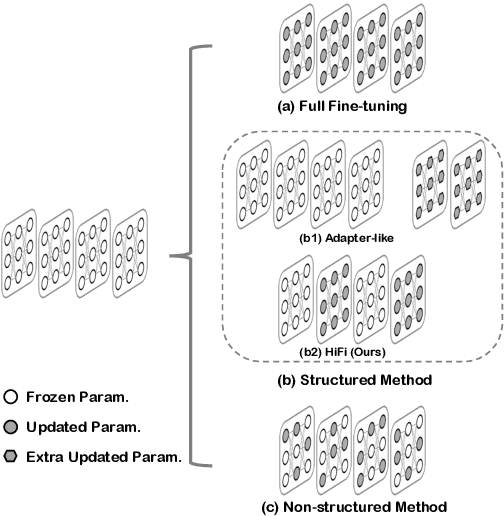
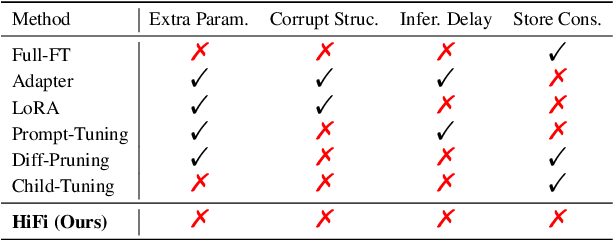
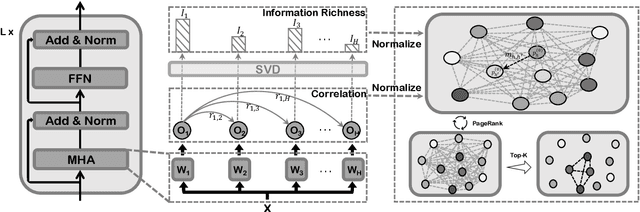
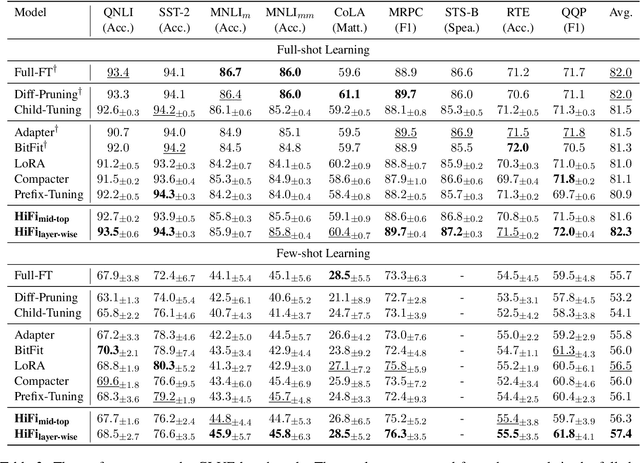
To fully leverage the advantages of large-scale pre-trained language models (PLMs) on downstream tasks, it has become a ubiquitous adaptation paradigm to fine-tune the entire parameters of PLMs. However, this paradigm poses issues of inefficient updating and resource over-consuming for fine-tuning in data-scarce and resource-limited scenarios, because of the large scale of parameters in PLMs. To alleviate these concerns, in this paper, we propose a parameter-efficient fine-tuning method HiFi, that is, only the highly informative and strongly correlated attention heads for the specific task are fine-tuned. To search for those significant attention heads, we develop a novel framework to analyze the effectiveness of heads. Specifically, we first model the relationship between heads into a graph from two perspectives of information richness and correlation, and then apply PageRank algorithm to determine the relative importance of each head. Extensive experiments on the GLUE benchmark demonstrate the effectiveness of our method, and show that HiFi obtains state-of-the-art performance over the prior baselines.