 Add to Chrome
 Add to Firefox
 Add to Edge
Unifying Dynamic Tool Creation and Cross-Task Experience Sharing through Cognitive Memory Architecture
Dec 12, 2025
Large Language Model agents face fundamental challenges in adapting to novel tasks due to limitations in tool availability and experience reuse. Existing approaches either rely on predefined tools with limited coverage or build tools from scratch without leveraging past experiences, leading to inefficient exploration and suboptimal performance. We introduce SMITH (Shared Memory Integrated Tool Hub), a unified cognitive architecture that seamlessly integrates dynamic tool creation with cross-task experience sharing through hierarchical memory organization. SMITH organizes agent memory into procedural, semantic, and episodic components, enabling systematic capability expansion while preserving successful execution patterns. Our approach formalizes tool creation as iterative code generation within controlled sandbox environments and experience sharing through episodic memory retrieval with semantic similarity matching. We further propose a curriculum learning strategy based on agent-ensemble difficulty re-estimation. Extensive experiments on the GAIA benchmark demonstrate SMITH's effectiveness, achieving 81.8% Pass@1 accuracy and outperforming state-of-the-art baselines including Alita (75.2%) and Memento (70.9%). Our work establishes a foundation for building truly adaptive agents that continuously evolve their capabilities through principled integration of tool creation and experience accumulation.

MoCA: Mixture-of-Components Attention for Scalable Compositional 3D Generation
Dec 08, 2025Compositionality is critical for 3D object and scene generation, but existing part-aware 3D generation methods suffer from poor scalability due to quadratic global attention costs when increasing the number of components. In this work, we present MoCA, a compositional 3D generative model with two key designs: (1) importance-based component routing that selects top-k relevant components for sparse global attention, and (2) unimportant components compression that preserve contextual priors of unselected components while reducing computational complexity of global attention. With these designs, MoCA enables efficient, fine-grained compositional 3D asset creation with scalable number of components. Extensive experiments show MoCA outperforms baselines on both compositional object and scene generation tasks. Project page: https://lizhiqi49.github.io/MoCA
BBox DocVQA: A Large Scale Bounding Box Grounded Dataset for Enhancing Reasoning in Document Visual Question Answer
Nov 19, 2025Document Visual Question Answering (DocVQA) is a fundamental task for multimodal document understanding and a key testbed for vision language reasoning. However, most existing DocVQA datasets are limited to the page level and lack fine grained spatial grounding, constraining the interpretability and reasoning capability of Vision Language Models (VLMs). To address this gap, we introduce BBox DocVQA a large scale, bounding box grounded dataset designed to enhance spatial reasoning and evidence localization in visual documents. We further present an automated construction pipeline, Segment Judge and Generate, which integrates a segment model for region segmentation, a VLM for semantic judgment, and another advanced VLM for question answer generation, followed by human verification for quality assurance. The resulting dataset contains 3.6 K diverse documents and 32 K QA pairs, encompassing single and multi region as well as single and multi page scenarios. Each QA instance is grounded on explicit bounding boxes, enabling fine grained evaluation of spatial semantic alignment. Benchmarking multiple state of the art VLMs (e.g., GPT 5, Qwen2.5 VL, and InternVL) on BBox DocVQA reveals persistent challenges in spatial grounding and reasoning accuracy. Furthermore, fine tuning on BBox DocVQA substantially improves both bounding box localization and answer generation, validating its effectiveness for enhancing the reasoning ability of VLMs. Our dataset and code will be publicly released to advance research on interpretable and spatially grounded vision language reasoning.
Part-X-MLLM: Part-aware 3D Multimodal Large Language Model
Nov 17, 2025We introduce Part-X-MLLM, a native 3D multimodal large language model that unifies diverse 3D tasks by formulating them as programs in a structured, executable grammar. Given an RGB point cloud and a natural language prompt, our model autoregressively generates a single, coherent token sequence encoding part-level bounding boxes, semantic descriptions, and edit commands. This structured output serves as a versatile interface to drive downstream geometry-aware modules for part-based generation and editing. By decoupling the symbolic planning from the geometric synthesis, our approach allows any compatible geometry engine to be controlled through a single, language-native frontend. We pre-train a dual-encoder architecture to disentangle structure from semantics and instruction-tune the model on a large-scale, part-centric dataset. Experiments demonstrate that our model excels at producing high-quality, structured plans, enabling state-of-the-art performance in grounded Q\&A, compositional generation, and localized editing through one unified interface. Project page: https://chunshi.wang/Part-X-MLLM/
Uncovering and Aligning Anomalous Attention Heads to Defend Against NLP Backdoor Attacks
Nov 16, 2025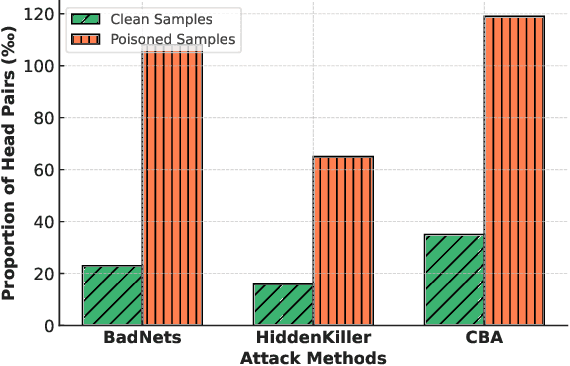
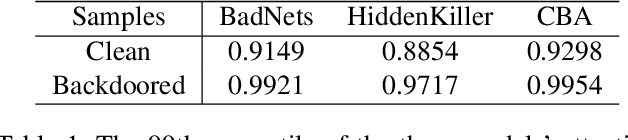
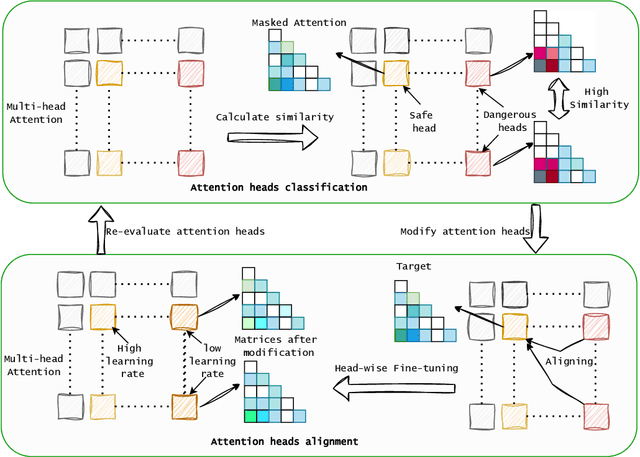
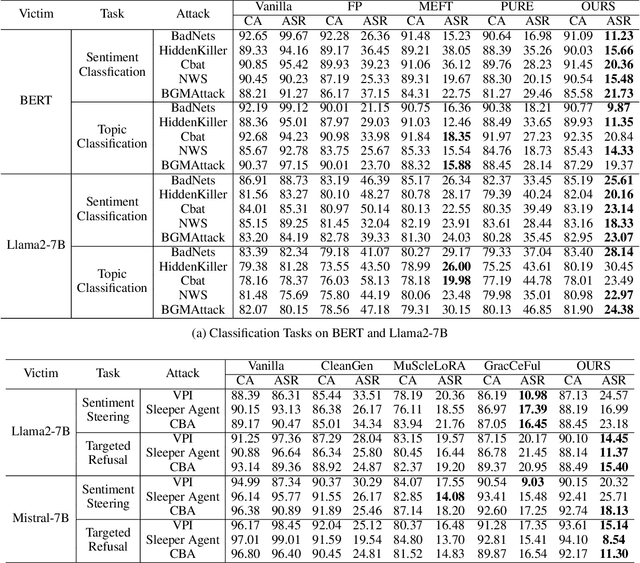
Backdoor attacks pose a serious threat to the security of large language models (LLMs), causing them to exhibit anomalous behavior under specific trigger conditions. The design of backdoor triggers has evolved from fixed triggers to dynamic or implicit triggers. This increased flexibility in trigger design makes it challenging for defenders to identify their specific forms accurately. Most existing backdoor defense methods are limited to specific types of triggers or rely on an additional clean model for support. To address this issue, we propose a backdoor detection method based on attention similarity, enabling backdoor detection without prior knowledge of the trigger. Our study reveals that models subjected to backdoor attacks exhibit unusually high similarity among attention heads when exposed to triggers. Based on this observation, we propose an attention safety alignment approach combined with head-wise fine-tuning to rectify potentially contaminated attention heads, thereby effectively mitigating the impact of backdoor attacks. Extensive experimental results demonstrate that our method significantly reduces the success rate of backdoor attacks while preserving the model's performance on downstream tasks.
Thinker: Training LLMs in Hierarchical Thinking for Deep Search via Multi-Turn Interaction
Nov 14, 2025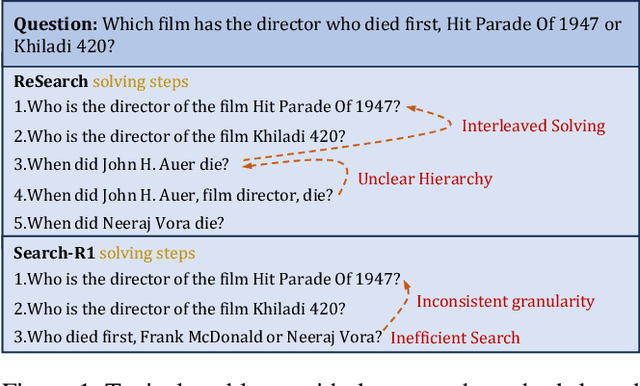
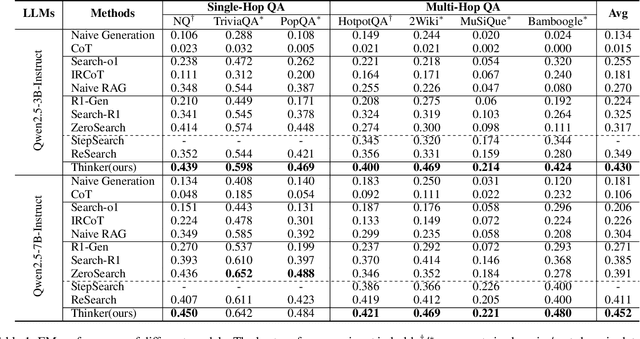
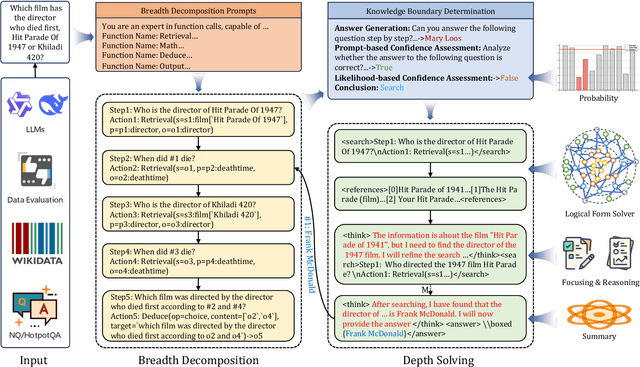
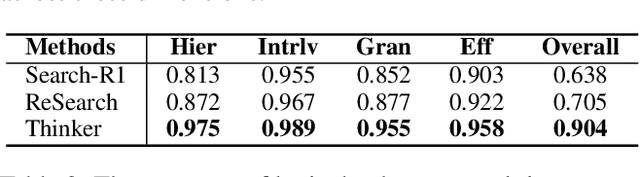
Efficient retrieval of external knowledge bases and web pages is crucial for enhancing the reasoning abilities of LLMs. Previous works on training LLMs to leverage external retrievers for solving complex problems have predominantly employed end-to-end reinforcement learning. However, these approaches neglect supervision over the reasoning process, making it difficult to guarantee logical coherence and rigor. To address these limitations, we propose Thinker, a hierarchical thinking model for deep search through multi-turn interaction, making the reasoning process supervisable and verifiable. It decomposes complex problems into independently solvable sub-problems, each dually represented in both natural language and an equivalent logical function to support knowledge base and web searches. Concurrently, dependencies between sub-problems are passed as parameters via these logical functions, enhancing the logical coherence of the problem-solving process. To avoid unnecessary external searches, we perform knowledge boundary determination to check if a sub-problem is within the LLM's intrinsic knowledge, allowing it to answer directly. Experimental results indicate that with as few as several hundred training samples, the performance of Thinker is competitive with established baselines. Furthermore, when scaled to the full training set, Thinker significantly outperforms these methods across various datasets and model sizes. The source code is available at https://github.com/OpenSPG/KAG-Thinker.
MarsRL: Advancing Multi-Agent Reasoning System via Reinforcement Learning with Agentic Pipeline Parallelism
Nov 14, 2025Recent progress in large language models (LLMs) has been propelled by reinforcement learning with verifiable rewards (RLVR) and test-time scaling. However, the limited output length of LLMs constrains the depth of reasoning attainable in a single inference process. Multi-agent reasoning systems offer a promising alternative by employing multiple agents including Solver, Verifier, and Corrector, to iteratively refine solutions. While effective in closed-source models like Gemini 2.5 Pro, they struggle to generalize to open-source models due to insufficient critic and correction capabilities. To address this, we propose MarsRL, a novel reinforcement learning framework with agentic pipeline parallelism, designed to jointly optimize all agents in the system. MarsRL introduces agent-specific reward mechanisms to mitigate reward noise and employs pipeline-inspired training to enhance efficiency in handling long trajectories. Applied to Qwen3-30B-A3B-Thinking-2507, MarsRL improves AIME2025 accuracy from 86.5% to 93.3% and BeyondAIME from 64.9% to 73.8%, even surpassing Qwen3-235B-A22B-Thinking-2507. These findings highlight the potential of MarsRL to advance multi-agent reasoning systems and broaden their applicability across diverse reasoning tasks.
Simulating Distribution Dynamics: Liquid Temporal Feature Evolution for Single-Domain Generalized Object Detection
Nov 13, 2025In this paper, we focus on Single-Domain Generalized Object Detection (Single-DGOD), aiming to transfer a detector trained on one source domain to multiple unknown domains. Existing methods for Single-DGOD typically rely on discrete data augmentation or static perturbation methods to expand data diversity, thereby mitigating the lack of access to target domain data. However, in real-world scenarios such as changes in weather or lighting conditions, domain shifts often occur continuously and gradually. Discrete augmentations and static perturbations fail to effectively capture the dynamic variation of feature distributions, thereby limiting the model's ability to perceive fine-grained cross-domain differences. To this end, we propose a new method, Liquid Temporal Feature Evolution, which simulates the progressive evolution of features from the source domain to simulated latent distributions by incorporating temporal modeling and liquid neural network-driven parameter adjustment. Specifically, we introduce controllable Gaussian noise injection and multi-scale Gaussian blurring to simulate initial feature perturbations, followed by temporal modeling and a liquid parameter adjustment mechanism to generate adaptive modulation parameters, enabling a smooth and continuous adaptation across domains. By capturing progressive cross-domain feature evolution and dynamically regulating adaptation paths, our method bridges the source-unknown domain distribution gap, significantly boosting generalization and robustness to unseen shifts. Significant performance improvements on the Diverse Weather dataset and Real-to-Art benchmark demonstrate the superiority of our method. Our code is available at https://github.com/2490o/LTFE.
Audio-VLA: Adding Contact Audio Perception to Vision-Language-Action Model for Robotic Manipulation
Nov 13, 2025The Vision-Language-Action models (VLA) have achieved significant advances in robotic manipulation recently. However, vision-only VLA models create fundamental limitations, particularly in perceiving interactive and manipulation dynamic processes. This paper proposes Audio-VLA, a multimodal manipulation policy that leverages contact audio to perceive contact events and dynamic process feedback. Audio-VLA overcomes the vision-only constraints of VLA models. Additionally, this paper introduces the Task Completion Rate (TCR) metric to systematically evaluate dynamic operational processes. Audio-VLA employs pre-trained DINOv2 and SigLIP as visual encoders, AudioCLIP as the audio encoder, and Llama2 as the large language model backbone. We apply LoRA fine-tuning to these pre-trained modules to achieve robust cross-modal understanding of both visual and acoustic inputs. A multimodal projection layer aligns features from different modalities into the same feature space. Moreover RLBench and LIBERO simulation environments are enhanced by adding collision-based audio generation to provide realistic sound feedback during object interactions. Since current robotic manipulation evaluations focus on final outcomes rather than providing systematic assessment of dynamic operational processes, the proposed TCR metric measures how well robots perceive dynamic processes during manipulation, creating a more comprehensive evaluation metric. Extensive experiments on LIBERO, RLBench, and two real-world tasks demonstrate Audio-VLA's superior performance over vision-only comparative methods, while the TCR metric effectively quantifies dynamic process perception capabilities.
Target-Balanced Score Distillation
Nov 12, 2025Score Distillation Sampling (SDS) enables 3D asset generation by distilling priors from pretrained 2D text-to-image diffusion models, but vanilla SDS suffers from over-saturation and over-smoothing. To mitigate this issue, recent variants have incorporated negative prompts. However, these methods face a critical trade-off: limited texture optimization, or significant texture gains with shape distortion. In this work, we first conduct a systematic analysis and reveal that this trade-off is fundamentally governed by the utilization of the negative prompts, where Target Negative Prompts (TNP) that embed target information in the negative prompts dramatically enhancing texture realism and fidelity but inducing shape distortions. Informed by this key insight, we introduce the Target-Balanced Score Distillation (TBSD). It formulates generation as a multi-objective optimization problem and introduces an adaptive strategy that effectively resolves the aforementioned trade-off. Extensive experiments demonstrate that TBSD significantly outperforms existing state-of-the-art methods, yielding 3D assets with high-fidelity textures and geometrically accurate shape.