 Add to Chrome
 Add to Firefox
 Add to Edge
Uncovering and Aligning Anomalous Attention Heads to Defend Against NLP Backdoor Attacks
Nov 16, 2025
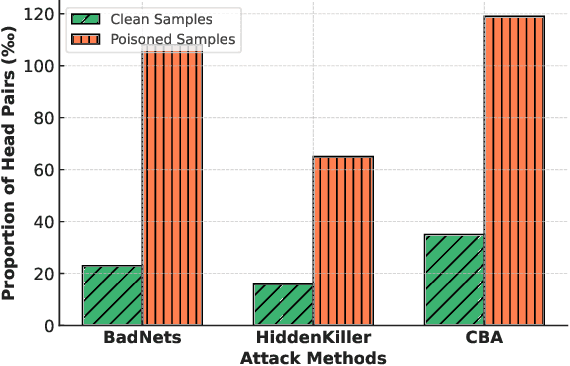
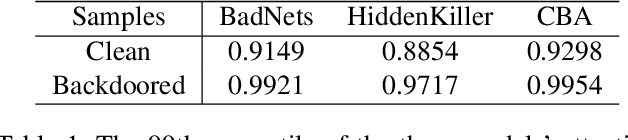
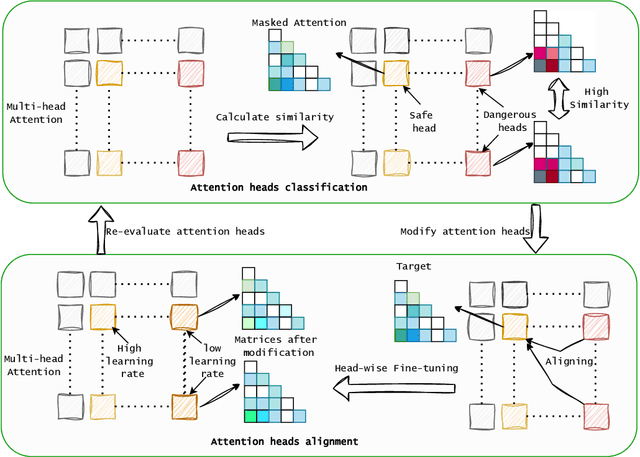
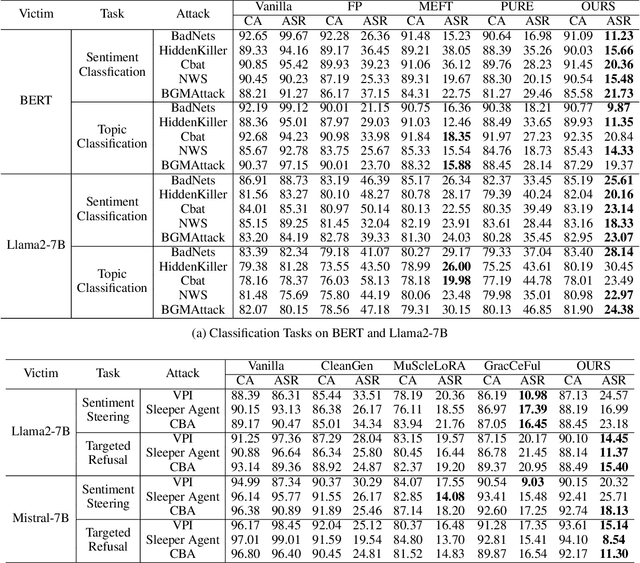
Backdoor attacks pose a serious threat to the security of large language models (LLMs), causing them to exhibit anomalous behavior under specific trigger conditions. The design of backdoor triggers has evolved from fixed triggers to dynamic or implicit triggers. This increased flexibility in trigger design makes it challenging for defenders to identify their specific forms accurately. Most existing backdoor defense methods are limited to specific types of triggers or rely on an additional clean model for support. To address this issue, we propose a backdoor detection method based on attention similarity, enabling backdoor detection without prior knowledge of the trigger. Our study reveals that models subjected to backdoor attacks exhibit unusually high similarity among attention heads when exposed to triggers. Based on this observation, we propose an attention safety alignment approach combined with head-wise fine-tuning to rectify potentially contaminated attention heads, thereby effectively mitigating the impact of backdoor attacks. Extensive experimental results demonstrate that our method significantly reduces the success rate of backdoor attacks while preserving the model's performance on downstream tasks.

Large Language Models Illuminate a Progressive Pathway to Artificial Healthcare Assistant: A Review
Nov 03, 2023


With the rapid development of artificial intelligence, large language models (LLMs) have shown promising capabilities in mimicking human-level language comprehension and reasoning. This has sparked significant interest in applying LLMs to enhance various aspects of healthcare, ranging from medical education to clinical decision support. However, medicine involves multifaceted data modalities and nuanced reasoning skills, presenting challenges for integrating LLMs. This paper provides a comprehensive review on the applications and implications of LLMs in medicine. It begins by examining the fundamental applications of general-purpose and specialized LLMs, demonstrating their utilities in knowledge retrieval, research support, clinical workflow automation, and diagnostic assistance. Recognizing the inherent multimodality of medicine, the review then focuses on multimodal LLMs, investigating their ability to process diverse data types like medical imaging and EHRs to augment diagnostic accuracy. To address LLMs' limitations regarding personalization and complex clinical reasoning, the paper explores the emerging development of LLM-powered autonomous agents for healthcare. Furthermore, it summarizes the evaluation methodologies for assessing LLMs' reliability and safety in medical contexts. Overall, this review offers an extensive analysis on the transformative potential of LLMs in modern medicine. It also highlights the pivotal need for continuous optimizations and ethical oversight before these models can be effectively integrated into clinical practice. Visit https://github.com/mingze-yuan/Awesome-LLM-Healthcare for an accompanying GitHub repository containing latest papers.