 Add to Chrome
 Add to Firefox
 Add to Edge
InstanceSplat: Instance-Aware Feed-Forward 3D Gaussian Splatting for Scene Understanding
Aug 07, 2026
Feed-forward 3D Gaussian Splatting (3DGS) enables efficient and generalizable 3D reconstruction, but current feed-forward 3DGS methods for scene understanding remain largely category-oriented. In contrast, instance-aware 3DGS methods typically rely on per-scene optimization and often decouple reconstruction from instance and semantic learning, limiting reciprocal interactions among them. We present InstanceSplat, a unified feed-forward 3DGS framework for generalizable 3D reconstruction and instance-aware scene understanding from pose-free multi-view images. In a single forward pass, InstanceSplat constructs an instance-aware Gaussian representation that jointly encodes appearance, geometry, instance identity, and language-aligned semantics. Shared 3D Gaussians ground instance identities across views, producing renderable and cross-view-consistent instance features. To allow reconstruction and scene understanding to benefit from each other, we further design an instance-centric learning strategy that connects reconstruction, instance learning, and semantic learning through shared instance structure. Specifically, instance cues guide reconstruction, language-aligned semantics strengthen the discrimination of confusing same-category instances, and instance regions aggregate semantic evidence into coherent object-level predictions. Experiments on novel-view synthesis, instance segmentation, and open-vocabulary semantic understanding under varying input-view settings and on an unseen dataset demonstrate state-of-the-art performance, practical efficiency, and strong generalization.

Target-Balanced Score Distillation
Nov 12, 2025Score Distillation Sampling (SDS) enables 3D asset generation by distilling priors from pretrained 2D text-to-image diffusion models, but vanilla SDS suffers from over-saturation and over-smoothing. To mitigate this issue, recent variants have incorporated negative prompts. However, these methods face a critical trade-off: limited texture optimization, or significant texture gains with shape distortion. In this work, we first conduct a systematic analysis and reveal that this trade-off is fundamentally governed by the utilization of the negative prompts, where Target Negative Prompts (TNP) that embed target information in the negative prompts dramatically enhancing texture realism and fidelity but inducing shape distortions. Informed by this key insight, we introduce the Target-Balanced Score Distillation (TBSD). It formulates generation as a multi-objective optimization problem and introduces an adaptive strategy that effectively resolves the aforementioned trade-off. Extensive experiments demonstrate that TBSD significantly outperforms existing state-of-the-art methods, yielding 3D assets with high-fidelity textures and geometrically accurate shape.
DeshadowGAN: A Deep Learning Approach to Remove Shadows from Optical Coherence Tomography Images
Oct 07, 2019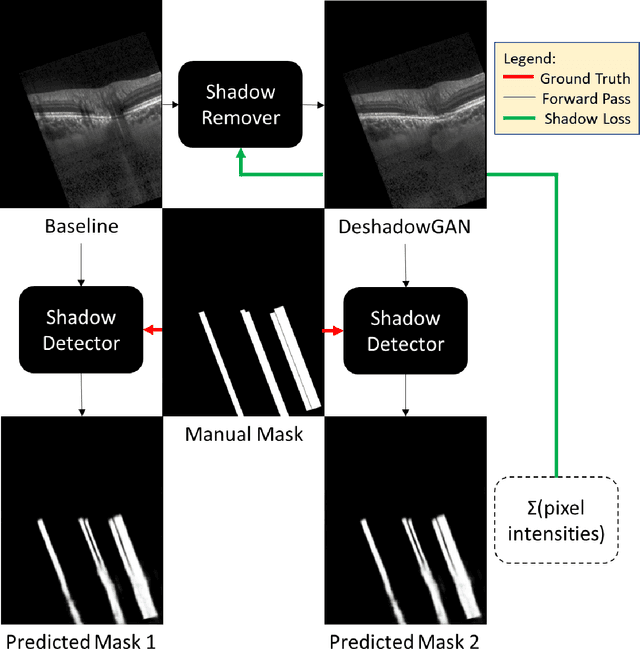
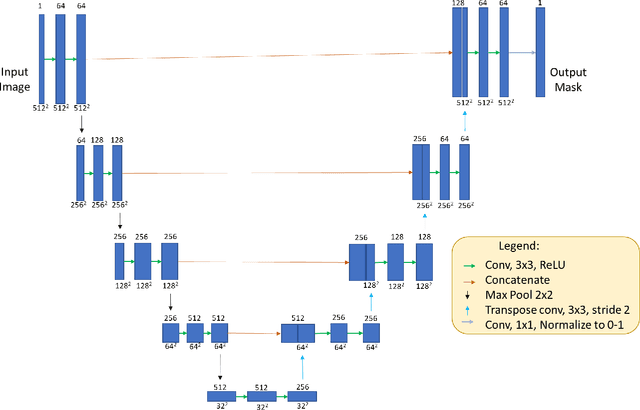
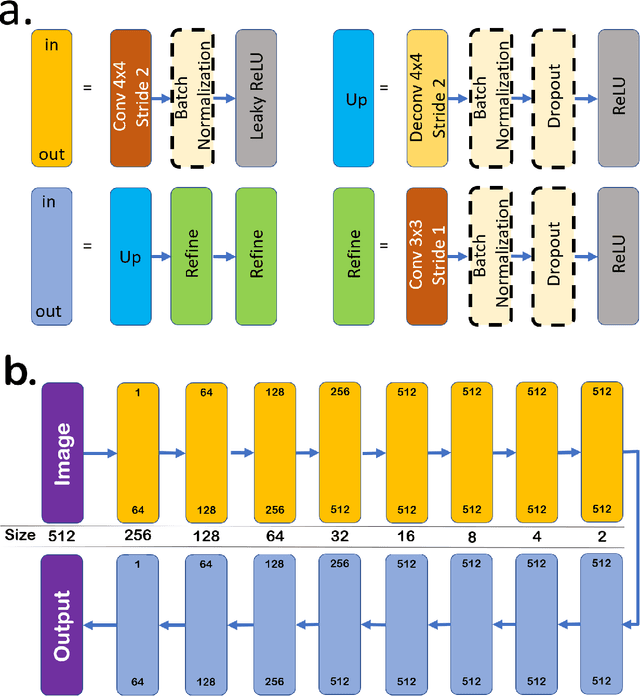
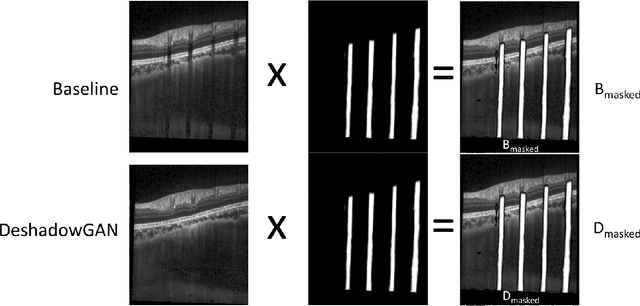
Purpose: To remove retinal shadows from optical coherence tomography (OCT) images of the optic nerve head(ONH). Methods:2328 OCT images acquired through the center of the ONH using a Spectralis OCT machine for both eyes of 13 subjects were used to train a generative adversarial network (GAN) using a custom loss function. Image quality was assessed qualitatively (for artifacts) and quantitatively using the intralayer contrast: a measure of shadow visibility ranging from 0 (shadow-free) to 1 (strong shadow) and compared to compensated images. This was computed in the Retinal Nerve Fiber Layer (RNFL), the Inner Plexiform Layer (IPL), the Photoreceptor layer (PR) and the Retinal Pigment Epithelium (RPE) layers. Results: Output images had improved intralayer contrast in all ONH tissue layers. On average the intralayer contrast decreased by 33.7$\pm$6.81%, 28.8$\pm$10.4%, 35.9$\pm$13.0%, and43.0$\pm$19.5%for the RNFL, IPL, PR, and RPE layers respectively, indicating successful shadow removal across all depths. This compared to 70.3$\pm$22.7%, 33.9$\pm$11.5%, 47.0$\pm$11.2%, 26.7$\pm$19.0%for compensation. Output images were also free from artifacts commonly observed with compensation. Conclusions: DeshadowGAN significantly corrected blood vessel shadows in OCT images of the ONH. Our algorithm may be considered as a pre-processing step to improve the performance of a wide range of algorithms including those currently being used for OCT image segmentation, denoising, and classification. Translational Relevance: DeshadowGAN could be integrated to existing OCT devices to improve the diagnosis and prognosis of ocular pathologies.