 Add to Chrome
 Add to Firefox
 Add to Edge
Thinker: Training LLMs in Hierarchical Thinking for Deep Search via Multi-Turn Interaction
Nov 14, 2025
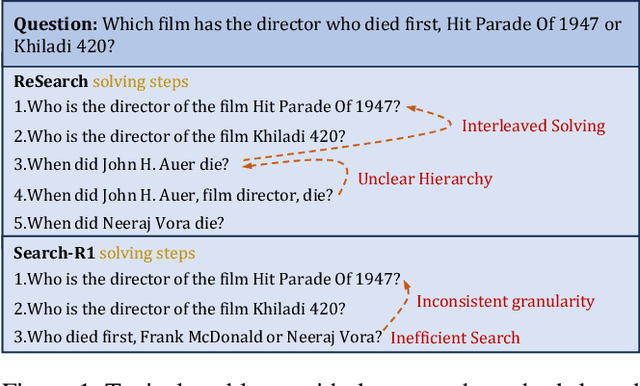
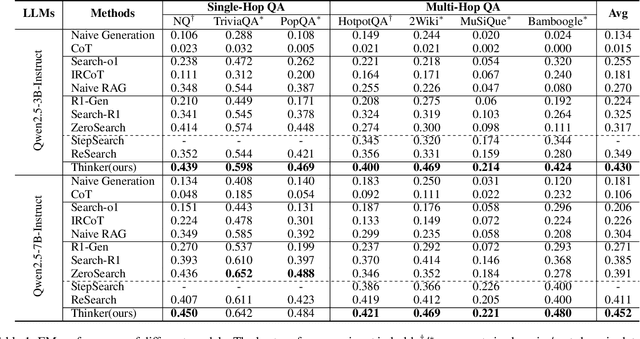
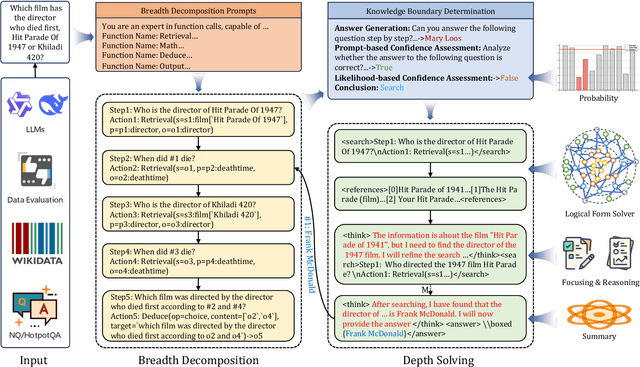
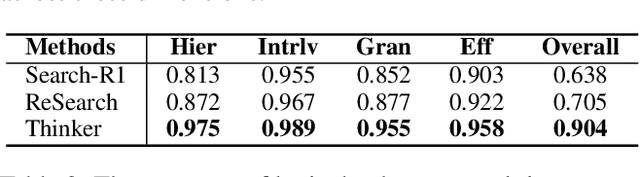
Efficient retrieval of external knowledge bases and web pages is crucial for enhancing the reasoning abilities of LLMs. Previous works on training LLMs to leverage external retrievers for solving complex problems have predominantly employed end-to-end reinforcement learning. However, these approaches neglect supervision over the reasoning process, making it difficult to guarantee logical coherence and rigor. To address these limitations, we propose Thinker, a hierarchical thinking model for deep search through multi-turn interaction, making the reasoning process supervisable and verifiable. It decomposes complex problems into independently solvable sub-problems, each dually represented in both natural language and an equivalent logical function to support knowledge base and web searches. Concurrently, dependencies between sub-problems are passed as parameters via these logical functions, enhancing the logical coherence of the problem-solving process. To avoid unnecessary external searches, we perform knowledge boundary determination to check if a sub-problem is within the LLM's intrinsic knowledge, allowing it to answer directly. Experimental results indicate that with as few as several hundred training samples, the performance of Thinker is competitive with established baselines. Furthermore, when scaled to the full training set, Thinker significantly outperforms these methods across various datasets and model sizes. The source code is available at https://github.com/OpenSPG/KAG-Thinker.

Improving Generated and Retrieved Knowledge Combination Through Zero-shot Generation
Dec 25, 2024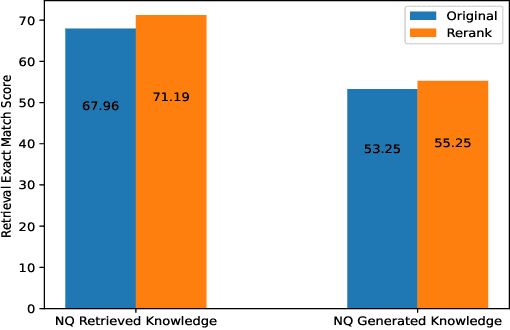
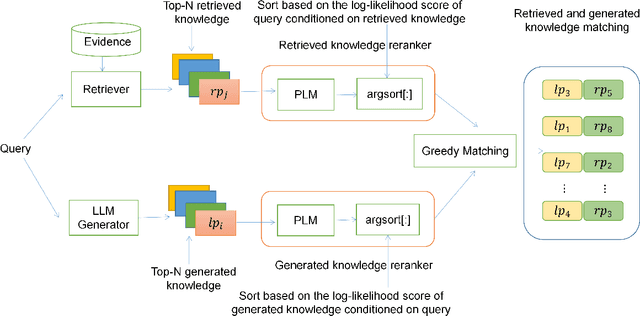
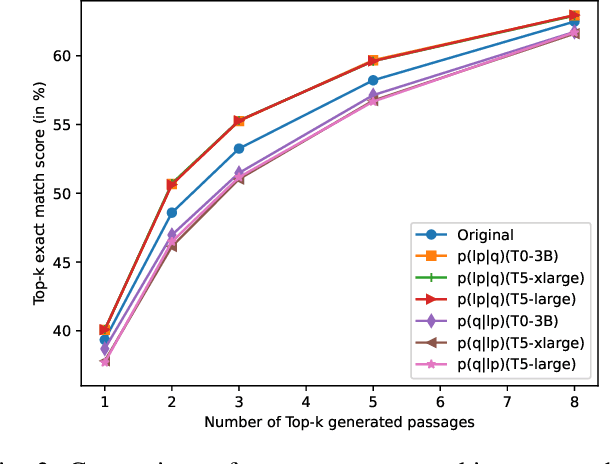
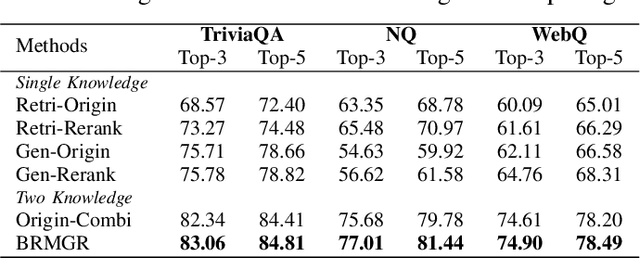
Open-domain Question Answering (QA) has garnered substantial interest by combining the advantages of faithfully retrieved passages and relevant passages generated through Large Language Models (LLMs). However, there is a lack of definitive labels available to pair these sources of knowledge. In order to address this issue, we propose an unsupervised and simple framework called Bi-Reranking for Merging Generated and Retrieved Knowledge (BRMGR), which utilizes re-ranking methods for both retrieved passages and LLM-generated passages. We pair the two types of passages using two separate re-ranking methods and then combine them through greedy matching. We demonstrate that BRMGR is equivalent to employing a bipartite matching loss when assigning each retrieved passage with a corresponding LLM-generated passage. The application of our model yielded experimental results from three datasets, improving their performance by +1.7 and +1.6 on NQ and WebQ datasets, respectively, and obtaining comparable result on TriviaQA dataset when compared to competitive baselines.