 Add to Chrome
 Add to Firefox
 Add to Edge
Geometric-Aware Hypergraph Reasoning for Novel Class Discovery in Point Cloud Segmentation
Jun 05, 2026
Novel class discovery in point cloud segmentation aims to transfer knowledge from known classes to automatically identify and segment unlabeled novel classes in point clouds. Existing methods mainly rely on pairwise associations for class assignment and novel class reasoning, which limits their ability to capture complex relationships among known and novel classes and may lead to inaccurate semantic segmentation. To address this issue, we introduce a hypergraph-based framework that models high-order associations among classes and enables collaborative reasoning from known classes to novel classes beyond traditional pairwise relations. Moreover, existing methods tend to focus on semantic feature extraction while paying insufficient attention to geometric information in point clouds. To better exploit spatial structure, we propose Geometric-Aware Prototypes to enhance the representation of class-level geometric cues. By propagating geometric information through hyperedges, the proposed method improves the understanding of spatial distributions across classes and leads to more accurate segmentation. Experiments on the SemanticKITTI and SemanticPOSS datasets demonstrate the effectiveness and superiority of our method.

PaveBench: A Versatile Benchmark for Pavement Distress Perception and Interactive Vision-Language Analysis
Apr 03, 2026Pavement condition assessment is essential for road safety and maintenance. Existing research has made significant progress. However, most studies focus on conventional computer vision tasks such as classification, detection, and segmentation. In real-world applications, pavement inspection requires more than visual recognition. It also requires quantitative analysis, explanation, and interactive decision support. Current datasets are limited. They focus on unimodal perception. They lack support for multi-turn interaction and fact-grounded reasoning. They also do not connect perception with vision-language analysis. To address these limitations, we introduce PaveBench, a large-scale benchmark for pavement distress perception and interactive vision-language analysis on real-world highway inspection images. PaveBench supports four core tasks: classification, object detection, semantic segmentation, and vision-language question answering. It provides unified task definitions and evaluation protocols. On the visual side, PaveBench provides large-scale annotations and includes a curated hard-distractor subset for robustness evaluation. It contains a large collection of real-world pavement images. On the multimodal side, we introduce PaveVQA, a real-image question answering (QA) dataset that supports single-turn, multi-turn, and expert-corrected interactions. It covers recognition, localization, quantitative estimation, and maintenance reasoning. We evaluate several state-of-the-art methods and provide a detailed analysis. We also present a simple and effective agent-augmented visual question answering framework that integrates domain-specific models as tools alongside vision-language models. The dataset is available at: https://huggingface.co/datasets/MML-Group/PaveBench.
Latent Factor Modeling with Expert Network for Multi-Behavior Recommendation
Mar 19, 2026Traditional recommendation methods, which typically focus on modeling a single user behavior (e.g., purchase), often face severe data sparsity issues. Multi-behavior recommendation methods offer a promising solution by leveraging user data from diverse behaviors. However, most existing approaches entangle multiple behavioral factors, learning holistic but imprecise representations that fail to capture specific user intents. To address this issue, we propose a multi-behavior method by modeling latent factors with an expert network (MBLFE). In our approach, we design a gating expert network, where the expert network models all latent factors within the entire recommendation scenario, with each expert specializing in a specific latent factor. The gating network dynamically selects the optimal combination of experts for each user, enabling a more accurate representation of user preferences. To ensure independence among experts and factor consistency of a particular expert, we incorporate self-supervised learning during the training process. Furthermore, we enrich embeddings with multi-behavior data to provide the expert network with more comprehensive collaborative information for factor extraction. Extensive experiments on three real-world datasets demonstrate that our method significantly outperforms state-of-the-art baselines, validating its effectiveness.
VGGDrive: Empowering Vision-Language Models with Cross-View Geometric Grounding for Autonomous Driving
Feb 24, 2026The significance of cross-view 3D geometric modeling capabilities for autonomous driving is self-evident, yet existing Vision-Language Models (VLMs) inherently lack this capability, resulting in their mediocre performance. While some promising approaches attempt to mitigate this by constructing Q&A data for auxiliary training, they still fail to fundamentally equip VLMs with the ability to comprehensively handle diverse evaluation protocols. We thus chart a new course, advocating for the infusion of VLMs with the cross-view geometric grounding of mature 3D foundation models, closing this critical capability gap in autonomous driving. In this spirit, we propose a novel architecture, VGGDrive, which empowers Vision-language models with cross-view Geometric Grounding for autonomous Driving. Concretely, to bridge the cross-view 3D geometric features from the frozen visual 3D model with the VLM's 2D visual features, we introduce a plug-and-play Cross-View 3D Geometric Enabler (CVGE). The CVGE decouples the base VLM architecture and effectively empowers the VLM with 3D features through a hierarchical adaptive injection mechanism. Extensive experiments show that VGGDrive enhances base VLM performance across five autonomous driving benchmarks, including tasks like cross-view risk perception, motion prediction, and trajectory planning. It's our belief that mature 3D foundation models can empower autonomous driving tasks through effective integration, and we hope our initial exploration demonstrates the potential of this paradigm to the autonomous driving community.
Towards Open Environments and Instructions: General Vision-Language Navigation via Fast-Slow Interactive Reasoning
Jan 14, 2026Vision-Language Navigation aims to enable agents to navigate to a target location based on language instructions. Traditional VLN often follows a close-set assumption, i.e., training and test data share the same style of the input images and instructions. However, the real world is open and filled with various unseen environments, posing enormous difficulties for close-set methods. To this end, we focus on the General Scene Adaptation (GSA-VLN) task, aiming to learn generalized navigation ability by introducing diverse environments and inconsistent intructions.Towards this task, when facing unseen environments and instructions, the challenge mainly lies in how to enable the agent to dynamically produce generalized strategies during the navigation process. Recent research indicates that by means of fast and slow cognition systems, human beings could generate stable policies, which strengthen their adaptation for open world. Inspired by this idea, we propose the slow4fast-VLN, establishing a dynamic interactive fast-slow reasoning framework. The fast-reasoning module, an end-to-end strategy network, outputs actions via real-time input. It accumulates execution records in a history repository to build memory. The slow-reasoning module analyze the memories generated by the fast-reasoning module. Through deep reflection, it extracts experiences that enhance the generalization ability of decision-making. These experiences are structurally stored and used to continuously optimize the fast-reasoning module. Unlike traditional methods that treat fast-slow reasoning as independent mechanisms, our framework enables fast-slow interaction. By leveraging the experiences from slow reasoning. This interaction allows the system to continuously adapt and efficiently execute navigation tasks when facing unseen scenarios.
Simulating Distribution Dynamics: Liquid Temporal Feature Evolution for Single-Domain Generalized Object Detection
Nov 13, 2025In this paper, we focus on Single-Domain Generalized Object Detection (Single-DGOD), aiming to transfer a detector trained on one source domain to multiple unknown domains. Existing methods for Single-DGOD typically rely on discrete data augmentation or static perturbation methods to expand data diversity, thereby mitigating the lack of access to target domain data. However, in real-world scenarios such as changes in weather or lighting conditions, domain shifts often occur continuously and gradually. Discrete augmentations and static perturbations fail to effectively capture the dynamic variation of feature distributions, thereby limiting the model's ability to perceive fine-grained cross-domain differences. To this end, we propose a new method, Liquid Temporal Feature Evolution, which simulates the progressive evolution of features from the source domain to simulated latent distributions by incorporating temporal modeling and liquid neural network-driven parameter adjustment. Specifically, we introduce controllable Gaussian noise injection and multi-scale Gaussian blurring to simulate initial feature perturbations, followed by temporal modeling and a liquid parameter adjustment mechanism to generate adaptive modulation parameters, enabling a smooth and continuous adaptation across domains. By capturing progressive cross-domain feature evolution and dynamically regulating adaptation paths, our method bridges the source-unknown domain distribution gap, significantly boosting generalization and robustness to unseen shifts. Significant performance improvements on the Diverse Weather dataset and Real-to-Art benchmark demonstrate the superiority of our method. Our code is available at https://github.com/2490o/LTFE.
Visual Consensus Prompting for Co-Salient Object Detection
Apr 19, 2025Existing co-salient object detection (CoSOD) methods generally employ a three-stage architecture (i.e., encoding, consensus extraction & dispersion, and prediction) along with a typical full fine-tuning paradigm. Although they yield certain benefits, they exhibit two notable limitations: 1) This architecture relies on encoded features to facilitate consensus extraction, but the meticulously extracted consensus does not provide timely guidance to the encoding stage. 2) This paradigm involves globally updating all parameters of the model, which is parameter-inefficient and hinders the effective representation of knowledge within the foundation model for this task. Therefore, in this paper, we propose an interaction-effective and parameter-efficient concise architecture for the CoSOD task, addressing two key limitations. It introduces, for the first time, a parameter-efficient prompt tuning paradigm and seamlessly embeds consensus into the prompts to formulate task-specific Visual Consensus Prompts (VCP). Our VCP aims to induce the frozen foundation model to perform better on CoSOD tasks by formulating task-specific visual consensus prompts with minimized tunable parameters. Concretely, the primary insight of the purposeful Consensus Prompt Generator (CPG) is to enforce limited tunable parameters to focus on co-salient representations and generate consensus prompts. The formulated Consensus Prompt Disperser (CPD) leverages consensus prompts to form task-specific visual consensus prompts, thereby arousing the powerful potential of pre-trained models in addressing CoSOD tasks. Extensive experiments demonstrate that our concise VCP outperforms 13 cutting-edge full fine-tuning models, achieving the new state of the art (with 6.8% improvement in F_m metrics on the most challenging CoCA dataset). Source code has been available at https://github.com/WJ-CV/VCP.
Style Evolving along Chain-of-Thought for Unknown-Domain Object Detection
Mar 13, 2025Recently, a task of Single-Domain Generalized Object Detection (Single-DGOD) is proposed, aiming to generalize a detector to multiple unknown domains never seen before during training. Due to the unavailability of target-domain data, some methods leverage the multimodal capabilities of vision-language models, using textual prompts to estimate cross-domain information, enhancing the model's generalization capability. These methods typically use a single textual prompt, often referred to as the one-step prompt method. However, when dealing with complex styles such as the combination of rain and night, we observe that the performance of the one-step prompt method tends to be relatively weak. The reason may be that many scenes incorporate not just a single style but a combination of multiple styles. The one-step prompt method may not effectively synthesize combined information involving various styles. To address this limitation, we propose a new method, i.e., Style Evolving along Chain-of-Thought, which aims to progressively integrate and expand style information along the chain of thought, enabling the continual evolution of styles. Specifically, by progressively refining style descriptions and guiding the diverse evolution of styles, this approach enables more accurate simulation of various style characteristics and helps the model gradually learn and adapt to subtle differences between styles. Additionally, it exposes the model to a broader range of style features with different data distributions, thereby enhancing its generalization capability in unseen domains. The significant performance gains over five adverse-weather scenarios and the Real to Art benchmark demonstrate the superiorities of our method.
Behavior-Contextualized Item Preference Modeling for Multi-Behavior Recommendation
Apr 28, 2024In recommender systems, multi-behavior methods have demonstrated their effectiveness in mitigating issues like data sparsity, a common challenge in traditional single-behavior recommendation approaches. These methods typically infer user preferences from various auxiliary behaviors and apply them to the target behavior for recommendations. However, this direct transfer can introduce noise to the target behavior in recommendation, due to variations in user attention across different behaviors. To address this issue, this paper introduces a novel approach, Behavior-Contextualized Item Preference Modeling (BCIPM), for multi-behavior recommendation. Our proposed Behavior-Contextualized Item Preference Network discerns and learns users' specific item preferences within each behavior. It then considers only those preferences relevant to the target behavior for final recommendations, significantly reducing noise from auxiliary behaviors. These auxiliary behaviors are utilized solely for training the network parameters, thereby refining the learning process without compromising the accuracy of the target behavior recommendations. To further enhance the effectiveness of BCIPM, we adopt a strategy of pre-training the initial embeddings. This step is crucial for enriching the item-aware preferences, particularly in scenarios where data related to the target behavior is sparse. Comprehensive experiments conducted on four real-world datasets demonstrate BCIPM's superior performance compared to several leading state-of-the-art models, validating the robustness and efficiency of our proposed approach.
Generalizing to Out-of-Sample Degradations via Model Reprogramming
Mar 09, 2024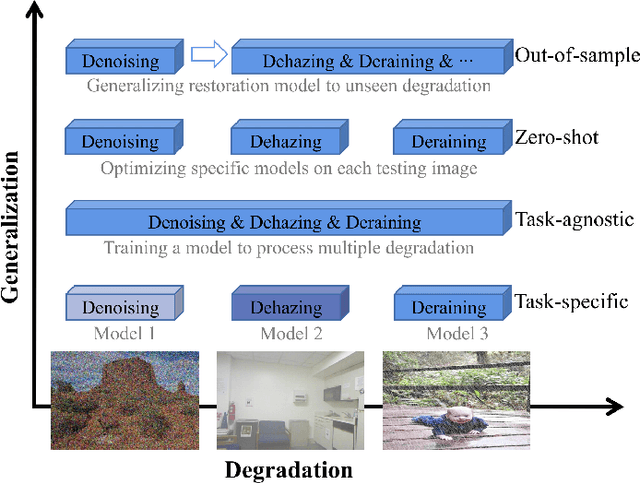
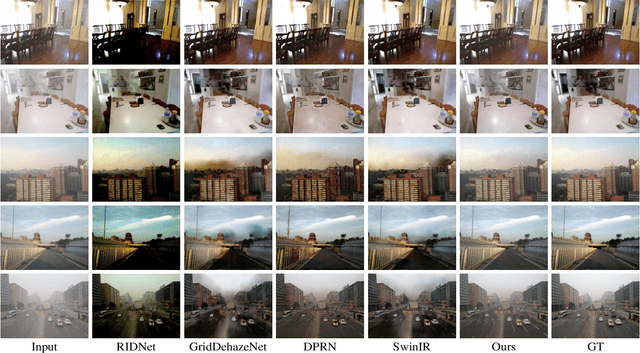
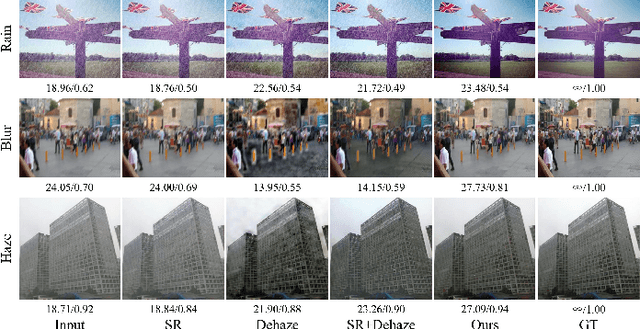
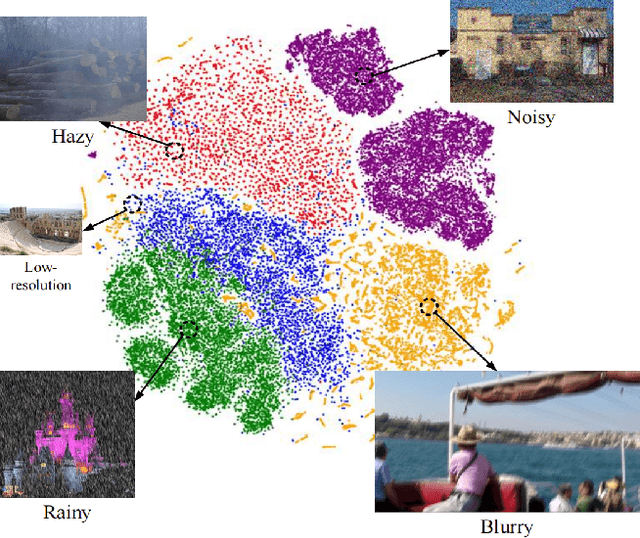
Existing image restoration models are typically designed for specific tasks and struggle to generalize to out-of-sample degradations not encountered during training. While zero-shot methods can address this limitation by fine-tuning model parameters on testing samples, their effectiveness relies on predefined natural priors and physical models of specific degradations. Nevertheless, determining out-of-sample degradations faced in real-world scenarios is always impractical. As a result, it is more desirable to train restoration models with inherent generalization ability. To this end, this work introduces the Out-of-Sample Restoration (OSR) task, which aims to develop restoration models capable of handling out-of-sample degradations. An intuitive solution involves pre-translating out-of-sample degradations to known degradations of restoration models. However, directly translating them in the image space could lead to complex image translation issues. To address this issue, we propose a model reprogramming framework, which translates out-of-sample degradations by quantum mechanic and wave functions. Specifically, input images are decoupled as wave functions of amplitude and phase terms. The translation of out-of-sample degradation is performed by adapting the phase term. Meanwhile, the image content is maintained and enhanced in the amplitude term. By taking these two terms as inputs, restoration models are able to handle out-of-sample degradations without fine-tuning. Through extensive experiments across multiple evaluation cases, we demonstrate the effectiveness and flexibility of our proposed framework. Our codes are available at \href{https://github.com/ddghjikle/Out-of-sample-restoration}{Github}.