 Add to Chrome
 Add to Firefox
 Add to Edge
Do VLMs Truly "Read" Candlesticks? A Multi-Scale Benchmark for Visual Stock Price Forecasting
Apr 14, 2026
Vision-language models(VLMs) are increasingly applied to visual stock price forecasting, yet existing benchmarks inadequately evaluate their understanding of stock price in candlestick charts. First, prior studies fail to isolate VLMs' comprehension of visual inputs genuinely improves predictive performance and whether VLMs truly comprehend candlestick patterns. Further, most existing datasets and evaluation setups are designed around single-period or tabular inputs. However, human analysts strongly rely on multi-scale candlestick charts, where longer-term horizons capture trend direction and shorter-term horizons provide cues for inflection points, making it difficult to systematically assess VLMs' ability to integrate short-term and long-term visual market dynamics. To bridge this gap, we construct a multi-scale candlestick charts dataset and a standardized evaluation framework to assess VLMs' ability to utilize multi-scale visual market signals. Evaluation combines confusion-matrix-based diagnostics with information coefficient(IC) time series metrics and includes XGBoost as a feature-based temporal baseline. Using this dataset, we benchmark representative VLMs and analyze their ability to leverage multi-scale stock price data. Experimental results show that most VLMs perform well only under persistent uptrend or downtrend conditions, while exhibiting weak predictive capability in more common market scenarios. We also identify significant prediction biases and limited sensitivity to explicitly specified forecast horizons in prompts, indicating inherent limitations in precise temporal reasoning.

Unifying Dynamic Tool Creation and Cross-Task Experience Sharing through Cognitive Memory Architecture
Dec 12, 2025Large Language Model agents face fundamental challenges in adapting to novel tasks due to limitations in tool availability and experience reuse. Existing approaches either rely on predefined tools with limited coverage or build tools from scratch without leveraging past experiences, leading to inefficient exploration and suboptimal performance. We introduce SMITH (Shared Memory Integrated Tool Hub), a unified cognitive architecture that seamlessly integrates dynamic tool creation with cross-task experience sharing through hierarchical memory organization. SMITH organizes agent memory into procedural, semantic, and episodic components, enabling systematic capability expansion while preserving successful execution patterns. Our approach formalizes tool creation as iterative code generation within controlled sandbox environments and experience sharing through episodic memory retrieval with semantic similarity matching. We further propose a curriculum learning strategy based on agent-ensemble difficulty re-estimation. Extensive experiments on the GAIA benchmark demonstrate SMITH's effectiveness, achieving 81.8% Pass@1 accuracy and outperforming state-of-the-art baselines including Alita (75.2%) and Memento (70.9%). Our work establishes a foundation for building truly adaptive agents that continuously evolve their capabilities through principled integration of tool creation and experience accumulation.
JoyAgent-JDGenie: Technical Report on the GAIA
Oct 01, 2025Large Language Models are increasingly deployed as autonomous agents for complex real-world tasks, yet existing systems often focus on isolated improvements without a unifying design for robustness and adaptability. We propose a generalist agent architecture that integrates three core components: a collective multi-agent framework combining planning and execution agents with critic model voting, a hierarchical memory system spanning working, semantic, and procedural layers, and a refined tool suite for search, code execution, and multimodal parsing. Evaluated on a comprehensive benchmark, our framework consistently outperforms open-source baselines and approaches the performance of proprietary systems. These results demonstrate the importance of system-level integration and highlight a path toward scalable, resilient, and adaptive AI assistants capable of operating across diverse domains and tasks.
Self-Supervised Contrastive Graph Clustering Network via Structural Information Fusion
Aug 08, 2024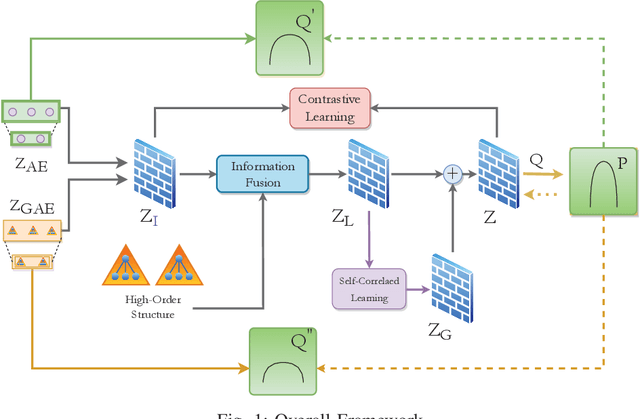
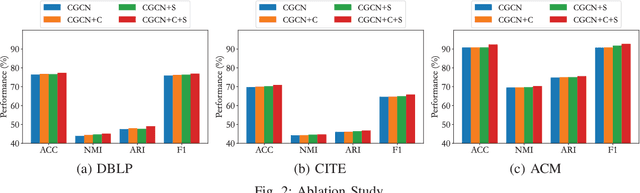
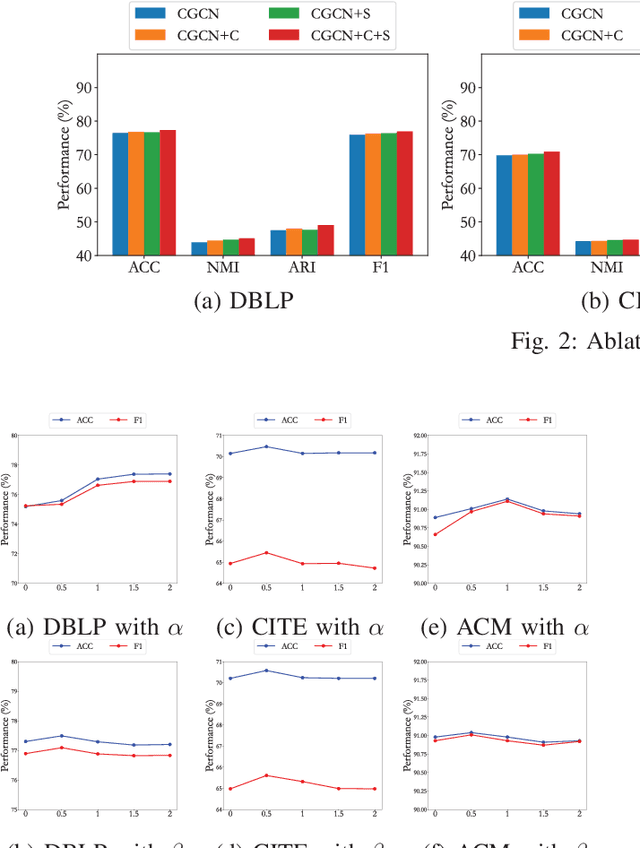
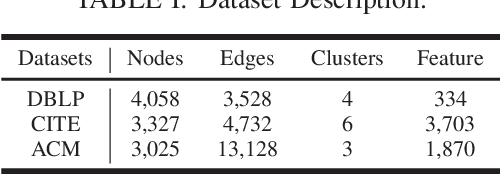
Graph clustering, a classical task in graph learning, involves partitioning the nodes of a graph into distinct clusters. This task has applications in various real-world scenarios, such as anomaly detection, social network analysis, and community discovery. Current graph clustering methods commonly rely on module pre-training to obtain a reliable prior distribution for the model, which is then used as the optimization objective. However, these methods often overlook deeper supervised signals, leading to sub-optimal reliability of the prior distribution. To address this issue, we propose a novel deep graph clustering method called CGCN. Our approach introduces contrastive signals and deep structural information into the pre-training process. Specifically, CGCN utilizes a contrastive learning mechanism to foster information interoperability among multiple modules and allows the model to adaptively adjust the degree of information aggregation for different order structures. Our CGCN method has been experimentally validated on multiple real-world graph datasets, showcasing its ability to boost the dependability of prior clustering distributions acquired through pre-training. As a result, we observed notable enhancements in the performance of the model.
* 6 pages, 3 figures