 Add to Chrome
 Add to Firefox
 Add to Edge
Decide Then Retrieve: A Training-Free Framework with Uncertainty-Guided Triggering and Dual-Path Retrieval
Jan 07, 2026
Retrieval-augmented generation (RAG) enhances large language models (LLMs) by incorporating external knowledge, but existing approaches indiscriminately trigger retrieval and rely on single-path evidence construction, often introducing noise and limiting performance gains. In this work, we propose Decide Then Retrieve (DTR), a training-free framework that adaptively determines when retrieval is necessary and how external information should be selected. DTR leverages generation uncertainty to guide retrieval triggering and introduces a dual-path retrieval mechanism with adaptive information selection to better handle sparse and ambiguous queries. Extensive experiments across five open-domain QA benchmarks, multiple model scales, and different retrievers demonstrate that DTR consistently improves EM and F1 over standard RAG and strong retrieval-enhanced baselines, while reducing unnecessary retrievals. The code and data used in this paper are available at https://github.com/ChenWangHKU/DTR.

BBox DocVQA: A Large Scale Bounding Box Grounded Dataset for Enhancing Reasoning in Document Visual Question Answer
Nov 19, 2025Document Visual Question Answering (DocVQA) is a fundamental task for multimodal document understanding and a key testbed for vision language reasoning. However, most existing DocVQA datasets are limited to the page level and lack fine grained spatial grounding, constraining the interpretability and reasoning capability of Vision Language Models (VLMs). To address this gap, we introduce BBox DocVQA a large scale, bounding box grounded dataset designed to enhance spatial reasoning and evidence localization in visual documents. We further present an automated construction pipeline, Segment Judge and Generate, which integrates a segment model for region segmentation, a VLM for semantic judgment, and another advanced VLM for question answer generation, followed by human verification for quality assurance. The resulting dataset contains 3.6 K diverse documents and 32 K QA pairs, encompassing single and multi region as well as single and multi page scenarios. Each QA instance is grounded on explicit bounding boxes, enabling fine grained evaluation of spatial semantic alignment. Benchmarking multiple state of the art VLMs (e.g., GPT 5, Qwen2.5 VL, and InternVL) on BBox DocVQA reveals persistent challenges in spatial grounding and reasoning accuracy. Furthermore, fine tuning on BBox DocVQA substantially improves both bounding box localization and answer generation, validating its effectiveness for enhancing the reasoning ability of VLMs. Our dataset and code will be publicly released to advance research on interpretable and spatially grounded vision language reasoning.
PAIRS: Parametric-Verified Adaptive Information Retrieval and Selection for Efficient RAG
Aug 06, 2025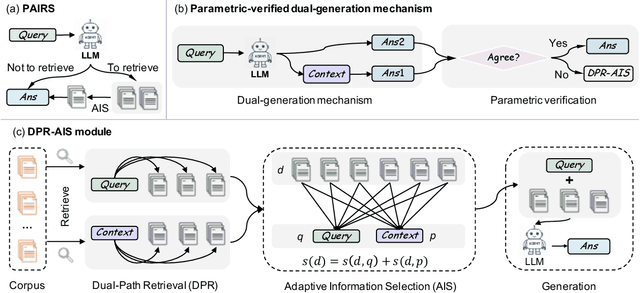
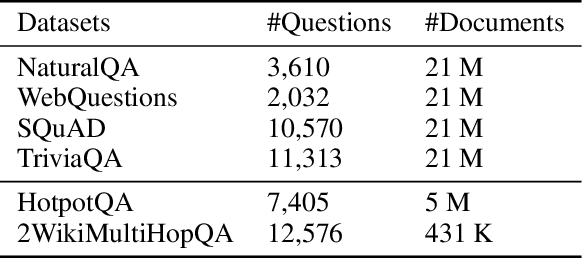
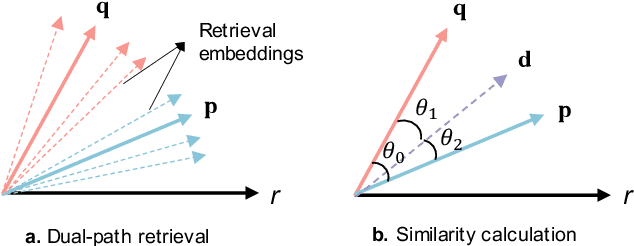
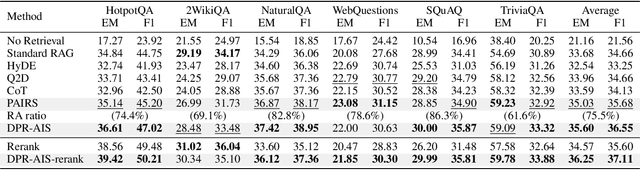
Retrieval-Augmented Generation (RAG) has become a cornerstone technique for enhancing large language models (LLMs) with external knowledge. However, current RAG systems face two critical limitations: (1) they inefficiently retrieve information for every query, including simple questions that could be resolved using the LLM's parametric knowledge alone, and (2) they risk retrieving irrelevant documents when queries contain sparse information signals. To address these gaps, we introduce Parametric-verified Adaptive Information Retrieval and Selection (PAIRS), a training-free framework that integrates parametric and retrieved knowledge to adaptively determine whether to retrieve and how to select external information. Specifically, PAIRS employs a dual-path generation mechanism: First, the LLM produces both a direct answer and a context-augmented answer using self-generated pseudo-context. When these outputs converge, PAIRS bypasses external retrieval entirely, dramatically improving the RAG system's efficiency. For divergent cases, PAIRS activates a dual-path retrieval (DPR) process guided by both the original query and self-generated contextual signals, followed by an Adaptive Information Selection (AIS) module that filters documents through weighted similarity to both sources. This simple yet effective approach can not only enhance efficiency by eliminating unnecessary retrievals but also improve accuracy through contextually guided retrieval and adaptive information selection. Experimental results on six question-answering (QA) benchmarks show that PAIRS reduces retrieval costs by around 25% (triggering for only 75% of queries) while still improving accuracy-achieving +1.1% EM and +1.0% F1 over prior baselines on average.