 Add to Chrome
 Add to Firefox
 Add to Edge
Uncovering and Aligning Anomalous Attention Heads to Defend Against NLP Backdoor Attacks
Nov 16, 2025
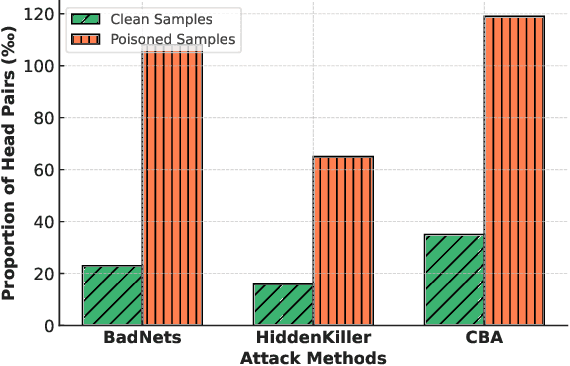
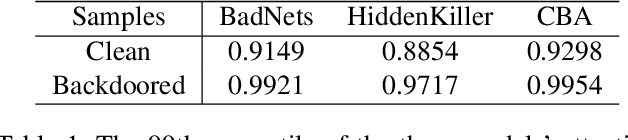
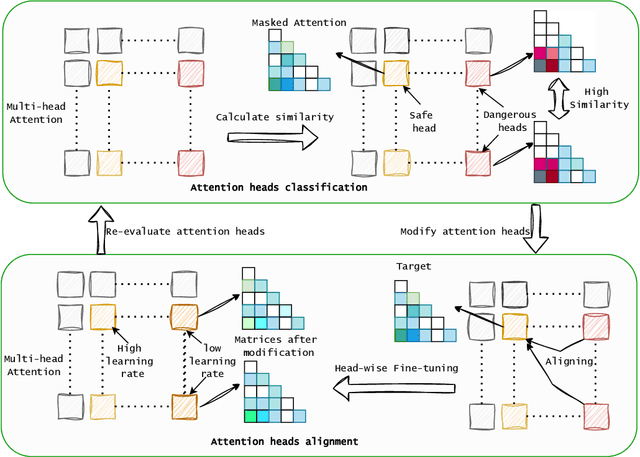
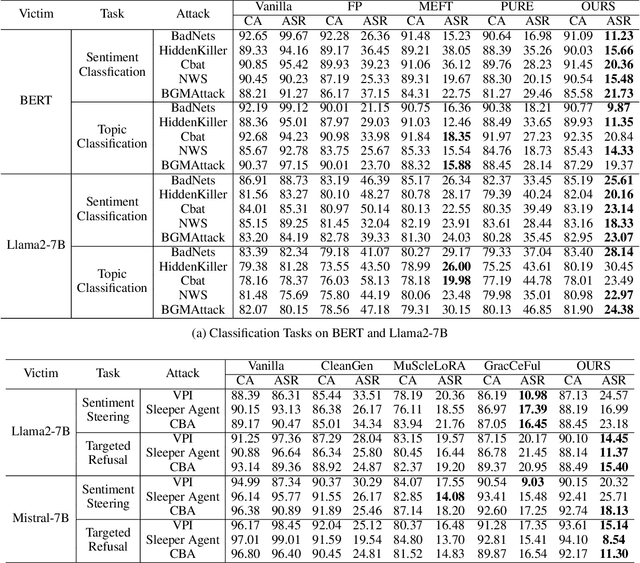
Backdoor attacks pose a serious threat to the security of large language models (LLMs), causing them to exhibit anomalous behavior under specific trigger conditions. The design of backdoor triggers has evolved from fixed triggers to dynamic or implicit triggers. This increased flexibility in trigger design makes it challenging for defenders to identify their specific forms accurately. Most existing backdoor defense methods are limited to specific types of triggers or rely on an additional clean model for support. To address this issue, we propose a backdoor detection method based on attention similarity, enabling backdoor detection without prior knowledge of the trigger. Our study reveals that models subjected to backdoor attacks exhibit unusually high similarity among attention heads when exposed to triggers. Based on this observation, we propose an attention safety alignment approach combined with head-wise fine-tuning to rectify potentially contaminated attention heads, thereby effectively mitigating the impact of backdoor attacks. Extensive experimental results demonstrate that our method significantly reduces the success rate of backdoor attacks while preserving the model's performance on downstream tasks.

Towards Confidential and Efficient LLM Inference with Dual Privacy Protection
Sep 11, 2025CPU-based trusted execution environments (TEEs) and differential privacy (DP) have gained wide applications for private inference. Due to high inference latency in TEEs, researchers use partition-based approaches that offload linear model components to GPUs. However, dense nonlinear layers of large language models (LLMs) result in significant communication overhead between TEEs and GPUs. DP-based approaches apply random noise to protect data privacy, but this compromises LLM performance and semantic understanding. To overcome the above drawbacks, this paper proposes CMIF, a Confidential and efficient Model Inference Framework. CMIF confidentially deploys the embedding layer in the client-side TEE and subsequent layers on GPU servers. Meanwhile, it optimizes the Report-Noisy-Max mechanism to protect sensitive inputs with a slight decrease in model performance. Extensive experiments on Llama-series models demonstrate that CMIF reduces additional inference overhead in TEEs while preserving user data privacy.