 Add to Chrome
 Add to Firefox
 Add to Edge
Raformer: Redundancy-Aware Transformer for Video Wire Inpainting
Apr 24, 2024
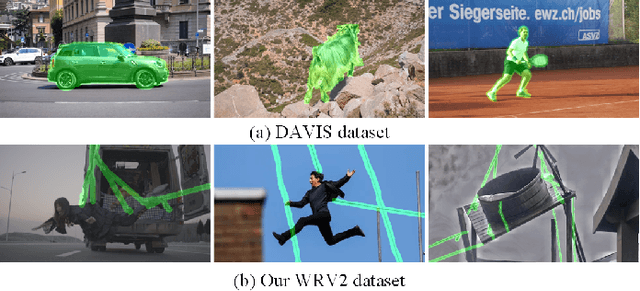


Video Wire Inpainting (VWI) is a prominent application in video inpainting, aimed at flawlessly removing wires in films or TV series, offering significant time and labor savings compared to manual frame-by-frame removal. However, wire removal poses greater challenges due to the wires being longer and slimmer than objects typically targeted in general video inpainting tasks, and often intersecting with people and background objects irregularly, which adds complexity to the inpainting process. Recognizing the limitations posed by existing video wire datasets, which are characterized by their small size, poor quality, and limited variety of scenes, we introduce a new VWI dataset with a novel mask generation strategy, namely Wire Removal Video Dataset 2 (WRV2) and Pseudo Wire-Shaped (PWS) Masks. WRV2 dataset comprises over 4,000 videos with an average length of 80 frames, designed to facilitate the development and efficacy of inpainting models. Building upon this, our research proposes the Redundancy-Aware Transformer (Raformer) method that addresses the unique challenges of wire removal in video inpainting. Unlike conventional approaches that indiscriminately process all frame patches, Raformer employs a novel strategy to selectively bypass redundant parts, such as static background segments devoid of valuable information for inpainting. At the core of Raformer is the Redundancy-Aware Attention (RAA) module, which isolates and accentuates essential content through a coarse-grained, window-based attention mechanism. This is complemented by a Soft Feature Alignment (SFA) module, which refines these features and achieves end-to-end feature alignment. Extensive experiments on both the traditional video inpainting datasets and our proposed WRV2 dataset demonstrate that Raformer outperforms other state-of-the-art methods.

Cantor: Inspiring Multimodal Chain-of-Thought of MLLM
Apr 24, 2024With the advent of large language models(LLMs) enhanced by the chain-of-thought(CoT) methodology, visual reasoning problem is usually decomposed into manageable sub-tasks and tackled sequentially with various external tools. However, such a paradigm faces the challenge of the potential "determining hallucinations" in decision-making due to insufficient visual information and the limitation of low-level perception tools that fail to provide abstract summaries necessary for comprehensive reasoning. We argue that converging visual context acquisition and logical reasoning is pivotal for tackling visual reasoning tasks. This paper delves into the realm of multimodal CoT to solve intricate visual reasoning tasks with multimodal large language models(MLLMs) and their cognitive capability. To this end, we propose an innovative multimodal CoT framework, termed Cantor, characterized by a perception-decision architecture. Cantor first acts as a decision generator and integrates visual inputs to analyze the image and problem, ensuring a closer alignment with the actual context. Furthermore, Cantor leverages the advanced cognitive functions of MLLMs to perform as multifaceted experts for deriving higher-level information, enhancing the CoT generation process. Our extensive experiments demonstrate the efficacy of the proposed framework, showing significant improvements in multimodal CoT performance across two complex visual reasoning datasets, without necessitating fine-tuning or ground-truth rationales. Project Page: https://ggg0919.github.io/cantor/ .
Logic Dynamic Movement Primitives for Long-horizon Manipulation Tasks in Dynamic Environments
Apr 24, 2024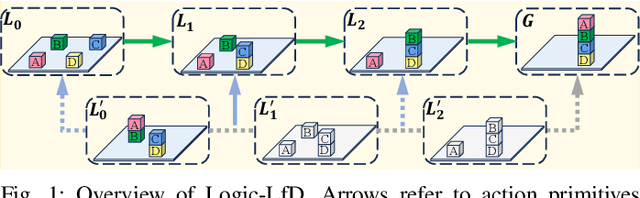
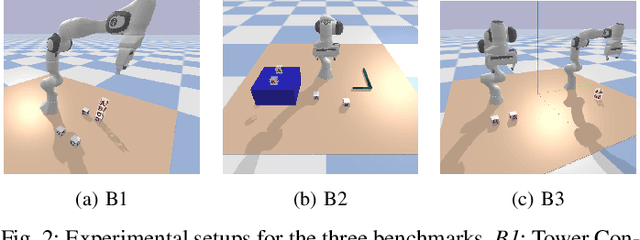
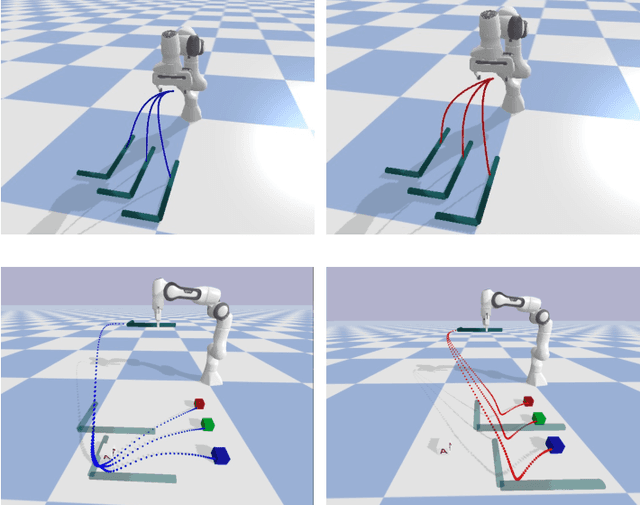

Learning from Demonstration (LfD) stands as an efficient framework for imparting human-like skills to robots. Nevertheless, designing an LfD framework capable of seamlessly imitating, generalizing, and reacting to disturbances for long-horizon manipulation tasks in dynamic environments remains a challenge. To tackle this challenge, we present Logic Dynamic Movement Primitives (Logic-DMP), which combines Task and Motion Planning (TAMP) with an optimal control formulation of DMP, allowing us to incorporate motion-level via-point specifications and to handle task-level variations or disturbances in dynamic environments. We conduct a comparative analysis of our proposed approach against several baselines, evaluating its generalization ability and reactivity across three long-horizon manipulation tasks. Our experiment demonstrates the fast generalization and reactivity of Logic-DMP for handling task-level variants and disturbances in long-horizon manipulation tasks.
Multi-Modal Prompt Learning on Blind Image Quality Assessment
Apr 23, 2024


Image Quality Assessment (IQA) models benefit significantly from semantic information, which allows them to treat different types of objects distinctly. Currently, leveraging semantic information to enhance IQA is a crucial research direction. Traditional methods, hindered by a lack of sufficiently annotated data, have employed the CLIP image-text pretraining model as their backbone to gain semantic awareness. However, the generalist nature of these pre-trained Vision-Language (VL) models often renders them suboptimal for IQA-specific tasks. Recent approaches have attempted to address this mismatch using prompt technology, but these solutions have shortcomings. Existing prompt-based VL models overly focus on incremental semantic information from text, neglecting the rich insights available from visual data analysis. This imbalance limits their performance improvements in IQA tasks. This paper introduces an innovative multi-modal prompt-based methodology for IQA. Our approach employs carefully crafted prompts that synergistically mine incremental semantic information from both visual and linguistic data. Specifically, in the visual branch, we introduce a multi-layer prompt structure to enhance the VL model's adaptability. In the text branch, we deploy a dual-prompt scheme that steers the model to recognize and differentiate between scene category and distortion type, thereby refining the model's capacity to assess image quality. Our experimental findings underscore the effectiveness of our method over existing Blind Image Quality Assessment (BIQA) approaches. Notably, it demonstrates competitive performance across various datasets. Our method achieves Spearman Rank Correlation Coefficient (SRCC) values of 0.961(surpassing 0.946 in CSIQ) and 0.941 (exceeding 0.930 in KADID), illustrating its robustness and accuracy in diverse contexts.
MoE-TinyMed: Mixture of Experts for Tiny Medical Large Vision-Language Models
Apr 16, 2024

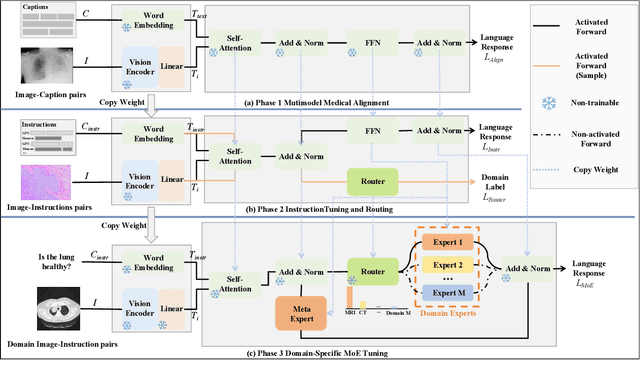

Mixture of Expert Tuning (MoE-Tuning) has effectively enhanced the performance of general MLLMs with fewer parameters, yet its application in resource-limited medical settings has not been fully explored. To address this gap, we developed MoE-TinyMed, a model tailored for medical applications that significantly lowers parameter demands. In evaluations on the VQA-RAD, SLAKE, and Path-VQA datasets, MoE-TinyMed outperformed LLaVA-Med in all Med-VQA closed settings with just 3.6B parameters. Additionally, a streamlined version with 2B parameters surpassed LLaVA-Med's performance in PathVQA, showcasing its effectiveness in resource-limited healthcare settings.
Joint Visual and Text Prompting for Improved Object-Centric Perception with Multimodal Large Language Models
Apr 06, 2024


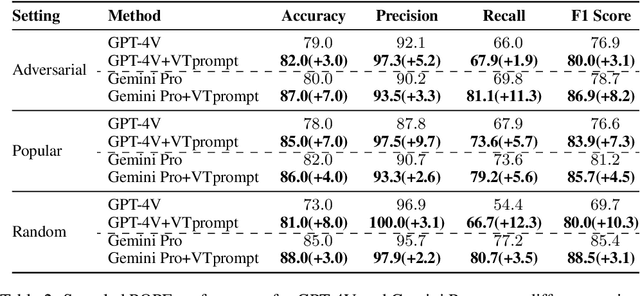
Multimodal Large Language Models (MLLMs) such as GPT-4V and Gemini Pro face challenges in achieving human-level perception in Visual Question Answering (VQA), particularly in object-oriented perception tasks which demand fine-grained understanding of object identities, locations or attributes, as indicated by empirical findings. This is mainly due to their limited capability to effectively integrate complex visual cues with textual information and potential object hallucinations. In this paper, we present a novel approach, Joint Visual and Text Prompting (VTPrompt), that employs fine-grained visual information to enhance the capability of MLLMs in VQA, especially for object-oriented perception. VTPrompt merges visual and text prompts to extract key concepts from textual questions and employs a detection model to highlight relevant objects as visual prompts in images. The processed images alongside text prompts are subsequently fed into MLLMs to produce more accurate answers. Our experiments with GPT-4V and Gemini Pro, on three benchmarks, i.e., MME , MMB and POPE, demonstrate significant improvements. Particularly, our method led to a score improvement of up to 183.5 for GPT-4V on MME and enhanced MMB performance by 8.17\% for GPT-4V and 15.69\% for Gemini Pro.
Quantifying and Mitigating Unimodal Biases in Multimodal Large Language Models: A Causal Perspective
Apr 03, 2024Recent advancements in Large Language Models (LLMs) have facilitated the development of Multimodal LLMs (MLLMs). Despite their impressive capabilities, MLLMs often suffer from an over-reliance on unimodal biases (e.g., language bias and vision bias), leading to incorrect answers in complex multimodal tasks. To investigate this issue, we propose a causal framework to interpret the biases in Visual Question Answering (VQA) problems. Within our framework, we devise a causal graph to elucidate the predictions of MLLMs on VQA problems, and assess the causal effect of biases through an in-depth causal analysis. Motivated by the causal graph, we introduce a novel MORE dataset, consisting of 12,000 VQA instances. This dataset is designed to challenge MLLMs' abilities, necessitating multi-hop reasoning and the surmounting of unimodal biases. Furthermore, we propose two strategies to mitigate unimodal biases and enhance MLLMs' reasoning capabilities, including a Decompose-Verify-Answer (DeVA) framework for limited-access MLLMs and the refinement of open-source MLLMs through fine-tuning. Extensive quantitative and qualitative experiments offer valuable insights for future research. Our project page is at https://opencausalab.github.io/MORE.
RELI11D: A Comprehensive Multimodal Human Motion Dataset and Method
Mar 28, 2024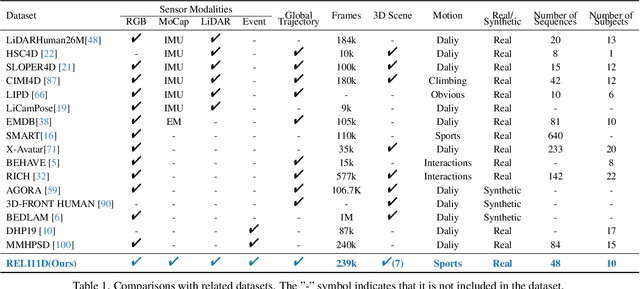
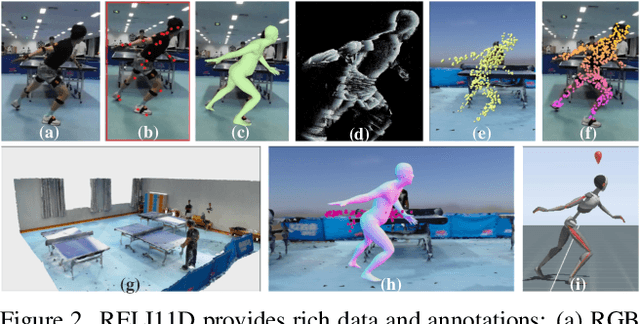
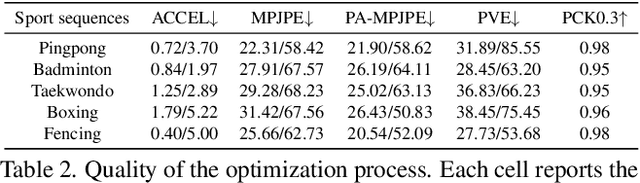
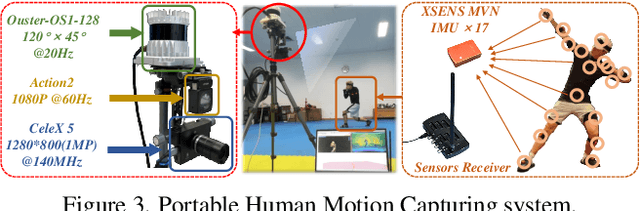
Comprehensive capturing of human motions requires both accurate captures of complex poses and precise localization of the human within scenes. Most of the HPE datasets and methods primarily rely on RGB, LiDAR, or IMU data. However, solely using these modalities or a combination of them may not be adequate for HPE, particularly for complex and fast movements. For holistic human motion understanding, we present RELI11D, a high-quality multimodal human motion dataset involves LiDAR, IMU system, RGB camera, and Event camera. It records the motions of 10 actors performing 5 sports in 7 scenes, including 3.32 hours of synchronized LiDAR point clouds, IMU measurement data, RGB videos and Event steams. Through extensive experiments, we demonstrate that the RELI11D presents considerable challenges and opportunities as it contains many rapid and complex motions that require precise location. To address the challenge of integrating different modalities, we propose LEIR, a multimodal baseline that effectively utilizes LiDAR Point Cloud, Event stream, and RGB through our cross-attention fusion strategy. We show that LEIR exhibits promising results for rapid motions and daily motions and that utilizing the characteristics of multiple modalities can indeed improve HPE performance. Both the dataset and source code will be released publicly to the research community, fostering collaboration and enabling further exploration in this field.
Lodge: A Coarse to Fine Diffusion Network for Long Dance Generation Guided by the Characteristic Dance Primitives
Mar 26, 2024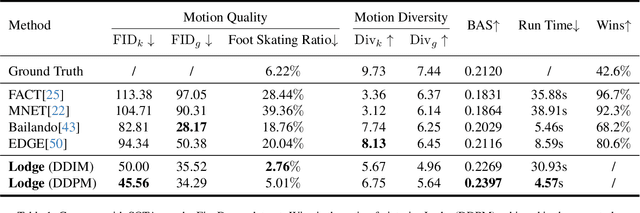
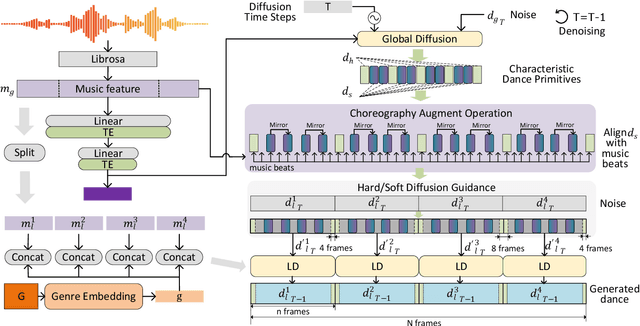
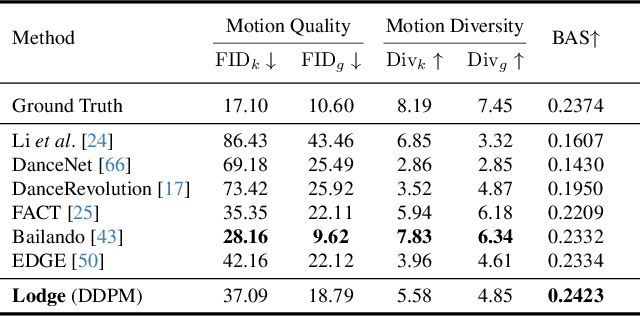
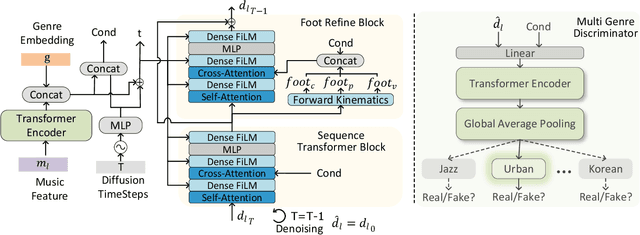
We propose Lodge, a network capable of generating extremely long dance sequences conditioned on given music. We design Lodge as a two-stage coarse to fine diffusion architecture, and propose the characteristic dance primitives that possess significant expressiveness as intermediate representations between two diffusion models. The first stage is global diffusion, which focuses on comprehending the coarse-level music-dance correlation and production characteristic dance primitives. In contrast, the second-stage is the local diffusion, which parallelly generates detailed motion sequences under the guidance of the dance primitives and choreographic rules. In addition, we propose a Foot Refine Block to optimize the contact between the feet and the ground, enhancing the physical realism of the motion. Our approach can parallelly generate dance sequences of extremely long length, striking a balance between global choreographic patterns and local motion quality and expressiveness. Extensive experiments validate the efficacy of our method.
Graph Neural Networks for Learning Equivariant Representations of Neural Networks
Mar 20, 2024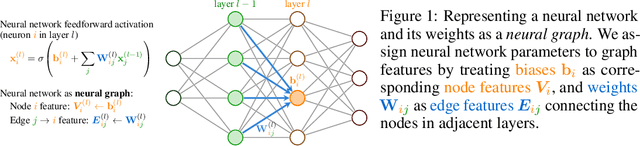
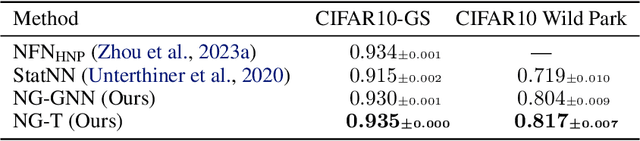
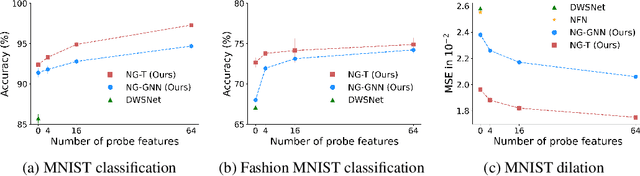
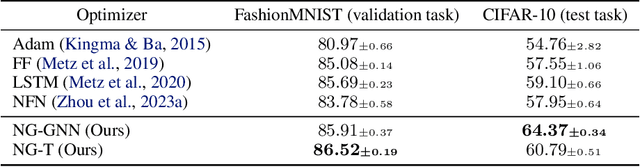
Neural networks that process the parameters of other neural networks find applications in domains as diverse as classifying implicit neural representations, generating neural network weights, and predicting generalization errors. However, existing approaches either overlook the inherent permutation symmetry in the neural network or rely on intricate weight-sharing patterns to achieve equivariance, while ignoring the impact of the network architecture itself. In this work, we propose to represent neural networks as computational graphs of parameters, which allows us to harness powerful graph neural networks and transformers that preserve permutation symmetry. Consequently, our approach enables a single model to encode neural computational graphs with diverse architectures. We showcase the effectiveness of our method on a wide range of tasks, including classification and editing of implicit neural representations, predicting generalization performance, and learning to optimize, while consistently outperforming state-of-the-art methods. The source code is open-sourced at https://github.com/mkofinas/neural-graphs.