 Add to Chrome
 Add to Firefox
 Add to Edge
SciToolAgent-Evo: An Ontology-Aware Self-Evolving Agent for Open-World Scientific Tool Acquisition
Jul 30, 2026
Large language model (LLM) agents have been increasingly adopted in scientific research for organizing and invoking specialized computational tools. However, their reliance on predefined tool spaces with static semantics limits their applicability to open-world scientific workflows, where tool requirements, capabilities, and boundaries evolve dynamically. To this end, we propose SciToolAgent-Evo, an ontology-aware self-evolving agent for open-world scientific tool acquisition. Driven by an evolving memory of skills, experiences, and an ontologized tool graph, it distills generalizable knowledge from contrastive trajectories during accumulation, whereas during inference, it formulates active requests and utilizes a LinUCB-based bandit gate to dynamically balance exploration and exploitation. Once a novel tool is acquired, its scientific ontology is completed online for seamless integration into the known graph. Moreover, we introduce OpenSciToolBench, a benchmark containing 900 realistic tasks across four difficulty levels. Extensive evaluations show that SciToolAgent-Evo achieves state-of-the-art performance, validating its robustness and generalization.

Embodied Science: Closing the Discovery Loop with Agentic Embodied AI
Mar 20, 2026Artificial intelligence has demonstrated remarkable capability in predicting scientific properties, yet scientific discovery remains an inherently physical, long-horizon pursuit governed by experimental cycles. Most current computational approaches are misaligned with this reality, framing discovery as isolated, task-specific predictions rather than continuous interaction with the physical world. Here, we argue for embodied science, a paradigm that reframes scientific discovery as a closed loop tightly coupling agentic reasoning with physical execution. We propose a unified Perception-Language-Action-Discovery (PLAD) framework, wherein embodied agents perceive experimental environments, reason over scientific knowledge, execute physical interventions, and internalize outcomes to drive subsequent exploration. By grounding computational reasoning in robust physical feedback, this approach bridges the gap between digital prediction and empirical validation, offering a roadmap for autonomous discovery systems in the life and chemical sciences.
Learning Transferable Temporal Primitives for Video Reasoning via Synthetic Videos
Mar 18, 2026The transition from image to video understanding requires vision-language models (VLMs) to shift from recognizing static patterns to reasoning over temporal dynamics such as motion trajectories, speed changes, and state transitions. Yet current post-training methods fall short due to two critical limitations: (1) existing datasets often lack temporal-centricity, where answers can be inferred from isolated keyframes rather than requiring holistic temporal integration; and (2) training data generated by proprietary models contains systematic errors in fundamental temporal perception, such as confusing motion directions or misjudging speeds. We introduce SynRL, a post-training framework that teaches models temporal primitives, the fundamental building blocks of temporal understanding including direction, speed, and state tracking. Our key insight is that these abstract primitives, learned from programmatically generated synthetic videos, transfer effectively to real-world scenarios. We decompose temporal understanding into short-term perceptual primitives (speed, direction) and long-term cognitive primitives, constructing 7.7K CoT and 7K RL samples with ground-truth frame-level annotations through code-based video generation. Despite training on simple geometric shapes, SynRL achieves substantial improvements across 15 benchmarks spanning temporal grounding, complex reasoning, and general video understanding. Remarkably, our 7.7K synthetic CoT samples outperform Video-R1 with 165K real-world samples. We attribute this to fundamental temporal skills, such as tracking frame by frame changes and comparing velocity, that transfer effectively from abstract synthetic patterns to complex real-world scenarios. This establishes a new paradigm for video post-training: video temporal learning through carefully designed synthetic data provides a more cost efficient scaling path.
IOSVLM: A 3D Vision-Language Model for Unified Dental Diagnosis from Intraoral Scans
Mar 17, 20263D intraoral scans (IOS) are increasingly adopted in routine dentistry due to abundant geometric evidence, and unified multi-disease diagnosis is desirable for clinical documentation and communication. While recent works introduce dental vision-language models (VLMs) to enable unified diagnosis and report generation on 2D images or multi-view images rendered from IOS, they do not fully leverage native 3D geometry. Such work is necessary and also challenging, due to: (i) heterogeneous scan forms and the complex IOS topology, (ii) multi-disease co-occurrence with class imbalance and fine-grained morphological ambiguity, (iii) limited paired 3D IOS-text data. Thus, we present IOSVLM, an end-to-end 3D VLM that represents scans as point clouds and follows a 3D encoder-projector-LLM design for unified diagnosis and generative visual question-answering (VQA), together with IOSVQA, a large-scale multi-source IOS diagnosis VQA dataset comprising 19,002 cases and 249,055 VQA pairs over 23 oral diseases and heterogeneous scan types. To address the distribution gap between color-free IOS data and color-dependent 3D pre-training, we propose a geometry-to-chromatic proxy that stabilizes fine-grained geometric perception and cross-modal alignment. A two-stage curriculum training strategy further enhances robustness. IOSVLM consistently outperforms strong baselines, achieving gains of at least +9.58% macro accuracy and +1.46% macro F1, indicating the effectiveness of direct 3D geometry modeling for IOS-based diagnosis.
MedThink: Explaining Medical Visual Question Answering via Multimodal Decision-Making Rationale
Apr 18, 2024


Medical Visual Question Answering (MedVQA), which offers language responses to image-based medical inquiries, represents a challenging task and significant advancement in healthcare. It assists medical experts to swiftly interpret medical images, thereby enabling faster and more accurate diagnoses. However, the model interpretability and transparency of existing MedVQA solutions are often limited, posing challenges in understanding their decision-making processes. To address this issue, we devise a semi-automated annotation process to streamlining data preparation and build new benchmark MedVQA datasets R-RAD and R-SLAKE. The R-RAD and R-SLAKE datasets provide intermediate medical decision-making rationales generated by multimodal large language models and human annotations for question-answering pairs in existing MedVQA datasets, i.e., VQA-RAD and SLAKE. Moreover, we design a novel framework which finetunes lightweight pretrained generative models by incorporating medical decision-making rationales into the training process. The framework includes three distinct strategies to generate decision outcomes and corresponding rationales, thereby clearly showcasing the medical decision-making process during reasoning. Extensive experiments demonstrate that our method can achieve an accuracy of 83.5% on R-RAD and 86.3% on R-SLAKE, significantly outperforming existing state-of-the-art baselines. Dataset and code will be released.
Joint Visual and Text Prompting for Improved Object-Centric Perception with Multimodal Large Language Models
Apr 06, 2024


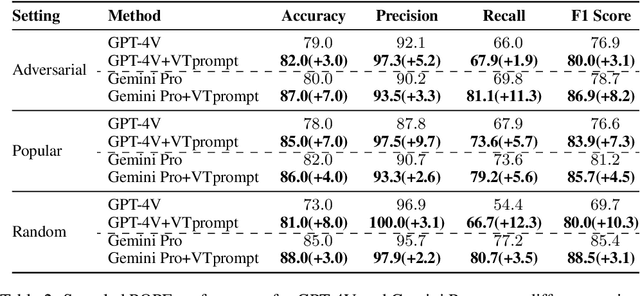
Multimodal Large Language Models (MLLMs) such as GPT-4V and Gemini Pro face challenges in achieving human-level perception in Visual Question Answering (VQA), particularly in object-oriented perception tasks which demand fine-grained understanding of object identities, locations or attributes, as indicated by empirical findings. This is mainly due to their limited capability to effectively integrate complex visual cues with textual information and potential object hallucinations. In this paper, we present a novel approach, Joint Visual and Text Prompting (VTPrompt), that employs fine-grained visual information to enhance the capability of MLLMs in VQA, especially for object-oriented perception. VTPrompt merges visual and text prompts to extract key concepts from textual questions and employs a detection model to highlight relevant objects as visual prompts in images. The processed images alongside text prompts are subsequently fed into MLLMs to produce more accurate answers. Our experiments with GPT-4V and Gemini Pro, on three benchmarks, i.e., MME , MMB and POPE, demonstrate significant improvements. Particularly, our method led to a score improvement of up to 183.5 for GPT-4V on MME and enhanced MMB performance by 8.17\% for GPT-4V and 15.69\% for Gemini Pro.