 Add to Chrome
 Add to Firefox
 Add to Edge
RecGPT: Generative Personalized Prompts for Sequential Recommendation via ChatGPT Training Paradigm
Apr 06, 2024
ChatGPT has achieved remarkable success in natural language understanding. Considering that recommendation is indeed a conversation between users and the system with items as words, which has similar underlying pattern with ChatGPT, we design a new chat framework in item index level for the recommendation task. Our novelty mainly contains three parts: model, training and inference. For the model part, we adopt Generative Pre-training Transformer (GPT) as the sequential recommendation model and design a user modular to capture personalized information. For the training part, we adopt the two-stage paradigm of ChatGPT, including pre-training and fine-tuning. In the pre-training stage, we train GPT model by auto-regression. In the fine-tuning stage, we train the model with prompts, which include both the newly-generated results from the model and the user's feedback. For the inference part, we predict several user interests as user representations in an autoregressive manner. For each interest vector, we recall several items with the highest similarity and merge the items recalled by all interest vectors into the final result. We conduct experiments with both offline public datasets and online A/B test to demonstrate the effectiveness of our proposed method.

DMAD: Dual Memory Bank for Real-World Anomaly Detection
Mar 19, 2024Training a unified model is considered to be more suitable for practical industrial anomaly detection scenarios due to its generalization ability and storage efficiency. However, this multi-class setting, which exclusively uses normal data, overlooks the few but important accessible annotated anomalies in the real world. To address the challenge of real-world anomaly detection, we propose a new framework named Dual Memory bank enhanced representation learning for Anomaly Detection (DMAD). This framework handles both unsupervised and semi-supervised scenarios in a unified (multi-class) setting. DMAD employs a dual memory bank to calculate feature distance and feature attention between normal and abnormal patterns, thereby encapsulating knowledge about normal and abnormal instances. This knowledge is then used to construct an enhanced representation for anomaly score learning. We evaluated DMAD on the MVTec-AD and VisA datasets. The results show that DMAD surpasses current state-of-the-art methods, highlighting DMAD's capability in handling the complexities of real-world anomaly detection scenarios.
Multiply Robust Estimation for Local Distribution Shifts with Multiple Domains
Feb 21, 2024Distribution shifts are ubiquitous in real-world machine learning applications, posing a challenge to the generalization of models trained on one data distribution to another. We focus on scenarios where data distributions vary across multiple segments of the entire population and only make local assumptions about the differences between training and test (deployment) distributions within each segment. We propose a two-stage multiply robust estimation method to improve model performance on each individual segment for tabular data analysis. The method involves fitting a linear combination of the based models, learned using clusters of training data from multiple segments, followed by a refinement step for each segment. Our method is designed to be implemented with commonly used off-the-shelf machine learning models. We establish theoretical guarantees on the generalization bound of the method on the test risk. With extensive experiments on synthetic and real datasets, we demonstrate that the proposed method substantially improves over existing alternatives in prediction accuracy and robustness on both regression and classification tasks. We also assess its effectiveness on a user city prediction dataset from a large technology company.
Large Language Model-based Human-Agent Collaboration for Complex Task Solving
Feb 20, 2024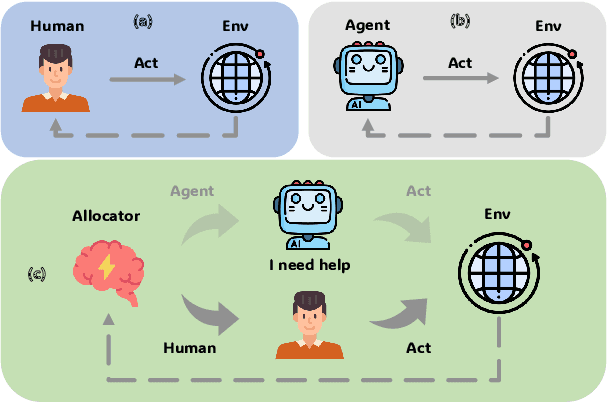


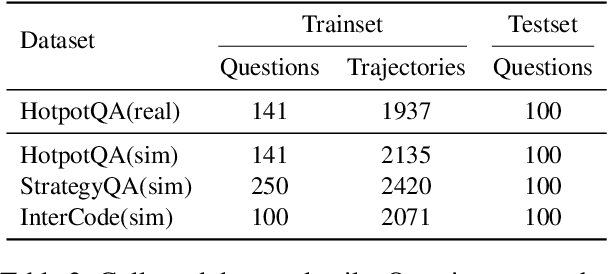
In recent developments within the research community, the integration of Large Language Models (LLMs) in creating fully autonomous agents has garnered significant interest. Despite this, LLM-based agents frequently demonstrate notable shortcomings in adjusting to dynamic environments and fully grasping human needs. In this work, we introduce the problem of LLM-based human-agent collaboration for complex task-solving, exploring their synergistic potential. In addition, we propose a Reinforcement Learning-based Human-Agent Collaboration method, ReHAC. This approach includes a policy model designed to determine the most opportune stages for human intervention within the task-solving process. We construct a human-agent collaboration dataset to train this policy model in an offline reinforcement learning environment. Our validation tests confirm the model's effectiveness. The results demonstrate that the synergistic efforts of humans and LLM-based agents significantly improve performance in complex tasks, primarily through well-planned, limited human intervention. Datasets and code are available at: https://github.com/XueyangFeng/ReHAC.
DMCE: Diffusion Model Channel Enhancer for Multi-User Semantic Communication Systems
Jan 29, 2024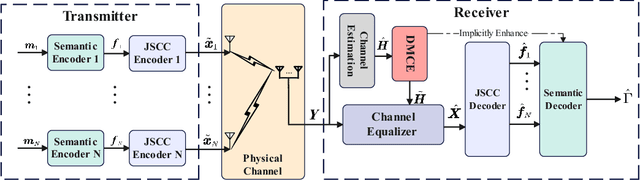
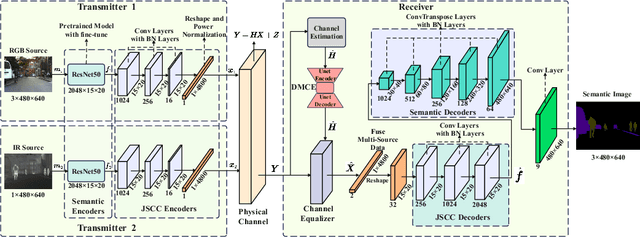

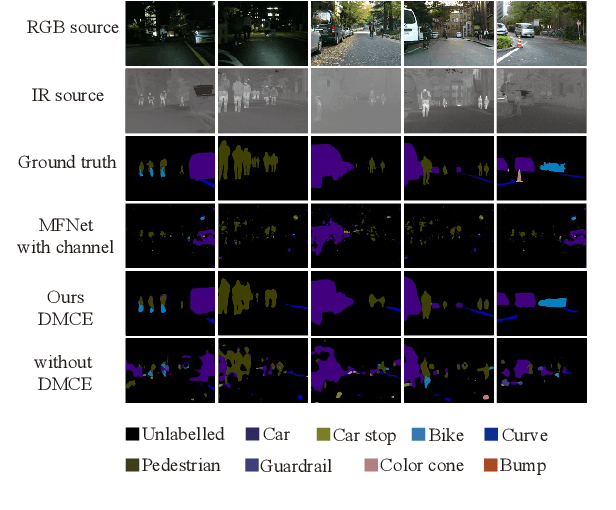
To achieve continuous massive data transmission with significantly reduced data payload, the users can adopt semantic communication techniques to compress the redundant information by transmitting semantic features instead. However, current works on semantic communication mainly focus on high compression ratio, neglecting the wireless channel effects including dynamic distortion and multi-user interference, which significantly limit the fidelity of semantic communication. To address this, this paper proposes a diffusion model (DM)-based channel enhancer (DMCE) for improving the performance of multi-user semantic communication, with the DM learning the particular data distribution of channel effects on the transmitted semantic features. In the considered system model, multiple users (such as road cameras) transmit semantic features of multi-source data to a receiver by applying the joint source-channel coding (JSCC) techniques, and the receiver fuses the semantic features from multiple users to complete specific tasks. Then, we propose DMCE to enhance the channel state information (CSI) estimation for improving the restoration of the received semantic features. Finally, the fusion results at the receiver are significantly enhanced, demonstrating a robust performance even under low signal-to-noise ratio (SNR) regimes, enabling the generation of effective object segmentation images. Extensive simulation results with a traffic scenario dataset show that the proposed scheme can improve the mean Intersection over Union (mIoU) by more than 25\% at low SNR regimes, compared with the benchmark schemes.
Efficient Online Crowdsourcing with Complex Annotations
Jan 25, 2024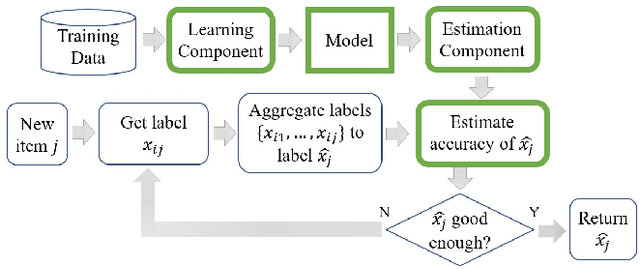
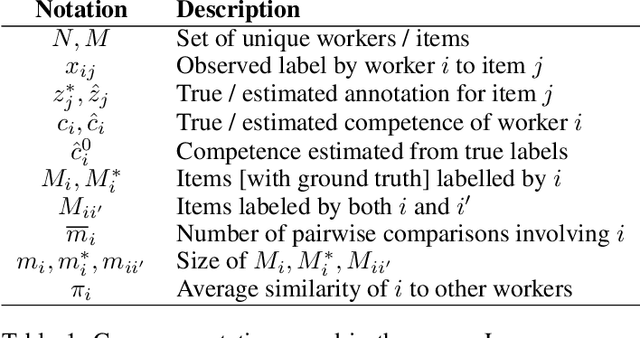
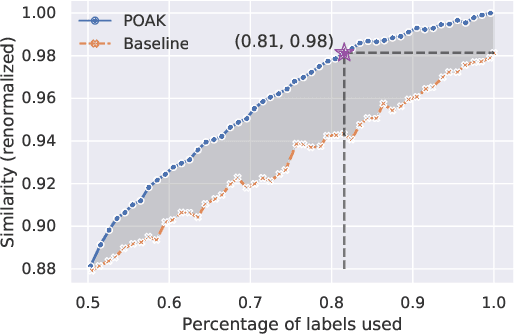
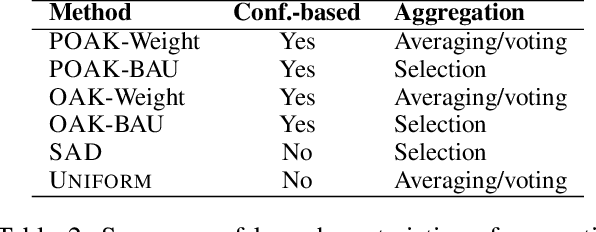
Crowdsourcing platforms use various truth discovery algorithms to aggregate annotations from multiple labelers. In an online setting, however, the main challenge is to decide whether to ask for more annotations for each item to efficiently trade off cost (i.e., the number of annotations) for quality of the aggregated annotations. In this paper, we propose a novel approach for general complex annotation (such as bounding boxes and taxonomy paths), that works in an online crowdsourcing setting. We prove that the expected average similarity of a labeler is linear in their accuracy \emph{conditional on the reported label}. This enables us to infer reported label accuracy in a broad range of scenarios. We conduct extensive evaluations on real-world crowdsourcing data from Meta and show the effectiveness of our proposed online algorithms in improving the cost-quality trade-off.
M$^3$TN: Multi-gate Mixture-of-Experts based Multi-valued Treatment Network for Uplift Modeling
Jan 24, 2024Uplift modeling is a technique used to predict the effect of a treatment (e.g., discounts) on an individual's response. Although several methods have been proposed for multi-valued treatment, they are extended from binary treatment methods. There are still some limitations. Firstly, existing methods calculate uplift based on predicted responses, which may not guarantee a consistent uplift distribution between treatment and control groups. Moreover, this may cause cumulative errors for multi-valued treatment. Secondly, the model parameters become numerous with many prediction heads, leading to reduced efficiency. To address these issues, we propose a novel \underline{M}ulti-gate \underline{M}ixture-of-Experts based \underline{M}ulti-valued \underline{T}reatment \underline{N}etwork (M$^3$TN). M$^3$TN consists of two components: 1) a feature representation module with Multi-gate Mixture-of-Experts to improve the efficiency; 2) a reparameterization module by modeling uplift explicitly to improve the effectiveness. We also conduct extensive experiments to demonstrate the effectiveness and efficiency of our M$^3$TN.
TAROT: A Hierarchical Framework with Multitask Co-Pretraining on Semi-Structured Data towards Effective Person-Job Fit
Jan 17, 2024Person-job fit is an essential part of online recruitment platforms in serving various downstream applications like Job Search and Candidate Recommendation. Recently, pretrained large language models have further enhanced the effectiveness by leveraging richer textual information in user profiles and job descriptions apart from user behavior features and job metadata. However, the general domain-oriented design struggles to capture the unique structural information within user profiles and job descriptions, leading to a loss of latent semantic correlations. We propose TAROT, a hierarchical multitask co-pretraining framework, to better utilize structural and semantic information for informative text embeddings. TAROT targets semi-structured text in profiles and jobs, and it is co-pretained with multi-grained pretraining tasks to constrain the acquired semantic information at each level. Experiments on a real-world LinkedIn dataset show significant performance improvements, proving its effectiveness in person-job fit tasks.
Text2Analysis: A Benchmark of Table Question Answering with Advanced Data Analysis and Unclear Queries
Dec 21, 2023Tabular data analysis is crucial in various fields, and large language models show promise in this area. However, current research mostly focuses on rudimentary tasks like Text2SQL and TableQA, neglecting advanced analysis like forecasting and chart generation. To address this gap, we developed the Text2Analysis benchmark, incorporating advanced analysis tasks that go beyond the SQL-compatible operations and require more in-depth analysis. We also develop five innovative and effective annotation methods, harnessing the capabilities of large language models to enhance data quality and quantity. Additionally, we include unclear queries that resemble real-world user questions to test how well models can understand and tackle such challenges. Finally, we collect 2249 query-result pairs with 347 tables. We evaluate five state-of-the-art models using three different metrics and the results show that our benchmark presents introduces considerable challenge in the field of tabular data analysis, paving the way for more advanced research opportunities.
Professional Network Matters: Connections Empower Person-Job Fit
Dec 19, 2023Online recruitment platforms typically employ Person-Job Fit models in the core service that automatically match suitable job seekers with appropriate job positions. While existing works leverage historical or contextual information, they often disregard a crucial aspect: job seekers' social relationships in professional networks. This paper emphasizes the importance of incorporating professional networks into the Person-Job Fit model. Our innovative approach consists of two stages: (1) defining a Workplace Heterogeneous Information Network (WHIN) to capture heterogeneous knowledge, including professional connections and pre-training representations of various entities using a heterogeneous graph neural network; (2) designing a Contextual Social Attention Graph Neural Network (CSAGNN) that supplements users' missing information with professional connections' contextual information. We introduce a job-specific attention mechanism in CSAGNN to handle noisy professional networks, leveraging pre-trained entity representations from WHIN. We demonstrate the effectiveness of our approach through experimental evaluations conducted across three real-world recruitment datasets from LinkedIn, showing superior performance compared to baseline models.