 Add to Chrome
 Add to Firefox
 Add to Edge
Soul: Breathe Life into Digital Human for High-fidelity Long-term Multimodal Animation
Dec 15, 2025
We propose a multimodal-driven framework for high-fidelity long-term digital human animation termed $\textbf{Soul}$, which generates semantically coherent videos from a single-frame portrait image, text prompts, and audio, achieving precise lip synchronization, vivid facial expressions, and robust identity preservation. We construct Soul-1M, containing 1 million finely annotated samples with a precise automated annotation pipeline (covering portrait, upper-body, full-body, and multi-person scenes) to mitigate data scarcity, and we carefully curate Soul-Bench for comprehensive and fair evaluation of audio-/text-guided animation methods. The model is built on the Wan2.2-5B backbone, integrating audio-injection layers and multiple training strategies together with threshold-aware codebook replacement to ensure long-term generation consistency. Meanwhile, step/CFG distillation and a lightweight VAE are used to optimize inference efficiency, achieving an 11.4$\times$ speedup with negligible quality loss. Extensive experiments show that Soul significantly outperforms current leading open-source and commercial models on video quality, video-text alignment, identity preservation, and lip-synchronization accuracy, demonstrating broad applicability in real-world scenarios such as virtual anchors and film production. Project page at https://zhangzjn.github.io/projects/Soul/

LLaVA-VSD: Large Language-and-Vision Assistant for Visual Spatial Description
Aug 09, 2024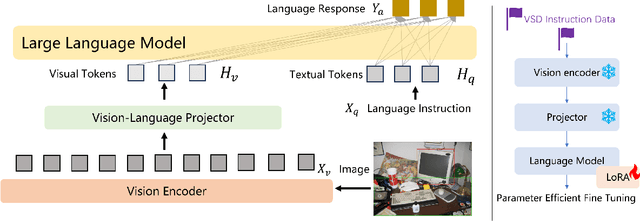


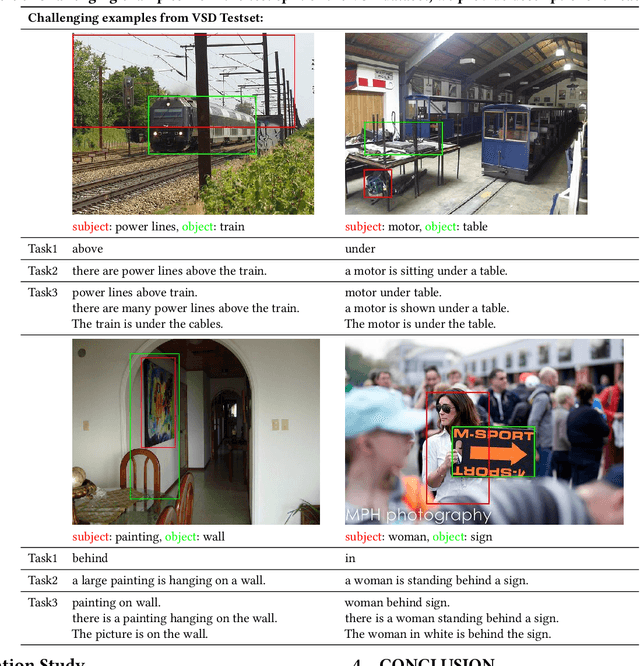
Visual Spatial Description (VSD) aims to generate texts that describe the spatial relationships between objects within images. Traditional visual spatial relationship classification (VSRC) methods typically output the spatial relationship between two objects in an image, often neglecting world knowledge and lacking general language capabilities. In this paper, we propose a Large Language-and-Vision Assistant for Visual Spatial Description, named LLaVA-VSD, which is designed for the classification, description, and open-ended description of visual spatial relationships. Specifically, the model first constructs a VSD instruction-following dataset using given figure-caption pairs for the three tasks. It then employs LoRA to fine-tune a Large Language and Vision Assistant for VSD, which has 13 billion parameters and supports high-resolution images. Finally, a large language model (Qwen-2) is used to refine the generated sentences, enhancing their diversity and accuracy. LLaVA-VSD demonstrates excellent multimodal conversational capabilities and can follow open-ended instructions to assist with inquiries about object relationships in images.
PSPU: Enhanced Positive and Unlabeled Learning by Leveraging Pseudo Supervision
Jul 09, 2024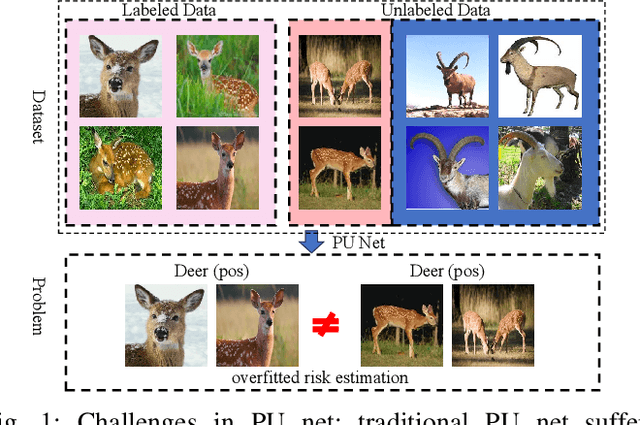
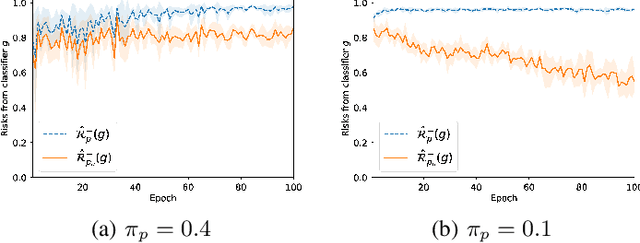
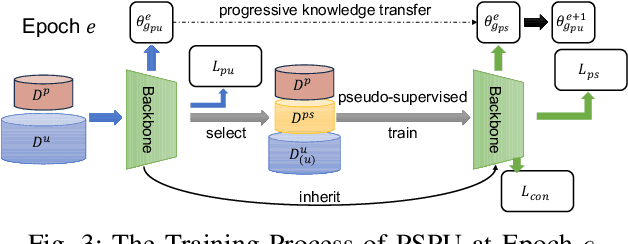

Positive and Unlabeled (PU) learning, a binary classification model trained with only positive and unlabeled data, generally suffers from overfitted risk estimation due to inconsistent data distributions. To address this, we introduce a pseudo-supervised PU learning framework (PSPU), in which we train the PU model first, use it to gather confident samples for the pseudo supervision, and then apply these supervision to correct the PU model's weights by leveraging non-PU objectives. We also incorporate an additional consistency loss to mitigate noisy sample effects. Our PSPU outperforms recent PU learning methods significantly on MNIST, CIFAR-10, CIFAR-100 in both balanced and imbalanced settings, and enjoys competitive performance on MVTecAD for industrial anomaly detection.
DMAD: Dual Memory Bank for Real-World Anomaly Detection
Mar 19, 2024Training a unified model is considered to be more suitable for practical industrial anomaly detection scenarios due to its generalization ability and storage efficiency. However, this multi-class setting, which exclusively uses normal data, overlooks the few but important accessible annotated anomalies in the real world. To address the challenge of real-world anomaly detection, we propose a new framework named Dual Memory bank enhanced representation learning for Anomaly Detection (DMAD). This framework handles both unsupervised and semi-supervised scenarios in a unified (multi-class) setting. DMAD employs a dual memory bank to calculate feature distance and feature attention between normal and abnormal patterns, thereby encapsulating knowledge about normal and abnormal instances. This knowledge is then used to construct an enhanced representation for anomaly score learning. We evaluated DMAD on the MVTec-AD and VisA datasets. The results show that DMAD surpasses current state-of-the-art methods, highlighting DMAD's capability in handling the complexities of real-world anomaly detection scenarios.