 Add to Chrome
 Add to Firefox
 Add to Edge
AgentProcessBench: Diagnosing Step-Level Process Quality in Tool-Using Agents
Mar 15, 2026
While Large Language Models (LLMs) have evolved into tool-using agents, they remain brittle in long-horizon interactions. Unlike mathematical reasoning where errors are often rectifiable via backtracking, tool-use failures frequently induce irreversible side effects, making accurate step-level verification critical. However, existing process-level benchmarks are predominantly confined to closed-world mathematical domains, failing to capture the dynamic and open-ended nature of tool execution. To bridge this gap, we introduce AgentProcessBench, the first benchmark dedicated to evaluating step-level effectiveness in realistic, tool-augmented trajectories. The benchmark comprises 1,000 diverse trajectories and 8,509 human-labeled step annotations with 89.1% inter-annotator agreement. It features a ternary labeling scheme to capture exploration and an error propagation rule to reduce labeling ambiguity. Extensive experiments reveal key insights: (1) weaker policy models exhibit inflated ratios of correct steps due to early termination; (2) distinguishing neutral and erroneous actions remains a significant challenge for current models; and (3) process-derived signals provide complementary value to outcome supervision, significantly enhancing test-time scaling. We hope AgentProcessBench can foster future research in reward models and pave the way toward general agents. The code and data are available at https://github.com/RUCBM/AgentProcessBench.

Large Language Model-based Human-Agent Collaboration for Complex Task Solving
Feb 20, 2024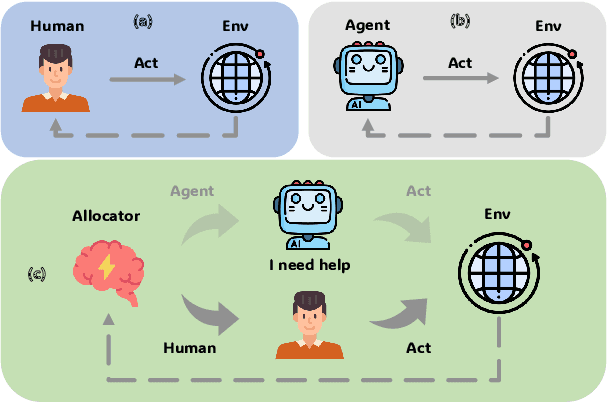


In recent developments within the research community, the integration of Large Language Models (LLMs) in creating fully autonomous agents has garnered significant interest. Despite this, LLM-based agents frequently demonstrate notable shortcomings in adjusting to dynamic environments and fully grasping human needs. In this work, we introduce the problem of LLM-based human-agent collaboration for complex task-solving, exploring their synergistic potential. In addition, we propose a Reinforcement Learning-based Human-Agent Collaboration method, ReHAC. This approach includes a policy model designed to determine the most opportune stages for human intervention within the task-solving process. We construct a human-agent collaboration dataset to train this policy model in an offline reinforcement learning environment. Our validation tests confirm the model's effectiveness. The results demonstrate that the synergistic efforts of humans and LLM-based agents significantly improve performance in complex tasks, primarily through well-planned, limited human intervention. Datasets and code are available at: https://github.com/XueyangFeng/ReHAC.