 Add to Chrome
 Add to Firefox
 Add to Edge
MedUP: Awakening Unified Understanding and Perception in Medical Vision-Language Models
Aug 11, 2026
Medical Vision-Language Models (Med-VLMs) excel at verbalizing visual content, yet precise visual perception, segmentation, and grounding remain challenging. Existing approaches either verbalize regions as coordinate strings or rely on external modules that decouple perception from understanding, creating representation gaps for region-language alignment. We present MedUP, a Med-VLM that natively unifies perception and understanding within a shared token space. At its core lies UniMedTok, a region tokenizer that encodes masks as discrete tokens in the LLM vocabulary, enabling the model to seamlessly interleave mask tokens with text. We curate UniMed-Train, a 1.84M-instance corpus spanning text-guided segmentation, region-grounded understanding, medical VQA and CoT-based segmentation, and introduce UniMed-Bench for unified evaluation. Extensive experiments show that MedUP outperforms native, agentic, and dual-decoder Med-VLMs across all tasks while remaining competitive with specialist segmentors, demonstrating the strong potential of unified understanding and perception modeling.

Poly-OPD: Heterogeneous Multi-Teacher On-Policy Distillation for Capability-Selectable Flow Models
Aug 05, 2026Leading open text-to-image models often carry complementary strengths: one may lead on preference-aligned aesthetics while another follows compositional instructions more faithfully. However, differences in their autoencoders and noise schedules make it difficult to transfer these strengths across models. In this paper, we present Poly-OPD, a framework that can consolidate complementary strengths of heterogeneous teachers into a single compact flow-matching student. To bridge the incompatible latent spaces of different teachers, Poly-OPD performs on-policy distillation through a pixel bridge. Each student-generated image is re-encoded by a selected teacher's encoder and refined from a noise level matched by magnitude under the teacher's noise schedule. The resulting target is further matched to the student in frozen DINOv2 space, enabling supervision across incompatible latent spaces. To retain complementary capabilities without cross-teacher interference, Poly-OPD uses a gradient compatibility diagnostic to organize its adapters: attention LoRA modules are shared across teachers, whereas feed-forward adapters remain teacher-specific. During distillation, a gap-aware curriculum devotes more training to compositional categories where the student still falls short of the teacher. As each gap narrows, training shifts toward categories with larger remaining gaps. By distilling FLUX.1-dev and Z-Image into a 2.5B SD3.5-Medium student, Poly-OPD improves GenEval from 67.3 to 73.3, surpassing both larger teachers, and raises DrawBench HPSv3 from 9.34 to 11.35, consolidating both strengths within a switchable model.
Any-OPD: Heterogeneous On-Policy Distillation for Flow-Matching Models via Representation-Space Bridging
Aug 04, 2026On-policy distillation, in which a teacher corrects samples that the student itself generates, presupposes that the two models speak the same language: identical VAE latents, matching architectures, and a common timestep grid. We ask what happens when none of this holds, as when the strongest teacher available and the student one wishes to deploy come from different model families, and find that the standard recipes have no answer: teacher latents cannot serve as targets in a foreign coordinate system, per-pixel losses against a teacher that stochastically re-draws local detail degenerate into blur or divergence, and timestep indices lose their meaning across mismatched schedules. We present Any-OPD, to our knowledge the first framework for on-policy distillation between arbitrary pairs of latent flow-matching generators. Any-OPD treats the teacher purely as a black-box sampler and connects the two models at exactly one point: a frozen, model-agnostic vision representation in which their independently decoded outputs are compared, sidestepping every assumption about latents, features, or architecture. Trajectory correspondence is recovered by matching continuous noise levels instead of step indices, and a brief anchoring phase, in which teacher samples are re-encoded through the student's own VAE, ensures the on-policy gradient measures sample quality rather than domain mismatch. Distilling the 12B FLUX.1-dev into the 2.5B SD3.5-Medium, Any-OPD lifts the student's PickScore from 0.846 to 0.884 and HPSv3 from 9.12 to 10.97, rivaling the teacher at a fifth of its size, where direct latent regression fails to train at all.
Rethinking Position Embedding as a Context Controller for Multi-Reference and Multi-Shot Video Generation
Apr 04, 2026Recent proprietary models such as Sora2 demonstrate promising progress in generating multi-shot videos conditioned on multiple reference characters. However, academic research on this problem remains limited. We study this task and identify a core challenge: when reference images exhibit highly similar appearances, the model often suffers from reference confusion, where semantically similar tokens degrade the model's ability to retrieve the correct context. To address this, we introduce PoCo (Position Embedding as a Context Controller), which incorporates position encoding as additional context control beyond semantic retrieval. By employing side information of tokens, PoCo enables precise token-level matching while preserving implicit semantic consistency modeling. Building on PoCo, we develop a multi-reference and multi-shot video generation model capable of reliably controlling characters with extremely similar visual traits. Extensive experiments demonstrate that PoCo improves cross-shot consistency and reference fidelity compared with various baselines.
Forgetting-Resistant and Lesion-Aware Source-Free Domain Adaptive Fundus Image Analysis with Vision-Language Model
Feb 23, 2026Source-free domain adaptation (SFDA) aims to adapt a model trained in the source domain to perform well in the target domain, with only unlabeled target domain data and the source model. Taking into account that conventional SFDA methods are inevitably error-prone under domain shift, recently greater attention has been directed to SFDA assisted with off-the-shelf foundation models, e.g., vision-language (ViL) models. However, existing works of leveraging ViL models for SFDA confront two issues: (i) Although mutual information is exploited to consider the joint distribution between the predictions of ViL model and the target model, we argue that the forgetting of some superior predictions of the target model still occurs, as indicated by the decline of the accuracies of certain classes during adaptation; (ii) Prior research disregards the rich, fine-grained knowledge embedded in the ViL model, which offers detailed grounding for fundus image diagnosis. In this paper, we introduce a novel forgetting-resistant and lesion-aware (FRLA) method for SFDA of fundus image diagnosis with ViL model. Specifically, a forgetting-resistant adaptation module explicitly preserves the confident predictions of the target model, and a lesion-aware adaptation module yields patch-wise predictions from ViL model and employs them to help the target model be aware of the lesion areas and leverage the ViL model's fine-grained knowledge. Extensive experiments show that our method not only significantly outperforms the vision-language model, but also achieves consistent improvements over the state-of-the-art methods. Our code will be released.
Cross-view Generalized Diffusion Model for Sparse-view CT Reconstruction
Aug 14, 2025Sparse-view computed tomography (CT) reduces radiation exposure by subsampling projection views, but conventional reconstruction methods produce severe streak artifacts with undersampled data. While deep-learning-based methods enable single-step artifact suppression, they often produce over-smoothed results under significant sparsity. Though diffusion models improve reconstruction via iterative refinement and generative priors, they require hundreds of sampling steps and struggle with stability in highly sparse regimes. To tackle these concerns, we present the Cross-view Generalized Diffusion Model (CvG-Diff), which reformulates sparse-view CT reconstruction as a generalized diffusion process. Unlike existing diffusion approaches that rely on stochastic Gaussian degradation, CvG-Diff explicitly models image-domain artifacts caused by angular subsampling as a deterministic degradation operator, leveraging correlations across sparse-view CT at different sample rates. To address the inherent artifact propagation and inefficiency of sequential sampling in generalized diffusion model, we introduce two innovations: Error-Propagating Composite Training (EPCT), which facilitates identifying error-prone regions and suppresses propagated artifacts, and Semantic-Prioritized Dual-Phase Sampling (SPDPS), an adaptive strategy that prioritizes semantic correctness before detail refinement. Together, these innovations enable CvG-Diff to achieve high-quality reconstructions with minimal iterations, achieving 38.34 dB PSNR and 0.9518 SSIM for 18-view CT using only \textbf{10} steps on AAPM-LDCT dataset. Extensive experiments demonstrate the superiority of CvG-Diff over state-of-the-art sparse-view CT reconstruction methods. The code is available at https://github.com/xmed-lab/CvG-Diff.
UniEval: Unified Holistic Evaluation for Unified Multimodal Understanding and Generation
May 15, 2025The emergence of unified multimodal understanding and generation models is rapidly attracting attention because of their ability to enhance instruction-following capabilities while minimizing model redundancy. However, there is a lack of a unified evaluation framework for these models, which would enable an elegant, simplified, and overall evaluation. Current models conduct evaluations on multiple task-specific benchmarks, but there are significant limitations, such as the lack of overall results, errors from extra evaluation models, reliance on extensive labeled images, benchmarks that lack diversity, and metrics with limited capacity for instruction-following evaluation. To tackle these challenges, we introduce UniEval, the first evaluation framework designed for unified multimodal models without extra models, images, or annotations. This facilitates a simplified and unified evaluation process. The UniEval framework contains a holistic benchmark, UniBench (supports both unified and visual generation models), along with the corresponding UniScore metric. UniBench includes 81 fine-grained tags contributing to high diversity. Experimental results indicate that UniBench is more challenging than existing benchmarks, and UniScore aligns closely with human evaluations, surpassing current metrics. Moreover, we extensively evaluated SoTA unified and visual generation models, uncovering new insights into Univeral's unique values.
DeepSparse: A Foundation Model for Sparse-View CBCT Reconstruction
May 05, 2025Cone-beam computed tomography (CBCT) is a critical 3D imaging technology in the medical field, while the high radiation exposure required for high-quality imaging raises significant concerns, particularly for vulnerable populations. Sparse-view reconstruction reduces radiation by using fewer X-ray projections while maintaining image quality, yet existing methods face challenges such as high computational demands and poor generalizability to different datasets. To overcome these limitations, we propose DeepSparse, the first foundation model for sparse-view CBCT reconstruction, featuring DiCE (Dual-Dimensional Cross-Scale Embedding), a novel network that integrates multi-view 2D features and multi-scale 3D features. Additionally, we introduce the HyViP (Hybrid View Sampling Pretraining) framework, which pretrains the model on large datasets with both sparse-view and dense-view projections, and a two-step finetuning strategy to adapt and refine the model for new datasets. Extensive experiments and ablation studies demonstrate that our proposed DeepSparse achieves superior reconstruction quality compared to state-of-the-art methods, paving the way for safer and more efficient CBCT imaging.
MuTri: Multi-view Tri-alignment for OCT to OCTA 3D Image Translation
Apr 02, 2025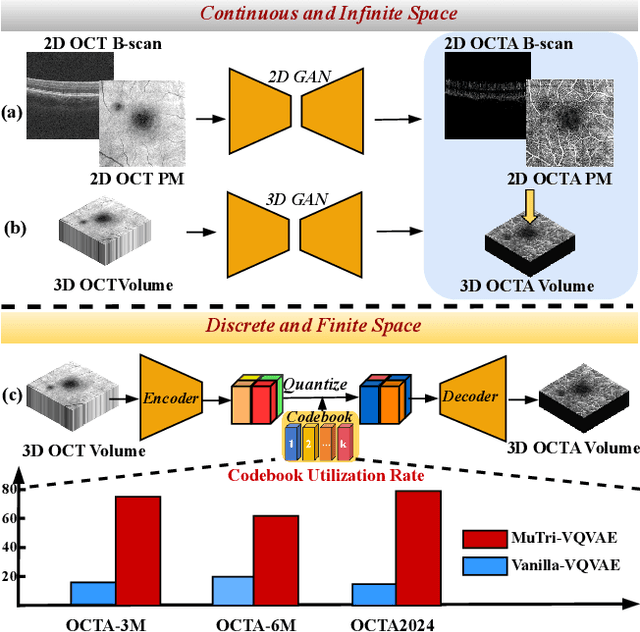
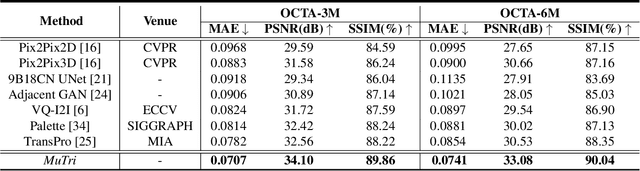
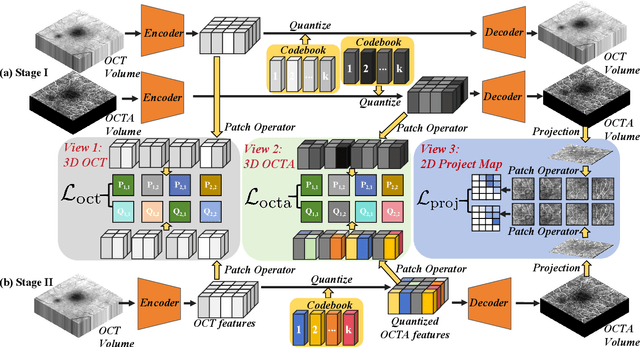
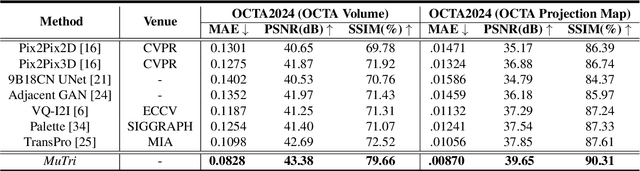
Optical coherence tomography angiography (OCTA) shows its great importance in imaging microvascular networks by providing accurate 3D imaging of blood vessels, but it relies upon specialized sensors and expensive devices. For this reason, previous works show the potential to translate the readily available 3D Optical Coherence Tomography (OCT) images into 3D OCTA images. However, existing OCTA translation methods directly learn the mapping from the OCT domain to the OCTA domain in continuous and infinite space with guidance from only a single view, i.e., the OCTA project map, resulting in suboptimal results. To this end, we propose the multi-view Tri-alignment framework for OCT to OCTA 3D image translation in discrete and finite space, named MuTri. In the first stage, we pre-train two vector-quantized variational auto-encoder (VQ- VAE) by reconstructing 3D OCT and 3D OCTA data, providing semantic prior for subsequent multi-view guidances. In the second stage, our multi-view tri-alignment facilitates another VQVAE model to learn the mapping from the OCT domain to the OCTA domain in discrete and finite space. Specifically, a contrastive-inspired semantic alignment is proposed to maximize the mutual information with the pre-trained models from OCT and OCTA views, to facilitate codebook learning. Meanwhile, a vessel structure alignment is proposed to minimize the structure discrepancy with the pre-trained models from the OCTA project map view, benefiting from learning the detailed vessel structure information. We also collect the first large-scale dataset, namely, OCTA2024, which contains a pair of OCT and OCTA volumes from 846 subjects.
Vision Foundation Models in Medical Image Analysis: Advances and Challenges
Feb 21, 2025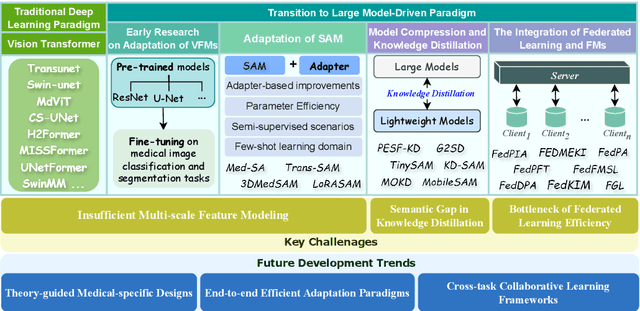
The rapid development of Vision Foundation Models (VFMs), particularly Vision Transformers (ViT) and Segment Anything Model (SAM), has sparked significant advances in the field of medical image analysis. These models have demonstrated exceptional capabilities in capturing long-range dependencies and achieving high generalization in segmentation tasks. However, adapting these large models to medical image analysis presents several challenges, including domain differences between medical and natural images, the need for efficient model adaptation strategies, and the limitations of small-scale medical datasets. This paper reviews the state-of-the-art research on the adaptation of VFMs to medical image segmentation, focusing on the challenges of domain adaptation, model compression, and federated learning. We discuss the latest developments in adapter-based improvements, knowledge distillation techniques, and multi-scale contextual feature modeling, and propose future directions to overcome these bottlenecks. Our analysis highlights the potential of VFMs, along with emerging methodologies such as federated learning and model compression, to revolutionize medical image analysis and enhance clinical applications. The goal of this work is to provide a comprehensive overview of current approaches and suggest key areas for future research that can drive the next wave of innovation in medical image segmentation.