 Add to Chrome
 Add to Firefox
 Add to Edge
DenseMLLM: Standard Multimodal LLMs are Intrinsic Dense Predictors
Feb 15, 2026
Multimodal Large Language Models (MLLMs) have demonstrated exceptional capabilities in high-level visual understanding. However, extending these models to fine-grained dense prediction tasks, such as semantic segmentation and depth estimation, typically necessitates the incorporation of complex, task-specific decoders and other customizations. This architectural fragmentation increases model complexity and deviates from the generalist design of MLLMs, ultimately limiting their practicality. In this work, we challenge this paradigm by accommodating standard MLLMs to perform dense predictions without requiring additional task-specific decoders. The proposed model is called DenseMLLM, grounded in the standard architecture with a novel vision token supervision strategy for multiple labels and tasks. Despite its minimalist design, our model achieves highly competitive performance across a wide range of dense prediction and vision-language benchmarks, demonstrating that a standard, general-purpose MLLM can effectively support dense perception without architectural specialization.

Youtu-VL: Unleashing Visual Potential via Unified Vision-Language Supervision
Jan 27, 2026Despite the significant advancements represented by Vision-Language Models (VLMs), current architectures often exhibit limitations in retaining fine-grained visual information, leading to coarse-grained multimodal comprehension. We attribute this deficiency to a suboptimal training paradigm inherent in prevailing VLMs, which exhibits a text-dominant optimization bias by conceptualizing visual signals merely as passive conditional inputs rather than supervisory targets. To mitigate this, we introduce Youtu-VL, a framework leveraging the Vision-Language Unified Autoregressive Supervision (VLUAS) paradigm, which fundamentally shifts the optimization objective from ``vision-as-input'' to ``vision-as-target.'' By integrating visual tokens directly into the prediction stream, Youtu-VL applies unified autoregressive supervision to both visual details and linguistic content. Furthermore, we extend this paradigm to encompass vision-centric tasks, enabling a standard VLM to perform vision-centric tasks without task-specific additions. Extensive empirical evaluations demonstrate that Youtu-VL achieves competitive performance on both general multimodal tasks and vision-centric tasks, establishing a robust foundation for the development of comprehensive generalist visual agents.
GIFT: Unlocking Global Optimality in Post-Training via Finite-Temperature Gibbs Initialization
Jan 14, 2026The prevailing post-training paradigm for Large Reasoning Models (LRMs)--Supervised Fine-Tuning (SFT) followed by Reinforcement Learning (RL)--suffers from an intrinsic optimization mismatch: the rigid supervision inherent in SFT induces distributional collapse, thereby exhausting the exploration space necessary for subsequent RL. In this paper, we reformulate SFT within a unified post-training framework and propose Gibbs Initialization with Finite Temperature (GIFT). We characterize standard SFT as a degenerate zero-temperature limit that suppresses base priors. Conversely, GIFT incorporates supervision as a finite-temperature energy potential, establishing a distributional bridge that ensures objective consistency throughout the post-training pipeline. Our experiments demonstrate that GIFT significantly outperforms standard SFT and other competitive baselines when utilized for RL initialization, providing a mathematically principled pathway toward achieving global optimality in post-training. Our code is available at https://github.com/zzy1127/GIFT.
Leash: Adaptive Length Penalty and Reward Shaping for Efficient Large Reasoning Model
Dec 25, 2025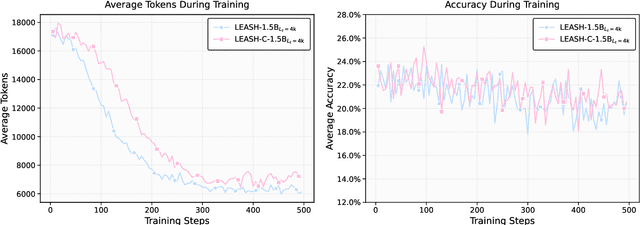
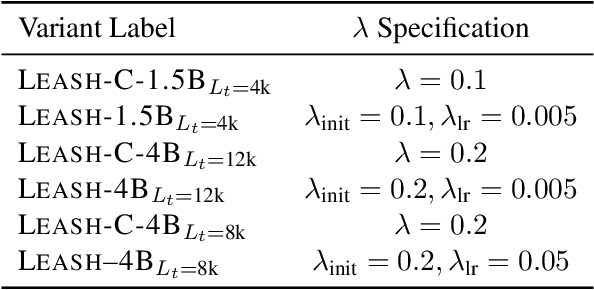
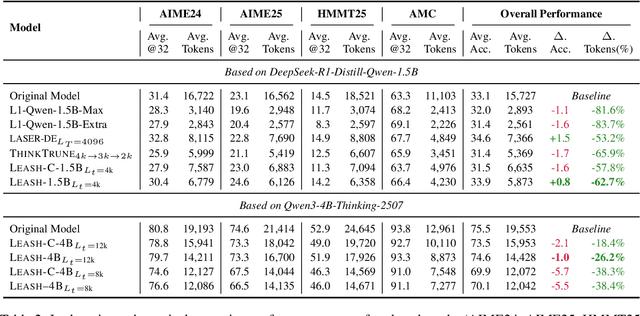

Existing approaches typically rely on fixed length penalties, but such penalties are hard to tune and fail to adapt to the evolving reasoning abilities of LLMs, leading to suboptimal trade-offs between accuracy and conciseness. To address this challenge, we propose Leash (adaptive LEngth penAlty and reward SHaping), a reinforcement learning framework for efficient reasoning in LLMs. We formulate length control as a constrained optimization problem and employ a Lagrangian primal-dual method to dynamically adjust the penalty coefficient. When generations exceed the target length, the penalty is intensified; when they are shorter, it is relaxed. This adaptive mechanism guides models toward producing concise reasoning without sacrificing task performance. Experiments on Deepseek-R1-Distill-Qwen-1.5B and Qwen3-4B-Thinking-2507 show that Leash reduces the average reasoning length by 60% across diverse tasks - including in-distribution mathematical reasoning and out-of-distribution domains such as coding and instruction following - while maintaining competitive performance. Our work thus presents a practical and effective paradigm for developing controllable and efficient LLMs that balance reasoning capabilities with computational budgets.
Not All Tokens and Heads Are Equally Important: Dual-Level Attention Intervention for Hallucination Mitigation
Jun 14, 2025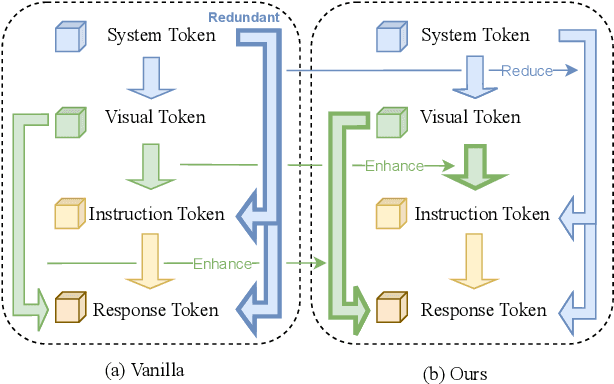
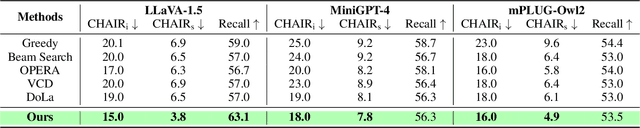
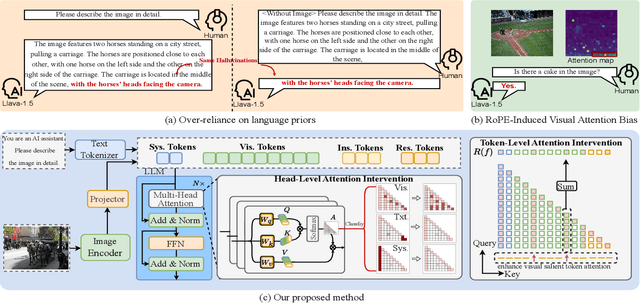

Large vision-language models (LVLMs) have shown remarkable capabilities across a wide range of multimodal tasks. However, they remain prone to visual hallucination (VH), often producing confident but incorrect descriptions of visual content. We present VisFlow, an efficient and training-free framework designed to mitigate VH by directly manipulating attention patterns during inference. Through systematic analysis, we identify three key pathological attention behaviors in LVLMs: (1) weak visual grounding, where attention to visual tokens is insufficient or misallocated, over-focusing on uninformative regions; (2) language prior dominance, where excessive attention to prior response tokens reinforces autoregressive patterns and impairs multimodal alignment; (3) prompt redundancy, where many attention heads fixate on system prompt tokens, disrupting the integration of image, instruction, and response content. To address these issues, we introduce two inference-time interventions: token-level attention intervention (TAI), which enhances focus on salient visual content, and head-level attention intervention (HAI), which suppresses over-attention to prompt and nearby text tokens. VisFlow operates without additional training or model modifications. Extensive experiments across models and benchmarks show that VisFlow effectively reduces hallucinations and improves visual factuality, with negligible computational cost.
Learning What Reinforcement Learning Can't: Interleaved Online Fine-Tuning for Hardest Questions
Jun 09, 2025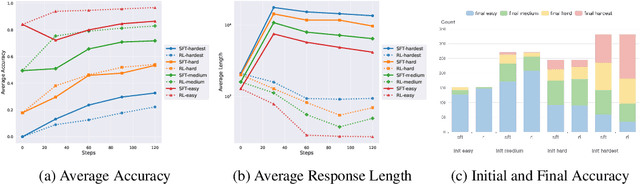
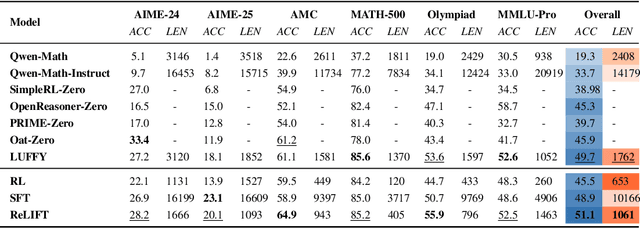
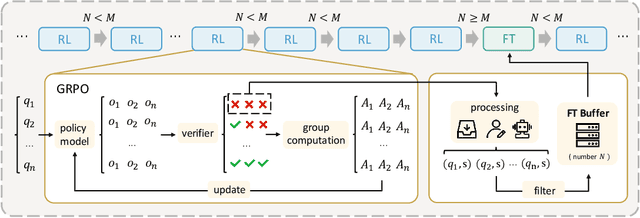
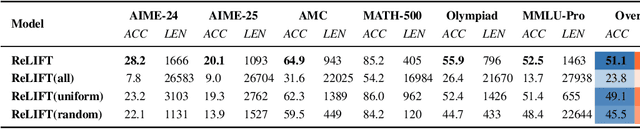
Recent advances in large language model (LLM) reasoning have shown that sophisticated behaviors such as planning and self-reflection can emerge through reinforcement learning (RL). However, despite these successes, RL in its current form remains insufficient to induce capabilities that exceed the limitations of the base model, as it is primarily optimized based on existing knowledge of the model rather than facilitating the acquisition of new information. To address this limitation, we employ supervised fine-tuning (SFT) to learn what RL cannot, which enables the incorporation of new knowledge and reasoning patterns by leveraging high-quality demonstration data. We analyze the training dynamics of RL and SFT for LLM reasoning and find that RL excels at maintaining and improving performance on questions within the model's original capabilities, while SFT is more effective at enabling progress on questions beyond the current scope of the model. Motivated by the complementary strengths of RL and SFT, we introduce a novel training approach, \textbf{ReLIFT} (\textbf{Re}inforcement \textbf{L}earning \textbf{I}nterleaved with Online \textbf{F}ine-\textbf{T}uning). In ReLIFT, the model is primarily trained using RL, but when it encounters challenging questions, high-quality solutions are collected for fine-tuning, and the training process alternates between RL and fine-tuning to enhance the model's reasoning abilities. ReLIFT achieves an average improvement of over +5.2 points across five competition-level benchmarks and one out-of-distribution benchmark compared to other zero-RL models. Furthermore, we demonstrate that ReLIFT outperforms both RL and SFT while using only 13\% of the detailed demonstration data, highlighting its scalability. These results provide compelling evidence that ReLIFT overcomes the fundamental limitations of RL and underscores the significant potential.