 Add to Chrome
 Add to Firefox
 Add to Edge
SurgVIL: Scaling Surgical Robot Imitation Learning with Open-source Surgical Videos
Aug 17, 2026
Learning-based surgical robot autonomy requires large-scale demonstrations with synchronized videos and robot actions, but such data are exceedingly rare in clinical or realistic tissue settings because robot kinematics are typically inaccessible outside controlled research systems. In contrast, phantom data collected on research platforms provide accurate action labels but lack the visual diversity of real tissue. We propose SurgVIL, a framework for scaling surgical robot imitation learning using open-source surgical videos. SurgVIL combines kinematically labeled phantom robot demonstrations with surgical videos from open-source datasets and online sources for policy learning. Since these videos lack robot motion labels, we estimate approximate kinematics as weak supervision. We evaluate SurgVIL on two da Vinci robot tasks: needle pick-up and cholecystectomy cutting. Across ACT, $π_0$, and GR00T-H backbones, adding surgical videos substantially improves generalization to real-tissue and out-of-distribution settings, suggesting a scalable path from phantom training toward generalizable surgical robot policies.

Open-H-Embodiment: A Large-Scale Dataset for Enabling Foundation Models in Medical Robotics
Apr 22, 2026Autonomous medical robots hold promise to improve patient outcomes, reduce provider workload, democratize access to care, and enable superhuman precision. However, autonomous medical robotics has been limited by a fundamental data problem: existing medical robotic datasets are small, single-embodiment, and rarely shared openly, restricting the development of foundation models that the field needs to advance. We introduce Open-H-Embodiment, the largest open dataset of medical robotic video with synchronized kinematics to date, spanning more than 49 institutions and multiple robotic platforms including the CMR Versius, Intuitive Surgical's da Vinci, da Vinci Research Kit (dVRK), Rob Surgical BiTrack, Virtual Incision's MIRA, Moon Surgical Maestro, and a variety of custom systems, spanning surgical manipulation, robotic ultrasound, and endoscopy procedures. We demonstrate the research enabled by this dataset through two foundation models. GR00T-H is the first open foundation vision-language-action model for medical robotics, which is the only evaluated model to achieve full end-to-end task completion on a structured suturing benchmark (25% of trials vs. 0% for all others) and achieves 64% average success across a 29-step ex vivo suturing sequence. We also train Cosmos-H-Surgical-Simulator, the first action-conditioned world model to enable multi-embodiment surgical simulation from a single checkpoint, spanning nine robotic platforms and supporting in silico policy evaluation and synthetic data generation for the medical domain. These results suggest that open, large-scale medical robot data collection can serve as critical infrastructure for the research community, enabling advances in robot learning, world modeling, and beyond.
Robust Autonomous Control of a Magnetic Millirobot in In Vitro Cardiac Flow
Apr 02, 2026Untethered magnetic millirobots offer significant potential for minimally invasive cardiac therapies; however, achieving reliable autonomous control in pulsatile cardiac flow remains challenging. This work presents a vision-guided control framework enabling precise autonomous navigation of a magnetic millirobot in an in vitro heart phantom under physiologically relevant flow conditions. The system integrates UNet-based localization, A* path planning, and a sliding mode controller with a disturbance observer (SMC-DOB) designed for multi-coil electromagnetic actuation. Although drag forces are estimated using steady-state CFD simulations, the controller compensates for transient pulsatile disturbances during closed-loop operation. In static fluid, the SMC-DOB achieved sub-millimeter accuracy (root-mean-square error, RMSE = 0.49 mm), outperforming PID and MPC baselines. Under moderate pulsatile flow (7 cm/s peak, 20 cP), it reduced RMSE by 37% and peak error by 2.4$\times$ compared to PID. It further maintained RMSE below 2 mm (0.27 body lengths) under elevated pulsatile flow (10 cm/s peak, 20 cP) and under low-viscosity conditions (4.3 cP, 7 cm/s peak), where baseline controllers exhibited unstable or failed tracking. These results demonstrate robust closed-loop magnetic control under time-varying cardiac flow disturbances and support the feasibility of autonomous millirobot navigation for targeted drug delivery.
Fluoroscopy-Constrained Magnetic Robot Control via Zernike-Based Field Modeling and Nonlinear MPC
Feb 17, 2026Magnetic actuation enables surgical robots to navigate complex anatomical pathways while reducing tissue trauma and improving surgical precision. However, clinical deployment is limited by the challenges of controlling such systems under fluoroscopic imaging, which provides low frame rate and noisy pose feedback. This paper presents a control framework that remains accurate and stable under such conditions by combining a nonlinear model predictive control (NMPC) framework that directly outputs coil currents, an analytically differentiable magnetic field model based on Zernike polynomials, and a Kalman filter to estimate the robot state. Experimental validation is conducted with two magnetic robots in a 3D-printed fluid workspace and a spine phantom replicating drug delivery in the epidural space. Results show the proposed control method remains highly accurate when feedback is downsampled to 3 Hz with added Gaussian noise (sigma = 2 mm), mimicking clinical fluoroscopy. In the spine phantom experiments, the proposed method successfully executed a drug delivery trajectory with a root mean square (RMS) position error of 1.18 mm while maintaining safe clearance from critical anatomical boundaries.
Mitigating Hallucination in Financial Retrieval-Augmented Generation via Fine-Grained Knowledge Verification
Feb 05, 2026In financial Retrieval-Augmented Generation (RAG) systems, models frequently rely on retrieved documents to generate accurate responses due to the time-sensitive nature of the financial domain. While retrieved documents help address knowledge gaps, model-generated responses still suffer from hallucinations that contradict the retrieved information. To mitigate this inconsistency, we propose a Reinforcement Learning framework enhanced with Fine-grained Knowledge Verification (RLFKV). Our method decomposes financial responses into atomic knowledge units and assesses the correctness of each unit to compute the fine-grained faithful reward. This reward offers more precise optimization signals, thereby improving alignment with the retrieved documents. Additionally, to prevent reward hacking (e.g., overly concise replies), we incorporate an informativeness reward that encourages the policy model to retain at least as many knowledge units as the base model. Experiments conducted on the public Financial Data Description (FDD) task and our newly proposed FDD-ANT dataset demonstrate consistent improvements, confirming the effectiveness of our approach.
Kimi K2.5: Visual Agentic Intelligence
Feb 02, 2026We introduce Kimi K2.5, an open-source multimodal agentic model designed to advance general agentic intelligence. K2.5 emphasizes the joint optimization of text and vision so that two modalities enhance each other. This includes a series of techniques such as joint text-vision pre-training, zero-vision SFT, and joint text-vision reinforcement learning. Building on this multimodal foundation, K2.5 introduces Agent Swarm, a self-directed parallel agent orchestration framework that dynamically decomposes complex tasks into heterogeneous sub-problems and executes them concurrently. Extensive evaluations show that Kimi K2.5 achieves state-of-the-art results across various domains including coding, vision, reasoning, and agentic tasks. Agent Swarm also reduces latency by up to $4.5\times$ over single-agent baselines. We release the post-trained Kimi K2.5 model checkpoint to facilitate future research and real-world applications of agentic intelligence.
A Mobile Magnetic Manipulation Platform for Gastrointestinal Navigation with Deep Reinforcement Learning Control
Jan 22, 2026Targeted drug delivery in the gastrointestinal (GI) tract using magnetic robots offers a promising alternative to systemic treatments. However, controlling these robots is a major challenge. Stationary magnetic systems have a limited workspace, while mobile systems (e.g., coils on a robotic arm) suffer from a "model-calibration bottleneck", requiring complex, pre-calibrated physical models that are time-consuming to create and computationally expensive. This paper presents a compact, low-cost mobile magnetic manipulation platform that overcomes this limitation using Deep Reinforcement Learning (DRL). Our system features a compact four-electromagnet array mounted on a UR5 collaborative robot. A Soft Actor-Critic (SAC)-based control strategy is trained through a sim-to-real pipeline, enabling effective policy deployment within 15 minutes and significantly reducing setup time. We validated the platform by controlling a 7-mm magnetic capsule along 2D trajectories. Our DRL-based controller achieved a root-mean-square error (RMSE) of 1.18~mm for a square path and 1.50~mm for a circular path. We also demonstrated successful tracking over a clinically relevant, 30 cm * 20 cm workspace. This work demonstrates a rapidly deployable, model-free control framework capable of precise magnetic manipulation in a large workspace,validated using a 2D GI phantom.
Rethinking Visual Layer Selection in Multimodal LLMs
Apr 30, 2025Multimodal large language models (MLLMs) have achieved impressive performance across a wide range of tasks, typically using CLIP-ViT as their visual encoder due to its strong text-image alignment capabilities. While prior studies suggest that different CLIP-ViT layers capture different types of information, with shallower layers focusing on fine visual details and deeper layers aligning more closely with textual semantics, most MLLMs still select visual features based on empirical heuristics rather than systematic analysis. In this work, we propose a Layer-wise Representation Similarity approach to group CLIP-ViT layers with similar behaviors into {shallow, middle, and deep} categories and assess their impact on MLLM performance. Building on this foundation, we revisit the visual layer selection problem in MLLMs at scale, training LLaVA-style models ranging from 1.4B to 7B parameters. Through extensive experiments across 10 datasets and 4 tasks, we find that: (1) deep layers are essential for OCR tasks; (2) shallow and middle layers substantially outperform deep layers on reasoning tasks involving counting, positioning, and object localization; (3) a lightweight fusion of features across shallow, middle, and deep layers consistently outperforms specialized fusion baselines and single-layer selections, achieving gains on 9 out of 10 datasets. Our work offers the first principled study of visual layer selection in MLLMs, laying the groundwork for deeper investigations into visual representation learning for MLLMs.
Syllables to Scenes: Literary-Guided Free-Viewpoint 3D Scene Synthesis from Japanese Haiku
Feb 17, 2025In the era of the metaverse, where immersive technologies redefine human experiences, translating abstract literary concepts into navigable 3D environments presents a fundamental challenge in preserving semantic and emotional fidelity. This research introduces HaikuVerse, a novel framework for transforming poetic abstraction into spatial representation, with Japanese Haiku serving as an ideal test case due to its sophisticated encapsulation of profound emotions and imagery within minimal text. While existing text-to-3D methods struggle with nuanced interpretations, we present a literary-guided approach that synergizes traditional poetry analysis with advanced generative technologies. Our framework centers on two key innovations: (1) Hierarchical Literary-Criticism Theory Grounded Parsing (H-LCTGP), which captures both explicit imagery and implicit emotional resonance through structured semantic decomposition, and (2) Progressive Dimensional Synthesis (PDS), a multi-stage pipeline that systematically transforms poetic elements into coherent 3D scenes through sequential diffusion processes, geometric optimization, and real-time enhancement. Extensive experiments demonstrate that HaikuVerse significantly outperforms conventional text-to-3D approaches in both literary fidelity and visual quality, establishing a new paradigm for preserving cultural heritage in immersive digital spaces. Project website at: https://syllables-to-scenes.github.io/
CERD: A Comprehensive Chinese Rhetoric Dataset for Rhetorical Understanding and Generation in Essays
Sep 29, 2024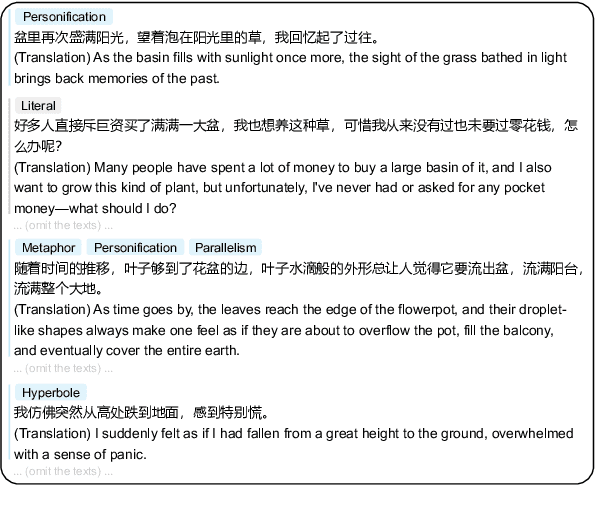
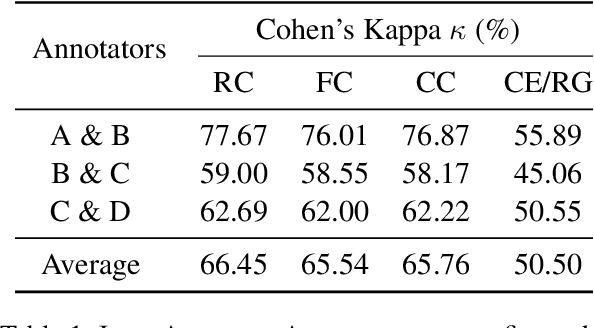
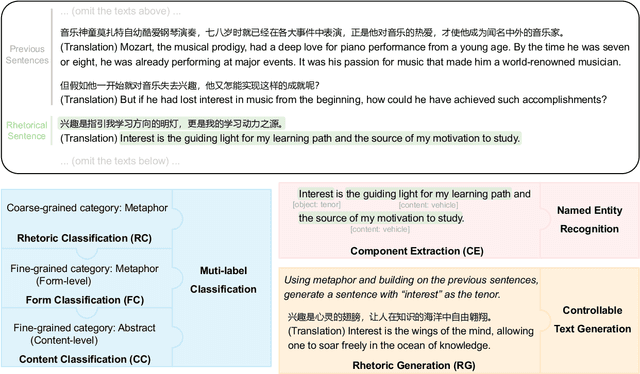
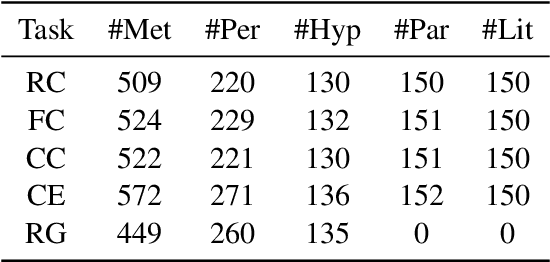
Existing rhetorical understanding and generation datasets or corpora primarily focus on single coarse-grained categories or fine-grained categories, neglecting the common interrelations between different rhetorical devices by treating them as independent sub-tasks. In this paper, we propose the Chinese Essay Rhetoric Dataset (CERD), consisting of 4 commonly used coarse-grained categories including metaphor, personification, hyperbole and parallelism and 23 fine-grained categories across both form and content levels. CERD is a manually annotated and comprehensive Chinese rhetoric dataset with five interrelated sub-tasks. Unlike previous work, our dataset aids in understanding various rhetorical devices, recognizing corresponding rhetorical components, and generating rhetorical sentences under given conditions, thereby improving the author's writing proficiency and language usage skills. Extensive experiments are conducted to demonstrate the interrelations between multiple tasks in CERD, as well as to establish a benchmark for future research on rhetoric. The experimental results indicate that Large Language Models achieve the best performance across most tasks, and jointly fine-tuning with multiple tasks further enhances performance.