 Add to Chrome
 Add to Firefox
 Add to Edge
MoWorld: A Flash World Model
Jul 07, 2026
The future of World Models depends not only on scaling model capability, but also on scaling practicality and inference efficiency. High-frame-rate inference enables responsive perception, planning, and control in real-world autonomous systems. To this end, we present MoWorld, a cost-effective yet high-performance Flash World Model with an end-to-end framework spanning data generation, pre-training, distillation, and efficient inference, enabling up to 50 FPS real-time interaction with cinematic visual quality without the need of high-end GPUs. To enable large-scale real-world deployment, MoWorld jointly optimizes model capability and cost throughout the entire development pipeline. Specifically, unlike existing approaches that primarily rely on large-scale video corpora, MoWorld is built upon a scalable 3D-native data engine accumulated from our large-scale 3D vision and generative modeling pipeline, enabling the efficient construction of geometrically consistent training data across diverse real-world and synthetic environments. Based on this foundation, a curriculum cross-frame pre-training strategy for stable and scalable World Model learning, an efficient denoising-step distillation algorithm to reduce diffusion training cost, and a mixed-precision parallel inference framework for low-cost real-time deployment. MoWorld is the first real-time interactive World Model built on the Neural Processing Unit (NPU) and can achieves up to 50 FPS in such the devices, enabling practical and efficient deployment at scale. Comprehensive evaluations demonstrate that MoWorld achieves leading performance; notably, its average inference cost is only 30\%-50\% of that of existing World Models, providing a practical foundation for large-scale real-world applications of World Models. We also demonstrate diverse applications of MoWorld.

4DVGGT-D: 4D Visual Geometry Transformer with Improved Dynamic Depth Estimation
May 12, 2026Reconstructing dynamic 4D scenes from monocular videos is a fundamental yet challenging task. While recent 3D foundation models provide strong geometric priors, their performance significantly degrades in dynamic environments. This degradation stems from a fundamental tension: the inherent coupling of camera ego-motion and object motion within global attention mechanisms. In this paper, we propose a novel, training-free progressive decoupling framework that disentangles dynamics from statics in a principled, coarse-to-fine manner. Our core insight is to resolve the tension by first stabilizing the camera pose, followed by geometric refinement. Specifically, our approach consists of three synergistic components: (1) a Dynamic-Mask-Guided Pose Decoupling module that isolates pose estimation from dynamic interference, yielding a stable motion-free reference frame; (2) a Topological Subspace Surgery mechanism that orthogonally decomposes the depth manifold, safely preserving dynamic objects while injecting refined, mask-aware geometry into static regions; and (3) an Information-Theoretic Confidence-Aware Fusion strategy that formulates depth integration as a heteroscedastic Bayesian inference problem, adaptively blending multi-pass predictions via inverse-variance weighting. Extensive experiments on standard 4D reconstruction benchmarks demonstrate that our method achieves consistent and substantial improvements across principal point-cloud metrics. Notably, our approach shows competitive performance in robust 4D scene reconstruction without requiring fine-tuning, suggesting the potential of mathematically grounded dynamic-static disentanglement.
Robust 4D Visual Geometry Transformer with Uncertainty-Aware Priors
Apr 10, 2026Reconstructing dynamic 4D scenes is an important yet challenging task. While 3D foundation models like VGGT excel in static settings, they often struggle with dynamic sequences where motion causes significant geometric ambiguity. To address this, we present a framework designed to disentangle dynamic and static components by modeling uncertainty across different stages of the reconstruction process. Our approach introduces three synergistic mechanisms: (1) Entropy-Guided Subspace Projection, which leverages information-theoretic weighting to adaptively aggregate multi-head attention distributions, effectively isolating dynamic motion cues from semantic noise; (2) Local-Consistency Driven Geometry Purification, which enforces spatial continuity via radius-based neighborhood constraints to eliminate structural outliers; and (3) Uncertainty-Aware Cross-View Consistency, which formulates multi-view projection refinement as a heteroscedastic maximum likelihood estimation problem, utilizing depth confidence as a probabilistic weight. Experiments on dynamic benchmarks show that our approach outperforms current state-of-the-art methods, reducing Mean Accuracy error by 13.43\% and improving segmentation F-measure by 10.49\%. Our framework maintains the efficiency of feed-forward inference and requires no task-specific fine-tuning or per-scene optimization.
HD-VGGT: High-Resolution Visual Geometry Transformer
Mar 28, 2026High-resolution imagery is essential for accurate 3D reconstruction, as many geometric details only emerge at fine spatial scales. Recent feed-forward approaches, such as the Visual Geometry Grounded Transformer (VGGT), have demonstrated the ability to infer scene geometry from large collections of images in a single forward pass. However, scaling these models to high-resolution inputs remains challenging: the number of tokens in transformer architectures grows rapidly with both image resolution and the number of views, leading to prohibitive computational and memory costs. Moreover, we observe that visually ambiguous regions, such as repetitive patterns, weak textures, or specular surfaces, often produce unstable feature tokens that degrade geometric inference, especially at higher resolutions. We introduce HD-VGGT, a dual-branch architecture for efficient and robust high-resolution 3D reconstruction. A low-resolution branch predicts a coarse, globally consistent geometry, while a high-resolution branch refines details via a learned feature upsampling module. To handle unstable tokens, we propose Feature Modulation, which suppresses unreliable features early in the transformer. HD-VGGT leverages high-resolution images and supervision without full-resolution transformer costs, achieving state-of-the-art reconstruction quality.
Syllables to Scenes: Literary-Guided Free-Viewpoint 3D Scene Synthesis from Japanese Haiku
Feb 17, 2025In the era of the metaverse, where immersive technologies redefine human experiences, translating abstract literary concepts into navigable 3D environments presents a fundamental challenge in preserving semantic and emotional fidelity. This research introduces HaikuVerse, a novel framework for transforming poetic abstraction into spatial representation, with Japanese Haiku serving as an ideal test case due to its sophisticated encapsulation of profound emotions and imagery within minimal text. While existing text-to-3D methods struggle with nuanced interpretations, we present a literary-guided approach that synergizes traditional poetry analysis with advanced generative technologies. Our framework centers on two key innovations: (1) Hierarchical Literary-Criticism Theory Grounded Parsing (H-LCTGP), which captures both explicit imagery and implicit emotional resonance through structured semantic decomposition, and (2) Progressive Dimensional Synthesis (PDS), a multi-stage pipeline that systematically transforms poetic elements into coherent 3D scenes through sequential diffusion processes, geometric optimization, and real-time enhancement. Extensive experiments demonstrate that HaikuVerse significantly outperforms conventional text-to-3D approaches in both literary fidelity and visual quality, establishing a new paradigm for preserving cultural heritage in immersive digital spaces. Project website at: https://syllables-to-scenes.github.io/
SAM2-Adapter: Evaluating & Adapting Segment Anything 2 in Downstream Tasks: Camouflage, Shadow, Medical Image Segmentation, and More
Aug 08, 2024The advent of large models, also known as foundation models, has significantly transformed the AI research landscape, with models like Segment Anything (SAM) achieving notable success in diverse image segmentation scenarios. Despite its advancements, SAM encountered limitations in handling some complex low-level segmentation tasks like camouflaged object and medical imaging. In response, in 2023, we introduced SAM-Adapter, which demonstrated improved performance on these challenging tasks. Now, with the release of Segment Anything 2 (SAM2), a successor with enhanced architecture and a larger training corpus, we reassess these challenges. This paper introduces SAM2-Adapter, the first adapter designed to overcome the persistent limitations observed in SAM2 and achieve new state-of-the-art (SOTA) results in specific downstream tasks including medical image segmentation, camouflaged (concealed) object detection, and shadow detection. SAM2-Adapter builds on the SAM-Adapter's strengths, offering enhanced generalizability and composability for diverse applications. We present extensive experimental results demonstrating SAM2-Adapter's effectiveness. We show the potential and encourage the research community to leverage the SAM2 model with our SAM2-Adapter for achieving superior segmentation outcomes. Code, pre-trained models, and data processing protocols are available at http://tianrun-chen.github.io/SAM-Adaptor/
Magic3DSketch: Create Colorful 3D Models From Sketch-Based 3D Modeling Guided by Text and Language-Image Pre-Training
Jul 27, 2024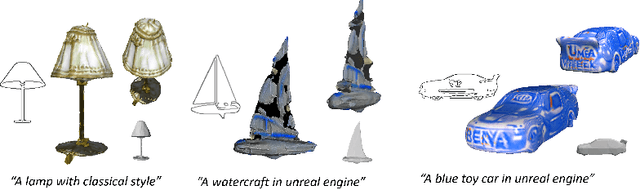
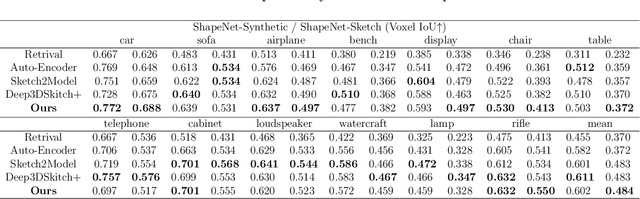
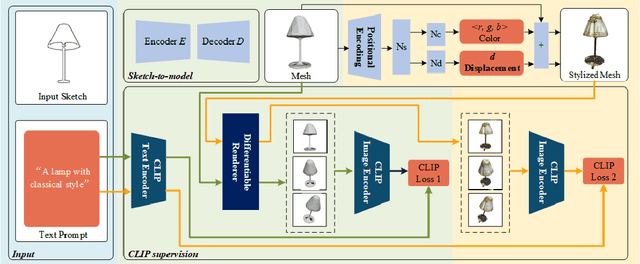
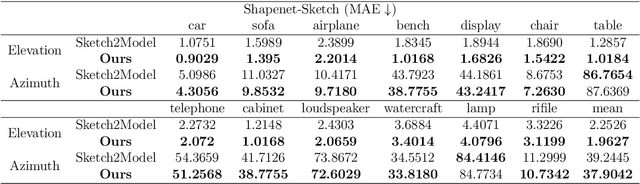
The requirement for 3D content is growing as AR/VR application emerges. At the same time, 3D modelling is only available for skillful experts, because traditional methods like Computer-Aided Design (CAD) are often too labor-intensive and skill-demanding, making it challenging for novice users. Our proposed method, Magic3DSketch, employs a novel technique that encodes sketches to predict a 3D mesh, guided by text descriptions and leveraging external prior knowledge obtained through text and language-image pre-training. The integration of language-image pre-trained neural networks complements the sparse and ambiguous nature of single-view sketch inputs. Our method is also more useful and offers higher degree of controllability compared to existing text-to-3D approaches, according to our user study. Moreover, Magic3DSketch achieves state-of-the-art performance in both synthetic and real dataset with the capability of producing more detailed structures and realistic shapes with the help of text input. Users are also more satisfied with models obtained by Magic3DSketch according to our user study. Additionally, we are also the first, to our knowledge, add color based on text description to the sketch-derived shapes. By combining sketches and text guidance with the help of language-image pretrained models, our Magic3DSketch can allow novice users to create custom 3D models with minimal effort and maximum creative freedom, with the potential to revolutionize future 3D modeling pipelines.
xLSTM-UNet can be an Effective 2D & 3D Medical Image Segmentation Backbone with Vision-LSTM (ViL) better than its Mamba Counterpart
Jul 02, 2024Convolutional Neural Networks (CNNs) and Vision Transformers (ViT) have been pivotal in biomedical image segmentation, yet their ability to manage long-range dependencies remains constrained by inherent locality and computational overhead. To overcome these challenges, in this technical report, we first propose xLSTM-UNet, a UNet structured deep learning neural network that leverages Vision-LSTM (xLSTM) as its backbone for medical image segmentation. xLSTM is a recently proposed as the successor of Long Short-Term Memory (LSTM) networks and have demonstrated superior performance compared to Transformers and State Space Models (SSMs) like Mamba in Neural Language Processing (NLP) and image classification (as demonstrated in Vision-LSTM, or ViL implementation). Here, xLSTM-UNet we designed extend the success in biomedical image segmentation domain. By integrating the local feature extraction strengths of convolutional layers with the long-range dependency capturing abilities of xLSTM, xLSTM-UNet offers a robust solution for comprehensive image analysis. We validate the efficacy of xLSTM-UNet through experiments. Our findings demonstrate that xLSTM-UNet consistently surpasses the performance of leading CNN-based, Transformer-based, and Mamba-based segmentation networks in multiple datasets in biomedical segmentation including organs in abdomen MRI, instruments in endoscopic images, and cells in microscopic images. With comprehensive experiments performed, this technical report highlights the potential of xLSTM-based architectures in advancing biomedical image analysis in both 2D and 3D. The code, models, and datasets are publicly available at http://tianrun-chen.github.io/xLSTM-UNet/
SAM Fails to Segment Anything? -- SAM-Adapter: Adapting SAM in Underperformed Scenes: Camouflage, Shadow, Medical Image Segmentation, and More
May 02, 2023The emergence of large models, also known as foundation models, has brought significant advancements to AI research. One such model is Segment Anything (SAM), which is designed for image segmentation tasks. However, as with other foundation models, our experimental findings suggest that SAM may fail or perform poorly in certain segmentation tasks, such as shadow detection and camouflaged object detection (concealed object detection). This study first paves the way for applying the large pre-trained image segmentation model SAM to these downstream tasks, even in situations where SAM performs poorly. Rather than fine-tuning the SAM network, we propose \textbf{SAM-Adapter}, which incorporates domain-specific information or visual prompts into the segmentation network by using simple yet effective adapters. By integrating task-specific knowledge with general knowledge learnt by the large model, SAM-Adapter can significantly elevate the performance of SAM in challenging tasks as shown in extensive experiments. We can even outperform task-specific network models and achieve state-of-the-art performance in the task we tested: camouflaged object detection, shadow detection. We also tested polyp segmentation (medical image segmentation) and achieves better results. We believe our work opens up opportunities for utilizing SAM in downstream tasks, with potential applications in various fields, including medical image processing, agriculture, remote sensing, and more.