 Add to Chrome
 Add to Firefox
 Add to Edge
CARE: An Explainable Computational Framework for Assessing Client-Perceived Therapeutic Alliance Using Large Language Models
Feb 24, 2026
Client perceptions of the therapeutic alliance are critical for counseling effectiveness. Accurately capturing these perceptions remains challenging, as traditional post-session questionnaires are burdensome and often delayed, while existing computational approaches produce coarse scores, lack interpretable rationales, and fail to model holistic session context. We present CARE, an LLM-based framework to automatically predict multi-dimensional alliance scores and generate interpretable rationales from counseling transcripts. Built on the CounselingWAI dataset and enriched with 9,516 expert-curated rationales, CARE is fine-tuned using rationale-augmented supervision with the LLaMA-3.1-8B-Instruct backbone. Experiments show that CARE outperforms leading LLMs and substantially reduces the gap between counselor evaluations and client-perceived alliance, achieving over 70% higher Pearson correlation with client ratings. Rationale-augmented supervision further improves predictive accuracy. CARE also produces high-quality, contextually grounded rationales, validated by both automatic and human evaluations. Applied to real-world Chinese online counseling sessions, CARE uncovers common alliance-building challenges, illustrates how interaction patterns shape alliance development, and provides actionable insights, demonstrating its potential as an AI-assisted tool for supporting mental health care.

Agent Skills for Large Language Models: Architecture, Acquisition, Security, and the Path Forward
Feb 17, 2026The transition from monolithic language models to modular, skill-equipped agents marks a defining shift in how large language models (LLMs) are deployed in practice. Rather than encoding all procedural knowledge within model weights, agent skills -- composable packages of instructions, code, and resources that agents load on demand -- enable dynamic capability extension without retraining. It is formalized in a paradigm of progressive disclosure, portable skill definitions, and integration with the Model Context Protocol (MCP). This survey provides a comprehensive treatment of the agent skills landscape, as it has rapidly evolved during the last few months. We organize the field along four axes: (i) architectural foundations, examining the SKILL$.$md specification, progressive context loading, and the complementary roles of skills and MCP; (ii) skill acquisition, covering reinforcement learning with skill libraries, autonomous skill discovery (SEAgent), and compositional skill synthesis; (iii) deployment at scale, including the computer-use agent (CUA) stack, GUI grounding advances, and benchmark progress on OSWorld and SWE-bench; and (iv) security, where recent empirical analyses reveal that 26.1% of community-contributed skills contain vulnerabilities, motivating our proposed Skill Trust and Lifecycle Governance Framework -- a four-tier, gate-based permission model that maps skill provenance to graduated deployment capabilities. We identify seven open challenges -- from cross-platform skill portability to capability-based permission models -- and propose a research agenda for realizing trustworthy, self-improving skill ecosystems. Unlike prior surveys that broadly cover LLM agents or tool use, this work focuses specifically on the emerging skill abstraction layer and its implications for the next generation of agentic systems. Project repo: https://github.com/scienceaix/agentskills
A Comprehensive Survey of Deep Research: Systems, Methodologies, and Applications
Jun 14, 2025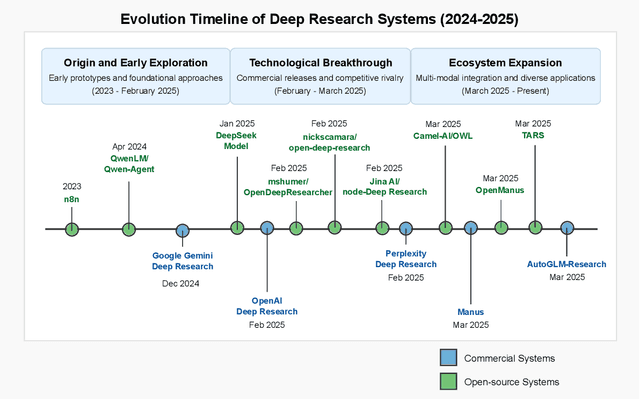

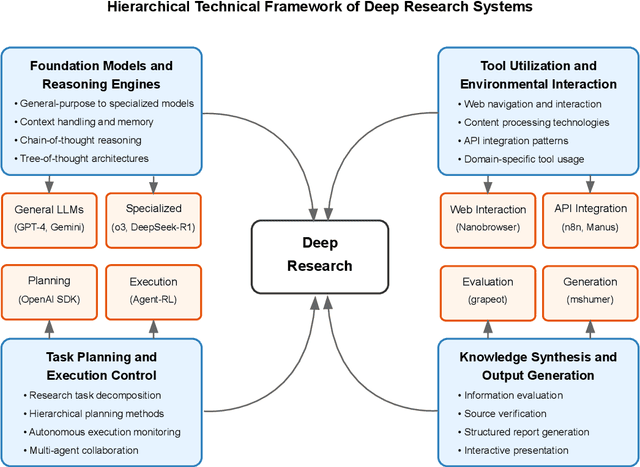

This survey examines the rapidly evolving field of Deep Research systems -- AI-powered applications that automate complex research workflows through the integration of large language models, advanced information retrieval, and autonomous reasoning capabilities. We analyze more than 80 commercial and non-commercial implementations that have emerged since 2023, including OpenAI/Deep Research, Gemini/Deep Research, Perplexity/Deep Research, and numerous open-source alternatives. Through comprehensive examination, we propose a novel hierarchical taxonomy that categorizes systems according to four fundamental technical dimensions: foundation models and reasoning engines, tool utilization and environmental interaction, task planning and execution control, and knowledge synthesis and output generation. We explore the architectural patterns, implementation approaches, and domain-specific adaptations that characterize these systems across academic, scientific, business, and educational applications. Our analysis reveals both the significant capabilities of current implementations and the technical and ethical challenges they present regarding information accuracy, privacy, intellectual property, and accessibility. The survey concludes by identifying promising research directions in advanced reasoning architectures, multimodal integration, domain specialization, human-AI collaboration, and ecosystem standardization that will likely shape the future evolution of this transformative technology. By providing a comprehensive framework for understanding Deep Research systems, this survey contributes to both the theoretical understanding of AI-augmented knowledge work and the practical development of more capable, responsible, and accessible research technologies. The paper resources can be viewed at https://github.com/scienceaix/deepresearch.
Do PhD-level LLMs Truly Grasp Elementary Addition? Probing Rule Learning vs. Memorization in Large Language Models
Apr 07, 2025Despite high benchmark scores, Large Language Models (LLMs) often fail simple problem, raising a critical question: Do LLMs learn mathematical principles or merely memorize patterns? Rather than designing increasingly complex benchmarks like recent works, we investigate this using elementary two-integer addition ($0$ to $2^{64}$), probing two core properties: commutativity ($A+B=B+A$) and compositional generalization (via isomorphic symbolic mappings, e.g., $7 \rightarrow y$). While state-of-the-art LLMs achieve 73.8-99.8\% accuracy on numerical addition, performance collapses to $\leq$7.5\% under symbolic mapping, indicating failure to generalize learned rules. Non-monotonic performance scaling with digit count and frequent commutativity violations (over 1,700 cases of $A+B \neq B+A$) further support this. Explicitly providing addition rules degrades performance by 81.2\% on average, while self-explanation maintains baseline accuracy, suggesting LLM arithmetic processing is misaligned with human-defined principles. Our findings indicate current LLMs rely on memory pattern over genuine rule learning, highlighting architectural limitations and the need for new approaches to achieve true mathematical reasoning.
Scaling Laws of Scientific Discovery with AI and Robot Scientists
Mar 28, 2025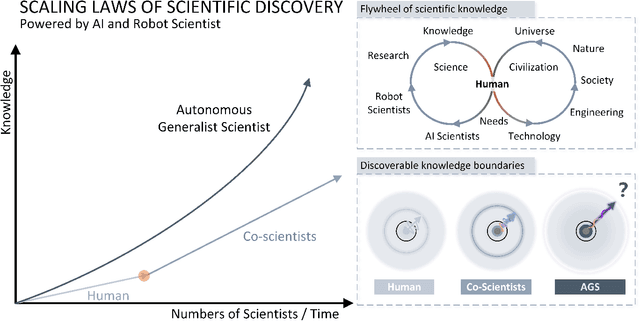
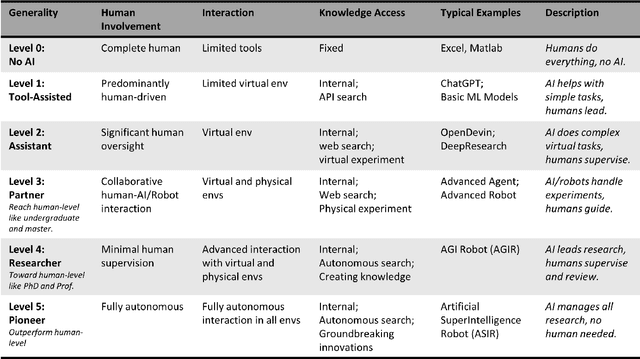
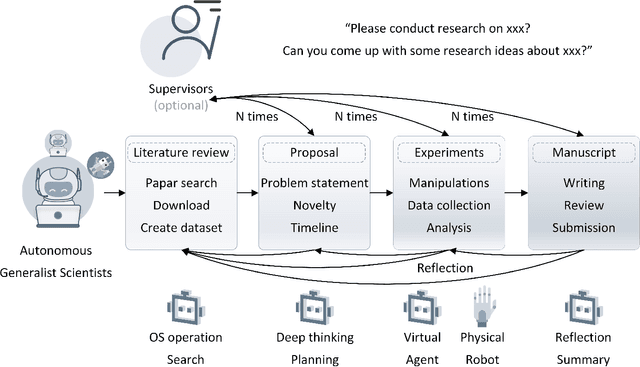
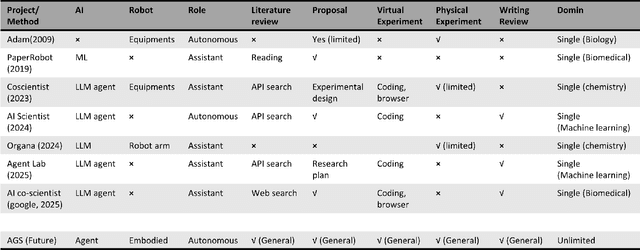
The rapid evolution of scientific inquiry highlights an urgent need for groundbreaking methodologies that transcend the limitations of traditional research. Conventional approaches, bogged down by manual processes and siloed expertise, struggle to keep pace with the demands of modern discovery. We envision an autonomous generalist scientist (AGS) system-a fusion of agentic AI and embodied robotics-that redefines the research lifecycle. This system promises to autonomously navigate physical and digital realms, weaving together insights from disparate disciplines with unprecedented efficiency. By embedding advanced AI and robot technologies into every phase-from hypothesis formulation to peer-ready manuscripts-AGS could slash the time and resources needed for scientific research in diverse field. We foresee a future where scientific discovery follows new scaling laws, driven by the proliferation and sophistication of such systems. As these autonomous agents and robots adapt to extreme environments and leverage a growing reservoir of knowledge, they could spark a paradigm shift, pushing the boundaries of what's possible and ushering in an era of relentless innovation.
Breaking the Box: Enhancing Remote Sensing Image Segmentation with Freehand Sketches
Mar 15, 2025This work advances zero-shot interactive segmentation for remote sensing imagery through three key contributions. First, we propose a novel sketch-based prompting method, enabling users to intuitively outline objects, surpassing traditional point or box prompts. Second, we introduce LTL-Sensing, the first dataset pairing human sketches with remote sensing imagery, setting a benchmark for future research. Third, we present LTL-Net, a model featuring a multi-input prompting transport module tailored for freehand sketches. Extensive experiments show our approach significantly improves segmentation accuracy and robustness over state-of-the-art methods like SAM, fostering more intuitive human-AI collaboration in remote sensing analysis and enhancing its applications.
Syllables to Scenes: Literary-Guided Free-Viewpoint 3D Scene Synthesis from Japanese Haiku
Feb 17, 2025In the era of the metaverse, where immersive technologies redefine human experiences, translating abstract literary concepts into navigable 3D environments presents a fundamental challenge in preserving semantic and emotional fidelity. This research introduces HaikuVerse, a novel framework for transforming poetic abstraction into spatial representation, with Japanese Haiku serving as an ideal test case due to its sophisticated encapsulation of profound emotions and imagery within minimal text. While existing text-to-3D methods struggle with nuanced interpretations, we present a literary-guided approach that synergizes traditional poetry analysis with advanced generative technologies. Our framework centers on two key innovations: (1) Hierarchical Literary-Criticism Theory Grounded Parsing (H-LCTGP), which captures both explicit imagery and implicit emotional resonance through structured semantic decomposition, and (2) Progressive Dimensional Synthesis (PDS), a multi-stage pipeline that systematically transforms poetic elements into coherent 3D scenes through sequential diffusion processes, geometric optimization, and real-time enhancement. Extensive experiments demonstrate that HaikuVerse significantly outperforms conventional text-to-3D approaches in both literary fidelity and visual quality, establishing a new paradigm for preserving cultural heritage in immersive digital spaces. Project website at: https://syllables-to-scenes.github.io/
UBER: Uncertainty-Based Evolution with Large Language Models for Automatic Heuristic Design
Dec 30, 2024

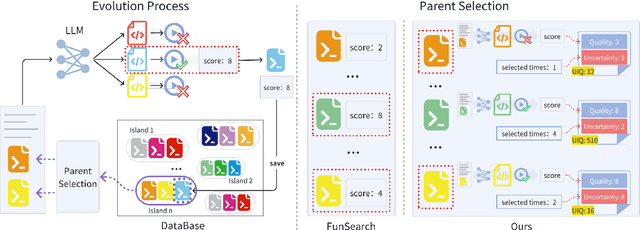

NP-hard problem-solving traditionally relies on heuristics, but manually crafting effective heuristics for complex problems remains challenging. While recent work like FunSearch has demonstrated that large language models (LLMs) can be leveraged for heuristic design in evolutionary algorithm (EA) frameworks, their potential is not fully realized due to its deficiency in exploitation and exploration. We present UBER (Uncertainty-Based Evolution for Refinement), a method that enhances LLM+EA methods for automatic heuristic design by integrating uncertainty on top of the FunSearch framework. UBER introduces two key innovations: an Uncertainty-Inclusive Evolution Process (UIEP) for adaptive exploration-exploitation balance, and a principled Uncertainty-Inclusive Island Reset (UIIS) strategy for maintaining population diversity. Through extensive experiments on challenging NP-complete problems, UBER demonstrates significant improvements over FunSearch. Our work provides a new direction for the synergy of LLMs and EA, advancing the field of automatic heuristic design.
MetaRuleGPT: Recursive Numerical Reasoning of Language Models Trained with Simple Rules
Dec 18, 2024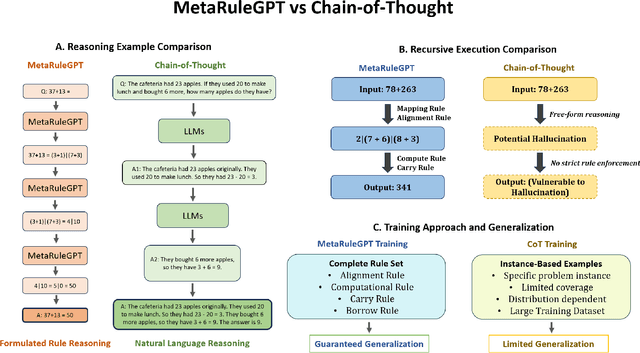
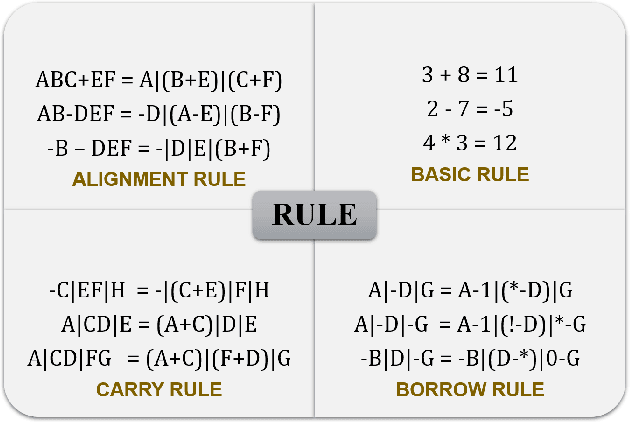
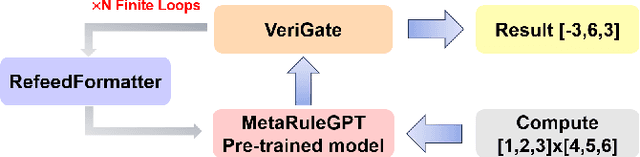
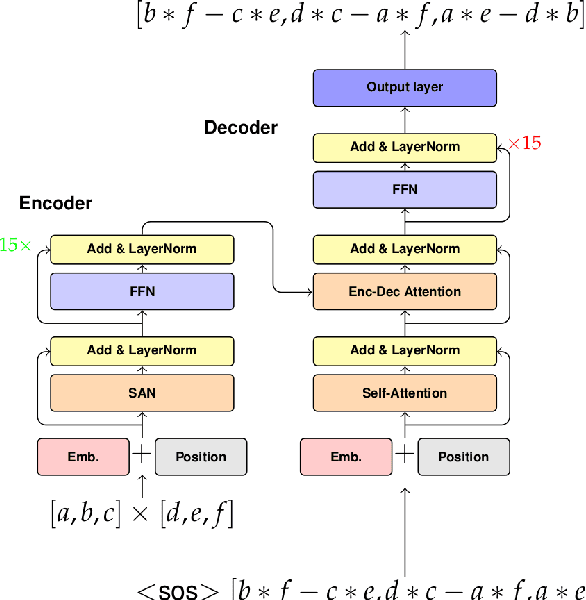
Recent studies have highlighted the limitations of large language models in mathematical reasoning, particularly their inability to capture the underlying logic. Inspired by meta-learning, we propose that models should acquire not only task-specific knowledge but also transferable problem-solving skills. We introduce MetaRuleGPT, a novel Transformer-based architecture that performs precise numerical calculations and complex logical operations by learning and combining different rules. In contrast with traditional training sets, which are heavily composed of massive raw instance data, MetaRuleGPT is pre-trained on much less abstract datasets containing basic, compound, and iterative rules for mathematical reasoning. Extensive experimental results demonstrate MetaRuleGPT can mimic human's rule-following capabilities, break down complexity, and iteratively derive accurate results for complex mathematical problems. These findings prove the potential of rule learning to enhance the numerical reasoning abilities of language models.
Nova: An Iterative Planning and Search Approach to Enhance Novelty and Diversity of LLM Generated Ideas
Oct 18, 2024Scientific innovation is pivotal for humanity, and harnessing large language models (LLMs) to generate research ideas could transform discovery. However, existing LLMs often produce simplistic and repetitive suggestions due to their limited ability in acquiring external knowledge for innovation. To address this problem, we introduce an enhanced planning and search methodology designed to boost the creative potential of LLM-based systems. Our approach involves an iterative process to purposely plan the retrieval of external knowledge, progressively enriching the idea generation with broader and deeper insights. Validation through automated and human assessments indicates that our framework substantially elevates the quality of generated ideas, particularly in novelty and diversity. The number of unique novel ideas produced by our framework is 3.4 times higher than without it. Moreover, our method outperforms the current state-of-the-art, generating at least 2.5 times more top-rated ideas based on 170 seed papers in a Swiss Tournament evaluation.