 Add to Chrome
 Add to Firefox
 Add to Edge
Seeing Globally, Refining Locally: Global Visual Guidance and Local Ultrasound Cues for Robust Freehand 3-D Ultrasound Reconstruction
Jul 14, 2026
Freehand 3-D ultrasound (US) imaging has attracted increasing attention owing to its intuitive volumetric visualization, ease of use, and low cost. However, accurate 3-D reconstruction critically depends on stable probe pose estimation, yet existing trackerless methods remain susceptible to accumulated pose errors, particularly over long scanning trajectories. To address this limitation, we propose a global-to-local pose estimation framework that exploits external camera observations for globally stable localization and B-mode US images for anatomy-aware local refinement. Specifically, the framework comprises a dual-camera branch that performs contextual feature aggregation across camera views and temporal observations to estimate a globally consistent probe trajectory, and a B-mode branch that performs anatomical feature aggregation from sequential US images to capture tissue-dependent local motion cues. A cross-modal fusion module subsequently integrates the contextual camera features and anatomical US features to predict pose residuals and refine the camera-derived estimates in the transformation space. Furthermore, a multi-scale pose loss constrains relative motion over multiple temporal horizons to suppress accumulated drift during extended scans. The proposed framework is validated on phantom and in vivo datasets. On two in-house datasets (FUSION-J and FUSION-L) collected using different machines, the proposed US + Dual-Cam model reduces average trajectory drift to 1.67 mm and 1.29 mm, representing improvement of 16.50% and 27.12%, respectively, over a strong dual-camera baseline, while substantially outperforming US-only pose estimation (>13 mm drift). In in vivo forearm arteries reconstruction, it achieves Hausdorff distances of 1.58 mm, demonstrating the effectiveness of the proposed method on real clinical scenarios.

Open-H-Embodiment: A Large-Scale Dataset for Enabling Foundation Models in Medical Robotics
Apr 22, 2026Autonomous medical robots hold promise to improve patient outcomes, reduce provider workload, democratize access to care, and enable superhuman precision. However, autonomous medical robotics has been limited by a fundamental data problem: existing medical robotic datasets are small, single-embodiment, and rarely shared openly, restricting the development of foundation models that the field needs to advance. We introduce Open-H-Embodiment, the largest open dataset of medical robotic video with synchronized kinematics to date, spanning more than 49 institutions and multiple robotic platforms including the CMR Versius, Intuitive Surgical's da Vinci, da Vinci Research Kit (dVRK), Rob Surgical BiTrack, Virtual Incision's MIRA, Moon Surgical Maestro, and a variety of custom systems, spanning surgical manipulation, robotic ultrasound, and endoscopy procedures. We demonstrate the research enabled by this dataset through two foundation models. GR00T-H is the first open foundation vision-language-action model for medical robotics, which is the only evaluated model to achieve full end-to-end task completion on a structured suturing benchmark (25% of trials vs. 0% for all others) and achieves 64% average success across a 29-step ex vivo suturing sequence. We also train Cosmos-H-Surgical-Simulator, the first action-conditioned world model to enable multi-embodiment surgical simulation from a single checkpoint, spanning nine robotic platforms and supporting in silico policy evaluation and synthetic data generation for the medical domain. These results suggest that open, large-scale medical robot data collection can serve as critical infrastructure for the research community, enabling advances in robot learning, world modeling, and beyond.
ConVibNet: Needle Detection during Continuous Insertion via Frequency-Inspired Features
Mar 01, 2026Purpose: Ultrasound-guided needle interventions are widely used in clinical practice, but their success critically depends on accurate needle placement, which is frequently hindered by the poor and intermittent visibility of needles in ultrasound images. Existing approaches remain limited by artifacts, occlusions, and low contrast, and often fail to support real-time continuous insertion. To overcome these challenges, this study introduces a robust real-time framework for continuous needle detection. Methods: We present ConVibNet, an extension of VibNet for detecting needles with significantly reduced visibility, addressing real-time, continuous needle tracking during insertion. ConVibNet leverages temporal dependencies across successive ultrasound frames to enable continuous estimation of both needle tip position and shaft angle in dynamic scenarios. To strengthen temporal awareness of needle-tip motion, we introduce a novel intersection-and-difference loss that explicitly leverages motion correlations across consecutive frames. In addition, we curated a dedicated dataset for model development and evaluation. Results: The performance of the proposed ConVibNet model was evaluated on our dataset, demonstrating superior accuracy compared to the baseline VibNet and UNet-LSTM models. Specifically, ConVibNet achieved a tip error of 2.80+-2.42 mm and an angle error of 1.69+-2.00 deg. These results represent a 0.75 mm improvement in tip localization accuracy over the best-performing baseline, while preserving real-time inference capability. Conclusion: ConVibNet advances real-time needle detection in ultrasound-guided interventions by integrating temporal correlation modeling with a novel intersection-and-difference loss, thereby improving accuracy and robustness and demonstrating high potential for integration into autonomous insertion systems.
RAG-RUSS: A Retrieval-Augmented Robotic Ultrasound for Autonomous Carotid Examination
Mar 01, 2026Robotic ultrasound (US) has recently attracted increasing attention as a means to overcome the limitations of conventional US examinations, such as the strong operator dependence. However, the decision-making process of existing methods is often either rule-based or relies on end-to-end learning models that operate as black boxes. This has been seen as a main limit for clinical acceptance and raises safety concerns for widespread adoption in routine practice. To tackle this challenge, we introduce the RAG-RUSS, an interpretable framework capable of performing a full carotid examination in accordance with the clinical workflow while explicitly explaining both the current stage and the next planned action. Furthermore, given the scarcity of medical data, we incorporate retrieval-augmented generation to enhance generalization and reduce dependence on large-scale training datasets. The method was trained on data acquired from 28 volunteers, while an additional four volumetric scans recorded from previously unseen volunteers were reserved for testing. The results demonstrate that the method can explain the current scanning stage and autonomously plan probe motions to complete the carotid examination, encompassing both transverse and longitudinal planes.
Vibration-Based Energy Metric for Restoring Needle Alignment in Autonomous Robotic Ultrasound
Aug 09, 2025Precise needle alignment is essential for percutaneous needle insertion in robotic ultrasound-guided procedures. However, inherent challenges such as speckle noise, needle-like artifacts, and low image resolution make robust needle detection difficult, particularly when visibility is reduced or lost. In this paper, we propose a method to restore needle alignment when the ultrasound imaging plane and the needle insertion plane are misaligned. Unlike many existing approaches that rely heavily on needle visibility in ultrasound images, our method uses a more robust feature by periodically vibrating the needle using a mechanical system. Specifically, we propose a vibration-based energy metric that remains effective even when the needle is fully out of plane. Using this metric, we develop a control strategy to reposition the ultrasound probe in response to misalignments between the imaging plane and the needle insertion plane in both translation and rotation. Experiments conducted on ex-vivo porcine tissue samples using a dual-arm robotic ultrasound-guided needle insertion system demonstrate the effectiveness of the proposed approach. The experimental results show the translational error of 0.41$\pm$0.27 mm and the rotational error of 0.51$\pm$0.19 degrees.
Tactile-Guided Robotic Ultrasound: Mapping Preplanned Scan Paths for Intercostal Imaging
Jul 27, 2025


Medical ultrasound (US) imaging is widely used in clinical examinations due to its portability, real-time capability, and radiation-free nature. To address inter- and intra-operator variability, robotic ultrasound systems have gained increasing attention. However, their application in challenging intercostal imaging remains limited due to the lack of an effective scan path generation method within the constrained acoustic window. To overcome this challenge, we explore the potential of tactile cues for characterizing subcutaneous rib structures as an alternative signal for ultrasound segmentation-free bone surface point cloud extraction. Compared to 2D US images, 1D tactile-related signals offer higher processing efficiency and are less susceptible to acoustic noise and artifacts. By leveraging robotic tracking data, a sparse tactile point cloud is generated through a few scans along the rib, mimicking human palpation. To robustly map the scanning trajectory into the intercostal space, the sparse tactile bone location point cloud is first interpolated to form a denser representation. This refined point cloud is then registered to an image-based dense bone surface point cloud, enabling accurate scan path mapping for individual patients. Additionally, to ensure full coverage of the object of interest, we introduce an automated tilt angle adjustment method to visualize structures beneath the bone. To validate the proposed method, we conducted comprehensive experiments on four distinct phantoms. The final scanning waypoint mapping achieved Mean Nearest Neighbor Distance (MNND) and Hausdorff distance (HD) errors of 3.41 mm and 3.65 mm, respectively, while the reconstructed object beneath the bone had errors of 0.69 mm and 2.2 mm compared to the CT ground truth.
Semantic Scene Graph for Ultrasound Image Explanation and Scanning Guidance
Jun 24, 2025Understanding medical ultrasound imaging remains a long-standing challenge due to significant visual variability caused by differences in imaging and acquisition parameters. Recent advancements in large language models (LLMs) have been used to automatically generate terminology-rich summaries orientated to clinicians with sufficient physiological knowledge. Nevertheless, the increasing demand for improved ultrasound interpretability and basic scanning guidance among non-expert users, e.g., in point-of-care settings, has not yet been explored. In this study, we first introduce the scene graph (SG) for ultrasound images to explain image content to ordinary and provide guidance for ultrasound scanning. The ultrasound SG is first computed using a transformer-based one-stage method, eliminating the need for explicit object detection. To generate a graspable image explanation for ordinary, the user query is then used to further refine the abstract SG representation through LLMs. Additionally, the predicted SG is explored for its potential in guiding ultrasound scanning toward missing anatomies within the current imaging view, assisting ordinary users in achieving more standardized and complete anatomical exploration. The effectiveness of this SG-based image explanation and scanning guidance has been validated on images from the left and right neck regions, including the carotid and thyroid, across five volunteers. The results demonstrate the potential of the method to maximally democratize ultrasound by enhancing its interpretability and usability for ordinaries.
Robotic CBCT Meets Robotic Ultrasound
Feb 17, 2025The multi-modality imaging system offers optimal fused images for safe and precise interventions in modern clinical practices, such as computed tomography - ultrasound (CT-US) guidance for needle insertion. However, the limited dexterity and mobility of current imaging devices hinder their integration into standardized workflows and the advancement toward fully autonomous intervention systems. In this paper, we present a novel clinical setup where robotic cone beam computed tomography (CBCT) and robotic US are pre-calibrated and dynamically co-registered, enabling new clinical applications. This setup allows registration-free rigid registration, facilitating multi-modal guided procedures in the absence of tissue deformation. First, a one-time pre-calibration is performed between the systems. To ensure a safe insertion path by highlighting critical vasculature on the 3D CBCT, SAM2 segments vessels from B-mode images, using the Doppler signal as an autonomously generated prompt. Based on the registration, the Doppler image or segmented vessel masks are then mapped onto the CBCT, creating an optimally fused image with comprehensive detail. To validate the system, we used a specially designed phantom, featuring lesions covered by ribs and multiple vessels with simulated moving flow. The mapping error between US and CBCT resulted in an average deviation of 1.72+-0.62 mm. A user study demonstrated the effectiveness of CBCT-US fusion for needle insertion guidance, showing significant improvements in time efficiency, accuracy, and success rate. Needle intervention performance improved by approximately 50% compared to the conventional US-guided workflow. We present the first robotic dual-modality imaging system designed to guide clinical applications. The results show significant performance improvements compared to traditional manual interventions.
Invisible Needle Detection in Ultrasound: Leveraging Mechanism-Induced Vibration
Mar 21, 2024
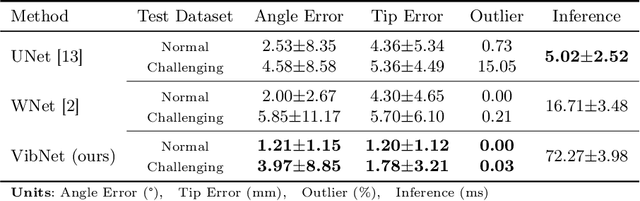


In clinical applications that involve ultrasound-guided intervention, the visibility of the needle can be severely impeded due to steep insertion and strong distractors such as speckle noise and anatomical occlusion. To address this challenge, we propose VibNet, a learning-based framework tailored to enhance the robustness and accuracy of needle detection in ultrasound images, even when the target becomes invisible to the naked eye. Inspired by Eulerian Video Magnification techniques, we utilize an external step motor to induce low-amplitude periodic motion on the needle. These subtle vibrations offer the potential to generate robust frequency features for detecting the motion patterns around the needle. To robustly and precisely detect the needle leveraging these vibrations, VibNet integrates learning-based Short-Time-Fourier-Transform and Hough-Transform modules to achieve successive sub-goals, including motion feature extraction in the spatiotemporal space, frequency feature aggregation, and needle detection in the Hough space. Based on the results obtained on distinct ex vivo porcine and bovine tissue samples, the proposed algorithm exhibits superior detection performance with efficient computation and generalization capability.
Machine Learning in Robotic Ultrasound Imaging: Challenges and Perspectives
Jan 04, 2024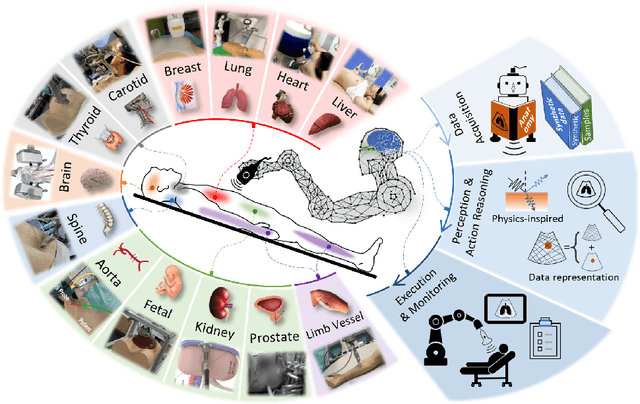
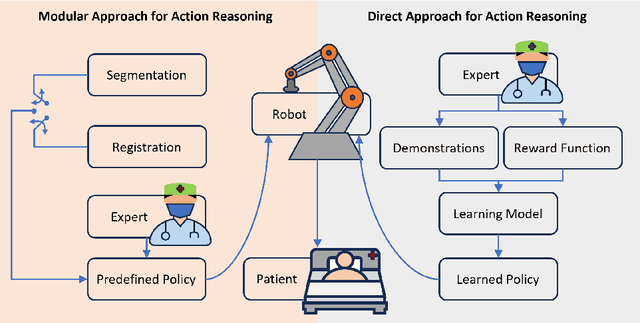
This article reviews the recent advances in intelligent robotic ultrasound (US) imaging systems. We commence by presenting the commonly employed robotic mechanisms and control techniques in robotic US imaging, along with their clinical applications. Subsequently, we focus on the deployment of machine learning techniques in the development of robotic sonographers, emphasizing crucial developments aimed at enhancing the intelligence of these systems. The methods for achieving autonomous action reasoning are categorized into two sets of approaches: those relying on implicit environmental data interpretation and those using explicit interpretation. Throughout this exploration, we also discuss practical challenges, including those related to the scarcity of medical data, the need for a deeper understanding of the physical aspects involved, and effective data representation approaches. Moreover, we conclude by highlighting the open problems in the field and analyzing different possible perspectives on how the community could move forward in this research area.