 Add to Chrome
 Add to Firefox
 Add to Edge
Fast High Dynamic Range Radiance Fields for Dynamic Scenes
Jan 11, 2024
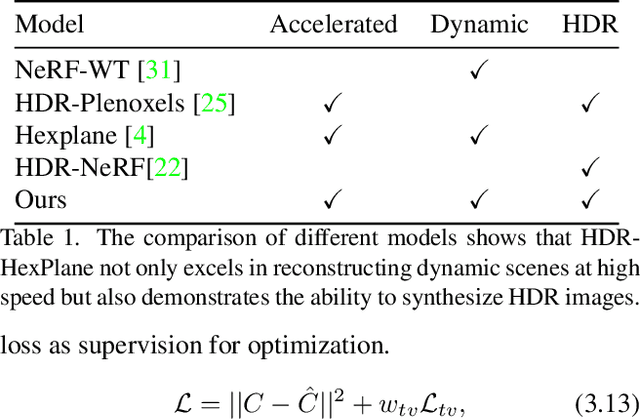
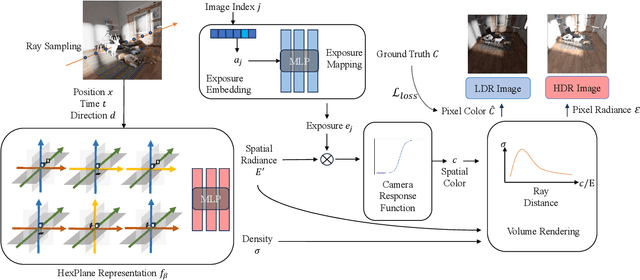
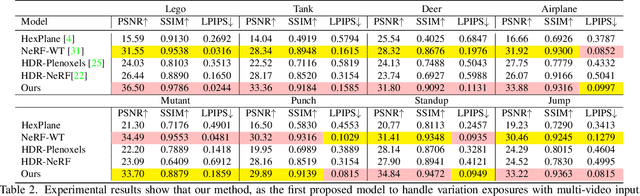
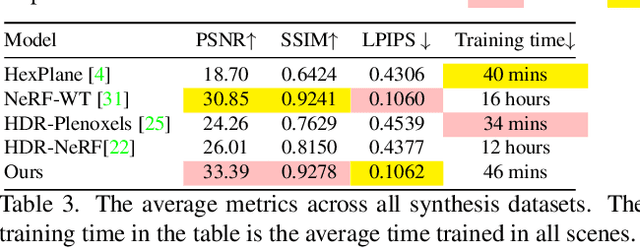
Neural Radiances Fields (NeRF) and their extensions have shown great success in representing 3D scenes and synthesizing novel-view images. However, most NeRF methods take in low-dynamic-range (LDR) images, which may lose details, especially with nonuniform illumination. Some previous NeRF methods attempt to introduce high-dynamic-range (HDR) techniques but mainly target static scenes. To extend HDR NeRF methods to wider applications, we propose a dynamic HDR NeRF framework, named HDR-HexPlane, which can learn 3D scenes from dynamic 2D images captured with various exposures. A learnable exposure mapping function is constructed to obtain adaptive exposure values for each image. Based on the monotonically increasing prior, a camera response function is designed for stable learning. With the proposed model, high-quality novel-view images at any time point can be rendered with any desired exposure. We further construct a dataset containing multiple dynamic scenes captured with diverse exposures for evaluation. All the datasets and code are available at \url{https://guanjunwu.github.io/HDR-HexPlane/}.

Cascade-Zero123: One Image to Highly Consistent 3D with Self-Prompted Nearby Views
Dec 07, 2023
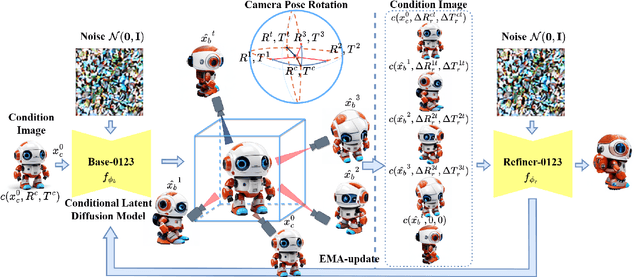

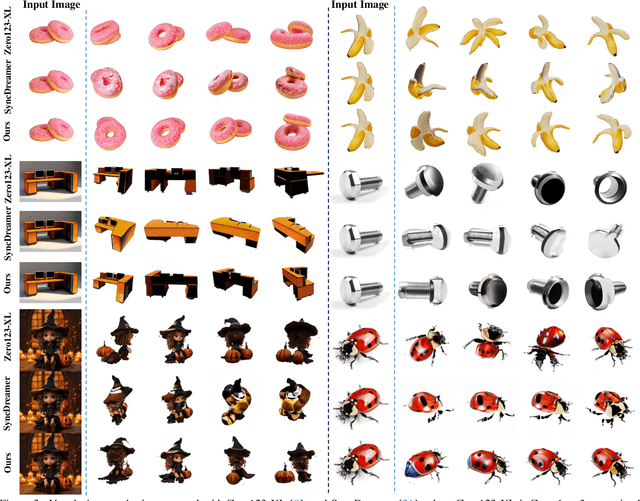
Synthesizing multi-view 3D from one single image is a significant and challenging task. For this goal, Zero-1-to-3 methods aim to extend a 2D latent diffusion model to the 3D scope. These approaches generate the target-view image with a single-view source image and the camera pose as condition information. However, the one-to-one manner adopted in Zero-1-to-3 incurs challenges for building geometric and visual consistency across views, especially for complex objects. We propose a cascade generation framework constructed with two Zero-1-to-3 models, named Cascade-Zero123, to tackle this issue, which progressively extracts 3D information from the source image. Specifically, a self-prompting mechanism is designed to generate several nearby views at first. These views are then fed into the second-stage model along with the source image as generation conditions. With self-prompted multiple views as the supplementary information, our Cascade-Zero123 generates more highly consistent novel-view images than Zero-1-to-3. The promotion is significant for various complex and challenging scenes, involving insects, humans, transparent objects, and stacked multiple objects etc. The project page is at https://cascadezero123.github.io/.
Circuit as Set of Points
Oct 26, 2023
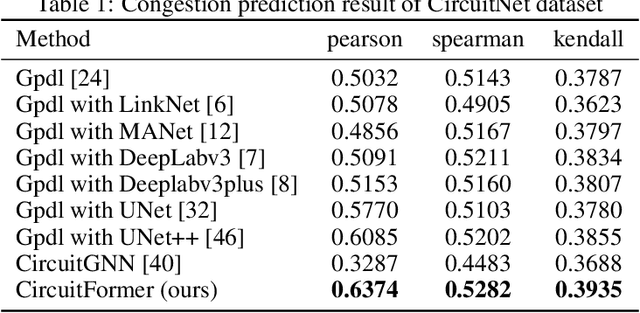

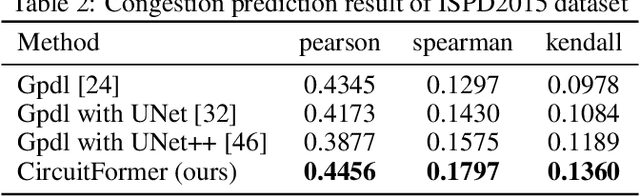
As the size of circuit designs continues to grow rapidly, artificial intelligence technologies are being extensively used in Electronic Design Automation (EDA) to assist with circuit design. Placement and routing are the most time-consuming parts of the physical design process, and how to quickly evaluate the placement has become a hot research topic. Prior works either transformed circuit designs into images using hand-crafted methods and then used Convolutional Neural Networks (CNN) to extract features, which are limited by the quality of the hand-crafted methods and could not achieve end-to-end training, or treated the circuit design as a graph structure and used Graph Neural Networks (GNN) to extract features, which require time-consuming preprocessing. In our work, we propose a novel perspective for circuit design by treating circuit components as point clouds and using Transformer-based point cloud perception methods to extract features from the circuit. This approach enables direct feature extraction from raw data without any preprocessing, allows for end-to-end training, and results in high performance. Experimental results show that our method achieves state-of-the-art performance in congestion prediction tasks on both the CircuitNet and ISPD2015 datasets, as well as in design rule check (DRC) violation prediction tasks on the CircuitNet dataset. Our method establishes a bridge between the relatively mature point cloud perception methods and the fast-developing EDA algorithms, enabling us to leverage more collective intelligence to solve this task. To facilitate the research of open EDA design, source codes and pre-trained models are released at https://github.com/hustvl/circuitformer.
JudgeLM: Fine-tuned Large Language Models are Scalable Judges
Oct 26, 2023Evaluating Large Language Models (LLMs) in open-ended scenarios is challenging because existing benchmarks and metrics can not measure them comprehensively. To address this problem, we propose to fine-tune LLMs as scalable judges (JudgeLM) to evaluate LLMs efficiently and effectively in open-ended benchmarks. We first propose a comprehensive, large-scale, high-quality dataset containing task seeds, LLMs-generated answers, and GPT-4-generated judgments for fine-tuning high-performance judges, as well as a new benchmark for evaluating the judges. We train JudgeLM at different scales from 7B, 13B, to 33B parameters, and conduct a systematic analysis of its capabilities and behaviors. We then analyze the key biases in fine-tuning LLM as a judge and consider them as position bias, knowledge bias, and format bias. To address these issues, JudgeLM introduces a bag of techniques including swap augmentation, reference support, and reference drop, which clearly enhance the judge's performance. JudgeLM obtains the state-of-the-art judge performance on both the existing PandaLM benchmark and our proposed new benchmark. Our JudgeLM is efficient and the JudgeLM-7B only needs 3 minutes to judge 5K samples with 8 A100 GPUs. JudgeLM obtains high agreement with the teacher judge, achieving an agreement exceeding 90% that even surpasses human-to-human agreement. JudgeLM also demonstrates extended capabilities in being judges of the single answer, multimodal models, multiple answers, and multi-turn chat.
4D Gaussian Splatting for Real-Time Dynamic Scene Rendering
Oct 12, 2023Representing and rendering dynamic scenes has been an important but challenging task. Especially, to accurately model complex motions, high efficiency is usually hard to maintain. We introduce the 4D Gaussian Splatting (4D-GS) to achieve real-time dynamic scene rendering while also enjoying high training and storage efficiency. An efficient deformation field is constructed to model both Gaussian motions and shape deformations. Different adjacent Gaussians are connected via a HexPlane to produce more accurate position and shape deformations. Our 4D-GS method achieves real-time rendering under high resolutions, 70 FPS at a 800$\times$800 resolution on an RTX 3090 GPU, while maintaining comparable or higher quality than previous state-of-the-art methods. More demos and code are available at https://guanjunwu.github.io/4dgs/.
GaussianDreamer: Fast Generation from Text to 3D Gaussian Splatting with Point Cloud Priors
Oct 12, 2023In recent times, the generation of 3D assets from text prompts has shown impressive results. Both 2D and 3D diffusion models can generate decent 3D objects based on prompts. 3D diffusion models have good 3D consistency, but their quality and generalization are limited as trainable 3D data is expensive and hard to obtain. 2D diffusion models enjoy strong abilities of generalization and fine generation, but the 3D consistency is hard to guarantee. This paper attempts to bridge the power from the two types of diffusion models via the recent explicit and efficient 3D Gaussian splatting representation. A fast 3D generation framework, named as \name, is proposed, where the 3D diffusion model provides point cloud priors for initialization and the 2D diffusion model enriches the geometry and appearance. Operations of noisy point growing and color perturbation are introduced to enhance the initialized Gaussians. Our \name can generate a high-quality 3D instance within 25 minutes on one GPU, much faster than previous methods, while the generated instances can be directly rendered in real time. Demos and code are available at https://taoranyi.com/gaussiandreamer/.
TinyCLIP: CLIP Distillation via Affinity Mimicking and Weight Inheritance
Sep 21, 2023In this paper, we propose a novel cross-modal distillation method, called TinyCLIP, for large-scale language-image pre-trained models. The method introduces two core techniques: affinity mimicking and weight inheritance. Affinity mimicking explores the interaction between modalities during distillation, enabling student models to mimic teachers' behavior of learning cross-modal feature alignment in a visual-linguistic affinity space. Weight inheritance transmits the pre-trained weights from the teacher models to their student counterparts to improve distillation efficiency. Moreover, we extend the method into a multi-stage progressive distillation to mitigate the loss of informative weights during extreme compression. Comprehensive experiments demonstrate the efficacy of TinyCLIP, showing that it can reduce the size of the pre-trained CLIP ViT-B/32 by 50%, while maintaining comparable zero-shot performance. While aiming for comparable performance, distillation with weight inheritance can speed up the training by 1.4 - 7.8 $\times$ compared to training from scratch. Moreover, our TinyCLIP ViT-8M/16, trained on YFCC-15M, achieves an impressive zero-shot top-1 accuracy of 41.1% on ImageNet, surpassing the original CLIP ViT-B/16 by 3.5% while utilizing only 8.9% parameters. Finally, we demonstrate the good transferability of TinyCLIP in various downstream tasks. Code and models will be open-sourced at https://aka.ms/tinyclip.
TiAVox: Time-aware Attenuation Voxels for Sparse-view 4D DSA Reconstruction
Sep 05, 2023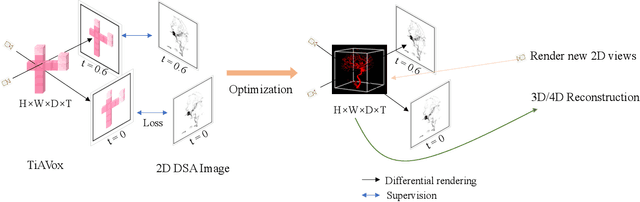
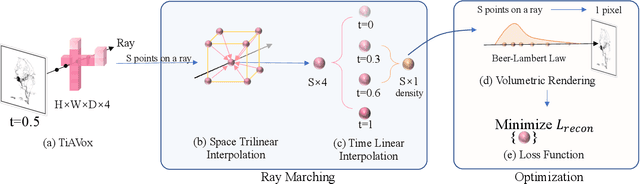

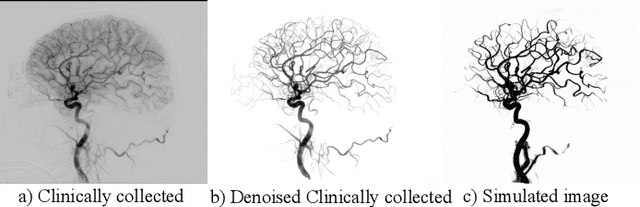
Four-dimensional Digital Subtraction Angiography (4D DSA) plays a critical role in the diagnosis of many medical diseases, such as Arteriovenous Malformations (AVM) and Arteriovenous Fistulas (AVF). Despite its significant application value, the reconstruction of 4D DSA demands numerous views to effectively model the intricate vessels and radiocontrast flow, thereby implying a significant radiation dose. To address this high radiation issue, we propose a Time-aware Attenuation Voxel (TiAVox) approach for sparse-view 4D DSA reconstruction, which paves the way for high-quality 4D imaging. Additionally, 2D and 3D DSA imaging results can be generated from the reconstructed 4D DSA images. TiAVox introduces 4D attenuation voxel grids, which reflect attenuation properties from both spatial and temporal dimensions. It is optimized by minimizing discrepancies between the rendered images and sparse 2D DSA images. Without any neural network involved, TiAVox enjoys specific physical interpretability. The parameters of each learnable voxel represent the attenuation coefficients. We validated the TiAVox approach on both clinical and simulated datasets, achieving a 31.23 Peak Signal-to-Noise Ratio (PSNR) for novel view synthesis using only 30 views on the clinically sourced dataset, whereas traditional Feldkamp-Davis-Kress methods required 133 views. Similarly, with merely 10 views from the synthetic dataset, TiAVox yielded a PSNR of 34.32 for novel view synthesis and 41.40 for 3D reconstruction. We also executed ablation studies to corroborate the essential components of TiAVox. The code will be publically available.
TouchStone: Evaluating Vision-Language Models by Language Models
Sep 04, 2023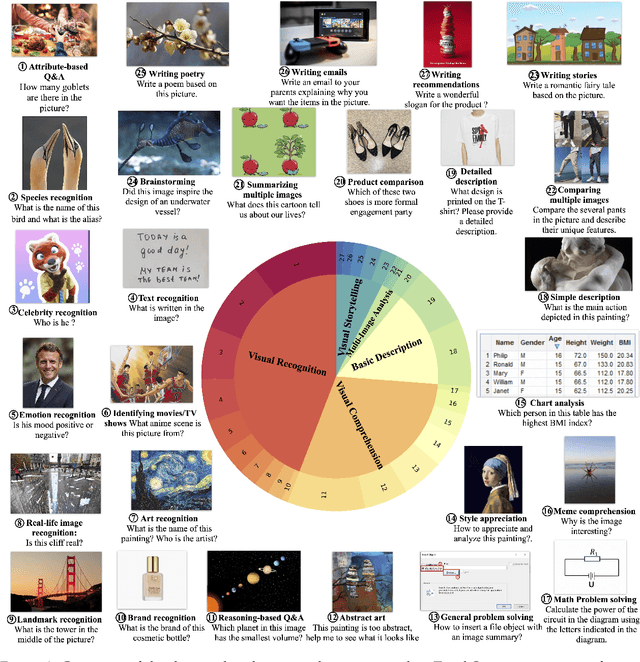
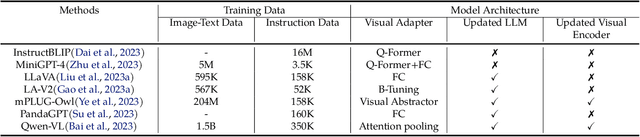
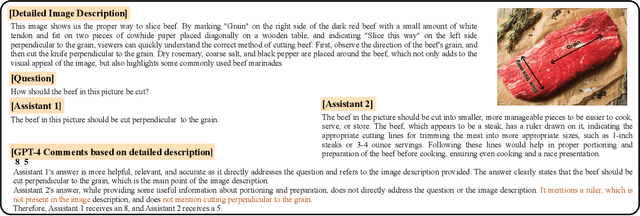

Large vision-language models (LVLMs) have recently witnessed rapid advancements, exhibiting a remarkable capacity for perceiving, understanding, and processing visual information by connecting visual receptor with large language models (LLMs). However, current assessments mainly focus on recognizing and reasoning abilities, lacking direct evaluation of conversational skills and neglecting visual storytelling abilities. In this paper, we propose an evaluation method that uses strong LLMs as judges to comprehensively evaluate the various abilities of LVLMs. Firstly, we construct a comprehensive visual dialogue dataset TouchStone, consisting of open-world images and questions, covering five major categories of abilities and 27 subtasks. This dataset not only covers fundamental recognition and comprehension but also extends to literary creation. Secondly, by integrating detailed image annotations we effectively transform the multimodal input content into a form understandable by LLMs. This enables us to employ advanced LLMs for directly evaluating the quality of the multimodal dialogue without requiring human intervention. Through validation, we demonstrate that powerful LVLMs, such as GPT-4, can effectively score dialogue quality by leveraging their textual capabilities alone, aligning with human preferences. We hope our work can serve as a touchstone for LVLMs' evaluation and pave the way for building stronger LVLMs. The evaluation code is available at https://github.com/OFA-Sys/TouchStone.
Condition-Adaptive Graph Convolution Learning for Skeleton-Based Gait Recognition
Aug 13, 2023
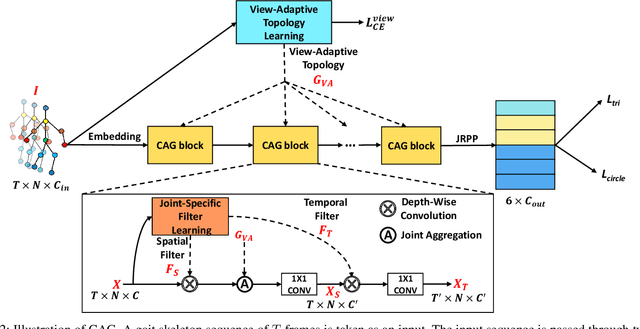
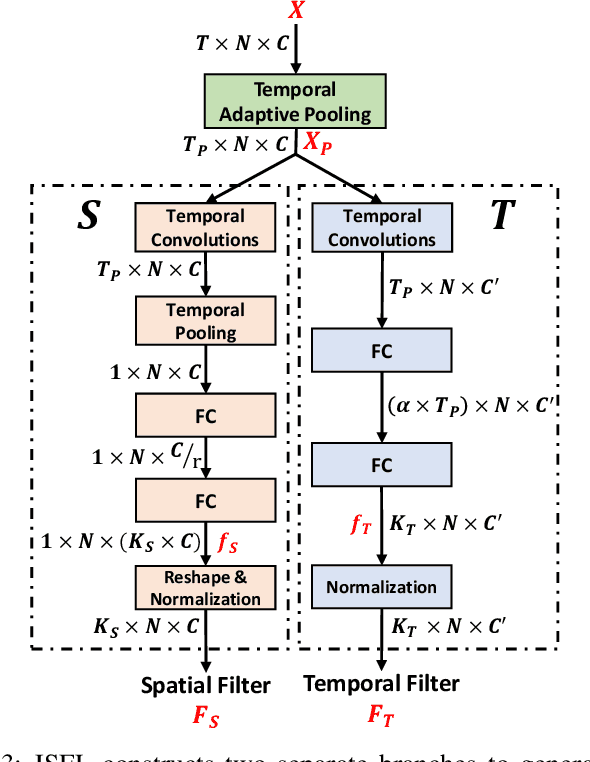
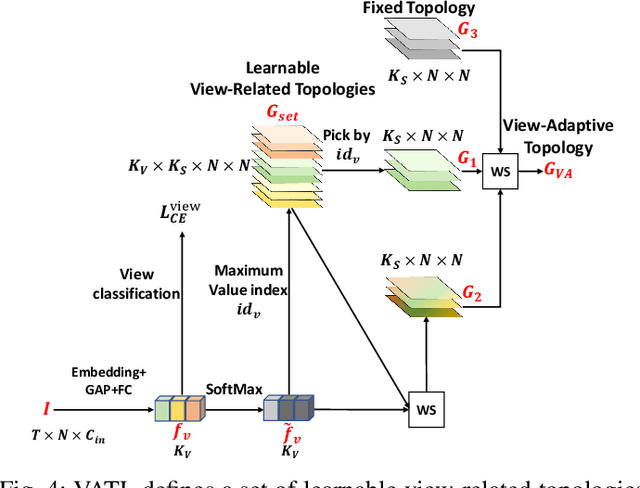
Graph convolutional networks have been widely applied in skeleton-based gait recognition. A key challenge in this task is to distinguish the individual walking styles of different subjects across various views. Existing state-of-the-art methods employ uniform convolutions to extract features from diverse sequences and ignore the effects of viewpoint changes. To overcome these limitations, we propose a condition-adaptive graph (CAG) convolution network that can dynamically adapt to the specific attributes of each skeleton sequence and the corresponding view angle. In contrast to using fixed weights for all joints and sequences, we introduce a joint-specific filter learning (JSFL) module in the CAG method, which produces sequence-adaptive filters at the joint level. The adaptive filters capture fine-grained patterns that are unique to each joint, enabling the extraction of diverse spatial-temporal information about body parts. Additionally, we design a view-adaptive topology learning (VATL) module that generates adaptive graph topologies. These graph topologies are used to correlate the joints adaptively according to the specific view conditions. Thus, CAG can simultaneously adjust to various walking styles and viewpoints. Experiments on the two most widely used datasets (i.e., CASIA-B and OU-MVLP) show that CAG surpasses all previous skeleton-based methods. Moreover, the recognition performance can be enhanced by simply combining CAG with appearance-based methods, demonstrating the ability of CAG to provide useful complementary information.The source code will be available at https://github.com/OliverHxh/CAG.