 Add to Chrome
 Add to Firefox
 Add to Edge
MolReFlect: Towards In-Context Fine-grained Alignments between Molecules and Texts
Nov 22, 2024
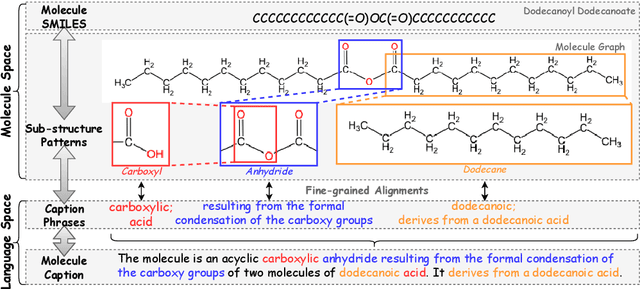
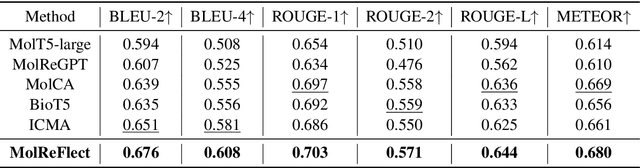
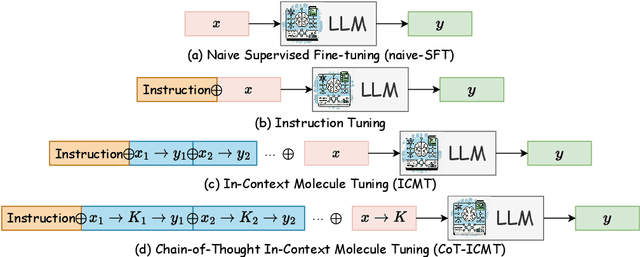
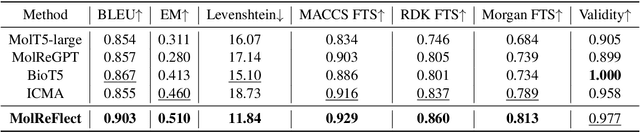
Molecule discovery is a pivotal research field, impacting everything from the medicines we take to the materials we use. Recently, Large Language Models (LLMs) have been widely adopted in molecule understanding and generation, yet the alignments between molecules and their corresponding captions remain a significant challenge. Previous endeavours often treat the molecule as a general SMILES string or molecular graph, neglecting the fine-grained alignments between the molecular sub-structures and the descriptive textual phrases, which are crucial for accurate and explainable predictions. In this case, we introduce MolReFlect, a novel teacher-student framework designed to contextually perform the molecule-caption alignments in a fine-grained way. Our approach initially leverages a larger teacher LLM to label the detailed alignments by directly extracting critical phrases from molecule captions or SMILES strings and implying them to corresponding sub-structures or characteristics. To refine these alignments, we propose In-Context Selective Reflection, which retrieves previous extraction results as context examples for teacher LLM to reflect and lets a smaller student LLM select from in-context reflection and previous extraction results. Finally, we enhance the learning process of the student LLM through Chain-of-Thought In-Context Molecule Tuning, integrating the fine-grained alignments and the reasoning processes within the Chain-of-Thought format. Our experimental results demonstrate that MolReFlect enables LLMs like Mistral-7B to significantly outperform the previous baselines, achieving SOTA performance on the ChEBI-20 dataset. This advancement not only enhances the generative capabilities of LLMs in the molecule-caption translation task, but also contributes to a more explainable framework.

Global Challenge for Safe and Secure LLMs Track 1
Nov 21, 2024


This paper introduces the Global Challenge for Safe and Secure Large Language Models (LLMs), a pioneering initiative organized by AI Singapore (AISG) and the CyberSG R&D Programme Office (CRPO) to foster the development of advanced defense mechanisms against automated jailbreaking attacks. With the increasing integration of LLMs in critical sectors such as healthcare, finance, and public administration, ensuring these models are resilient to adversarial attacks is vital for preventing misuse and upholding ethical standards. This competition focused on two distinct tracks designed to evaluate and enhance the robustness of LLM security frameworks. Track 1 tasked participants with developing automated methods to probe LLM vulnerabilities by eliciting undesirable responses, effectively testing the limits of existing safety protocols within LLMs. Participants were challenged to devise techniques that could bypass content safeguards across a diverse array of scenarios, from offensive language to misinformation and illegal activities. Through this process, Track 1 aimed to deepen the understanding of LLM vulnerabilities and provide insights for creating more resilient models.
LiV-GS: LiDAR-Vision Integration for 3D Gaussian Splatting SLAM in Outdoor Environments
Nov 19, 2024We present LiV-GS, a LiDAR-visual SLAM system in outdoor environments that leverages 3D Gaussian as a differentiable spatial representation. Notably, LiV-GS is the first method that directly aligns discrete and sparse LiDAR data with continuous differentiable Gaussian maps in large-scale outdoor scenes, overcoming the limitation of fixed resolution in traditional LiDAR mapping. The system aligns point clouds with Gaussian maps using shared covariance attributes for front-end tracking and integrates the normal orientation into the loss function to refines the Gaussian map. To reliably and stably update Gaussians outside the LiDAR field of view, we introduce a novel conditional Gaussian constraint that aligns these Gaussians closely with the nearest reliable ones. The targeted adjustment enables LiV-GS to achieve fast and accurate mapping with novel view synthesis at a rate of 7.98 FPS. Extensive comparative experiments demonstrate LiV-GS's superior performance in SLAM, image rendering and mapping. The successful cross-modal radar-LiDAR localization highlights the potential of LiV-GS for applications in cross-modal semantic positioning and object segmentation with Gaussian maps.
Towards Next-Generation Medical Agent: How o1 is Reshaping Decision-Making in Medical Scenarios
Nov 16, 2024

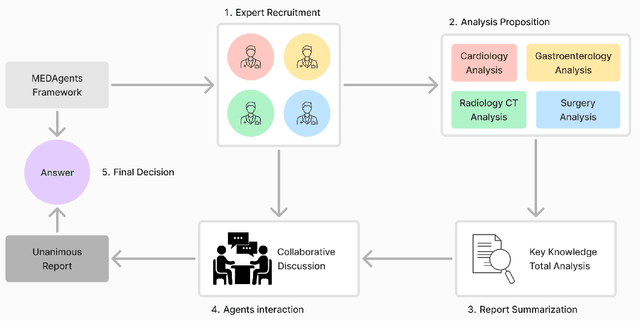

Artificial Intelligence (AI) has become essential in modern healthcare, with large language models (LLMs) offering promising advances in clinical decision-making. Traditional model-based approaches, including those leveraging in-context demonstrations and those with specialized medical fine-tuning, have demonstrated strong performance in medical language processing but struggle with real-time adaptability, multi-step reasoning, and handling complex medical tasks. Agent-based AI systems address these limitations by incorporating reasoning traces, tool selection based on context, knowledge retrieval, and both short- and long-term memory. These additional features enable the medical AI agent to handle complex medical scenarios where decision-making should be built on real-time interaction with the environment. Therefore, unlike conventional model-based approaches that treat medical queries as isolated questions, medical AI agents approach them as complex tasks and behave more like human doctors. In this paper, we study the choice of the backbone LLM for medical AI agents, which is the foundation for the agent's overall reasoning and action generation. In particular, we consider the emergent o1 model and examine its impact on agents' reasoning, tool-use adaptability, and real-time information retrieval across diverse clinical scenarios, including high-stakes settings such as intensive care units (ICUs). Our findings demonstrate o1's ability to enhance diagnostic accuracy and consistency, paving the way for smarter, more responsive AI tools that support better patient outcomes and decision-making efficacy in clinical practice.
HELENE: Hessian Layer-wise Clipping and Gradient Annealing for Accelerating Fine-tuning LLM with Zeroth-order Optimization
Nov 16, 2024


Fine-tuning large language models (LLMs) poses significant memory challenges, as the back-propagation process demands extensive resources, especially with growing model sizes. Recent work, MeZO, addresses this issue using a zeroth-order (ZO) optimization method, which reduces memory consumption by matching the usage to the inference phase. However, MeZO experiences slow convergence due to varying curvatures across model parameters. To overcome this limitation, we introduce HELENE, a novel scalable and memory-efficient optimizer that integrates annealed A-GNB gradients with a diagonal Hessian estimation and layer-wise clipping, serving as a second-order pre-conditioner. This combination allows for faster and more stable convergence. Our theoretical analysis demonstrates that HELENE improves convergence rates, particularly for models with heterogeneous layer dimensions, by reducing the dependency on the total parameter space dimension. Instead, the method scales with the largest layer dimension, making it highly suitable for modern LLM architectures. Experimental results on RoBERTa-large and OPT-1.3B across multiple tasks show that HELENE achieves up to a 20x speedup compared to MeZO, with average accuracy improvements of 1.5%. Furthermore, HELENE remains compatible with both full parameter tuning and parameter-efficient fine-tuning (PEFT), outperforming several state-of-the-art optimizers. The codes will be released after reviewing.
Deceiving Question-Answering Models: A Hybrid Word-Level Adversarial Approach
Nov 12, 2024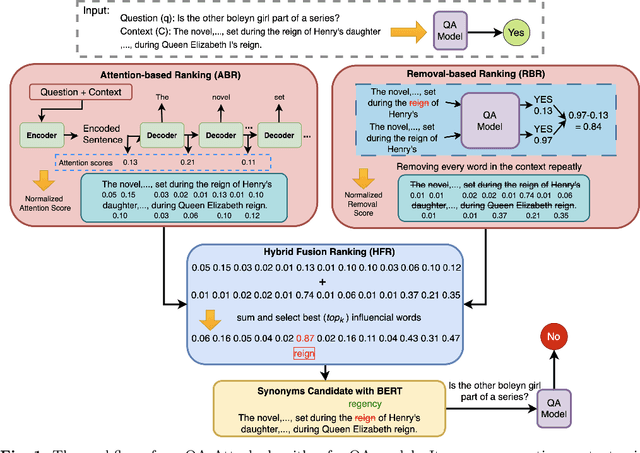
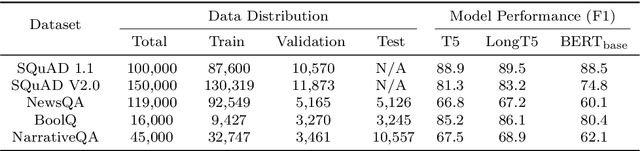
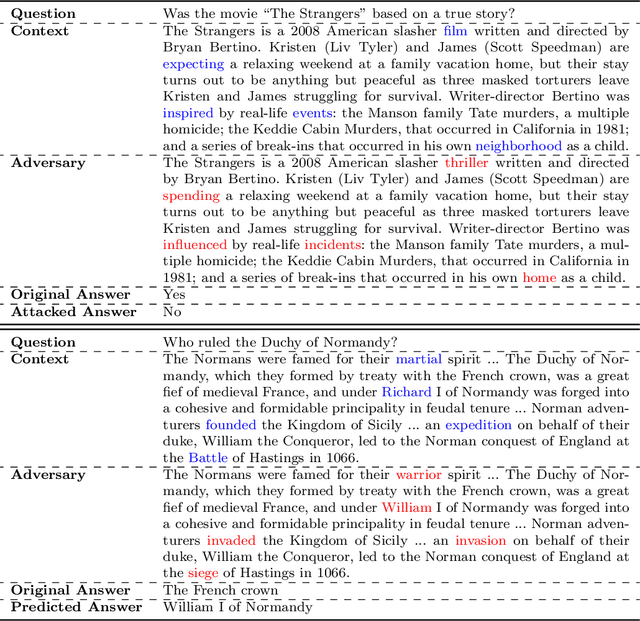
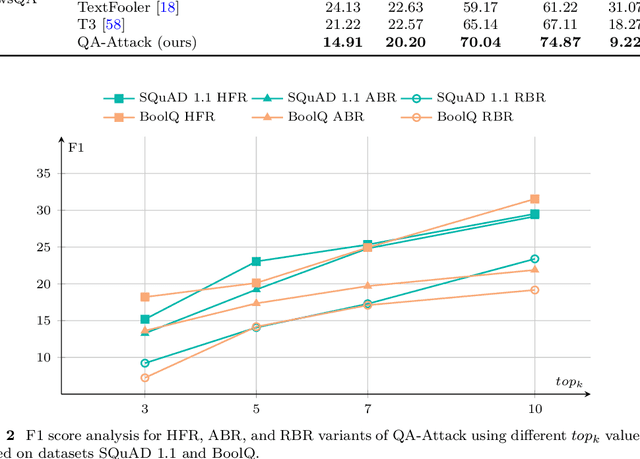
Deep learning underpins most of the currently advanced natural language processing (NLP) tasks such as textual classification, neural machine translation (NMT), abstractive summarization and question-answering (QA). However, the robustness of the models, particularly QA models, against adversarial attacks is a critical concern that remains insufficiently explored. This paper introduces QA-Attack (Question Answering Attack), a novel word-level adversarial strategy that fools QA models. Our attention-based attack exploits the customized attention mechanism and deletion ranking strategy to identify and target specific words within contextual passages. It creates deceptive inputs by carefully choosing and substituting synonyms, preserving grammatical integrity while misleading the model to produce incorrect responses. Our approach demonstrates versatility across various question types, particularly when dealing with extensive long textual inputs. Extensive experiments on multiple benchmark datasets demonstrate that QA-Attack successfully deceives baseline QA models and surpasses existing adversarial techniques regarding success rate, semantics changes, BLEU score, fluency and grammar error rate.
Contextual Representation Anchor Network to Alleviate Selection Bias in Few-Shot Drug Discovery
Oct 29, 2024In the drug discovery process, the low success rate of drug candidate screening often leads to insufficient labeled data, causing the few-shot learning problem in molecular property prediction. Existing methods for few-shot molecular property prediction overlook the sample selection bias, which arises from non-random sample selection in chemical experiments. This bias in data representativeness leads to suboptimal performance. To overcome this challenge, we present a novel method named contextual representation anchor Network (CRA), where an anchor refers to a cluster center of the representations of molecules and serves as a bridge to transfer enriched contextual knowledge into molecular representations and enhance their expressiveness. CRA introduces a dual-augmentation mechanism that includes context augmentation, which dynamically retrieves analogous unlabeled molecules and captures their task-specific contextual knowledge to enhance the anchors, and anchor augmentation, which leverages the anchors to augment the molecular representations. We evaluate our approach on the MoleculeNet and FS-Mol benchmarks, as well as in domain transfer experiments. The results demonstrate that CRA outperforms the state-of-the-art by 2.60% and 3.28% in AUC and $\Delta$AUC-PR metrics, respectively, and exhibits superior generalization capabilities.
HoPE: A Novel Positional Encoding Without Long-Term Decay for Enhanced Context Awareness and Extrapolation
Oct 28, 2024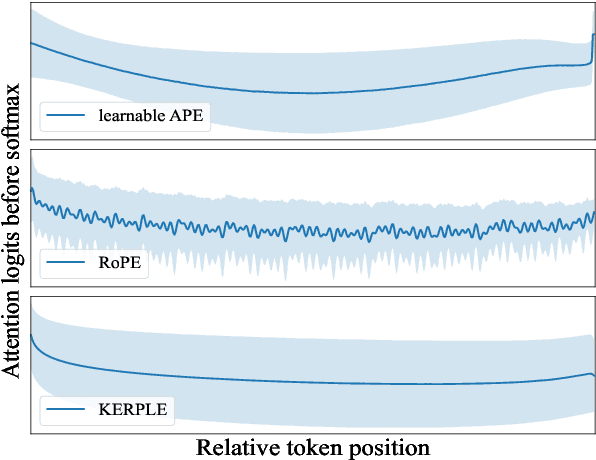

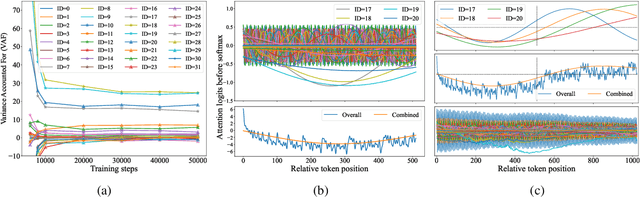

Many positional encodings (PEs) are designed to exhibit long-term decay, based on an entrenched and long-standing inductive opinion: tokens farther away from the current position carry less relevant information. We argue that long-term decay is outdated in the era of LLMs, as LLMs are now applied to tasks demanding precise retrieval of in-context information from arbitrary positions. Firstly, we present empirical analyses on various PEs, demonstrating that models inherently learn attention with only a local-decay pattern while forming a U-shape pattern globally, contradicting the principle of long-term decay. Furthermore, we conduct a detailed analysis of rotary position encoding (RoPE, a prevalent relative positional encoding in LLMs), and found that the U-shape attention is caused by some learned components, which are also the key factor limiting RoPE's expressiveness and extrapolation.Inspired by these insights, we propose High-frequency rotary Position Encoding (HoPE). HoPE replaces the specific components in RoPE with position-independent ones, retaining only high-frequency signals, which also breaks the principle of long-term decay in theory. HoPE achieves two major advantages: (1) Without constraints imposed by long-term decay, contradictory factors that limit spontaneous attention optimization and model extrapolation performance are removed. (2) Components representing positions and semantics are are optimized. These enhances model's context awareness and extrapolation, as validated by extensive experiments.
Conditional GAN for Enhancing Diffusion Models in Efficient and Authentic Global Gesture Generation from Audios
Oct 27, 2024


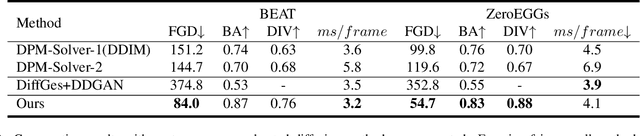
Audio-driven simultaneous gesture generation is vital for human-computer communication, AI games, and film production. While previous research has shown promise, there are still limitations. Methods based on VAEs are accompanied by issues of local jitter and global instability, whereas methods based on diffusion models are hampered by low generation efficiency. This is because the denoising process of DDPM in the latter relies on the assumption that the noise added at each step is sampled from a unimodal distribution, and the noise values are small. DDIM borrows the idea from the Euler method for solving differential equations, disrupts the Markov chain process, and increases the noise step size to reduce the number of denoising steps, thereby accelerating generation. However, simply increasing the step size during the step-by-step denoising process causes the results to gradually deviate from the original data distribution, leading to a significant drop in the quality of the generated actions and the emergence of unnatural artifacts. In this paper, we break the assumptions of DDPM and achieves breakthrough progress in denoising speed and fidelity. Specifically, we introduce a conditional GAN to capture audio control signals and implicitly match the multimodal denoising distribution between the diffusion and denoising steps within the same sampling step, aiming to sample larger noise values and apply fewer denoising steps for high-speed generation.
RopeTP: Global Human Motion Recovery via Integrating Robust Pose Estimation with Diffusion Trajectory Prior
Oct 27, 2024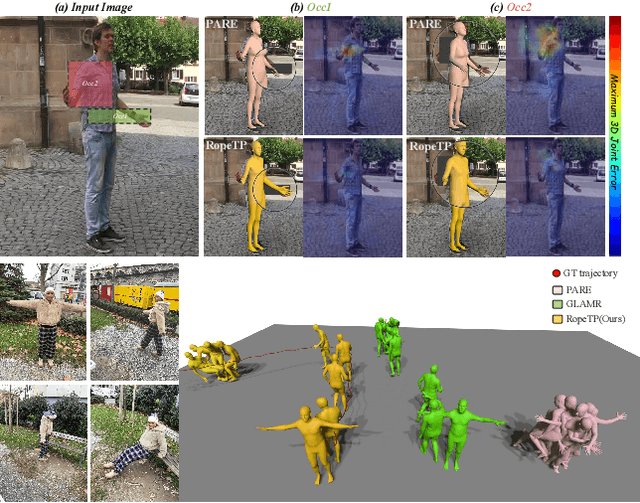
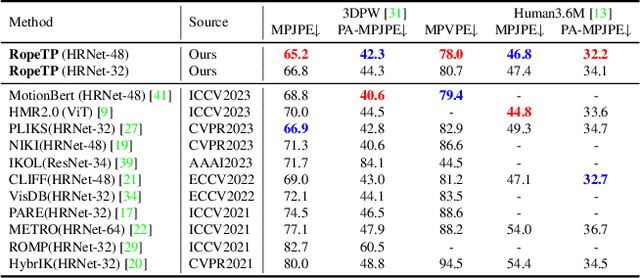
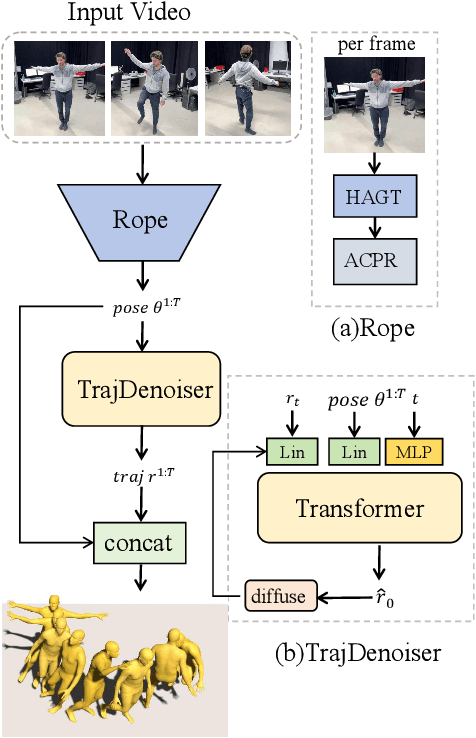

We present RopeTP, a novel framework that combines Robust pose estimation with a diffusion Trajectory Prior to reconstruct global human motion from videos. At the heart of RopeTP is a hierarchical attention mechanism that significantly improves context awareness, which is essential for accurately inferring the posture of occluded body parts. This is achieved by exploiting the relationships with visible anatomical structures, enhancing the accuracy of local pose estimations. The improved robustness of these local estimations allows for the reconstruction of precise and stable global trajectories. Additionally, RopeTP incorporates a diffusion trajectory model that predicts realistic human motion from local pose sequences. This model ensures that the generated trajectories are not only consistent with observed local actions but also unfold naturally over time, thereby improving the realism and stability of 3D human motion reconstruction. Extensive experimental validation shows that RopeTP surpasses current methods on two benchmark datasets, particularly excelling in scenarios with occlusions. It also outperforms methods that rely on SLAM for initial camera estimates and extensive optimization, delivering more accurate and realistic trajectories.