 Add to Chrome
 Add to Firefox
 Add to Edge
Can Large Language Models Help Experimental Design for Causal Discovery?
Mar 04, 2025
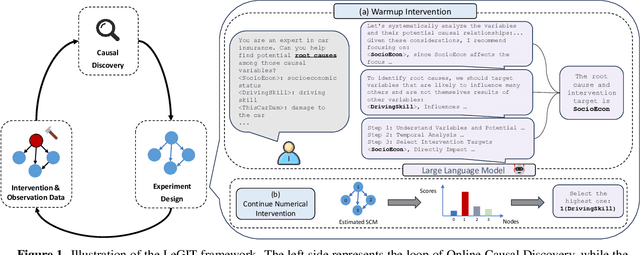
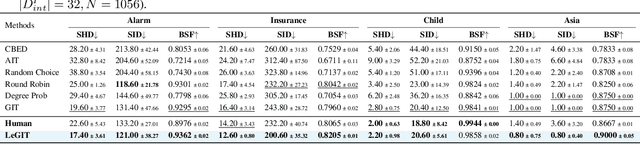
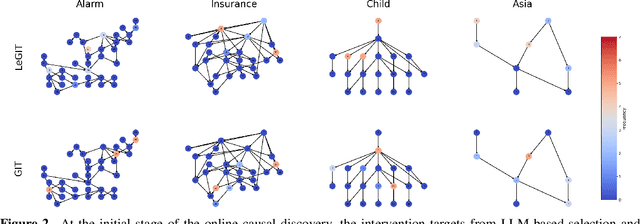
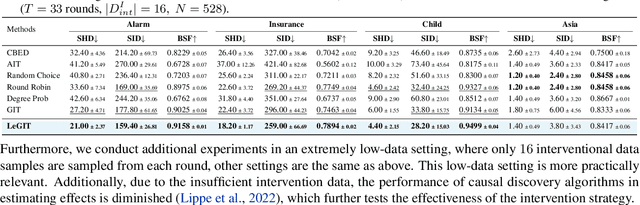
Designing proper experiments and selecting optimal intervention targets is a longstanding problem in scientific or causal discovery. Identifying the underlying causal structure from observational data alone is inherently difficult. Obtaining interventional data, on the other hand, is crucial to causal discovery, yet it is usually expensive and time-consuming to gather sufficient interventional data to facilitate causal discovery. Previous approaches commonly utilize uncertainty or gradient signals to determine the intervention targets. However, numerical-based approaches may yield suboptimal results due to the inaccurate estimation of the guiding signals at the beginning when with limited interventional data. In this work, we investigate a different approach, whether we can leverage Large Language Models (LLMs) to assist with the intervention targeting in causal discovery by making use of the rich world knowledge about the experimental design in LLMs. Specifically, we present Large Language Model Guided Intervention Targeting (LeGIT) -- a robust framework that effectively incorporates LLMs to augment existing numerical approaches for the intervention targeting in causal discovery. Across 4 realistic benchmark scales, LeGIT demonstrates significant improvements and robustness over existing methods and even surpasses humans, which demonstrates the usefulness of LLMs in assisting with experimental design for scientific discovery.

Noisy Test-Time Adaptation in Vision-Language Models
Feb 20, 2025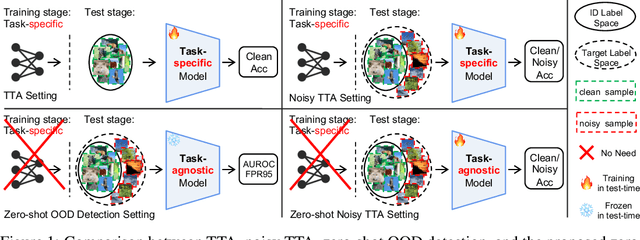
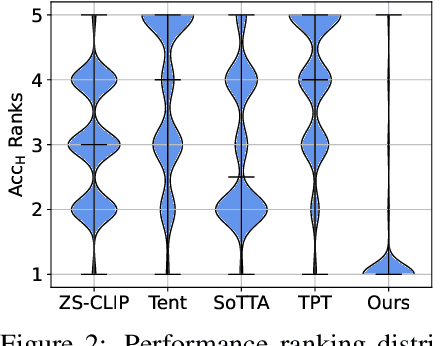
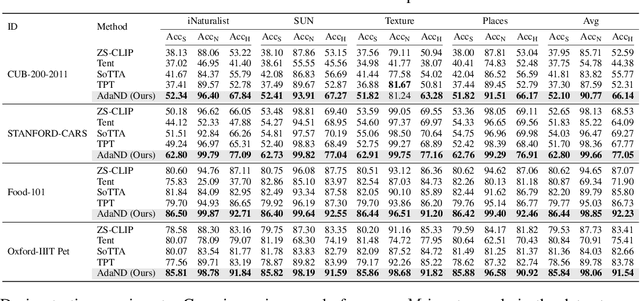
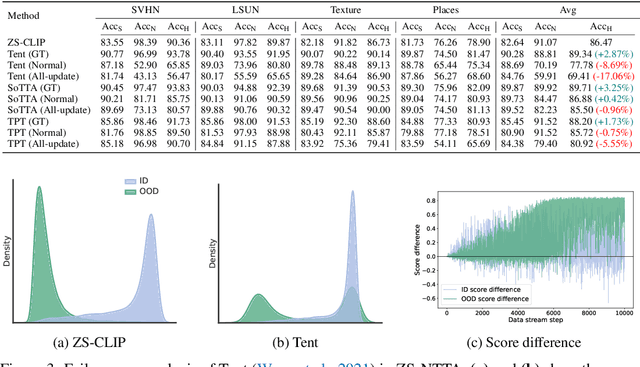
Test-time adaptation (TTA) aims to address distribution shifts between source and target data by relying solely on target data during testing. In open-world scenarios, models often encounter noisy samples, i.e., samples outside the in-distribution (ID) label space. Leveraging the zero-shot capability of pre-trained vision-language models (VLMs), this paper introduces Zero-Shot Noisy TTA (ZS-NTTA), focusing on adapting the model to target data with noisy samples during test-time in a zero-shot manner. We find existing TTA methods underperform under ZS-NTTA, often lagging behind even the frozen model. We conduct comprehensive experiments to analyze this phenomenon, revealing that the negative impact of unfiltered noisy data outweighs the benefits of clean data during model updating. Also, adapting a classifier for ID classification and noise detection hampers both sub-tasks. Built on this, we propose a framework that decouples the classifier and detector, focusing on developing an individual detector while keeping the classifier frozen. Technically, we introduce the Adaptive Noise Detector (AdaND), which utilizes the frozen model's outputs as pseudo-labels to train a noise detector. To handle clean data streams, we further inject Gaussian noise during adaptation, preventing the detector from misclassifying clean samples as noisy. Beyond the ZS-NTTA, AdaND can also improve the zero-shot out-of-distribution (ZS-OOD) detection ability of VLMs. Experiments show that AdaND outperforms in both ZS-NTTA and ZS-OOD detection. On ImageNet, AdaND achieves a notable improvement of $8.32\%$ in harmonic mean accuracy ($\text{Acc}_\text{H}$) for ZS-NTTA and $9.40\%$ in FPR95 for ZS-OOD detection, compared to SOTA methods. Importantly, AdaND is computationally efficient and comparable to the model-frozen method. The code is publicly available at: https://github.com/tmlr-group/ZS-NTTA.
Toward Robust Non-Transferable Learning: A Survey and Benchmark
Feb 19, 2025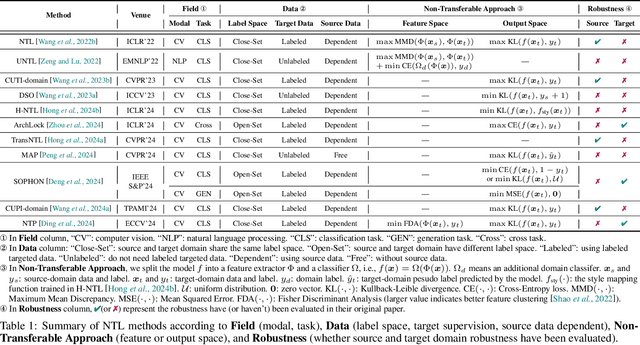
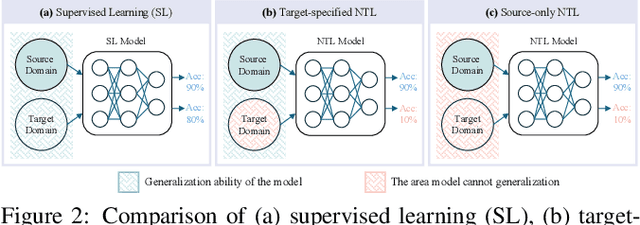
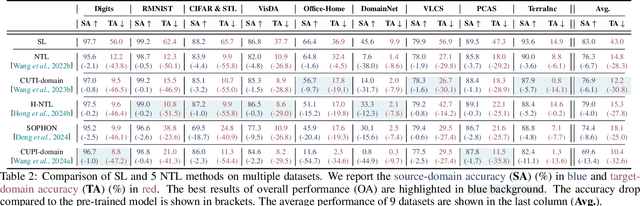

Over the past decades, researchers have primarily focused on improving the generalization abilities of models, with limited attention given to regulating such generalization. However, the ability of models to generalize to unintended data (e.g., harmful or unauthorized data) can be exploited by malicious adversaries in unforeseen ways, potentially resulting in violations of model ethics. Non-transferable learning (NTL), a task aimed at reshaping the generalization abilities of deep learning models, was proposed to address these challenges. While numerous methods have been proposed in this field, a comprehensive review of existing progress and a thorough analysis of current limitations remain lacking. In this paper, we bridge this gap by presenting the first comprehensive survey on NTL and introducing NTLBench, the first benchmark to evaluate NTL performance and robustness within a unified framework. Specifically, we first introduce the task settings, general framework, and criteria of NTL, followed by a summary of NTL approaches. Furthermore, we emphasize the often-overlooked issue of robustness against various attacks that can destroy the non-transferable mechanism established by NTL. Experiments conducted via NTLBench verify the limitations of existing NTL methods in robustness. Finally, we discuss the practical applications of NTL, along with its future directions and associated challenges.
Enhancing Sample Selection by Cutting Mislabeled Easy Examples
Feb 12, 2025Sample selection is a prevalent approach in learning with noisy labels, aiming to identify confident samples for training. Although existing sample selection methods have achieved decent results by reducing the noise rate of the selected subset, they often overlook that not all mislabeled examples harm the model's performance equally. In this paper, we demonstrate that mislabeled examples correctly predicted by the model early in the training process are particularly harmful to model performance. We refer to these examples as Mislabeled Easy Examples (MEEs). To address this, we propose Early Cutting, which introduces a recalibration step that employs the model's later training state to re-select the confident subset identified early in training, thereby avoiding misleading confidence from early learning and effectively filtering out MEEs. Experiments on the CIFAR, WebVision, and full ImageNet-1k datasets demonstrate that our method effectively improves sample selection and model performance by reducing MEEs.
Early Stopping Against Label Noise Without Validation Data
Feb 11, 2025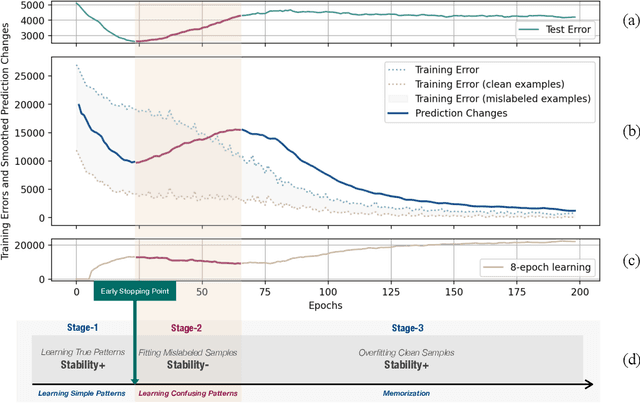
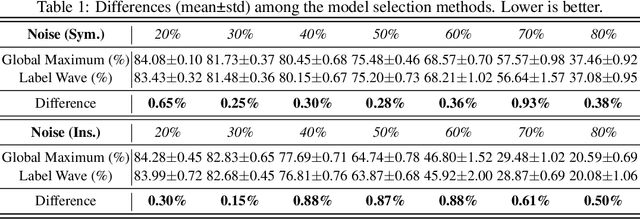
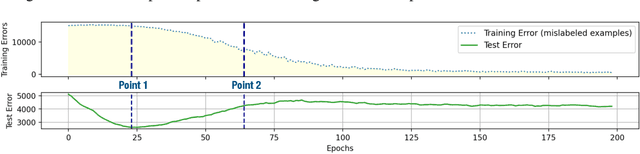
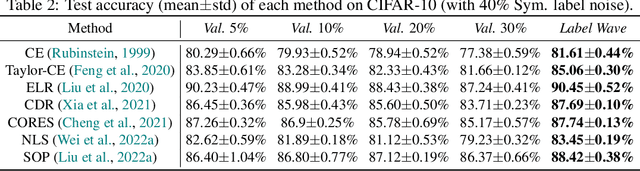
Early stopping methods in deep learning face the challenge of balancing the volume of training and validation data, especially in the presence of label noise. Concretely, sparing more data for validation from training data would limit the performance of the learned model, yet insufficient validation data could result in a sub-optimal selection of the desired model. In this paper, we propose a novel early stopping method called Label Wave, which does not require validation data for selecting the desired model in the presence of label noise. It works by tracking the changes in the model's predictions on the training set during the training process, aiming to halt training before the model unduly fits mislabeled data. This method is empirically supported by our observation that minimum fluctuations in predictions typically occur at the training epoch before the model excessively fits mislabeled data. Through extensive experiments, we show both the effectiveness of the Label Wave method across various settings and its capability to enhance the performance of existing methods for learning with noisy labels.
Instance-dependent Early Stopping
Feb 11, 2025In machine learning practice, early stopping has been widely used to regularize models and can save computational costs by halting the training process when the model's performance on a validation set stops improving. However, conventional early stopping applies the same stopping criterion to all instances without considering their individual learning statuses, which leads to redundant computations on instances that are already well-learned. To further improve the efficiency, we propose an Instance-dependent Early Stopping (IES) method that adapts the early stopping mechanism from the entire training set to the instance level, based on the core principle that once the model has mastered an instance, the training on it should stop. IES considers an instance as mastered if the second-order differences of its loss value remain within a small range around zero. This offers a more consistent measure of an instance's learning status compared with directly using the loss value, and thus allows for a unified threshold to determine when an instance can be excluded from further backpropagation. We show that excluding mastered instances from backpropagation can increase the gradient norms, thereby accelerating the decrease of the training loss and speeding up the training process. Extensive experiments on benchmarks demonstrate that IES method can reduce backpropagation instances by 10%-50% while maintaining or even slightly improving the test accuracy and transfer learning performance of a model.
Label Distribution Learning with Biased Annotations by Learning Multi-Label Representation
Feb 03, 2025Multi-label learning (MLL) has gained attention for its ability to represent real-world data. Label Distribution Learning (LDL), an extension of MLL to learning from label distributions, faces challenges in collecting accurate label distributions. To address the issue of biased annotations, based on the low-rank assumption, existing works recover true distributions from biased observations by exploring the label correlations. However, recent evidence shows that the label distribution tends to be full-rank, and naive apply of low-rank approximation on biased observation leads to inaccurate recovery and performance degradation. In this paper, we address the LDL with biased annotations problem from a novel perspective, where we first degenerate the soft label distribution into a hard multi-hot label and then recover the true label information for each instance. This idea stems from an insight that assigning hard multi-hot labels is often easier than assigning a soft label distribution, and it shows stronger immunity to noise disturbances, leading to smaller label bias. Moreover, assuming that the multi-label space for predicting label distributions is low-rank offers a more reasonable approach to capturing label correlations. Theoretical analysis and experiments confirm the effectiveness and robustness of our method on real-world datasets.
Flow: A Modular Approach to Automated Agentic Workflow Generation
Jan 14, 2025
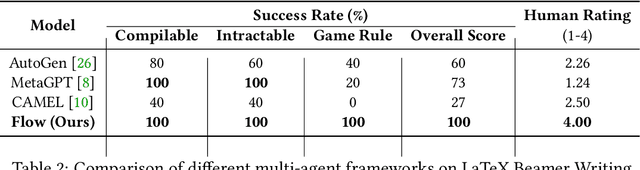

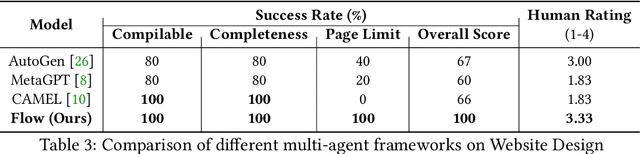
Multi-agent frameworks powered by large language models (LLMs) have demonstrated great success in automated planning and task execution. However, the effective adjustment of Agentic workflows during execution has not been well-studied. A effective workflow adjustment is crucial, as in many real-world scenarios, the initial plan must adjust to unforeseen challenges and changing conditions in real-time to ensure the efficient execution of complex tasks. In this paper, we define workflows as an activity-on-vertex (AOV) graphs. We continuously refine the workflow by dynamically adjusting task allocations based on historical performance and previous AOV with LLM agents. To further enhance system performance, we emphasize modularity in workflow design based on measuring parallelism and dependence complexity. Our proposed multi-agent framework achieved efficient sub-task concurrent execution, goal achievement, and error tolerance. Empirical results across different practical tasks demonstrate dramatic improvements in the efficiency of multi-agent frameworks through dynamic workflow updating and modularization.
NVS-SQA: Exploring Self-Supervised Quality Representation Learning for Neurally Synthesized Scenes without References
Jan 11, 2025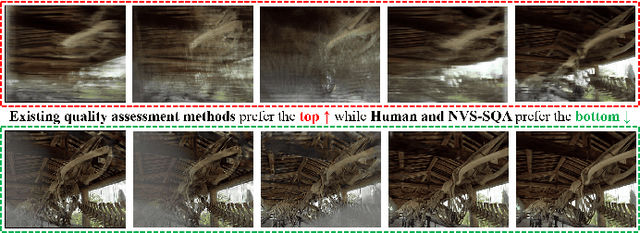
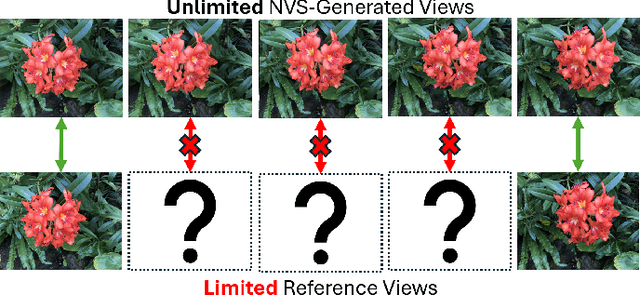
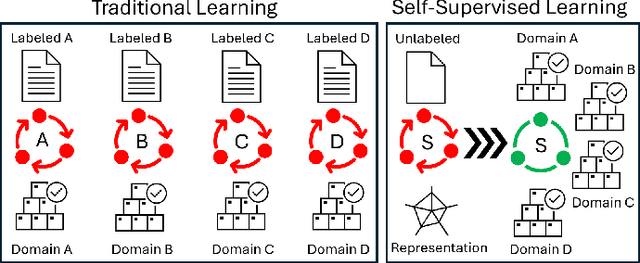
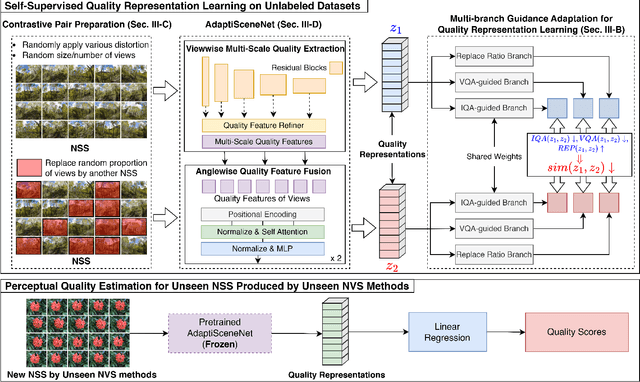
Neural View Synthesis (NVS), such as NeRF and 3D Gaussian Splatting, effectively creates photorealistic scenes from sparse viewpoints, typically evaluated by quality assessment methods like PSNR, SSIM, and LPIPS. However, these full-reference methods, which compare synthesized views to reference views, may not fully capture the perceptual quality of neurally synthesized scenes (NSS), particularly due to the limited availability of dense reference views. Furthermore, the challenges in acquiring human perceptual labels hinder the creation of extensive labeled datasets, risking model overfitting and reduced generalizability. To address these issues, we propose NVS-SQA, a NSS quality assessment method to learn no-reference quality representations through self-supervision without reliance on human labels. Traditional self-supervised learning predominantly relies on the "same instance, similar representation" assumption and extensive datasets. However, given that these conditions do not apply in NSS quality assessment, we employ heuristic cues and quality scores as learning objectives, along with a specialized contrastive pair preparation process to improve the effectiveness and efficiency of learning. The results show that NVS-SQA outperforms 17 no-reference methods by a large margin (i.e., on average 109.5% in SRCC, 98.6% in PLCC, and 91.5% in KRCC over the second best) and even exceeds 16 full-reference methods across all evaluation metrics (i.e., 22.9% in SRCC, 19.1% in PLCC, and 18.6% in KRCC over the second best).
PanoSLAM: Panoptic 3D Scene Reconstruction via Gaussian SLAM
Dec 31, 2024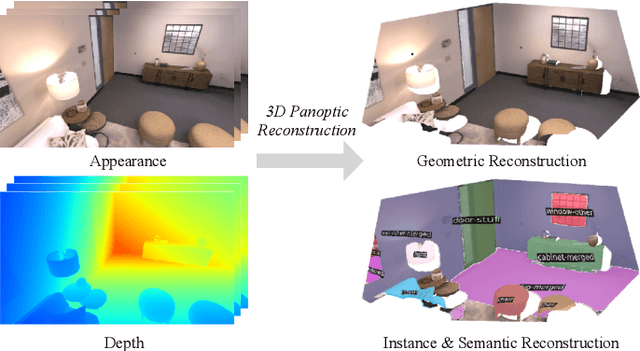


Understanding geometric, semantic, and instance information in 3D scenes from sequential video data is essential for applications in robotics and augmented reality. However, existing Simultaneous Localization and Mapping (SLAM) methods generally focus on either geometric or semantic reconstruction. In this paper, we introduce PanoSLAM, the first SLAM system to integrate geometric reconstruction, 3D semantic segmentation, and 3D instance segmentation within a unified framework. Our approach builds upon 3D Gaussian Splatting, modified with several critical components to enable efficient rendering of depth, color, semantic, and instance information from arbitrary viewpoints. To achieve panoptic 3D scene reconstruction from sequential RGB-D videos, we propose an online Spatial-Temporal Lifting (STL) module that transfers 2D panoptic predictions from vision models into 3D Gaussian representations. This STL module addresses the challenges of label noise and inconsistencies in 2D predictions by refining the pseudo labels across multi-view inputs, creating a coherent 3D representation that enhances segmentation accuracy. Our experiments show that PanoSLAM outperforms recent semantic SLAM methods in both mapping and tracking accuracy. For the first time, it achieves panoptic 3D reconstruction of open-world environments directly from the RGB-D video. (https://github.com/runnanchen/PanoSLAM)