 Add to Chrome
 Add to Firefox
 Add to Edge
From Fixed Grids to Moving Particles:A Transferable Latent Operator for Fluid Dynamics
Aug 14, 2026
Lagrangian modeling is vital to fluid dynamics, as it characterizes particle transport and complements the Eulerian description.However, Lagrangian trajectories are less commonly available than Eulerian fields, while most neural operators are trained and evaluated primarily in the Eulerian representation. This mismatch motivates a new learning problem: can a model trained solely on Eulerian observations generalize zero-shot from Eulerian field prediction to Lagrangian particle rollout, without Lagrangian supervision or task-specific adaptation? To address this problem, we propose the Transferable Latent Operator (TLO), which learns a unified flow representation shared by Eulerian field prediction and Lagrangian particle rollout. TLO decouples latent flow evolution from coordinate-dependent decoding: querying the evolving latent representation at fixed spatial coordinates yields Eulerian fields, whereas querying velocities at particle positions and recursively updating these positions enables Lagrangian rollout. Across five fluid-dynamics benchmarks, TLO consistently outperforms existing neural operators in both Eulerian field prediction and zero-shot Lagrangian rollout, with further gains from limited Lagrangian fine-tuning.

DART: Semantic Recoverability for Structured Tool Agents
May 22, 2026When a structured tool agent fails mid-execution, the runtime faces a dilemma: replaying the entire task is safe but wasteful, while restoring from a local checkpoint is efficient but can leave committed downstream work tied to an upstream history that no longer exists. This tension is acute in commitment-sensitive settings, where rollback targets a single failed instance yet downstream consumers have already acted on its output. Existing recovery approaches provide mechanical rollback but no criterion for whether a local restore remains semantically valid after downstream commitment. We formalize this gap as semantic recoverability and address it in DART, a modular runtime that localizes the failed instance, certifies semantically recoverable boundaries of that instance, aligns checkpoints to those boundaries, and selects an admissible restore point that preserves committed downstream work under dependency and effect constraints-or blocks otherwise. Across three LLM-driven domains and external validation on a LangGraph-based substrate, DART correctly recovers all evaluated commitment-sensitive cases where baseline local recovery fails, and a five-domain safety audit finds no unsafe admitted rollbacks. These results show that controller legality does not imply semantic validity, and that sound local recovery requires an explicit admissibility check.
COSMO-Agent: Tool-Augmented Agent for Closed-loop Optimization,Simulation,and Modeling Orchestration
Apr 07, 2026Iterative industrial design-simulation optimization is bottlenecked by the CAD-CAE semantic gap: translating simulation feedback into valid geometric edits under diverse, coupled constraints. To fill this gap, we propose COSMO-Agent (Closed-loop Optimization, Simulation, and Modeling Orchestration), a tool-augmented reinforcement learning (RL) framework that teaches LLMs to complete the closed-loop CAD-CAE process. Specifically, we cast CAD generation, CAE solving, result parsing, and geometry revision as an interactive RL environment, where an LLM learns to orchestrate external tools and revise parametric geometries until constraints are satisfied. To make this learning stable and industrially usable, we design a multi-constraint reward that jointly encourages feasibility, toolchain robustness, and structured output validity. In addition, we contribute an industry-aligned dataset that covers 25 component categories with executable CAD-CAE tasks to support realistic training and evaluation. Experiments show that COSMO-Agent training substantially improves small open-source LLMs for constraint-driven design, exceeding large open-source and strong closed-source models in feasibility, efficiency, and stability.
Holi-Spatial: Evolving Video Streams into Holistic 3D Spatial Intelligence
Mar 08, 2026The pursuit of spatial intelligence fundamentally relies on access to large-scale, fine-grained 3D data. However, existing approaches predominantly construct spatial understanding benchmarks by generating question-answer (QA) pairs from a limited number of manually annotated datasets, rather than systematically annotating new large-scale 3D scenes from raw web data. As a result, their scalability is severely constrained, and model performance is further hindered by domain gaps inherent in these narrowly curated datasets. In this work, we propose Holi-Spatial, the first fully automated, large-scale, spatially-aware multimodal dataset, constructed from raw video inputs without human intervention, using the proposed data curation pipeline. Holi-Spatial supports multi-level spatial supervision, ranging from geometrically accurate 3D Gaussian Splatting (3DGS) reconstructions with rendered depth maps to object-level and relational semantic annotations, together with corresponding spatial Question-Answer (QA) pairs. Following a principled and systematic pipeline, we further construct Holi-Spatial-4M, the first large-scale, high-quality 3D semantic dataset, containing 12K optimized 3DGS scenes, 1.3M 2D masks, 320K 3D bounding boxes, 320K instance captions, 1.2M 3D grounding instances, and 1.2M spatial QA pairs spanning diverse geometric, relational, and semantic reasoning tasks. Holi-Spatial demonstrates exceptional performance in data curation quality, significantly outperforming existing feed-forward and per-scene optimized methods on datasets such as ScanNet, ScanNet++, and DL3DV. Furthermore, fine-tuning Vision-Language Models (VLMs) on spatial reasoning tasks using this dataset has also led to substantial improvements in model performance.
BrepLLM: Native Boundary Representation Understanding with Large Language Models
Dec 18, 2025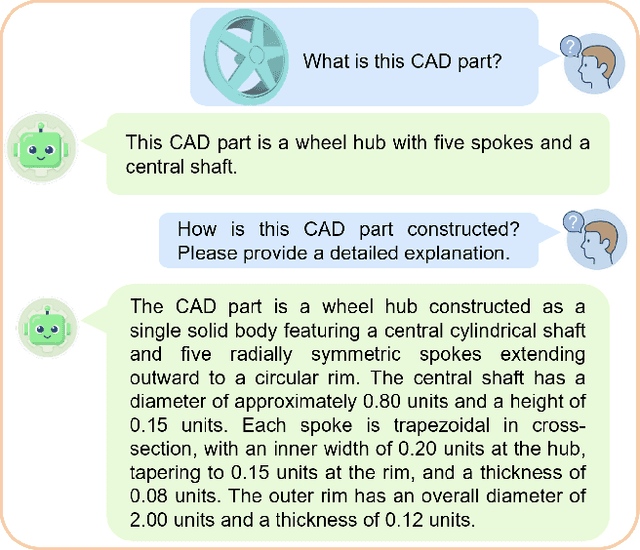


Current token-sequence-based Large Language Models (LLMs) are not well-suited for directly processing 3D Boundary Representation (Brep) models that contain complex geometric and topological information. We propose BrepLLM, the first framework that enables LLMs to parse and reason over raw Brep data, bridging the modality gap between structured 3D geometry and natural language. BrepLLM employs a two-stage training pipeline: Cross-modal Alignment Pre-training and Multi-stage LLM Fine-tuning. In the first stage, an adaptive UV sampling strategy converts Breps into graphs representation with geometric and topological information. We then design a hierarchical BrepEncoder to extract features from geometry (i.e., faces and edges) and topology, producing both a single global token and a sequence of node tokens. Then we align the global token with text embeddings from a frozen CLIP text encoder (ViT-L/14) via contrastive learning. In the second stage, we integrate the pretrained BrepEncoder into an LLM. We then align its sequence of node tokens using a three-stage progressive training strategy: (1) training an MLP-based semantic mapping from Brep representation to 2D with 2D-LLM priors. (2) performing fine-tuning of the LLM. (3) designing a Mixture-of-Query Experts (MQE) to enhance geometric diversity modeling. We also construct Brep2Text, a dataset comprising 269,444 Brep-text question-answer pairs. Experiments show that BrepLLM achieves state-of-the-art (SOTA) results on 3D object classification and captioning tasks.
Visionary: The World Model Carrier Built on WebGPU-Powered Gaussian Splatting Platform
Dec 09, 2025Neural rendering, particularly 3D Gaussian Splatting (3DGS), has evolved rapidly and become a key component for building world models. However, existing viewer solutions remain fragmented, heavy, or constrained by legacy pipelines, resulting in high deployment friction and limited support for dynamic content and generative models. In this work, we present Visionary, an open, web-native platform for real-time various Gaussian Splatting and meshes rendering. Built on an efficient WebGPU renderer with per-frame ONNX inference, Visionary enables dynamic neural processing while maintaining a lightweight, "click-to-run" browser experience. It introduces a standardized Gaussian Generator contract, which not only supports standard 3DGS rendering but also allows plug-and-play algorithms to generate or update Gaussians each frame. Such inference also enables us to apply feedforward generative post-processing. The platform further offers a plug in three.js library with a concise TypeScript API for seamless integration into existing web applications. Experiments show that, under identical 3DGS assets, Visionary achieves superior rendering efficiency compared to current Web viewers due to GPU-based primitive sorting. It already supports multiple variants, including MLP-based 3DGS, 4DGS, neural avatars, and style transformation or enhancement networks. By unifying inference and rendering directly in the browser, Visionary significantly lowers the barrier to reproduction, comparison, and deployment of 3DGS-family methods, serving as a unified World Model Carrier for both reconstructive and generative paradigms.
Turing Machine Evaluation for Large Language Model
Apr 29, 2025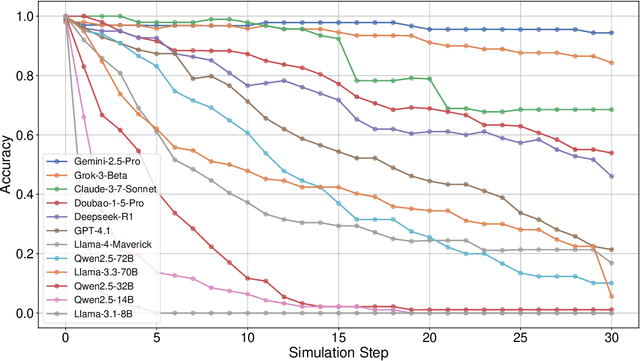
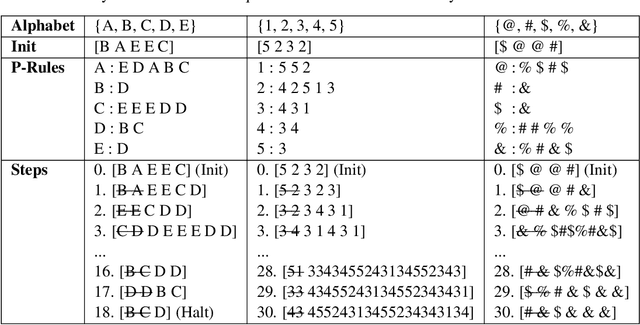
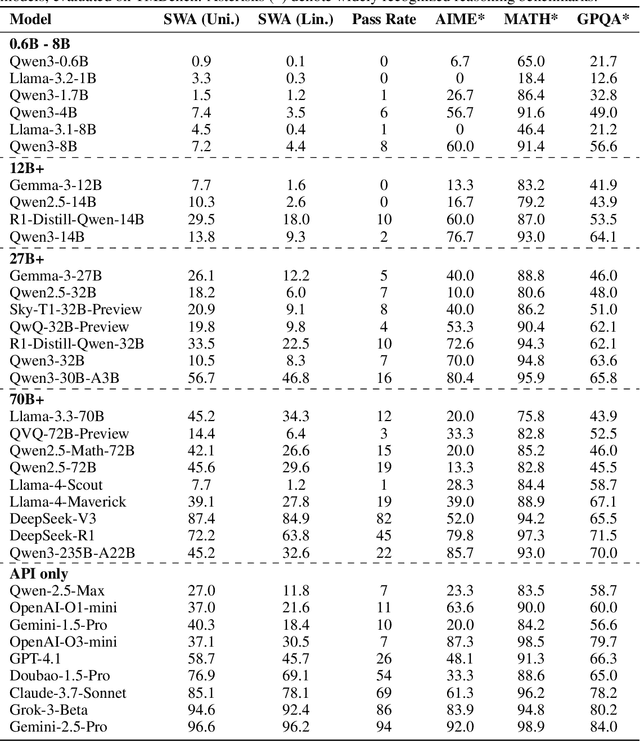
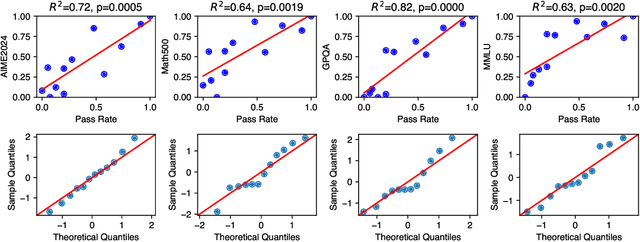
With the rapid development and widespread application of Large Language Models (LLMs), rigorous evaluation has become particularly crucial. This research adopts a novel perspective, focusing on evaluating the core computational reasoning ability of LLMs, defined as the capacity of model to accurately understand rules, and execute logically computing operations. This capability assesses the reliability of LLMs as precise executors, and is critical to advanced tasks such as complex code generation and multi-step problem-solving. We propose an evaluation framework based on Universal Turing Machine (UTM) simulation. This framework requires LLMs to strictly follow instructions and track dynamic states, such as tape content and read/write head position, during multi-step computations. To enable standardized evaluation, we developed TMBench, a benchmark for systematically studying the computational reasoning capabilities of LLMs. TMBench provides several key advantages, including knowledge-agnostic evaluation, adjustable difficulty, foundational coverage through Turing machine encoding, and unlimited capacity for instance generation, ensuring scalability as models continue to evolve. We find that model performance on TMBench correlates strongly with performance on other recognized reasoning benchmarks (Pearson correlation coefficient is 0.73), clearly demonstrating that computational reasoning is a significant dimension for measuring the deep capabilities of LLMs. Code and data are available at https://github.com/HaitaoWuTJU/Turing-Machine-Bench.
Enhancing User-Centric Privacy Protection: An Interactive Framework through Diffusion Models and Machine Unlearning
Sep 05, 2024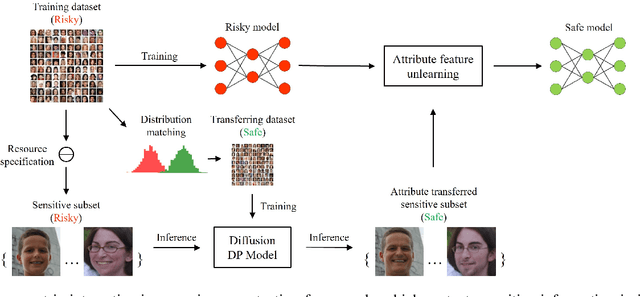
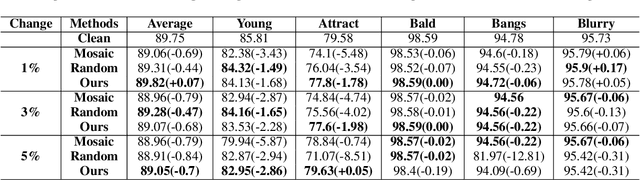
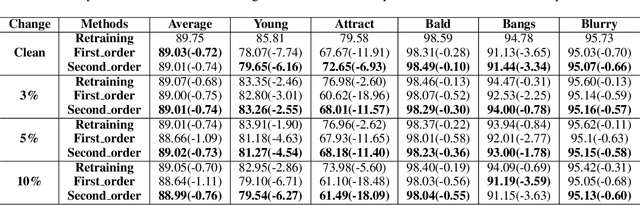
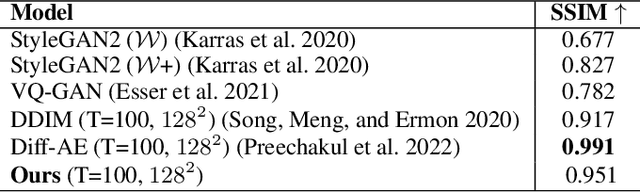
In the realm of multimedia data analysis, the extensive use of image datasets has escalated concerns over privacy protection within such data. Current research predominantly focuses on privacy protection either in data sharing or upon the release of trained machine learning models. Our study pioneers a comprehensive privacy protection framework that safeguards image data privacy concurrently during data sharing and model publication. We propose an interactive image privacy protection framework that utilizes generative machine learning models to modify image information at the attribute level and employs machine unlearning algorithms for the privacy preservation of model parameters. This user-interactive framework allows for adjustments in privacy protection intensity based on user feedback on generated images, striking a balance between maximal privacy safeguarding and maintaining model performance. Within this framework, we instantiate two modules: a differential privacy diffusion model for protecting attribute information in images and a feature unlearning algorithm for efficient updates of the trained model on the revised image dataset. Our approach demonstrated superiority over existing methods on facial datasets across various attribute classifications.
Masked Cross-image Encoding for Few-shot Segmentation
Aug 22, 2023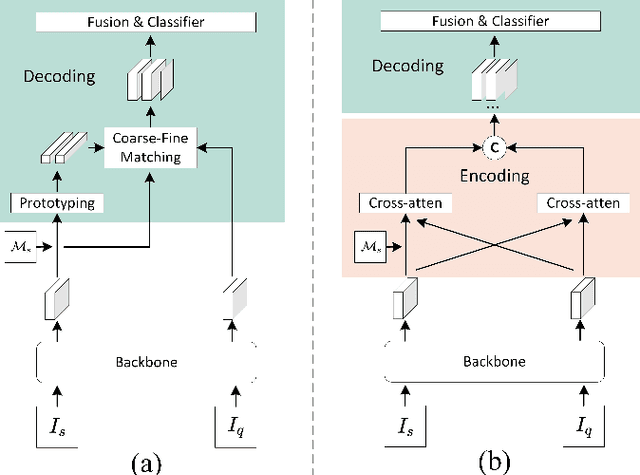
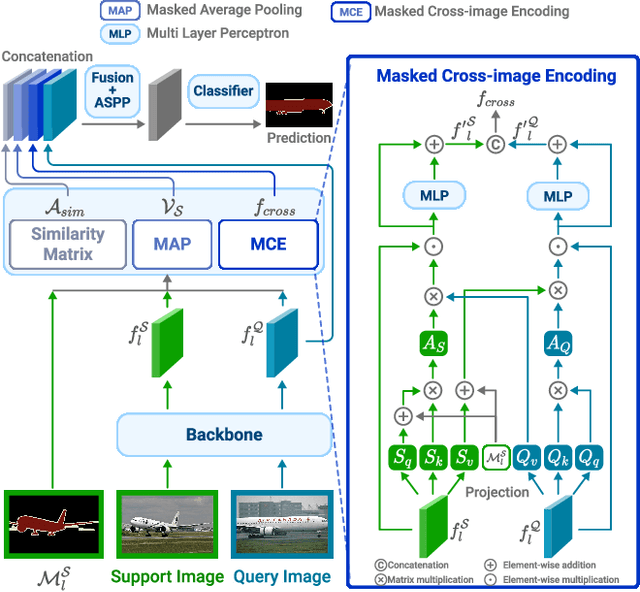
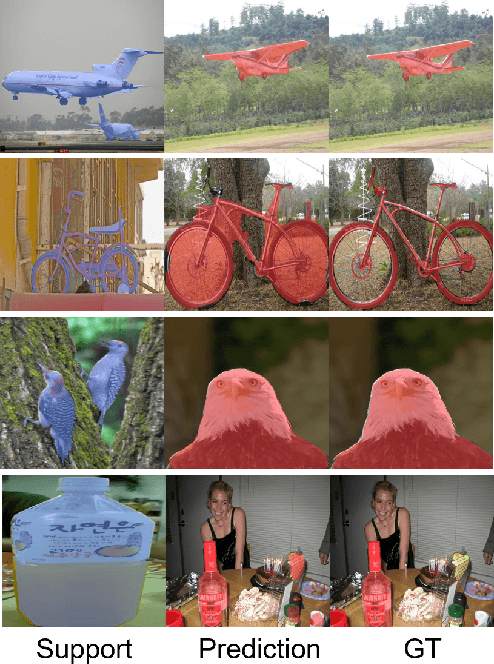
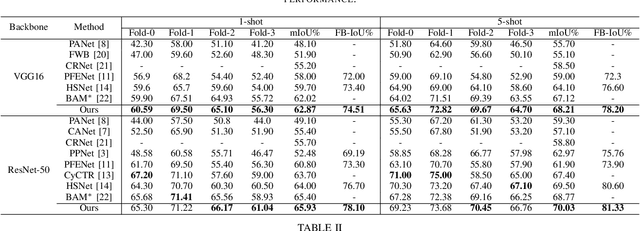
Few-shot segmentation (FSS) is a dense prediction task that aims to infer the pixel-wise labels of unseen classes using only a limited number of annotated images. The key challenge in FSS is to classify the labels of query pixels using class prototypes learned from the few labeled support exemplars. Prior approaches to FSS have typically focused on learning class-wise descriptors independently from support images, thereby ignoring the rich contextual information and mutual dependencies among support-query features. To address this limitation, we propose a joint learning method termed Masked Cross-Image Encoding (MCE), which is designed to capture common visual properties that describe object details and to learn bidirectional inter-image dependencies that enhance feature interaction. MCE is more than a visual representation enrichment module; it also considers cross-image mutual dependencies and implicit guidance. Experiments on FSS benchmarks PASCAL-$5^i$ and COCO-$20^i$ demonstrate the advanced meta-learning ability of the proposed method.
Channel-Wise Contrastive Learning for Learning with Noisy Labels
Aug 14, 2023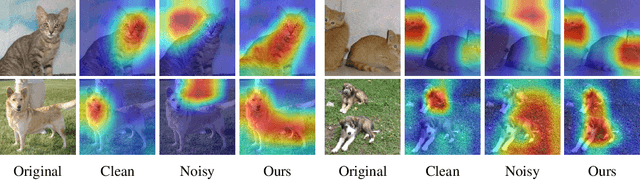
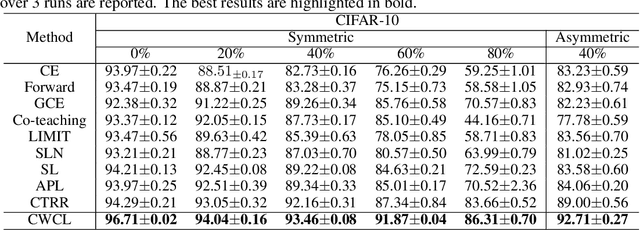
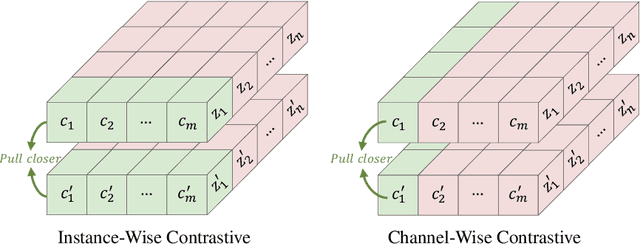
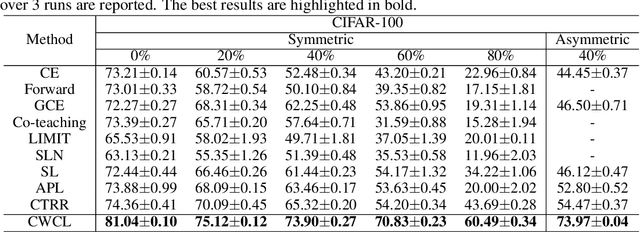
In real-world datasets, noisy labels are pervasive. The challenge of learning with noisy labels (LNL) is to train a classifier that discerns the actual classes from given instances. For this, the model must identify features indicative of the authentic labels. While research indicates that genuine label information is embedded in the learned features of even inaccurately labeled data, it's often intertwined with noise, complicating its direct application. Addressing this, we introduce channel-wise contrastive learning (CWCL). This method distinguishes authentic label information from noise by undertaking contrastive learning across diverse channels. Unlike conventional instance-wise contrastive learning (IWCL), CWCL tends to yield more nuanced and resilient features aligned with the authentic labels. Our strategy is twofold: firstly, using CWCL to extract pertinent features to identify cleanly labeled samples, and secondly, progressively fine-tuning using these samples. Evaluations on several benchmark datasets validate our method's superiority over existing approaches.