 Add to Chrome
 Add to Firefox
 Add to Edge
Neural auto-designer for enhanced quantum kernels
Jan 20, 2024
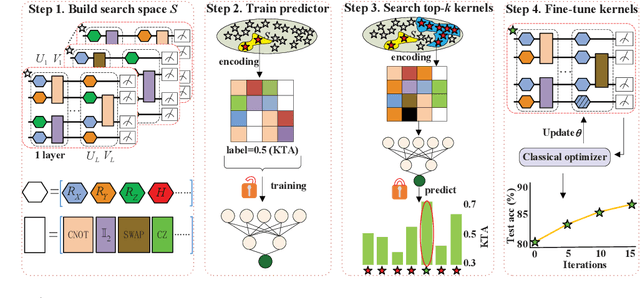
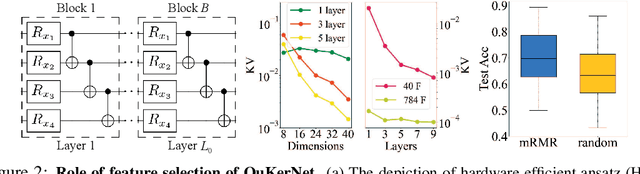
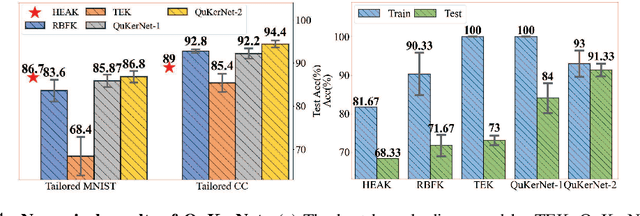

Quantum kernels hold great promise for offering computational advantages over classical learners, with the effectiveness of these kernels closely tied to the design of the quantum feature map. However, the challenge of designing effective quantum feature maps for real-world datasets, particularly in the absence of sufficient prior information, remains a significant obstacle. In this study, we present a data-driven approach that automates the design of problem-specific quantum feature maps. Our approach leverages feature-selection techniques to handle high-dimensional data on near-term quantum machines with limited qubits, and incorporates a deep neural predictor to efficiently evaluate the performance of various candidate quantum kernels. Through extensive numerical simulations on different datasets, we demonstrate the superiority of our proposal over prior methods, especially for the capability of eliminating the kernel concentration issue and identifying the feature map with prediction advantages. Our work not only unlocks the potential of quantum kernels for enhancing real-world tasks but also highlights the substantial role of deep learning in advancing quantum machine learning.

HCVP: Leveraging Hierarchical Contrastive Visual Prompt for Domain Generalization
Jan 18, 2024


Domain Generalization (DG) endeavors to create machine learning models that excel in unseen scenarios by learning invariant features. In DG, the prevalent practice of constraining models to a fixed structure or uniform parameterization to encapsulate invariant features can inadvertently blend specific aspects. Such an approach struggles with nuanced differentiation of inter-domain variations and may exhibit bias towards certain domains, hindering the precise learning of domain-invariant features. Recognizing this, we introduce a novel method designed to supplement the model with domain-level and task-specific characteristics. This approach aims to guide the model in more effectively separating invariant features from specific characteristics, thereby boosting the generalization. Building on the emerging trend of visual prompts in the DG paradigm, our work introduces the novel \textbf{H}ierarchical \textbf{C}ontrastive \textbf{V}isual \textbf{P}rompt (HCVP) methodology. This represents a significant advancement in the field, setting itself apart with a unique generative approach to prompts, alongside an explicit model structure and specialized loss functions. Differing from traditional visual prompts that are often shared across entire datasets, HCVP utilizes a hierarchical prompt generation network enhanced by prompt contrastive learning. These generative prompts are instance-dependent, catering to the unique characteristics inherent to different domains and tasks. Additionally, we devise a prompt modulation network that serves as a bridge, effectively incorporating the generated visual prompts into the vision transformer backbone. Experiments conducted on five DG datasets demonstrate the effectiveness of HCVP, outperforming both established DG algorithms and adaptation protocols.
E2HQV: High-Quality Video Generation from Event Camera via Theory-Inspired Model-Aided Deep Learning
Jan 16, 2024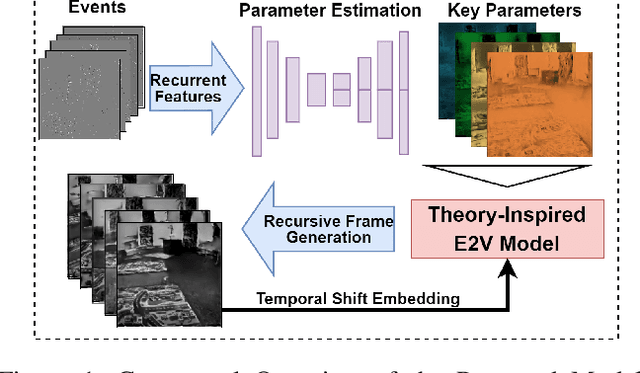
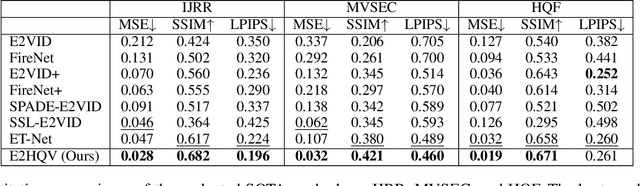
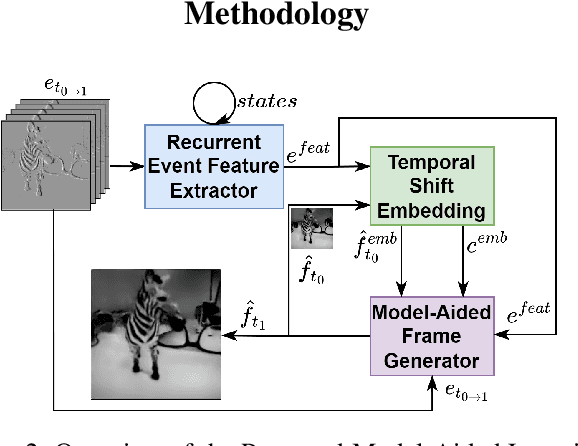

The bio-inspired event cameras or dynamic vision sensors are capable of asynchronously capturing per-pixel brightness changes (called event-streams) in high temporal resolution and high dynamic range. However, the non-structural spatial-temporal event-streams make it challenging for providing intuitive visualization with rich semantic information for human vision. It calls for events-to-video (E2V) solutions which take event-streams as input and generate high quality video frames for intuitive visualization. However, current solutions are predominantly data-driven without considering the prior knowledge of the underlying statistics relating event-streams and video frames. It highly relies on the non-linearity and generalization capability of the deep neural networks, thus, is struggling on reconstructing detailed textures when the scenes are complex. In this work, we propose \textbf{E2HQV}, a novel E2V paradigm designed to produce high-quality video frames from events. This approach leverages a model-aided deep learning framework, underpinned by a theory-inspired E2V model, which is meticulously derived from the fundamental imaging principles of event cameras. To deal with the issue of state-reset in the recurrent components of E2HQV, we also design a temporal shift embedding module to further improve the quality of the video frames. Comprehensive evaluations on the real world event camera datasets validate our approach, with E2HQV, notably outperforming state-of-the-art approaches, e.g., surpassing the second best by over 40\% for some evaluation metrics.
Prompt-based Multi-interest Learning Method for Sequential Recommendation
Jan 09, 2024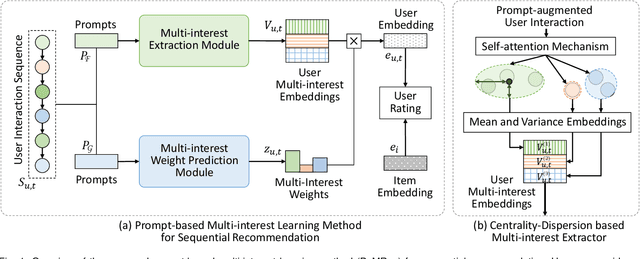
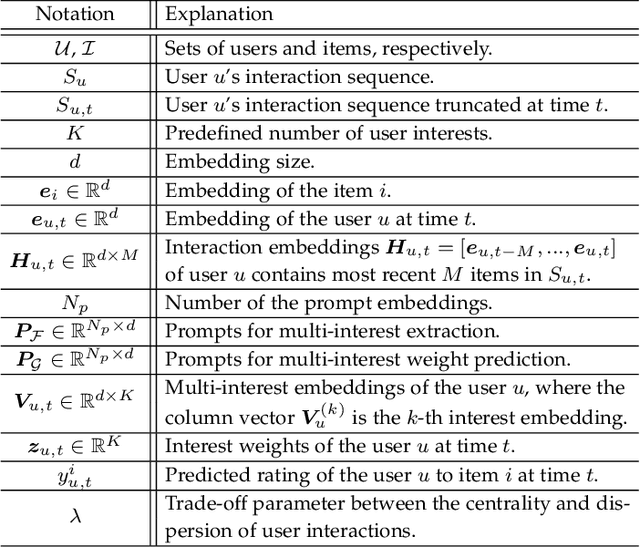
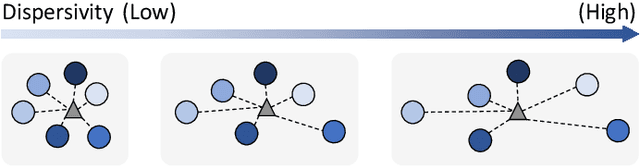
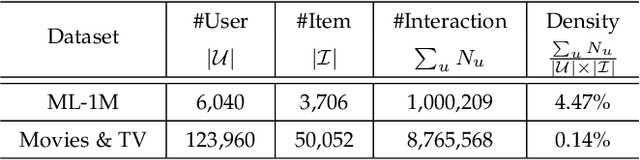
Multi-interest learning method for sequential recommendation aims to predict the next item according to user multi-faceted interests given the user historical interactions. Existing methods mainly consist of two modules: the multi-interest extraction module that learns user multi-interest embeddings to capture the user multi-interests, and the multi-interest weight prediction module that learns the weight of each interest for aggregating the learned multi-interest embeddings to derive the user embedding, used for predicting the user rating to an item. Despite their effectiveness, existing methods have two key limitations: 1) they directly feed the user interactions into the two modules, while ignoring their different learning objectives, and 2) they merely consider the centrality of the user interactions to learn the user multi-interests, while overlooking their dispersion. To tackle these limitations, we propose a prompt-based multi-interest learning method (PoMRec), where specific prompts are inserted into user interactions to make them adaptive to different learning objectives of the two modules. Moreover, we utilize both the mean and variance embeddings of user interactions to derive the user multi-interest embeddings for comprehensively model the user multi-interests. We conduct extensive experiments on two public datasets, and the results verify that our proposed PoMRec outperforms the state-of-the-art multi-interest learning methods.
One Shot Learning as Instruction Data Prospector for Large Language Models
Jan 04, 2024Aligning large language models(LLMs) with human is a critical step in effectively utilizing their pre-trained capabilities across a wide array of language tasks. Current instruction tuning practices often rely on expanding dataset size without a clear strategy for ensuring data quality, which can inadvertently introduce noise and degrade model performance. To address this challenge, we introduce Nuggets, a novel and efficient methodology that employs one shot learning to select high-quality instruction data from expansive datasets. Nuggets assesses the potential of individual instruction examples to act as effective one shot examples, thereby identifying those that can significantly enhance diverse task performance. Nuggets utilizes a scoring system based on the impact of candidate examples on the perplexity of a diverse anchor set, facilitating the selection of the most beneficial data for instruction tuning. Through rigorous testing on two benchmarks, including MT-Bench and Alpaca-Eval, we demonstrate that instruction tuning with the top 1% of Nuggets-curated examples substantially outperforms conventional methods that use the full dataset. These findings advocate for a data selection paradigm that prioritizes quality, offering a more efficient pathway to align LLMs with humans.
How Well Does GPT-4V Adapt to Distribution Shifts? A Preliminary Investigation
Dec 13, 2023
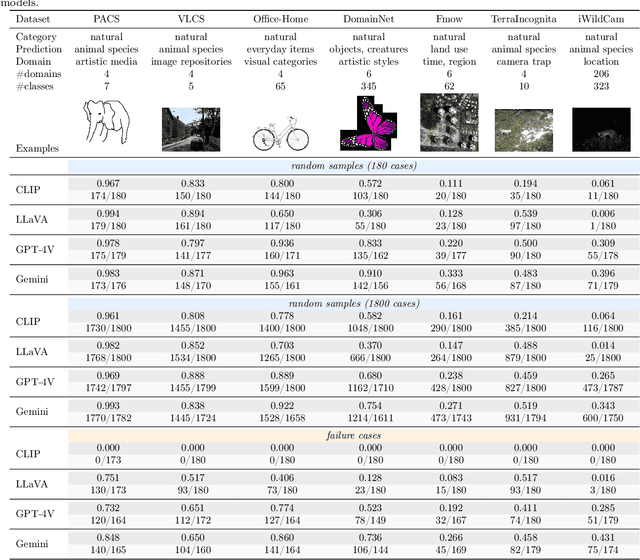
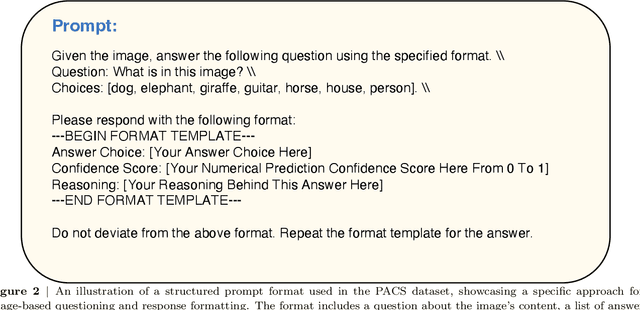
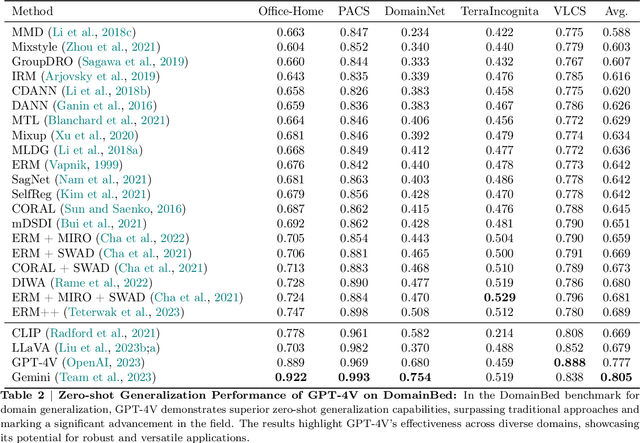
In machine learning, generalization against distribution shifts -- where deployment conditions diverge from the training scenarios -- is crucial, particularly in fields like climate modeling, biomedicine, and autonomous driving. The emergence of foundation models, distinguished by their extensive pretraining and task versatility, has led to an increased interest in their adaptability to distribution shifts. GPT-4V(ision) acts as the most advanced publicly accessible multimodal foundation model, with extensive applications across various domains, including anomaly detection, video understanding, image generation, and medical diagnosis. However, its robustness against data distributions remains largely underexplored. Addressing this gap, this study rigorously evaluates GPT-4V's adaptability and generalization capabilities in dynamic environments, benchmarking against prominent models like CLIP and LLaVA. We delve into GPT-4V's zero-shot generalization across 13 diverse datasets spanning natural, medical, and molecular domains. We further investigate its adaptability to controlled data perturbations and examine the efficacy of in-context learning as a tool to enhance its adaptation. Our findings delineate GPT-4V's capability boundaries in distribution shifts, shedding light on its strengths and limitations across various scenarios. Importantly, this investigation contributes to our understanding of how AI foundation models generalize to distribution shifts, offering pivotal insights into their adaptability and robustness. Code is publicly available at https://github.com/jameszhou-gl/gpt-4v-distribution-shift.
ERASE: Error-Resilient Representation Learning on Graphs for Label Noise Tolerance
Dec 13, 2023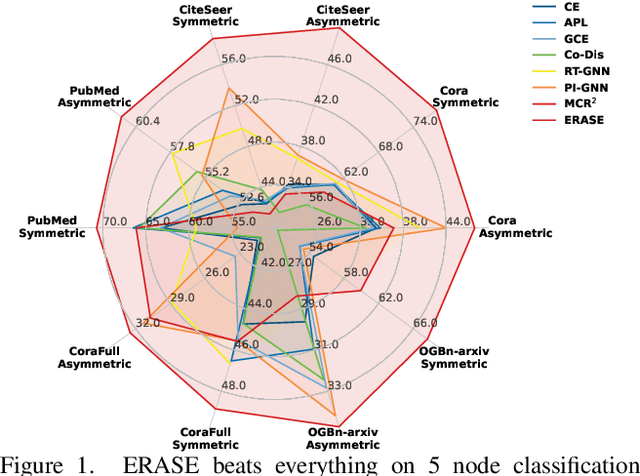


Deep learning has achieved remarkable success in graph-related tasks, yet this accomplishment heavily relies on large-scale high-quality annotated datasets. However, acquiring such datasets can be cost-prohibitive, leading to the practical use of labels obtained from economically efficient sources such as web searches and user tags. Unfortunately, these labels often come with noise, compromising the generalization performance of deep networks. To tackle this challenge and enhance the robustness of deep learning models against label noise in graph-based tasks, we propose a method called ERASE (Error-Resilient representation learning on graphs for lAbel noiSe tolerancE). The core idea of ERASE is to learn representations with error tolerance by maximizing coding rate reduction. Particularly, we introduce a decoupled label propagation method for learning representations. Before training, noisy labels are pre-corrected through structural denoising. During training, ERASE combines prototype pseudo-labels with propagated denoised labels and updates representations with error resilience, which significantly improves the generalization performance in node classification. The proposed method allows us to more effectively withstand errors caused by mislabeled nodes, thereby strengthening the robustness of deep networks in handling noisy graph data. Extensive experimental results show that our method can outperform multiple baselines with clear margins in broad noise levels and enjoy great scalability. Codes are released at https://github.com/eraseai/erase.
Machine Vision Therapy: Multimodal Large Language Models Can Enhance Visual Robustness via Denoising In-Context Learning
Dec 05, 2023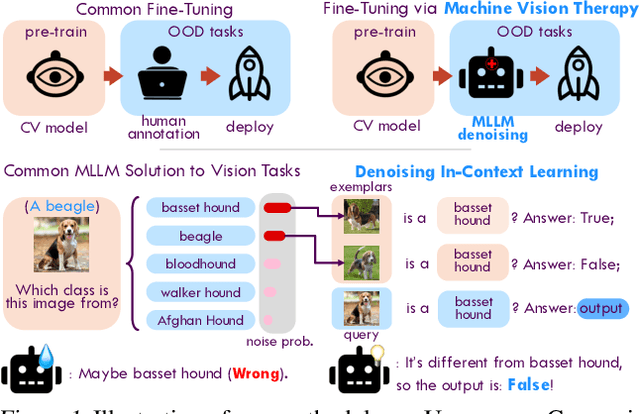


Although vision models such as Contrastive Language-Image Pre-Training (CLIP) show impressive generalization performance, their zero-shot robustness is still limited under Out-of-Distribution (OOD) scenarios without fine-tuning. Instead of undesirably providing human supervision as commonly done, it is possible to take advantage of Multi-modal Large Language Models (MLLMs) that hold powerful visual understanding abilities. However, MLLMs are shown to struggle with vision problems due to the incompatibility of tasks, thus hindering their utilization. In this paper, we propose to effectively leverage MLLMs to conduct Machine Vision Therapy which aims to rectify the noisy predictions from vision models. By fine-tuning with the denoised labels, the learning model performance can be boosted in an unsupervised manner. To solve the incompatibility issue, we propose a novel Denoising In-Context Learning (DICL) strategy to align vision tasks with MLLMs. Concretely, by estimating a transition matrix that captures the probability of one class being confused with another, an instruction containing a correct exemplar and an erroneous one from the most probable noisy class can be constructed. Such an instruction can help any MLLMs with ICL ability to detect and rectify incorrect predictions of vision models. Through extensive experiments on ImageNet, WILDS, DomainBed, and other OOD datasets, we carefully validate the quantitative and qualitative effectiveness of our method. Our code is available at https://github.com/tmllab/Machine_Vision_Therapy.
Coreset Selection with Prioritized Multiple Objectives
Nov 15, 2023Coreset selection is powerful in reducing computational costs and accelerating data processing for deep learning algorithms. It strives to identify a small subset from large-scale data, so that training only on the subset practically performs on par with full data. When coreset selection is applied in realistic scenes, under the premise that the identified coreset has achieved comparable model performance, practitioners regularly desire the identified coreset can have a size as small as possible for lower costs and greater acceleration. Motivated by this desideratum, for the first time, we pose the problem of "coreset selection with prioritized multiple objectives", in which the smallest coreset size under model performance constraints is explored. Moreover, to address this problem, an innovative method is proposed, which maintains optimization priority order over the model performance and coreset size, and efficiently optimizes them in the coreset selection procedure. Theoretically, we provide the convergence guarantee of the proposed method. Empirically, extensive experiments confirm its superiority compared with previous strategies, often yielding better model performance with smaller coreset sizes.
DeepInception: Hypnotize Large Language Model to Be Jailbreaker
Nov 06, 2023Despite remarkable success in various applications, large language models (LLMs) are vulnerable to adversarial jailbreaks that make the safety guardrails void. However, previous studies for jailbreaks usually resort to brute-force optimization or extrapolations of a high computation cost, which might not be practical or effective. In this paper, inspired by the Milgram experiment that individuals can harm another person if they are told to do so by an authoritative figure, we disclose a lightweight method, termed as DeepInception, which can easily hypnotize LLM to be a jailbreaker and unlock its misusing risks. Specifically, DeepInception leverages the personification ability of LLM to construct a novel nested scene to behave, which realizes an adaptive way to escape the usage control in a normal scenario and provides the possibility for further direct jailbreaks. Empirically, we conduct comprehensive experiments to show its efficacy. Our DeepInception can achieve competitive jailbreak success rates with previous counterparts and realize a continuous jailbreak in subsequent interactions, which reveals the critical weakness of self-losing on both open/closed-source LLMs like Falcon, Vicuna, Llama-2, and GPT-3.5/4/4V. Our investigation appeals that people should pay more attention to the safety aspects of LLMs and a stronger defense against their misuse risks. The code is publicly available at: https://github.com/tmlr-group/DeepInception.