 Add to Chrome
 Add to Firefox
 Add to Edge
Molt: A Scalable PyTorch-Native Training Framework for Agentic Reinforcement Learning
Jul 22, 2026
Agentic reinforcement learning research is constant algorithm modification, new estimators, new pipeline stages, new rollout schemes, and in mainstream frameworks each change threads through layers of trainer, distributed backend, and rollout glue: the cost lands on the researcher at every iteration. Molt is a PyTorch-native training framework built to keep that cost small: a codebase compact and clean enough for a researcher to hold in their head, and for an AI coding assistant to read and reason about in its entirety, so the algorithm flow can be traced and changed end to end. The agent is an ordinary program, and one asynchronous loop trains multimodal and mixture-of-experts policies while never training on a token it did not generate, consistent in tokens, policy versions, and model semantics. Leanness does not cost performance: under a matched, fully asynchronous protocol, Molt is statistically comparable to a state-of-the-art Megatron-based stack. Molt is open source and provides recipes and containers at https://github.com/NVIDIA-NeMo/labs-molt.

An Empirical Study for Android-to-OpenHarmony GUI Test Migration
Jul 14, 2026To reduce the substantial engineering effort required to test the corresponding applications from Android to OpenHarmony, migrating existing GUI test cases has become a critical problem. However, current research neither proposes solutions tailored for OpenHarmony nor provides a systematic evaluation of migration approaches on this system, leaving developers with limited empirical guidance in practice. In this paper, we present the first systematic empirical study of test migration from Android to OpenHarmony. Specifically, we first construct a dataset referred to as the ATH Benchmark, comprising 36 commercial applications with an average of over 9 billion downloads, along with 108 manually designed test cases. Second, we select two state-of-the-art test migration approaches (i.e., ReSPlay and ITeM) and adapt these two approaches to enable their execution on OpenHarmony. Third, we use the preceding infrastructure to evaluate these two approaches from three perspectives, including testing performance, root causes of failures, and the impact of OpenHarmony characteristics. Our results reveal that existing test migration approaches are less effective (15% success-rate on ReSPlay and 26% success-rate on ITeM) in Android-to-OpenHarmony scenarios. Through an in-depth analysis of failed cases, we identify that test performance is primarily hindered by OpenHarmony-specific characteristics, including technical architecture differences and unique ecosystem traits. Utilizing these findings, we propose an enhanced approach based on ITeM, referred as ITeM-HM, which incorporates specific OpenHarmony system features. As a result, ITeM-HM successfully achieves a 214% success-rate relative improvement over the original ITeM (from 26% to 81%).
Who&When Pro: Can LLMs Really Attribute Failures in AI Agents?
Jul 10, 2026Automated failure attribution uses LLMs to identify where and why agentic systems fail. As agents become more capable, their failures become subtler, making automated attribution increasingly important. We introduce Who&When Pro, a large-scale benchmark for automated failure attribution in agentic systems. Using a strictly controlled pipeline that injects a failure only after exactly replaying a successful prefix, we construct 12,326 failed trajectories with golden labels across 3 modalities and 26 benchmarks covering various scenarios. Beyond benchmarking, we conduct extensive experiments and analyses, revealing systematic patterns in how models attribute failures across modalities, protocols, and model families, and providing empirical guidance for future automated failure attribution systems.
ProCUA-SFT Technical Report
Jun 15, 2026Training computer-use agents (CUAs) -- models that interact with graphical desktops through screenshots and keyboard/mouse actions -- requires large-scale, diverse trajectory data collected in full desktop environments. The largest public resource, AgentNet (22.5K human trajectories), leads to negative transfer when used for supervised fine-tuning (SFT): continuing training UI-TARS 7B on AgentNet causes OSWorld success rate to fall from 26.3% to 8-10%. We present ProCUA-SFT, a dataset of 3.1M step-level SFT samples distilled from 93K synthetic trajectories across 2,484 application combinations. The dataset is produced by a fully automated pipeline that (i) synthesizes grounded tasks on live desktops seeded with real-world content -- 912 spreadsheets from SpreadsheetBench, approximately 10K permissively-licensed presentations from Zenodo10K, and multi-application OSWorld configs -- and (ii) verifies each task's feasibility through binary precondition checking before rollout. A single VLM (Kimi-K2.5) serves as goal generator, precondition judge, and trajectory executor, eliminating planner-actor capability gaps. Each trajectory is expanded into step-prefix samples that exactly reproduce the context layout seen at inference time. Fine-tuning UI-TARS 7B on ProCUA-SFT for one epoch yields 45.0% on OSWorld -- an 18.7 percentage-point improvement over the base model and over 35% above AgentNet-trained counterparts. A subset of ProCUA was incorporated into the training data for the Nemotron 3 Nano Omni model, contributing to its computer-use capabilities.
Nemotron 3 Nano Omni: Efficient and Open Multimodal Intelligence
Apr 27, 2026We introduce Nemotron 3 Nano Omni, the latest model in the Nemotron multimodal series and the first to natively support audio inputs alongside text, images, and video. Nemotron 3 Nano Omni delivers consistent accuracy improvements over its predecessor, Nemotron Nano V2 VL, across all modalities, enabled by advances in architecture, training data and recipes. In particular, Nemotron 3 delivers leading results in real-world document understanding, long audio-video comprehension, and agentic computer use. Built on the highly efficient Nemotron 3 Nano 30B-A3B backbone, Nemotron 3 Nano Omni further incorporates innovative multimodal token-reduction techniques to deliver substantially lower inference latency and higher throughput than other models of similar size. We are releasing model checkpoints in BF16, FP8, and FP4 formats, along with portions of the training data and codebase to facilitate further research and development.
ProRL Agent: Rollout-as-a-Service for RL Training of Multi-Turn LLM Agents
Mar 19, 2026Multi-turn LLM agents are increasingly important for solving complex, interactive tasks, and reinforcement learning (RL) is a key ingredient for improving their long-horizon behavior. However, RL training requires generating large numbers of sandboxed rollout trajectories, and existing infrastructures often couple rollout orchestration with the training loop, making systems hard to migrate and maintain. Under the rollout-as-a-service philosophy, we present ProRL Agent , a scalable infrastructure that serves the full agentic rollout lifecycle through an API service. ProRL Agent also provides standardized and extensible sandbox environments that support diverse agentic tasks in rootless HPC settings. We validate ProRL Agent through RL training on software engineering, math, STEM, and coding tasks. ProRL Agent is open-sourced and integrated as part of NVIDIA NeMo Gym.
Golden Goose: A Simple Trick to Synthesize Unlimited RLVR Tasks from Unverifiable Internet Text
Jan 30, 2026Reinforcement Learning with Verifiable Rewards (RLVR) has become a cornerstone for unlocking complex reasoning in Large Language Models (LLMs). Yet, scaling up RL is bottlenecked by limited existing verifiable data, where improvements increasingly saturate over prolonged training. To overcome this, we propose Golden Goose, a simple trick to synthesize unlimited RLVR tasks from unverifiable internet text by constructing a multiple-choice question-answering version of the fill-in-the-middle task. Given a source text, we prompt an LLM to identify and mask key reasoning steps, then generate a set of diverse, plausible distractors. This enables us to leverage reasoning-rich unverifiable corpora typically excluded from prior RLVR data construction (e.g., science textbooks) to synthesize GooseReason-0.7M, a large-scale RLVR dataset with over 0.7 million tasks spanning mathematics, programming, and general scientific domains. Empirically, GooseReason effectively revives models saturated on existing RLVR data, yielding robust, sustained gains under continuous RL and achieving new state-of-the-art results for 1.5B and 4B-Instruct models across 15 diverse benchmarks. Finally, we deploy Golden Goose in a real-world setting, synthesizing RLVR tasks from raw FineWeb scrapes for the cybersecurity domain, where no prior RLVR data exists. Training Qwen3-4B-Instruct on the resulting data GooseReason-Cyber sets a new state-of-the-art in cybersecurity, surpassing a 7B domain-specialized model with extensive domain-specific pre-training and post-training. This highlights the potential of automatically scaling up RLVR data by exploiting abundant, reasoning-rich, unverifiable internet text.
NVIDIA Nemotron Nano V2 VL
Nov 07, 2025We introduce Nemotron Nano V2 VL, the latest model of the Nemotron vision-language series designed for strong real-world document understanding, long video comprehension, and reasoning tasks. Nemotron Nano V2 VL delivers significant improvements over our previous model, Llama-3.1-Nemotron-Nano-VL-8B, across all vision and text domains through major enhancements in model architecture, datasets, and training recipes. Nemotron Nano V2 VL builds on Nemotron Nano V2, a hybrid Mamba-Transformer LLM, and innovative token reduction techniques to achieve higher inference throughput in long document and video scenarios. We are releasing model checkpoints in BF16, FP8, and FP4 formats and sharing large parts of our datasets, recipes and training code.
A Survey of Self-Evolving Agents: On Path to Artificial Super Intelligence
Jul 28, 2025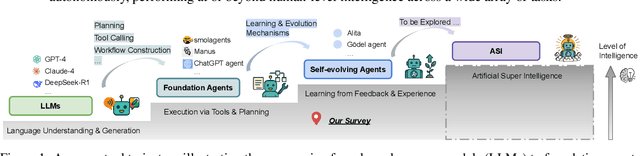

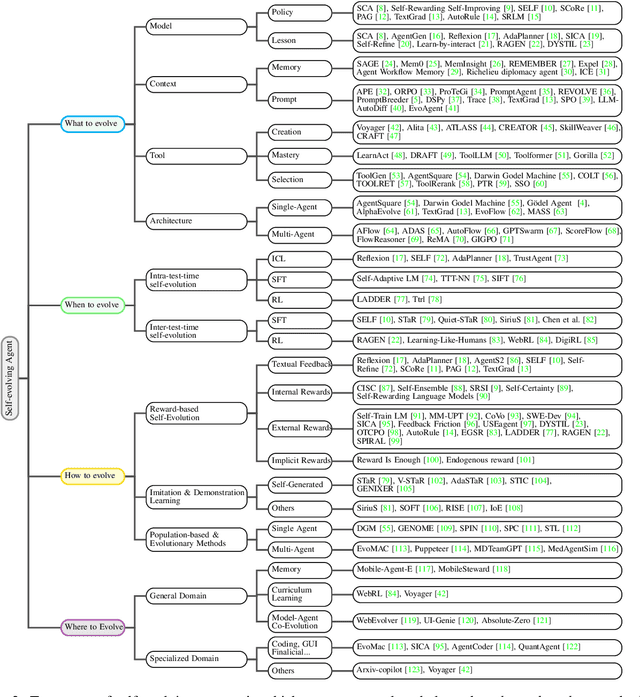
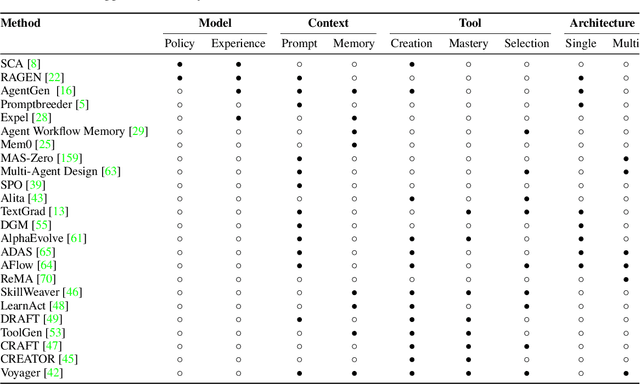
Large Language Models (LLMs) have demonstrated strong capabilities but remain fundamentally static, unable to adapt their internal parameters to novel tasks, evolving knowledge domains, or dynamic interaction contexts. As LLMs are increasingly deployed in open-ended, interactive environments, this static nature has become a critical bottleneck, necessitating agents that can adaptively reason, act, and evolve in real time. This paradigm shift -- from scaling static models to developing self-evolving agents -- has sparked growing interest in architectures and methods enabling continual learning and adaptation from data, interactions, and experiences. This survey provides the first systematic and comprehensive review of self-evolving agents, organized around three foundational dimensions -- what to evolve, when to evolve, and how to evolve. We examine evolutionary mechanisms across agent components (e.g., models, memory, tools, architecture), categorize adaptation methods by stages (e.g., intra-test-time, inter-test-time), and analyze the algorithmic and architectural designs that guide evolutionary adaptation (e.g., scalar rewards, textual feedback, single-agent and multi-agent systems). Additionally, we analyze evaluation metrics and benchmarks tailored for self-evolving agents, highlight applications in domains such as coding, education, and healthcare, and identify critical challenges and research directions in safety, scalability, and co-evolutionary dynamics. By providing a structured framework for understanding and designing self-evolving agents, this survey establishes a roadmap for advancing adaptive agentic systems in both research and real-world deployments, ultimately shedding lights to pave the way for the realization of Artificial Super Intelligence (ASI), where agents evolve autonomously, performing at or beyond human-level intelligence across a wide array of tasks.
Divide, Optimize, Merge: Fine-Grained LLM Agent Optimization at Scale
May 06, 2025LLM-based optimization has shown remarkable potential in enhancing agentic systems. However, the conventional approach of prompting LLM optimizer with the whole training trajectories on training dataset in a single pass becomes untenable as datasets grow, leading to context window overflow and degraded pattern recognition. To address these challenges, we propose Fine-Grained Optimization (FGO), a scalable framework that divides large optimization tasks into manageable subsets, performs targeted optimizations, and systematically combines optimized components through progressive merging. Evaluation across ALFWorld, LogisticsQA, and GAIA benchmarks demonstrate that FGO outperforms existing approaches by 1.6-8.6% while reducing average prompt token consumption by 56.3%. Our framework provides a practical solution for scaling up LLM-based optimization of increasingly sophisticated agent systems. Further analysis demonstrates that FGO achieves the most consistent performance gain in all training dataset sizes, showcasing its scalability and efficiency.