 Add to Chrome
 Add to Firefox
 Add to Edge
FA-LAM: Focus-Aware Large Avatar Model for One-Shot 4D Animatable Gaussian Head
Jul 23, 2026
We propose FA-LAM, a Focus-Aware Large Avatar Model for one-shot animatable Gaussian head creation, while simultaneously enabling static 3D and dynamic 4D full-head recovery. The core of our method lies in a thorough analysis of the attention mechanisms and the entangled reconstruction and animation training pipeline adopted by prior state-of-the-art approaches. Our analysis identifies two main factors that compromise the quality of 3D full-head generation: (1) incorrect and noisy attention activations, and (2) conflicts between the tasks of reconstruction and animation. To address the first issue, we introduce a symmetric and semantic attention regularization strategy that leverages the inherent semantics and structural symmetry of human heads. To disentangle the objectives of reconstruction and animation, we develop a novel dual-phase training pipeline that separates the model's capabilities for large-view hallucination and animation into distinct modules. Moreover, we enhance our model to support multi-view and streaming 4D reconstruction in an efficient and memory-friendly manner through a core autoregressive modification with tailored visibility-aware token fusion. Collectively, these innovations enable FA-LAM to reconstruct animatable Gaussian full heads with superior quality, particularly in fine facial regions and large viewing angles.

Training-Free Image Editing with Visual Context Integration and Concept Alignment
Apr 06, 2026In image editing, it is essential to incorporate a context image to convey the user's precise requirements, such as subject appearance or image style. Existing training-based visual context-aware editing methods incur data collection effort and training cost. On the other hand, the training-free alternatives are typically established on diffusion inversion, which struggles with consistency and flexibility. In this work, we propose VicoEdit, a training-free and inversion-free method to inject the visual context into the pretrained text-prompted editing model. More specifically, VicoEdit directly transforms the source image into the target one based on the visual context, thereby eliminating the need for inversion that can lead to deviated trajectories. Moreover, we design a posterior sampling approach guided by concept alignment to enhance the editing consistency. Empirical results demonstrate that our training-free method achieves even better editing performance than the state-of-the-art training-based models.
Real-Time Human Frontal View Synthesis from a Single Image
Mar 16, 2026Photorealistic human novel view synthesis from a single image is crucial for democratizing immersive 3D telepresence, eliminating the need for complex multi-camera setups. However, current rendering-centric methods prioritize visual fidelity over explicit geometric understanding and struggle with intricate regions like faces and hands, leading to temporal instability. Meanwhile, human-centric frameworks suffer from memory bottlenecks since they typically rely on an auxiliary model to provide informative structural priors for geometric modeling, which limits real-time performance. To address these challenges, we propose PrismMirror, a geometry-guided framework for instant frontal view synthesis from a single image. By avoiding external geometric modeling and focusing on frontal view synthesis, our model optimizes visual integrity for telepresence. Specifically, PrismMirror introduces a novel cascade learning strategy that enables coarse-to-fine geometric feature learning. It first directly learns coarse geometric features, such as SMPL-X meshes and point clouds, and then refines textures through rendering supervision. To achieve real-time efficiency, we distill this unified framework into a lightweight linear attention model. Notably, PrismMirror is the first monocular human frontal view synthesis model that achieves real-time inference at 24 FPS, significantly outperforming previous methods in both visual authenticity and structural accuracy.
Token-level Data Selection for Safe LLM Fine-tuning
Mar 01, 2026Fine-tuning large language models (LLMs) on custom datasets has become a standard approach for adapting these models to specific domains and applications. However, recent studies have shown that such fine-tuning can lead to significant degradation in the model's safety. Existing defense methods operate at the sample level and often suffer from an unsatisfactory trade-off between safety and utility. To address this limitation, we perform a systematic token-level diagnosis of safety degradation during fine-tuning. Based on this, we propose token-level data selection for safe LLM fine-tuning (TOSS), a novel framework that quantifies the safety risk of each token by measuring the loss difference between a safety-degraded model and a utility-oriented model. This token-level granularity enables accurate identification and removal of unsafe tokens, thereby preserving valuable task-specific information. In addition, we introduce a progressive refinement strategy, TOSS-Pro, which iteratively enhances the safety-degraded model's ability to identify unsafe tokens. Extensive experiments demonstrate that our approach robustly safeguards LLMs during fine-tuning while achieving superior downstream task performance, significantly outperforming existing sample-level defense methods. Our code is available at https://github.com/Polly-LYP/TOSS.
Flash-VAED: Plug-and-Play VAE Decoders for Efficient Video Generation
Feb 22, 2026Latent diffusion models have enabled high-quality video synthesis, yet their inference remains costly and time-consuming. As diffusion transformers become increasingly efficient, the latency bottleneck inevitably shifts to VAE decoders. To reduce their latency while maintaining quality, we propose a universal acceleration framework for VAE decoders that preserves full alignment with the original latent distribution. Specifically, we propose (1) an independence-aware channel pruning method to effectively mitigate severe channel redundancy, and (2) a stage-wise dominant operator optimization strategy to address the high inference cost of the widely used causal 3D convolutions in VAE decoders. Based on these innovations, we construct a Flash-VAED family. Moreover, we design a three-phase dynamic distillation framework that efficiently transfers the capabilities of the original VAE decoder to Flash-VAED. Extensive experiments on Wan and LTX-Video VAE decoders demonstrate that our method outperforms baselines in both quality and speed, achieving approximately a 6$\times$ speedup while maintaining the reconstruction performance up to 96.9%. Notably, Flash-VAED accelerates the end-to-end generation pipeline by up to 36% with negligible quality drops on VBench-2.0.
Bridging Visual and Wireless Sensing: A Unified Radiation Field for 3D Radio Map Construction
Jan 27, 2026The emerging applications of next-generation wireless networks (e.g., immersive 3D communication, low-altitude networks, and integrated sensing and communication) necessitate high-fidelity environmental intelligence. 3D radio maps have emerged as a critical tool for this purpose, enabling spectrum-aware planning and environment-aware sensing by bridging the gap between physical environments and electromagnetic signal propagation. However, constructing accurate 3D radio maps requires fine-grained 3D geometric information and a profound understanding of electromagnetic wave propagation. Existing approaches typically treat optical and wireless knowledge as distinct modalities, failing to exploit the fundamental physical principles governing both light and electromagnetic propagation. To bridge this gap, we propose URF-GS, a unified radio-optical radiation field representation framework for accurate and generalizable 3D radio map construction based on 3D Gaussian splatting (3D-GS) and inverse rendering. By fusing visual and wireless sensing observations, URF-GS recovers scene geometry and material properties while accurately predicting radio signal behavior at arbitrary transmitter-receiver (Tx-Rx) configurations. Experimental results demonstrate that URF-GS achieves up to a 24.7% improvement in spatial spectrum prediction accuracy and a 10x increase in sample efficiency for 3D radio map construction compared with neural radiance field (NeRF)-based methods. This work establishes a foundation for next-generation wireless networks by integrating perception, interaction, and communication through holistic radiation field reconstruction.
Mon3tr: Monocular 3D Telepresence with Pre-built Gaussian Avatars as Amortization
Jan 12, 2026Immersive telepresence aims to transform human interaction in AR/VR applications by enabling lifelike full-body holographic representations for enhanced remote collaboration. However, existing systems rely on hardware-intensive multi-camera setups and demand high bandwidth for volumetric streaming, limiting their real-time performance on mobile devices. To overcome these challenges, we propose Mon3tr, a novel Monocular 3D telepresence framework that integrates 3D Gaussian splatting (3DGS) based parametric human modeling into telepresence for the first time. Mon3tr adopts an amortized computation strategy, dividing the process into a one-time offline multi-view reconstruction phase to build a user-specific avatar and a monocular online inference phase during live telepresence sessions. A single monocular RGB camera is used to capture body motions and facial expressions in real time to drive the 3DGS-based parametric human model, significantly reducing system complexity and cost. The extracted motion and appearance features are transmitted at < 0.2 Mbps over WebRTC's data channel, allowing robust adaptation to network fluctuations. On the receiver side, e.g., Meta Quest 3, we develop a lightweight 3DGS attribute deformation network to dynamically generate corrective 3DGS attribute adjustments on the pre-built avatar, synthesizing photorealistic motion and appearance at ~ 60 FPS. Extensive experiments demonstrate the state-of-the-art performance of our method, achieving a PSNR of > 28 dB for novel poses, an end-to-end latency of ~ 80 ms, and > 1000x bandwidth reduction compared to point-cloud streaming, while supporting real-time operation from monocular inputs across diverse scenarios. Our demos can be found at https://mon3tr3d.github.io.
WRF-GS: Wireless Radiation Field Reconstruction with 3D Gaussian Splatting
Dec 06, 2024Wireless channel modeling plays a pivotal role in designing, analyzing, and optimizing wireless communication systems. Nevertheless, developing an effective channel modeling approach has been a longstanding challenge. This issue has been escalated due to the denser network deployment, larger antenna arrays, and wider bandwidth in 5G and beyond networks. To address this challenge, we put forth WRF-GS, a novel framework for channel modeling based on wireless radiation field (WRF) reconstruction using 3D Gaussian splatting. WRF-GS employs 3D Gaussian primitives and neural networks to capture the interactions between the environment and radio signals, enabling efficient WRF reconstruction and visualization of the propagation characteristics. The reconstructed WRF can then be used to synthesize the spatial spectrum for comprehensive wireless channel characterization. Notably, with a small number of measurements, WRF-GS can synthesize new spatial spectra within milliseconds for a given scene, thereby enabling latency-sensitive applications. Experimental results demonstrate that WRF-GS outperforms existing methods for spatial spectrum synthesis, such as ray tracing and other deep-learning approaches. Moreover, WRF-GS achieves superior performance in the channel state information prediction task, surpassing existing methods by a significant margin of more than 2.43 dB.
Dynamics-Aware Gaussian Splatting Streaming Towards Fast On-the-Fly Training for 4D Reconstruction
Nov 22, 2024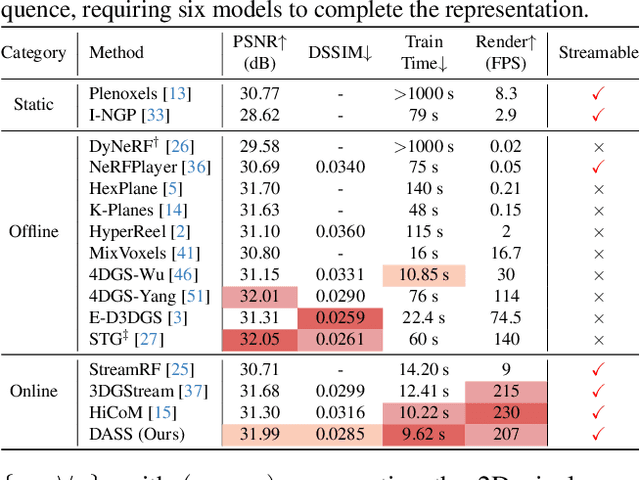
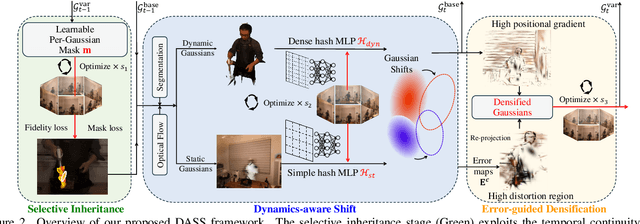
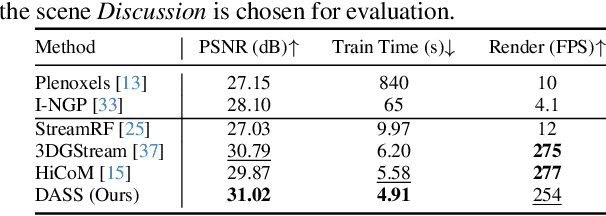
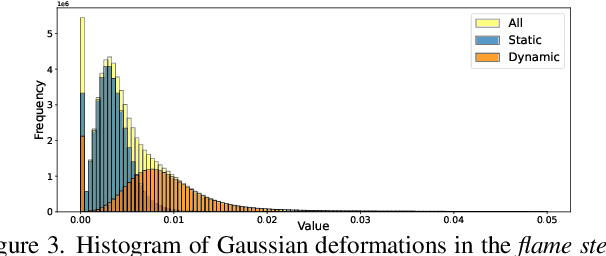
The recent development of 3D Gaussian Splatting (3DGS) has led to great interest in 4D dynamic spatial reconstruction from multi-view visual inputs. While existing approaches mainly rely on processing full-length multi-view videos for 4D reconstruction, there has been limited exploration of iterative online reconstruction methods that enable on-the-fly training and per-frame streaming. Current 3DGS-based streaming methods treat the Gaussian primitives uniformly and constantly renew the densified Gaussians, thereby overlooking the difference between dynamic and static features and also neglecting the temporal continuity in the scene. To address these limitations, we propose a novel three-stage pipeline for iterative streamable 4D dynamic spatial reconstruction. Our pipeline comprises a selective inheritance stage to preserve temporal continuity, a dynamics-aware shift stage for distinguishing dynamic and static primitives and optimizing their movements, and an error-guided densification stage to accommodate emerging objects. Our method achieves state-of-the-art performance in online 4D reconstruction, demonstrating a 20% improvement in on-the-fly training speed, superior representation quality, and real-time rendering capability. Project page: https://www.liuzhening.top/DASS
MEGA: Memory-Efficient 4D Gaussian Splatting for Dynamic Scenes
Oct 17, 20244D Gaussian Splatting (4DGS) has recently emerged as a promising technique for capturing complex dynamic 3D scenes with high fidelity. It utilizes a 4D Gaussian representation and a GPU-friendly rasterizer, enabling rapid rendering speeds. Despite its advantages, 4DGS faces significant challenges, notably the requirement of millions of 4D Gaussians, each with extensive associated attributes, leading to substantial memory and storage cost. This paper introduces a memory-efficient framework for 4DGS. We streamline the color attribute by decomposing it into a per-Gaussian direct color component with only 3 parameters and a shared lightweight alternating current color predictor. This approach eliminates the need for spherical harmonics coefficients, which typically involve up to 144 parameters in classic 4DGS, thereby creating a memory-efficient 4D Gaussian representation. Furthermore, we introduce an entropy-constrained Gaussian deformation technique that uses a deformation field to expand the action range of each Gaussian and integrates an opacity-based entropy loss to limit the number of Gaussians, thus forcing our model to use as few Gaussians as possible to fit a dynamic scene well. With simple half-precision storage and zip compression, our framework achieves a storage reduction by approximately 190$\times$ and 125$\times$ on the Technicolor and Neural 3D Video datasets, respectively, compared to the original 4DGS. Meanwhile, it maintains comparable rendering speeds and scene representation quality, setting a new standard in the field.