 Add to Chrome
 Add to Firefox
 Add to Edge
AR Forcing: Towards Long-Horizon Robot Navigation World Model
May 29, 2026
The diffusion based robot navigation world models are typically trained using parallel supervision, while autoregressive inference is employed during path planning. This results in a distribution shift between training and inference, which destabilizes the performance over long-horizon prediction. We propose AR Forcing, an autoregressive training strategy, which integrates the standard diffusion loss into the autoregressive training loop. At each step, the model uses its own predictions to update the context and optimize the single step noise prediction objective, thereby explicitly exposing the model to the inference state distribution during training. Our method does not require additional discriminators or distribution-matching losses, retains the original diffusion framework and sampler, and is easy to integrate. Experiments on multi-domain navigation datasets (RECON, SCAND, HuRoN, TartanDrive) show that compared with strong baselines, AR Forcing improved the consistency of generated images during long-horizon navigation and the accuracy of predicted trajectories, enhancing robustness of the model in complex known and unknown environments. We will release the code soon.

RoboMemArena: A Comprehensive and Challenging Robotic Memory Benchmark
May 11, 2026Memory is a critical component of robotic intelligence, as robots must rely on past observations and actions to accomplish long-horizon tasks in partially observable environments. However, existing robotic memory benchmarks still lack multimodal annotations for memory formation, provide limited task coverage and structural complexity, and remain restricted to simulation without real-world evaluation. We address this gap with RoboMemArena, a large-scale benchmark of 26 tasks, with average trajectory lengths exceeding 1,000 steps per task and 68.9% of subtasks being memory-dependent. The generation pipeline leverages a vision-language model (VLM) to design and compose subtasks, generates full trajectories through atomic functions, and provides memory-related annotations, including subtask instructions and native keyframe annotations, while paired real-world memory tasks support physical evaluation. We further design PrediMem, a dual-system VLA in which a high-level VLM planner manages a memory bank with recent and keyframe buffers and uses a predictive coding head to improve sensitivity to task dynamics. Extensive experiments on RoboMemArena show that PrediMem outperforms all baselines and provides insights into memory management, model architecture, and scaling laws for complex memory systems.
PROSPECT: Unified Streaming Vision-Language Navigation via Semantic--Spatial Fusion and Latent Predictive Representation
Mar 04, 2026Multimodal large language models (MLLMs) have advanced zero-shot end-to-end Vision-Language Navigation (VLN), yet robust navigation requires not only semantic understanding but also predictive modeling of environment dynamics and spatial structure. We propose PROSPECT, a unified streaming navigation agent that couples a streaming Vision-Language-Action (VLA) policy with latent predictive representation learning. PROSPECT uses CUT3R as a streaming 3D foundation spatial encoder to produce long-context, absolute-scale spatial features, and fuses them with SigLIP semantic features via cross-attention. During training, we introduce learnable stream query tokens that query the streaming context and predict next-step 2D and 3D latent features (rather than pixels or explicit modalities), supervised in the latent spaces of frozen SigLIP and CUT3R teachers. The predictive branch shapes internal representations without inference overhead. Experiments on VLN-CE benchmarks and real-robot deployment demonstrate state-of-the-art performance and improved long-horizon robustness under diverse lighting. We will release code for the community soon.
V-Shuffle: Zero-Shot Style Transfer via Value Shuffle
Nov 09, 2025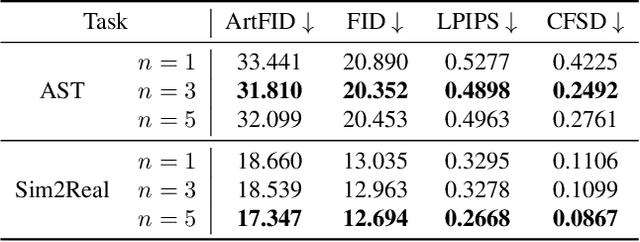
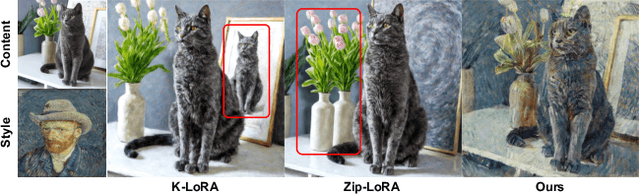
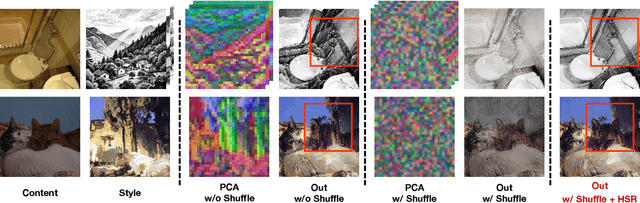
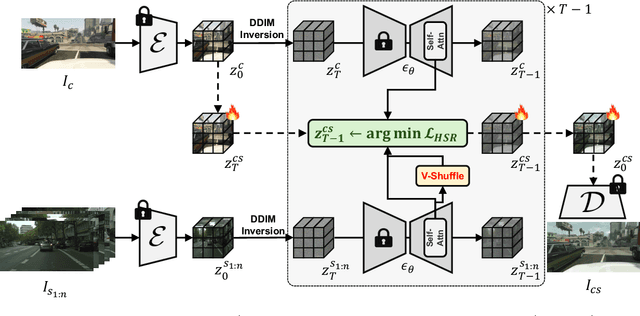
Attention injection-based style transfer has achieved remarkable progress in recent years. However, existing methods often suffer from content leakage, where the undesired semantic content of the style image mistakenly appears in the stylized output. In this paper, we propose V-Shuffle, a zero-shot style transfer method that leverages multiple style images from the same style domain to effectively navigate the trade-off between content preservation and style fidelity. V-Shuffle implicitly disrupts the semantic content of the style images by shuffling the value features within the self-attention layers of the diffusion model, thereby preserving low-level style representations. We further introduce a Hybrid Style Regularization that complements these low-level representations with high-level style textures to enhance style fidelity. Empirical results demonstrate that V-Shuffle achieves excellent performance when utilizing multiple style images. Moreover, when applied to a single style image, V-Shuffle outperforms previous state-of-the-art methods.