 Add to Chrome
 Add to Firefox
 Add to Edge
Contrastive Parameter Disentanglement for Multi-modal Remote Sensing Image Generation
Jul 26, 2026
Existing remote sensing image generation methods are largely confined to single-modality synthesis and therefore fail to exploit the complementary information inherent in multimodal imagery. To address this limitation, we propose a contrastive parameter disentanglement framework for multimodal remote sensing image generation, which generates semantically consistent and structurally aligned images across multiple modalities, including optical, infrared, and synthetic aperture radar (SAR), from a single text prompt. Specifically, we introduce a contrastive parameter disentanglement module that disentangles shared semantics from modality-specific attributes at the parameter level within an orthogonal core subspace. Based on this module, we develop a disentangled optimization strategy that first constrains the parameter matrix A of the LoRA adapter to capture modality-invariant semantics through a multimodal contrastive objective and then guides multiple parameter matrices B to learn modality-specific attributes under text conditioning. This strategy enables the simultaneous generation of multimodal images with consistent semantic content and distinct modality characteristics. Furthermore, to ensure structural alignment across the generated images, we devise a query-key structure transfer mechanism that jointly models multimodal sampling trajectories during inference by transferring structural correlation priors from an anchor modality to the remaining modalities. Extensive experiments demonstrate that our method outperforms state-of-the-art remote sensing image generation approaches in terms of generation quality, semantic consistency, and structural alignment, while also achieving superior performance in the downstream object classification task.

V-Shuffle: Zero-Shot Style Transfer via Value Shuffle
Nov 09, 2025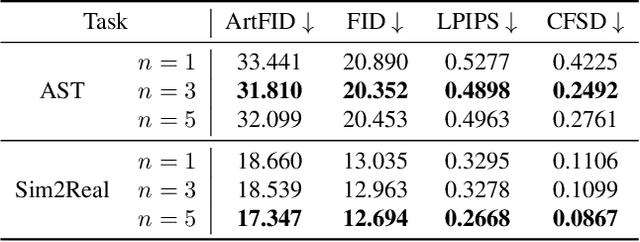
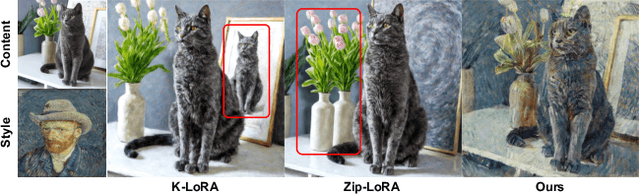
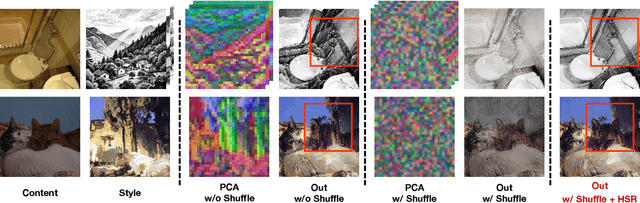
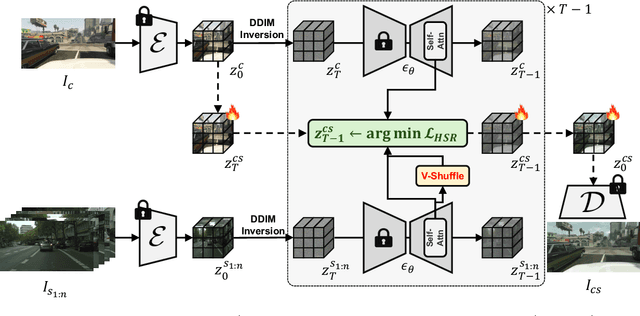
Attention injection-based style transfer has achieved remarkable progress in recent years. However, existing methods often suffer from content leakage, where the undesired semantic content of the style image mistakenly appears in the stylized output. In this paper, we propose V-Shuffle, a zero-shot style transfer method that leverages multiple style images from the same style domain to effectively navigate the trade-off between content preservation and style fidelity. V-Shuffle implicitly disrupts the semantic content of the style images by shuffling the value features within the self-attention layers of the diffusion model, thereby preserving low-level style representations. We further introduce a Hybrid Style Regularization that complements these low-level representations with high-level style textures to enhance style fidelity. Empirical results demonstrate that V-Shuffle achieves excellent performance when utilizing multiple style images. Moreover, when applied to a single style image, V-Shuffle outperforms previous state-of-the-art methods.