 Add to Chrome
 Add to Firefox
 Add to Edge
Understanding Long Videos via LLM-Powered Entity Relation Graphs
Jan 27, 2025
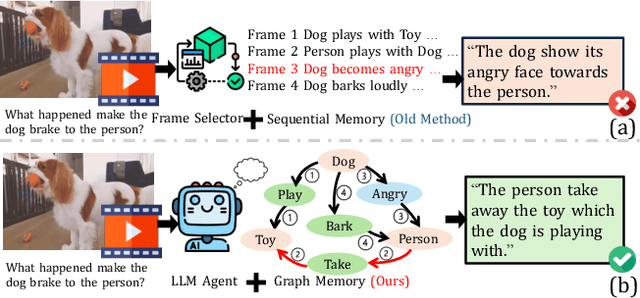
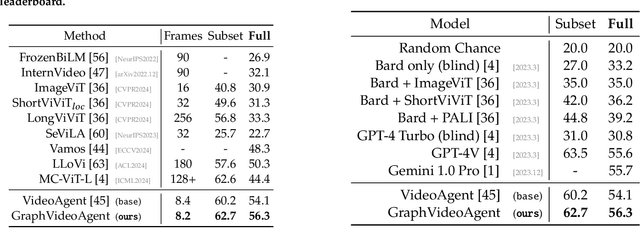

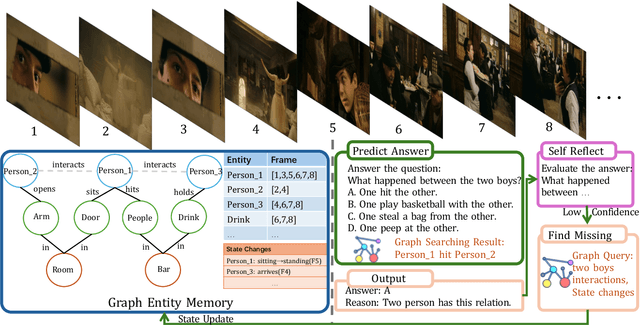
The analysis of extended video content poses unique challenges in artificial intelligence, particularly when dealing with the complexity of tracking and understanding visual elements across time. Current methodologies that process video frames sequentially struggle to maintain coherent tracking of objects, especially when these objects temporarily vanish and later reappear in the footage. A critical limitation of these approaches is their inability to effectively identify crucial moments in the video, largely due to their limited grasp of temporal relationships. To overcome these obstacles, we present GraphVideoAgent, a cutting-edge system that leverages the power of graph-based object tracking in conjunction with large language model capabilities. At its core, our framework employs a dynamic graph structure that maps and monitors the evolving relationships between visual entities throughout the video sequence. This innovative approach enables more nuanced understanding of how objects interact and transform over time, facilitating improved frame selection through comprehensive contextual awareness. Our approach demonstrates remarkable effectiveness when tested against industry benchmarks. In evaluations on the EgoSchema dataset, GraphVideoAgent achieved a 2.2 improvement over existing methods while requiring analysis of only 8.2 frames on average. Similarly, testing on the NExT-QA benchmark yielded a 2.0 performance increase with an average frame requirement of 8.1. These results underscore the efficiency of our graph-guided methodology in enhancing both accuracy and computational performance in long-form video understanding tasks.

Integrate Temporal Graph Learning into LLM-based Temporal Knowledge Graph Model
Jan 21, 2025Temporal Knowledge Graph Forecasting (TKGF) aims to predict future events based on the observed events in history. Recently, Large Language Models (LLMs) have exhibited remarkable capabilities, generating significant research interest in their application for reasoning over temporal knowledge graphs (TKGs). Existing LLM-based methods have integrated retrieved historical facts or static graph representations into LLMs. Despite the notable performance of LLM-based methods, they are limited by the insufficient modeling of temporal patterns and ineffective cross-modal alignment between graph and language, hindering the ability of LLMs to fully grasp the temporal and structural information in TKGs. To tackle these issues, we propose a novel framework TGL-LLM to integrate temporal graph learning into LLM-based temporal knowledge graph model. Specifically, we introduce temporal graph learning to capture the temporal and relational patterns and obtain the historical graph embedding. Furthermore, we design a hybrid graph tokenization to sufficiently model the temporal patterns within LLMs. To achieve better alignment between graph and language, we employ a two-stage training paradigm to finetune LLMs on high-quality and diverse data, thereby resulting in better performance. Extensive experiments on three real-world datasets show that our approach outperforms a range of state-of-the-art (SOTA) methods.
Dynamic Multimodal Fusion via Meta-Learning Towards Micro-Video Recommendation
Jan 13, 2025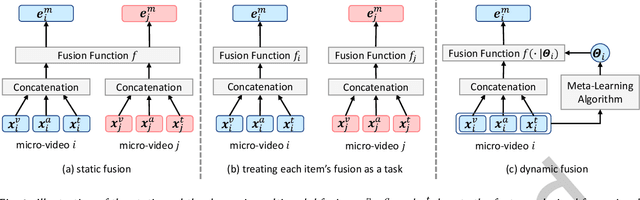

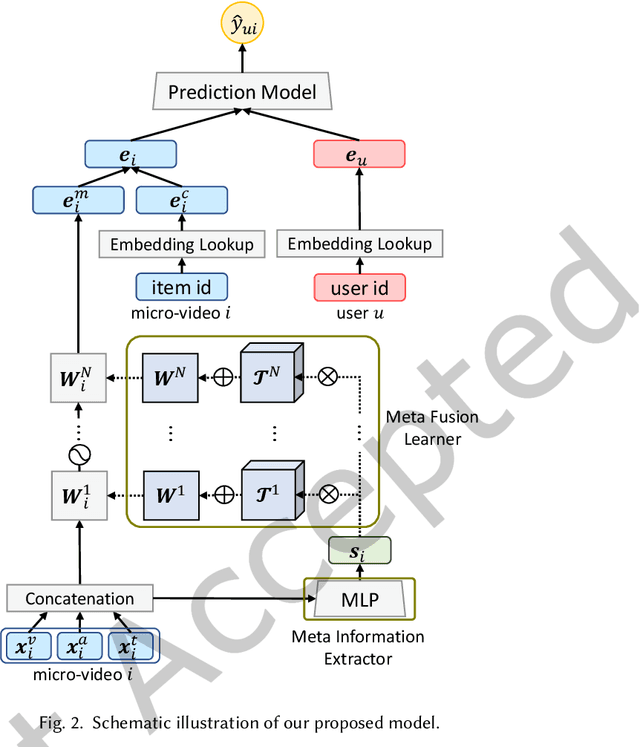
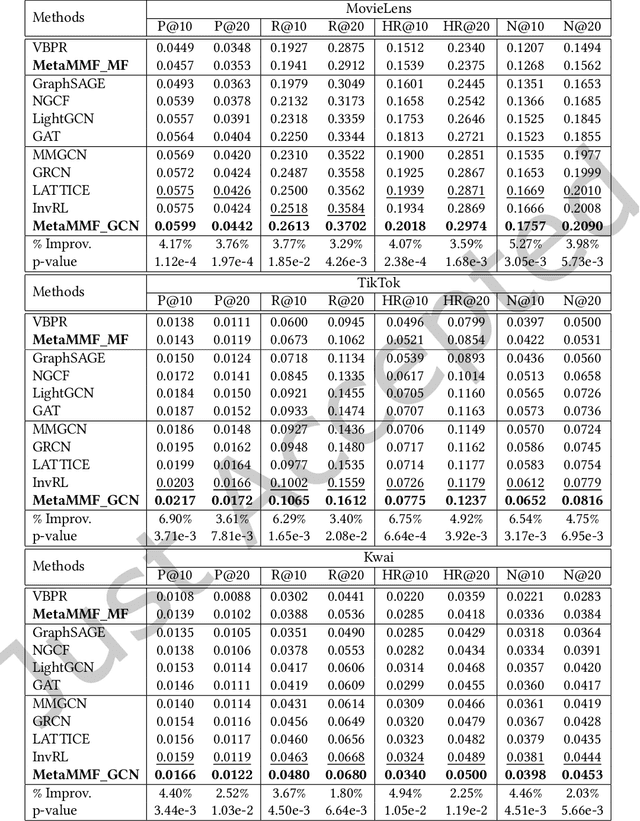
Multimodal information (e.g., visual, acoustic, and textual) has been widely used to enhance representation learning for micro-video recommendation. For integrating multimodal information into a joint representation of micro-video, multimodal fusion plays a vital role in the existing micro-video recommendation approaches. However, the static multimodal fusion used in previous studies is insufficient to model the various relationships among multimodal information of different micro-videos. In this paper, we develop a novel meta-learning-based multimodal fusion framework called Meta Multimodal Fusion (MetaMMF), which dynamically assigns parameters to the multimodal fusion function for each micro-video during its representation learning. Specifically, MetaMMF regards the multimodal fusion of each micro-video as an independent task. Based on the meta information extracted from the multimodal features of the input task, MetaMMF parameterizes a neural network as the item-specific fusion function via a meta learner. We perform extensive experiments on three benchmark datasets, demonstrating the significant improvements over several state-of-the-art multimodal recommendation models, like MMGCN, LATTICE, and InvRL. Furthermore, we lighten our model by adopting canonical polyadic decomposition to improve the training efficiency, and validate its effectiveness through experimental results. Codes are available at https://github.com/hanliu95/MetaMMF.
How to Enable Effective Cooperation Between Humans and NLP Models: A Survey of Principles, Formalizations, and Beyond
Jan 10, 2025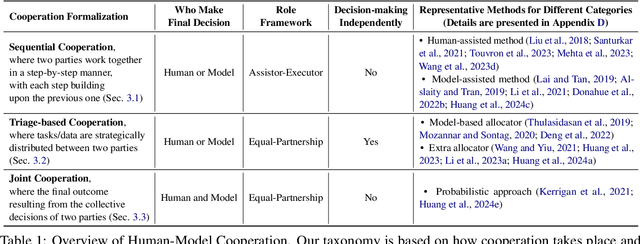
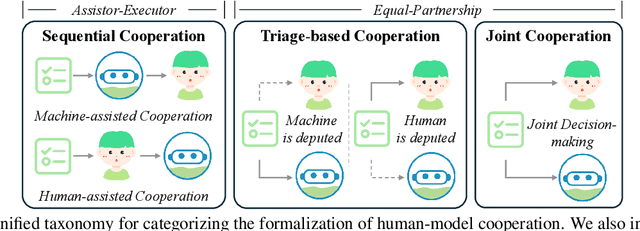
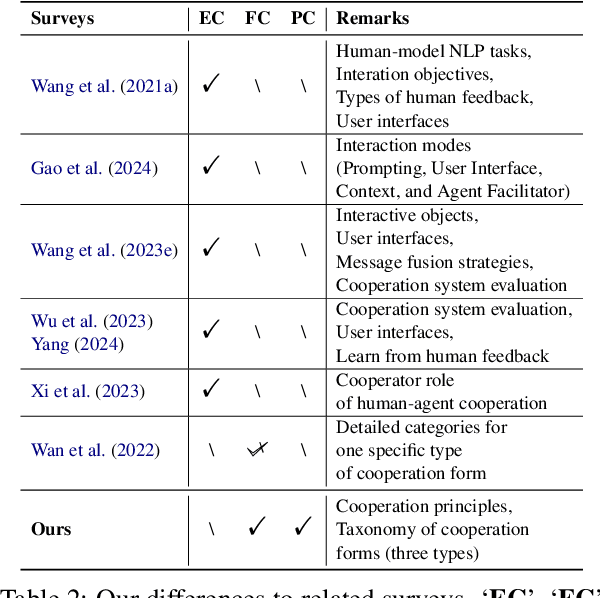

With the advancement of large language models (LLMs), intelligent models have evolved from mere tools to autonomous agents with their own goals and strategies for cooperating with humans. This evolution has birthed a novel paradigm in NLP, i.e., human-model cooperation, that has yielded remarkable progress in numerous NLP tasks in recent years. In this paper, we take the first step to present a thorough review of human-model cooperation, exploring its principles, formalizations, and open challenges. In particular, we introduce a new taxonomy that provides a unified perspective to summarize existing approaches. Also, we discuss potential frontier areas and their corresponding challenges. We regard our work as an entry point, paving the way for more breakthrough research in this regard.
Optimize Incompatible Parameters through Compatibility-aware Knowledge Integration
Jan 10, 2025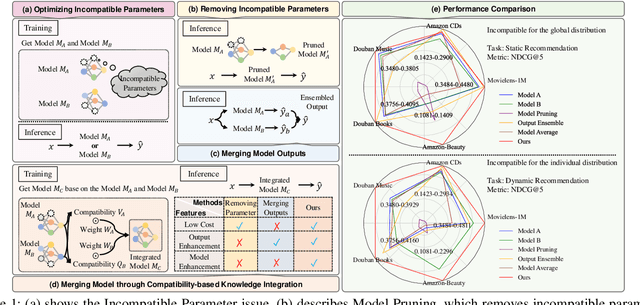

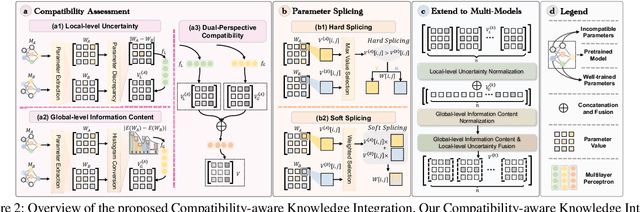
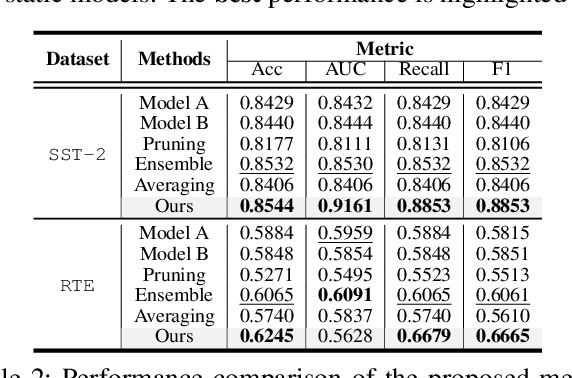
Deep neural networks have become foundational to advancements in multiple domains, including recommendation systems, natural language processing, and so on. Despite their successes, these models often contain incompatible parameters that can be underutilized or detrimental to model performance, particularly when faced with specific, varying data distributions. Existing research excels in removing such parameters or merging the outputs of multiple different pretrained models. However, the former focuses on efficiency rather than performance, while the latter requires several times more computing and storage resources to support inference. In this paper, we set the goal to explicitly improve these incompatible parameters by leveraging the complementary strengths of different models, thereby directly enhancing the models without any additional parameters. Specifically, we propose Compatibility-aware Knowledge Integration (CKI), which consists of Parameter Compatibility Assessment and Parameter Splicing, which are used to evaluate the knowledge content of multiple models and integrate the knowledge into one model, respectively. The integrated model can be used directly for inference or for further fine-tuning. We conduct extensive experiments on various datasets for recommendation and language tasks, and the results show that Compatibility-aware Knowledge Integration can effectively optimize incompatible parameters under multiple tasks and settings to break through the training limit of the original model without increasing the inference cost.
Aligning Large Language Models for Faithful Integrity Against Opposing Argument
Jan 02, 2025


Large Language Models (LLMs) have demonstrated impressive capabilities in complex reasoning tasks. However, they can be easily misled by unfaithful arguments during conversations, even when their original statements are correct. To this end, we investigate the problem of maintaining faithful integrity in LLMs. This involves ensuring that LLMs adhere to their faithful statements in the face of opposing arguments and are able to correct their incorrect statements when presented with faithful arguments. In this work, we propose a novel framework, named Alignment for Faithful Integrity with Confidence Estimation (AFICE), which aims to align the LLM responses with faithful integrity. Specifically, AFICE first designs a Bilateral Confidence Estimation (BCE) approach for estimating the uncertainty of each response generated by the LLM given a specific context, which simultaneously estimate the model's confidence to the question based on the internal states during decoding as well as to the answer based on cumulative probability ratios. With the BCE, we construct a conversational preference dataset composed of context, original statement, and argument, which is adopted for aligning the LLM for faithful integrity using Direct Preference Optimization (DPO). Extensive experimental results on a wide range of benchmarks demonstrate significant improvements in the LLM's ability to maintain faithful responses when encountering opposing arguments, ensuring both the practical utility and trustworthiness of LLMs in complex interactive settings. Code and data will be released via https://github.com/zhaoy777/AFICE.git
Towards Modality Generalization: A Benchmark and Prospective Analysis
Dec 24, 2024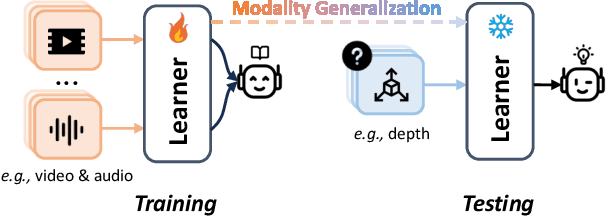
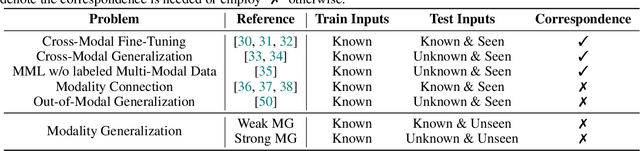
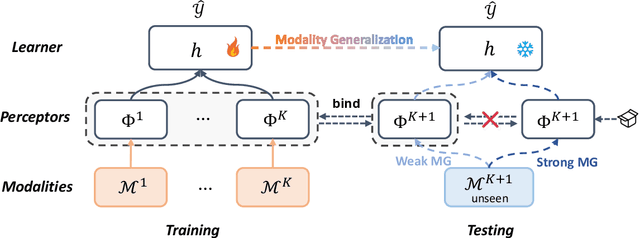
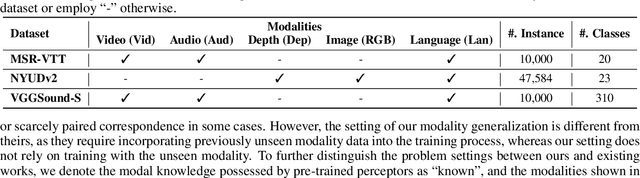
Multi-modal learning has achieved remarkable success by integrating information from various modalities, achieving superior performance in tasks like recognition and retrieval compared to uni-modal approaches. However, real-world scenarios often present novel modalities that are unseen during training due to resource and privacy constraints, a challenge current methods struggle to address. This paper introduces Modality Generalization (MG), which focuses on enabling models to generalize to unseen modalities. We define two cases: weak MG, where both seen and unseen modalities can be mapped into a joint embedding space via existing perceptors, and strong MG, where no such mappings exist. To facilitate progress, we propose a comprehensive benchmark featuring multi-modal algorithms and adapt existing methods that focus on generalization. Extensive experiments highlight the complexity of MG, exposing the limitations of existing methods and identifying key directions for future research. Our work provides a foundation for advancing robust and adaptable multi-modal models, enabling them to handle unseen modalities in realistic scenarios.
Length Controlled Generation for Black-box LLMs
Dec 19, 2024


Large language models (LLMs) have demonstrated impressive instruction following capabilities, while still struggling to accurately manage the length of the generated text, which is a fundamental requirement in many real-world applications. Existing length control methods involve fine-tuning the parameters of LLMs, which is inefficient and suboptimal for practical use. In this paper, we propose a novel iterative sampling framework for text length control, integrating the Metropolis-Hastings algorithm with an importance sampling acceleration strategy. This framework efficiently and reliably regulates LLMs to generate length-constrained text without modifying the underlying parameters, thereby preserving the original capabilities of LLMs. Experimental results demonstrate that our framework achieves almost 100\% success rates of length control on Llama3.1 for tasks such as length-controlled abstractive summarization and length-constrained instruction following, with minimal additional computational overhead. This also highlights the significant potential of our method for precise length control across a broader range of applications, without compromising the versatility of LLMs.
Cracking the Code of Hallucination in LVLMs with Vision-aware Head Divergence
Dec 18, 2024


Large vision-language models (LVLMs) have made substantial progress in integrating large language models (LLMs) with visual inputs, enabling advanced multimodal reasoning. Despite their success, a persistent challenge is hallucination-where generated text fails to accurately reflect visual content-undermining both accuracy and reliability. Existing methods focus on alignment training or decoding refinements but primarily address symptoms at the generation stage without probing the underlying causes. In this work, we investigate the internal mechanisms driving hallucination in LVLMs, with an emphasis on the multi-head attention module. Specifically, we introduce Vision-aware Head Divergence (VHD), a metric that quantifies the sensitivity of attention head outputs to visual context. Based on this, our findings reveal the presence of vision-aware attention heads that are more attuned to visual information; however, the model's overreliance on its prior language patterns is closely related to hallucinations. Building on these insights, we propose Vision-aware Head Reinforcement (VHR), a training-free approach to mitigate hallucination by enhancing the role of vision-aware attention heads. Extensive experiments demonstrate that our method achieves superior performance compared to state-of-the-art approaches in mitigating hallucinations, while maintaining high efficiency with negligible additional time overhead.
LLaVA-UHD v2: an MLLM Integrating High-Resolution Feature Pyramid via Hierarchical Window Transformer
Dec 18, 2024In multimodal large language models (MLLMs), vision transformers (ViTs) are widely employed for visual encoding. However, their performance in solving universal MLLM tasks is not satisfactory. We attribute it to a lack of information from diverse visual levels, impeding alignment with the various semantic granularity required for language generation. To address this issue, we present LLaVA-UHD v2, an advanced MLLM centered around a Hierarchical window transformer that enables capturing diverse visual granularity by constructing and integrating a high-resolution feature pyramid. As a vision-language projector, Hiwin transformer comprises two primary modules: (i) an inverse feature pyramid, constructed by a ViT-derived feature up-sampling process utilizing high-frequency details from an image pyramid, and (ii) hierarchical window attention, focusing on a set of key sampling features within cross-scale windows to condense multi-level feature maps. Extensive experiments demonstrate that LLaVA-UHD v2 achieves superior performance over existing MLLMs on popular benchmarks. Notably, our design brings an average boost of 3.7% across 14 benchmarks compared with the baseline method, 9.3% on DocVQA for instance. We make all the data, model checkpoint, and code publicly available to facilitate future research.