 Add to Chrome
 Add to Firefox
 Add to Edge
MathCoPilot: An Interactive System for Human-AI Symbiotic Paradigm of Mathematical Research
Jul 16, 2026
Existing LLM-based theorem provers have achieved impressive results on formal mathematics benchmarks, yet they remain confined to acting as autonomous agents that prove a stated proposition. In this paper, we propose MathCoPilot, a human-in-the-loop system that embodies a new human--AI symbiotic paradigm for mathematical research, in which the mathematician steers the high-level mathematical direction while AI agents carry out the detailed formalization and proof work under continuous human guidance. MathCoPilot unifies three core capabilities: (1) an interactive workbench where the mathematician and AI agents collaborate through a living proof blueprint that decomposes a proof into navigable steps the human can directly inspect, direct, and refine; (2) automated proving skill orchestration with adaptive knowledge base search and Lean-integrated iterative verification; and (3) topic-driven paper retrieval and automated formalization into a verified Lean knowledge base. Using MathCoPilot, we systematically compare four state-of-the-art LLMs, including Gemini~3.1~Pro, GPT-5.4, and Claude~Opus~4.7, on a FormalMATH subset and on two real PDE theorems requiring deep domain expertise, evaluating their ability to produce verified Lean~4 proofs and to identify errors in deliberately incorrect proofs. Our results show that while current models can handle undergraduate-level problems with high success rates under favorable autoformalization conditions, substantial challenges remain for domain-specific theorems requiring genuine mathematical understanding.

Xiaomi-GUI-0 Technical Report
Jul 01, 2026Graphical user interface (GUI) agents build on vision-language models to complete user tasks end-to-end in real applications through interface actions such as tapping, swiping, text entry, and navigation. However, existing GUI agents are trained and evaluated largely on offline trajectories, simulated environments, and standardized benchmarks. These differ substantially from real applications in interface layout, interaction logic, and abnormal-state distribution, and cannot faithfully characterize execution stability in real-world use, where account states, permission dialogs, payment authentication, and risk control continually reshape the state distribution and open a persistent gap between benchmark scores and real usability. To close this gap, we propose Xiaomi-GUI-0, a native multimodal GUI agent for real mobile environments, trained and evaluated within a real-device closed loop. At its core is a real-device-dominant hybrid infrastructure, where physical devices are the primary execution environment and sandboxes provide auxiliary support, so that data collection, training, rollout, and evaluation share an execution distribution close to real deployment. We construct multi-source training data spanning high-frequency head tasks, high-generalization data for long-tail intents, and capability-enhancement data for reflection and memory, and introduce an error-driven data flywheel that turns failure trajectories into corrected actions, reflective explanations, and recovery demonstrations. The model is trained through a progressive three-stage pipeline of supervised fine-tuning, step-level reinforcement learning, and agentic reinforcement learning. Evaluated on public benchmarks and our in-house RealMobile, Xiaomi-GUI-0 achieves 72.0% success on RealMobile and 78.9% on AndroidWorld, while substantially improving execution stability and abnormal-state recognition in real-world tasks.
DeskCraft: Benchmarking Desktop Agents on Professional Workflows and Human-in-the-Loop Collaboration
Jun 02, 2026Real-world professional desktop workflows in specialized creative and engineering software unfold over long horizons and often require human-in-the-loop coordination, where agents proactively seek necessary information and users provide additional instructions, clarifications, feedback, or corrections as the task progresses. Yet existing desktop GUI benchmarks mostly reduce this setting to short, simplified tasks with all user instructions provided upfront. To address this issue, we introduce DeskCraft, a desktop GUI benchmark targeting long horizon creative and engineering workflows and proactive human-agent collaboration. DeskCraft organizes tasks into a multilevel difficulty taxonomy, with long horizon tasks requiring over 50 execution steps, and covers professional creative software across design, video, audio, and 3D creation. Furthermore, DeskCraft formalizes human-agent collaboration into an interaction protocol covering mid-turn and post-turn exchanges. Mid-turn interaction captures both agent-initiated clarification under uncertainty and user-initiated interruption during execution, while post-turn interaction accommodates user-driven feedback after the agent signals completion, together spanning the full space of realistic collaboration patterns. We evaluate 18 proprietary and open source agents on 538 tasks and find that GPT-5.4 reaches 31.6% on standard tasks and 27.6% on interactive tasks. Further analyses reveal persistent failures in long horizon workflow delivery and proactive clarification. We will open-source all evaluation codes, tasks, and data at https://github.com/mrwwk/DeskCraft.
OS Agents: A Survey on MLLM-based Agents for General Computing Devices Use
Aug 06, 2025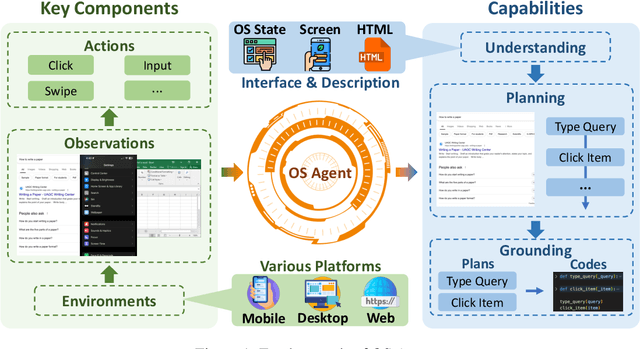
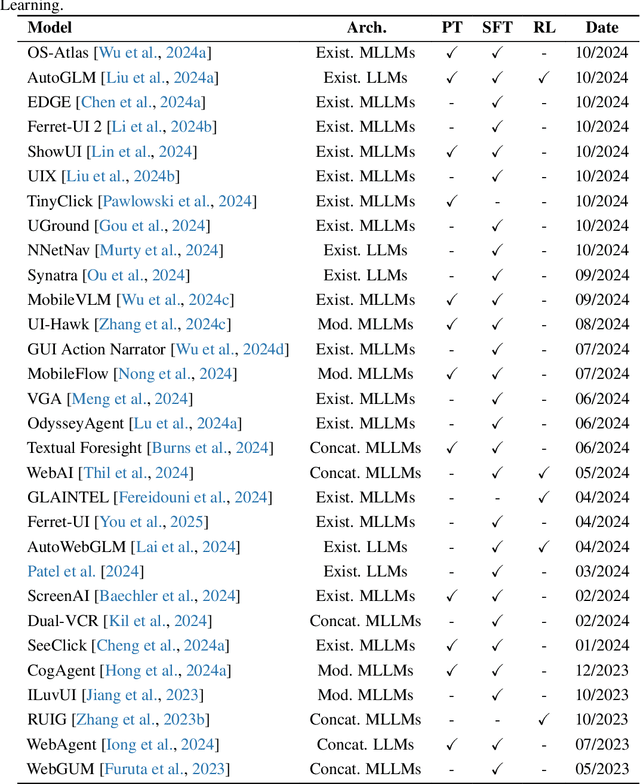
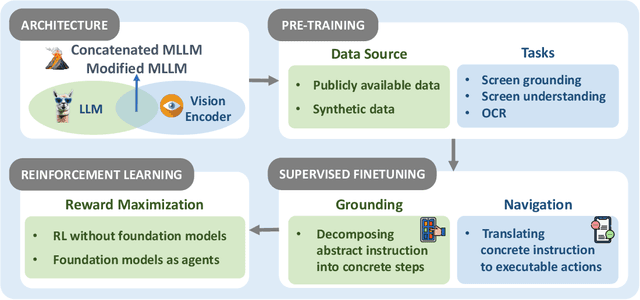
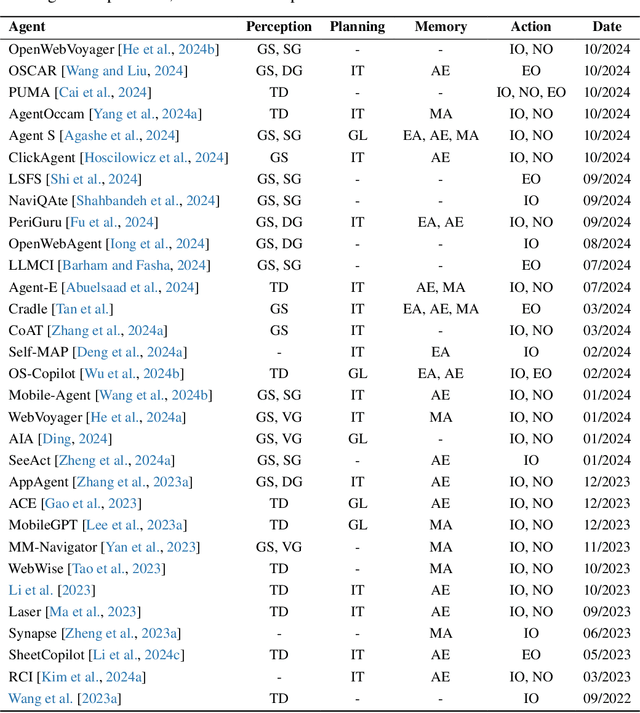
The dream to create AI assistants as capable and versatile as the fictional J.A.R.V.I.S from Iron Man has long captivated imaginations. With the evolution of (multi-modal) large language models ((M)LLMs), this dream is closer to reality, as (M)LLM-based Agents using computing devices (e.g., computers and mobile phones) by operating within the environments and interfaces (e.g., Graphical User Interface (GUI)) provided by operating systems (OS) to automate tasks have significantly advanced. This paper presents a comprehensive survey of these advanced agents, designated as OS Agents. We begin by elucidating the fundamentals of OS Agents, exploring their key components including the environment, observation space, and action space, and outlining essential capabilities such as understanding, planning, and grounding. We then examine methodologies for constructing OS Agents, focusing on domain-specific foundation models and agent frameworks. A detailed review of evaluation protocols and benchmarks highlights how OS Agents are assessed across diverse tasks. Finally, we discuss current challenges and identify promising directions for future research, including safety and privacy, personalization and self-evolution. This survey aims to consolidate the state of OS Agents research, providing insights to guide both academic inquiry and industrial development. An open-source GitHub repository is maintained as a dynamic resource to foster further innovation in this field. We present a 9-page version of our work, accepted by ACL 2025, to provide a concise overview to the domain.
Cyber Physical System Information Collection: Robot Location and Navigation Method Based on QR Code
Oct 05, 2023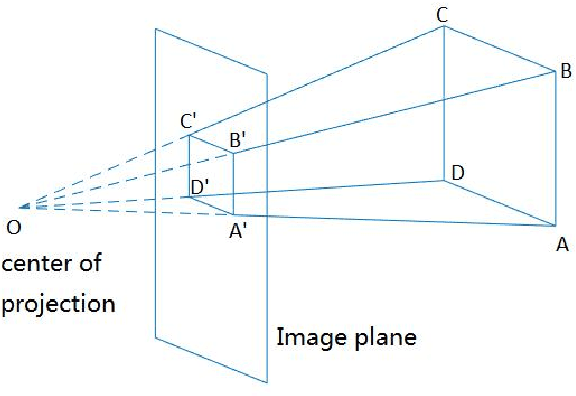
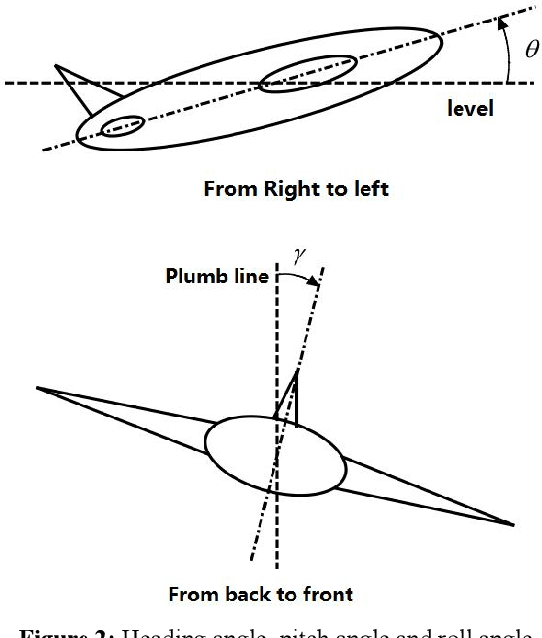
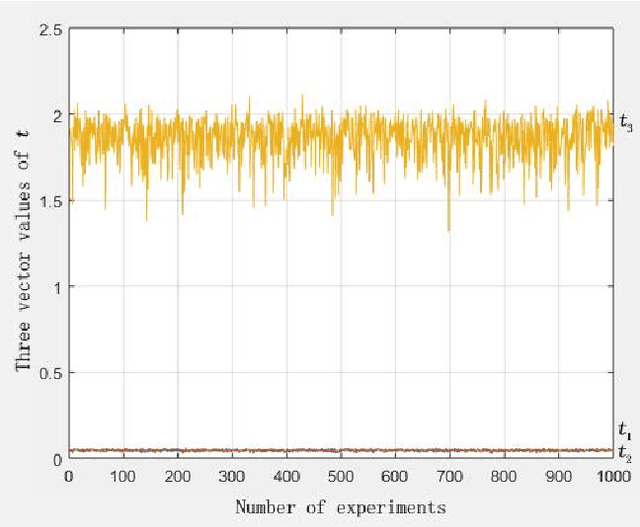
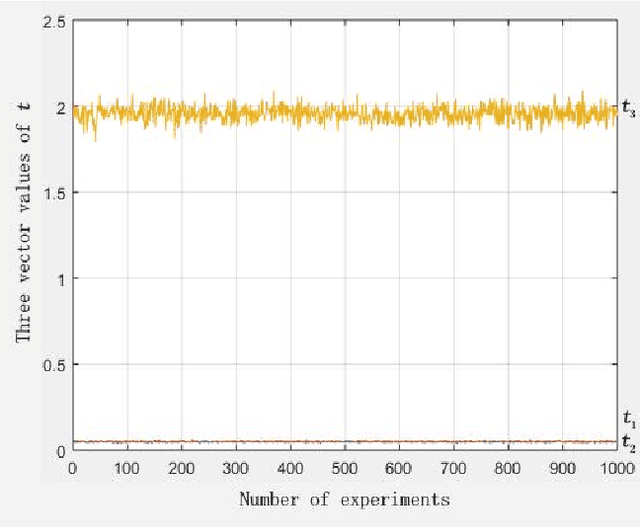
In this paper, we propose a method to estimate the exact location of a camera in a cyber-physical system using the exact geographic coordinates of four feature points stored in QR codes(Quick response codes) and the pixel coordinates of four feature points analyzed from the QR code images taken by the camera. Firstly, the P4P(Perspective 4 Points) algorithm is designed to uniquely determine the initial pose estimation value of the QR coordinate system relative to the camera coordinate system by using the four feature points of the selected QR code. In the second step, the manifold gradient optimization algorithm is designed. The rotation matrix and displacement vector are taken as the initial values of iteration, and the iterative optimization is carried out to improve the positioning accuracy and obtain the rotation matrix and displacement vector with higher accuracy. The third step is to convert the pose of the QR coordinate system with respect to the camera coordinate system to the pose of the AGV(Automated Guided Vehicle) with respect to the world coordinate system. Finally, the performance of manifold gradient optimization algorithm and P4P analytical algorithm are simulated and compared under the same conditions.One can see that the performance of the manifold gradient optimization algorithm proposed in this paper is much better than that of the P4P analytic algorithm when the signal-to-noise ratio is small.With the increase of the signal-to-noise ratio,the performance of the P4P analytic algorithm approaches that of the manifold gradient optimization algorithm.when the noise is same,the performance of manifold gradient optimization algorithm is better when there are more feature points.
sqSGD: Locally Private and Communication Efficient Federated Learning
Jun 22, 2022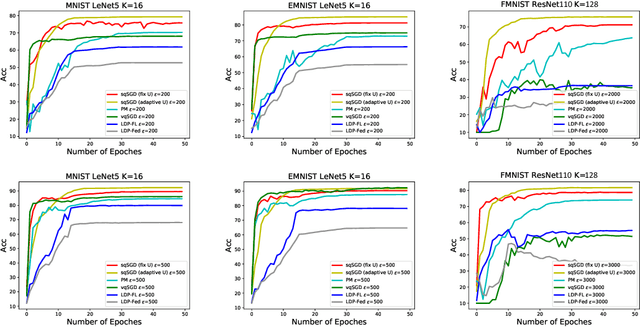
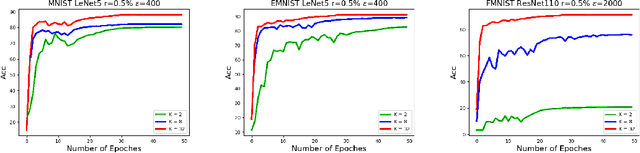
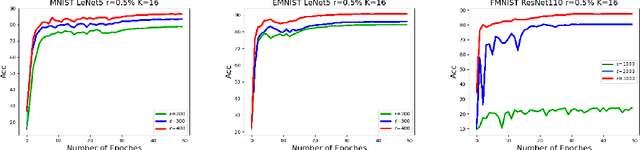
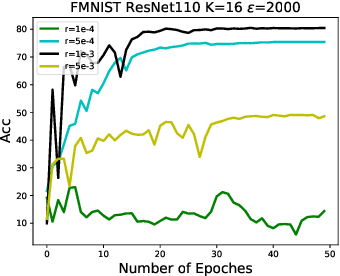
Federated learning (FL) is a technique that trains machine learning models from decentralized data sources. We study FL under local notions of privacy constraints, which provides strong protection against sensitive data disclosures via obfuscating the data before leaving the client. We identify two major concerns in designing practical privacy-preserving FL algorithms: communication efficiency and high-dimensional compatibility. We then develop a gradient-based learning algorithm called \emph{sqSGD} (selective quantized stochastic gradient descent) that addresses both concerns. The proposed algorithm is based on a novel privacy-preserving quantization scheme that uses a constant number of bits per dimension per client. Then we improve the base algorithm in three ways: first, we apply a gradient subsampling strategy that simultaneously offers better training performance and smaller communication costs under a fixed privacy budget. Secondly, we utilize randomized rotation as a preprocessing step to reduce quantization error. Thirdly, an adaptive gradient norm upper bound shrinkage strategy is adopted to improve accuracy and stabilize training. Finally, the practicality of the proposed framework is demonstrated on benchmark datasets. Experiment results show that sqSGD successfully learns large models like LeNet and ResNet with local privacy constraints. In addition, with fixed privacy and communication level, the performance of sqSGD significantly dominates that of various baseline algorithms.
SHORING: Design Provable Conditional High-Order Interaction Network via Symbolic Testing
Jul 03, 2021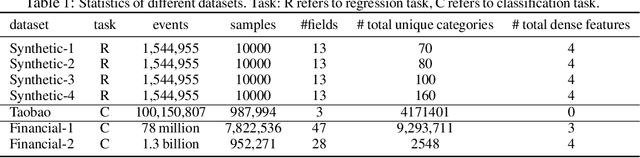
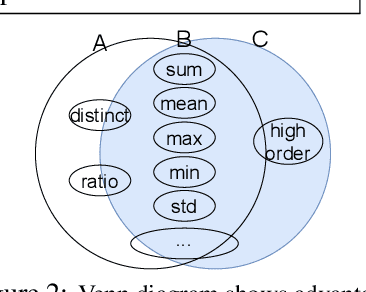
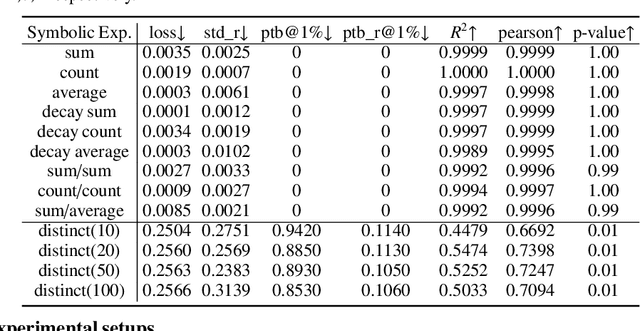
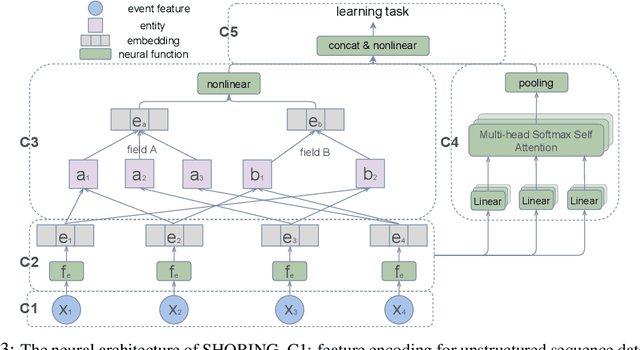
Deep learning provides a promising way to extract effective representations from raw data in an end-to-end fashion and has proven its effectiveness in various domains such as computer vision, natural language processing, etc. However, in domains such as content/product recommendation and risk management, where sequence of event data is the most used raw data form and experts derived features are more commonly used, deep learning models struggle to dominate the game. In this paper, we propose a symbolic testing framework that helps to answer the question of what kinds of expert-derived features could be learned by a neural network. Inspired by this testing framework, we introduce an efficient architecture named SHORING, which contains two components: \textit{event network} and \textit{sequence network}. The \textit{event} network learns arbitrarily yet efficiently high-order \textit{event-level} embeddings via a provable reparameterization trick, the \textit{sequence} network aggregates from sequence of \textit{event-level} embeddings. We argue that SHORING is capable of learning certain standard symbolic expressions which the standard multi-head self-attention network fails to learn, and conduct comprehensive experiments and ablation studies on four synthetic datasets and three real-world datasets. The results show that SHORING empirically outperforms the state-of-the-art methods.
Bilinear Representation for Language-based Image Editing Using Conditional Generative Adversarial Networks
Mar 18, 2019

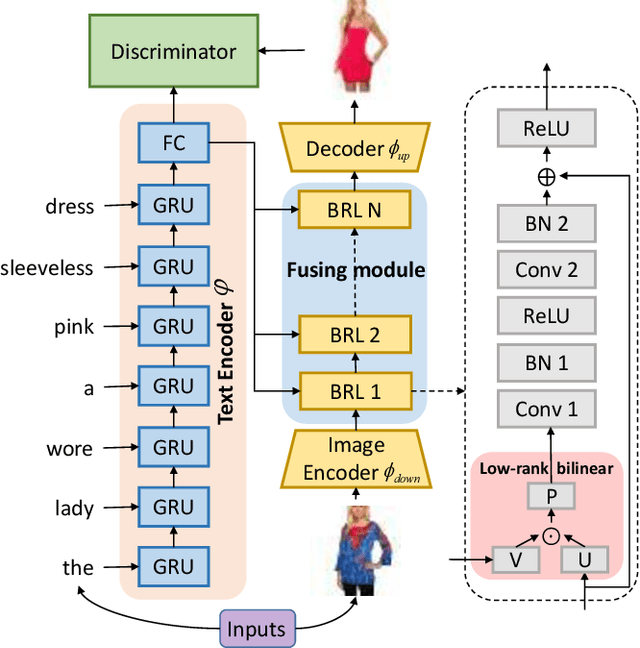
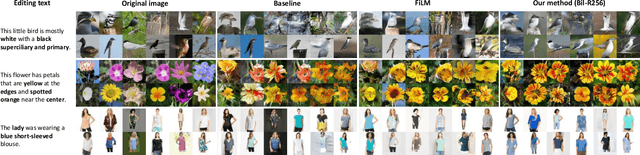
The task of Language-Based Image Editing (LBIE) aims at generating a target image by editing the source image based on the given language description. The main challenge of LBIE is to disentangle the semantics in image and text and then combine them to generate realistic images. Therefore, the editing performance is heavily dependent on the learned representation. In this work, conditional generative adversarial network (cGAN) is utilized for LBIE. We find that existing conditioning methods in cGAN lack of representation power as they cannot learn the second-order correlation between two conditioning vectors. To solve this problem, we propose an improved conditional layer named Bilinear Residual Layer (BRL) to learning more powerful representations for LBIE task. Qualitative and quantitative comparisons demonstrate that our method can generate images with higher quality when compared to previous LBIE techniques.
Sensitivity based Neural Networks Explanations
Dec 03, 2018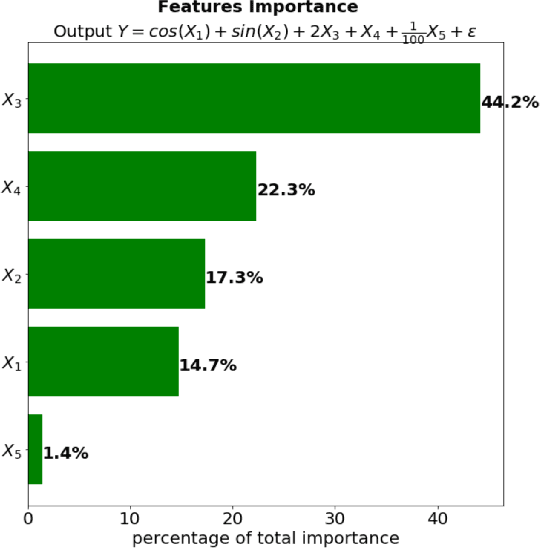
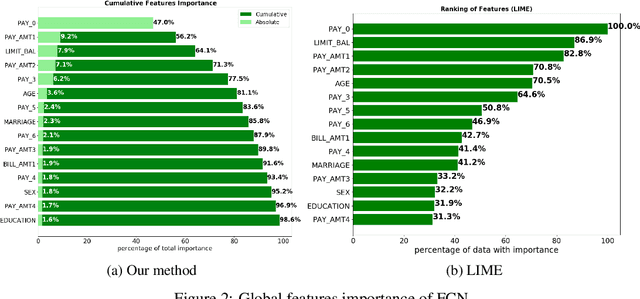
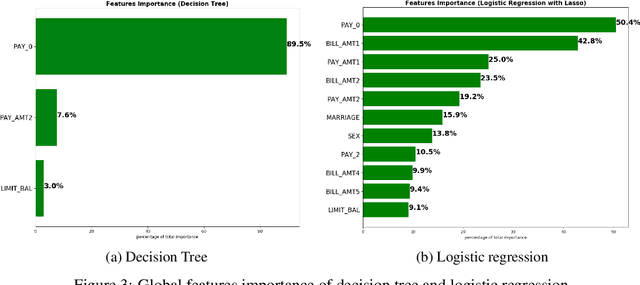
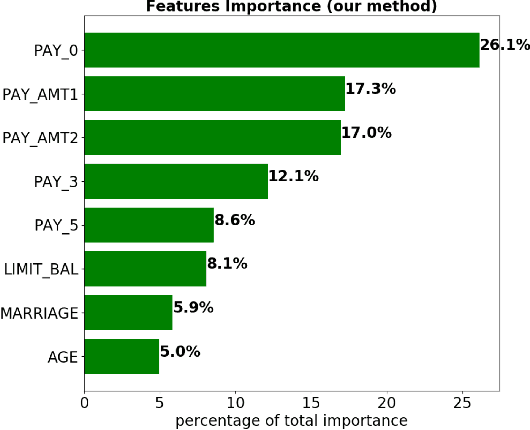
Although neural networks can achieve very high predictive performance on various different tasks such as image recognition or natural language processing, they are often considered as opaque "black boxes". The difficulty of interpreting the predictions of a neural network often prevents its use in fields where explainability is important, such as the financial industry where regulators and auditors often insist on this aspect. In this paper, we present a way to assess the relative input features importance of a neural network based on the sensitivity of the model output with respect to its input. This method has the advantage of being fast to compute, it can provide both global and local levels of explanations and is applicable for many types of neural network architectures. We illustrate the performance of this method on both synthetic and real data and compare it with other interpretation techniques. This method is implemented into an open-source Python package that allows its users to easily generate and visualize explanations for their neural networks.
Automatic Vertebra Labeling in Large-Scale 3D CT using Deep Image-to-Image Network with Message Passing and Sparsity Regularization
May 17, 2017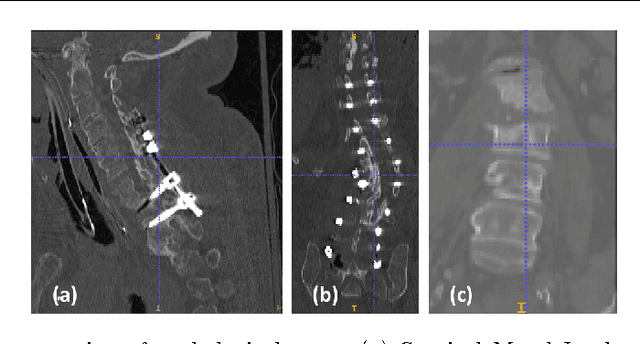
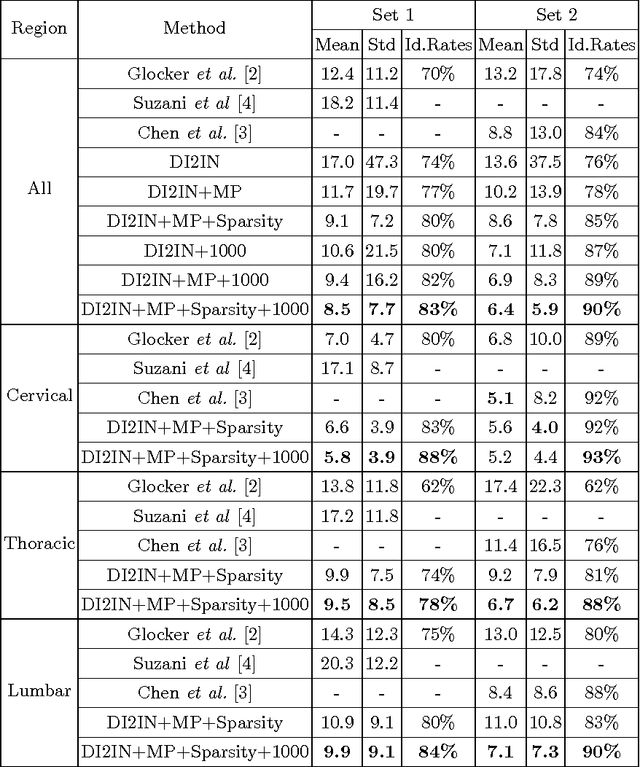

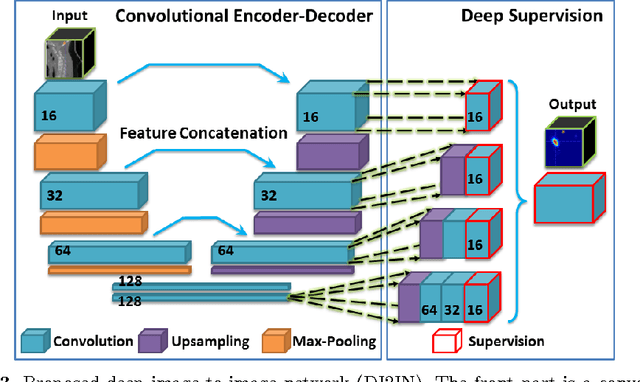
Automatic localization and labeling of vertebra in 3D medical images plays an important role in many clinical tasks, including pathological diagnosis, surgical planning and postoperative assessment. However, the unusual conditions of pathological cases, such as the abnormal spine curvature, bright visual imaging artifacts caused by metal implants, and the limited field of view, increase the difficulties of accurate localization. In this paper, we propose an automatic and fast algorithm to localize and label the vertebra centroids in 3D CT volumes. First, we deploy a deep image-to-image network (DI2IN) to initialize vertebra locations, employing the convolutional encoder-decoder architecture together with multi-level feature concatenation and deep supervision. Next, the centroid probability maps from DI2IN are iteratively evolved with the message passing schemes based on the mutual relation of vertebra centroids. Finally, the localization results are refined with sparsity regularization. The proposed method is evaluated on a public dataset of 302 spine CT volumes with various pathologies. Our method outperforms other state-of-the-art methods in terms of localization accuracy. The run time is around 3 seconds on average per case. To further boost the performance, we retrain the DI2IN on additional 1000+ 3D CT volumes from different patients. To the best of our knowledge, this is the first time more than 1000 3D CT volumes with expert annotation are adopted in experiments for the anatomic landmark detection tasks. Our experimental results show that training with such a large dataset significantly improves the performance and the overall identification rate, for the first time by our knowledge, reaches 90 %.