 Add to Chrome
 Add to Firefox
 Add to Edge
High-Fidelity Two-Step Image Generation via Teacher-Aligned End-to-End Distillation
Jun 10, 2026
Few-step diffusion distillation has become increasingly mature for 4-8-step generation, yet pushing further to 2 steps remains challenging. In this work, we introduce Z-Image Turbo++, a high-quality 2-step image generation model distilled from the 8-step Z-Image Turbo teacher. Our method addresses the central bottlenecks of increased task difficulty and limited model capacity in 2-step generation through three simple but effective design choices tailored to this regime. First, we propose Distribution-Aligned Adversarial Learning, which uses teacher-generated images rather than external real images as real samples for GAN training, providing a more attainable and informative adversarial target. Second, we adopt Step-Decoupled Parameterization, assigning independent model parameters to the two denoising steps to better match their distinct capacity demands. Third, we perform End-to-End Training with Iterative Regularization, allowing the first step to receive gradients from final image quality while preserving a meaningful intermediate generation through an explicit step-1 loss. Together, these designs substantially narrow the quality gap between 2-step and 8-step generation in both qualitative and quantitative evaluations, highlighting the potential of carefully tailored distillation strategies for improving the quality-efficiency trade-off in few-step generation.

XTinyU-Net: Training-Free U-Net Scaling via Initialization-Time Sensitivity
May 10, 2026While U-Net architectures remain the gold standard for medical image segmentation, their deployment in resource-constrained environments demands aggressive model compression. However, finding an optimally efficient configuration is computationally prohibitive, typically requiring exhaustive train-and-evaluate cycles to find the smallest model that maintains peak performance. In this paper, we introduce a training-free selection framework to automatically identify ultralightweight, dataset-specific U-Net configurations directly at initialization. We observe that systematically scaling down U-Net channel width induces a sharp transition from a stable performance plateau to representational capacity collapse. To pinpoint this boundary without training, we propose a Jacobian-based sensitivity metric that scores discrete, width-capped U-Net variants using a small set of unlabeled images. By analyzing the total variation of this sensitivity curve, we isolate the smallest stable configuration, which we denote as XTinyU-Net. Evaluated across six diverse medical datasets within the nnU-Net framework, XTinyU-Net achieves segmentation accuracy comparable to the heavy nnU-Net baseline with 400x-1600x fewer parameters, and outperforms contemporary lightweight architectures while utilizing 5x-72x fewer parameters. Code is publicly accessible on https://github.com/alvinkimbowa/nntinyunet.git.
MonoUNet: A Robust Tiny Neural Network for Automated Knee Cartilage Segmentation on Point-of-Care Ultrasound Devices
Apr 09, 2026Objective: To develop a robust and compact deep learning model for automated knee cartilage segmentation on point-of-care ultrasound (POCUS) devices. Methods: We propose MonoUNet, an ultra-compact U-Net consisting of (i) an aggressively reduced backbone with an asymmetric decoder, (ii) a trainable monogenic block that extracts multi-scale local phase features, and (iii) a gated feature injection mechanism that integrates these features into the encoder stages to reduce sensitivity to variations in ultrasound image appearance and improve robustness across devices. MonoUNet was evaluated on a multi-site, multi-device knee cartilage ultrasound dataset acquired using cart-based, portable, and handheld POCUS devices. Results: Overall, MonoUNet outperformed existing lightweight segmentation models, with average Dice scores ranging from 92.62% to 94.82% and mean average surface distance (MASD) values between 0.133 mm and 0.254 mm. MonoUNet reduces the number of parameters by 10x--700x and computational cost by 14x--2000x relative to existing lightweight models. MonoUNet cartilage outcomes showed excellent reliability and agreement with the manual outcomes: intraclass correlation coefficients (ICC$_{2,k})$=0.96 and bias=2.00% (0.047 mm) for average thickness, and ICC$_{2,k}$=0.99 and bias=0.80% (0.328 a.u.) for echo intensity. Conclusion: Incorporating trainable local phase features improves the robustness of highly compact neural networks for knee cartilage segmentation across varying acquisition settings and could support scalable ultrasound-based assessment and monitoring of knee osteoarthritis using POCUS devices. The code is publicly available at https://github.com/alvinkimbowa/monounet.
Generating Synthetic Doctor-Patient Conversations for Long-form Audio Summarization
Apr 07, 2026Long-context audio reasoning is underserved in both training data and evaluation. Existing benchmarks target short-context tasks, and the open-ended generation tasks most relevant to long-context reasoning pose well-known challenges for automatic evaluation. We propose a synthetic data generation pipeline designed to serve both as a training resource and as a controlled evaluation environment, and instantiate it for first-visit doctor-patient conversations with SOAP note generation as the task. The pipeline has three stages, persona-driven dialogue generation, multi-speaker audio synthesis with overlap/pause modeling, room acoustics, and sound events, and LLM-based reference SOAP note production, built entirely on open-weight models. We release 8,800 synthetic conversations with 1.3k hours of corresponding audio and reference notes. Evaluating current open-weight systems, we find that cascaded approaches still substantially outperform end-to-end models.
Representation-Level Adversarial Regularization for Clinically Aligned Multitask Thyroid Ultrasound Assessment
Mar 22, 2026Thyroid ultrasound is the first-line exam for assessing thyroid nodules and determining whether biopsy is warranted. In routine reporting, radiologists produce two coupled outputs: a nodule contour for measurement and a TI-RADS risk category based on sonographic criteria. Yet both contouring style and risk grading vary across readers, creating inconsistent supervision that can degrade standard learning pipelines. In this paper, we address this workflow with a clinically guided multitask framework that jointly predicts the nodule mask and TI-RADS category within a single model. To ground risk prediction in clinically meaningful evidence, we guide the classification embedding using a compact TI-RADS aligned radiomics target during training, while preserving complementary deep features for discriminative performance. However, under annotator variability, naive multitask optimization often fails not because the tasks are unrelated, but because their gradients compete within the shared representation. To make this competition explicit and controllable, we introduce RLAR, a representation-level adversarial gradient regularizer. Rather than performing parameter-level gradient surgery, RLAR uses each task's normalized adversarial direction in latent space as a geometric probe of task sensitivity and penalizes excessive angular alignment between task-specific adversarial directions. On a public TI-RADS dataset, our clinically guided multitask model with RLAR consistently improves risk stratification while maintaining segmentation quality compared to single-task training and conventional multitask baselines. Code and pretrained models will be released.
ViThinker: Active Vision-Language Reasoning via Dynamic Perceptual Querying
Feb 02, 2026Chain-of-Thought (CoT) reasoning excels in language models but struggles in vision-language models due to premature visual-to-text conversion that discards continuous information such as geometry and spatial layout. While recent methods enhance CoT through static enumeration or attention-based selection, they remain passive, i.e., processing pre-computed inputs rather than actively seeking task-relevant details. Inspired by human active perception, we introduce ViThinker, a framework that enables vision-language models to autonomously generate decision (query) tokens triggering the synthesis of expert-aligned visual features on demand. ViThinker internalizes vision-expert capabilities during training, performing generative mental simulation during inference without external tool calls. Through a two-stage curriculum: first distilling frozen experts into model parameters, then learning task-driven querying via sparsity penalties, i.e., ViThinker discovers minimal sufficient perception for each reasoning step. Evaluations across vision-centric benchmarks demonstrate consistent improvements, validating that active query generation outperforms passive approaches in both perceptual grounding and reasoning accuracy.
Distribution Matching Distillation Meets Reinforcement Learning
Nov 19, 2025Distribution Matching Distillation (DMD) distills a pre-trained multi-step diffusion model to a few-step one to improve inference efficiency. However, the performance of the latter is often capped by the former. To circumvent this dilemma, we propose DMDR, a novel framework that combines Reinforcement Learning (RL) techniques into the distillation process. We show that for the RL of the few-step generator, the DMD loss itself is a more effective regularization compared to the traditional ones. In turn, RL can help to guide the mode coverage process in DMD more effectively. These allow us to unlock the capacity of the few-step generator by conducting distillation and RL simultaneously. Meanwhile, we design the dynamic distribution guidance and dynamic renoise sampling training strategies to improve the initial distillation process. The experiments demonstrate that DMDR can achieve leading visual quality, prompt coherence among few-step methods, and even exhibit performance that exceeds the multi-step teacher.
Mono2D: A Trainable Monogenic Layer for Robust Knee Cartilage Segmentation on Out-of-Distribution 2D Ultrasound Data
Mar 12, 2025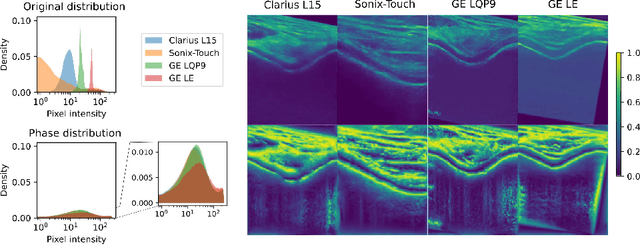
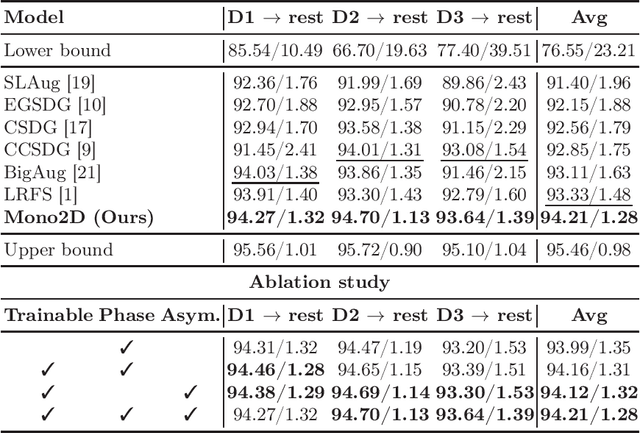
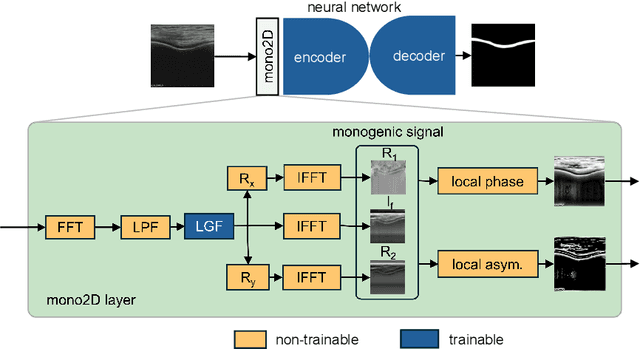
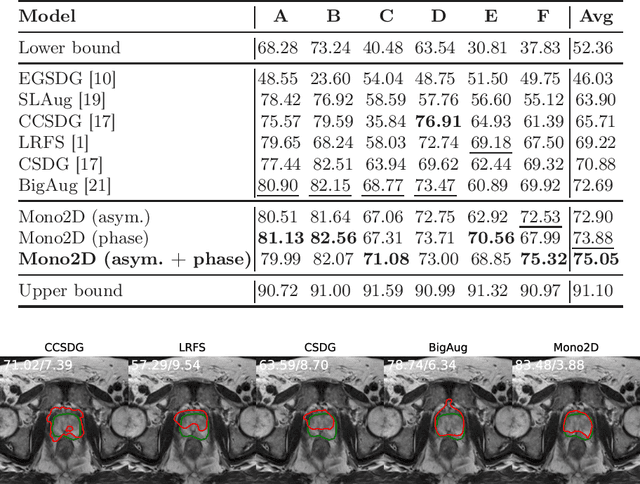
Automated knee cartilage segmentation using point-of-care ultrasound devices and deep-learning networks has the potential to enhance the management of knee osteoarthritis. However, segmentation algorithms often struggle with domain shifts caused by variations in ultrasound devices and acquisition parameters, limiting their generalizability. In this paper, we propose Mono2D, a monogenic layer that extracts multi-scale, contrast- and intensity-invariant local phase features using trainable bandpass quadrature filters. This layer mitigates domain shifts, improving generalization to out-of-distribution domains. Mono2D is integrated before the first layer of a segmentation network, and its parameters jointly trained alongside the network's parameters. We evaluated Mono2D on a multi-domain 2D ultrasound knee cartilage dataset for single-source domain generalization (SSDG). Our results demonstrate that Mono2D outperforms other SSDG methods in terms of Dice score and mean average surface distance. To further assess its generalizability, we evaluate Mono2D on a multi-site prostate MRI dataset, where it continues to outperform other SSDG methods, highlighting its potential to improve domain generalization in medical imaging. Nevertheless, further evaluation on diverse datasets is still necessary to assess its clinical utility.
Re-visiting Skip-Gram Negative Sampling: Dimension Regularization for More Efficient Dissimilarity Preservation in Graph Embeddings
Apr 30, 2024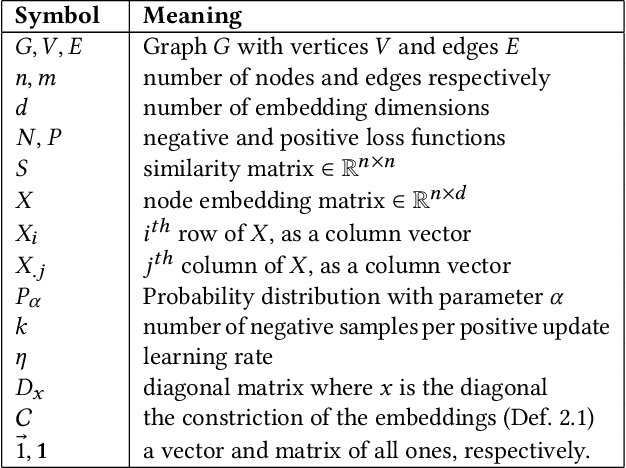
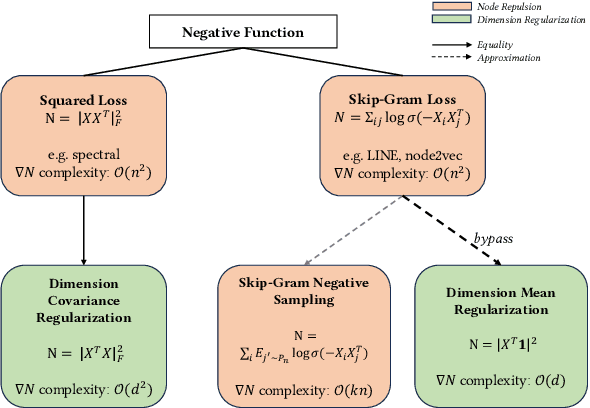
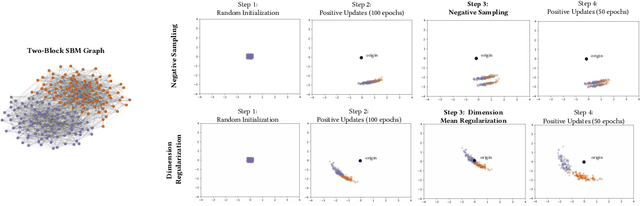
A wide range of graph embedding objectives decompose into two components: one that attracts the embeddings of nodes that are perceived as similar, and another that repels embeddings of nodes that are perceived as dissimilar. Because real-world graphs are sparse and the number of dissimilar pairs grows quadratically with the number of nodes, Skip-Gram Negative Sampling (SGNS) has emerged as a popular and efficient repulsion approach. SGNS repels each node from a sample of dissimilar nodes, as opposed to all dissimilar nodes. In this work, we show that node-wise repulsion is, in aggregate, an approximate re-centering of the node embedding dimensions. Such dimension operations are much more scalable than node operations. The dimension approach, in addition to being more efficient, yields a simpler geometric interpretation of the repulsion. Our result extends findings from the self-supervised learning literature to the skip-gram model, establishing a connection between skip-gram node contrast and dimension regularization. We show that in the limit of large graphs, under mild regularity conditions, the original node repulsion objective converges to optimization with dimension regularization. We use this observation to propose an algorithm augmentation framework that speeds up any existing algorithm, supervised or unsupervised, using SGNS. The framework prioritizes node attraction and replaces SGNS with dimension regularization. We instantiate this generic framework for LINE and node2vec and show that the augmented algorithms preserve downstream performance while dramatically increasing efficiency.
APP-RUSS: Automated Path Planning for Robotic Ultrasound System
Oct 22, 2023Autonomous robotic ultrasound System (RUSS) has been extensively studied. However, fully automated ultrasound image acquisition is still challenging, partly due to the lack of study in combining two phases of path planning: guiding the ultrasound probe to the scan target and covering the scan surface or volume. This paper presents a system of Automated Path Planning for RUSS (APP-RUSS). Our focus is on the first phase of automation, which emphasizes directing the ultrasound probe's path toward the target over extended distances. Specifically, our APP-RUSS system consists of a RealSense D405 RGB-D camera that is employed for visual guidance of the UR5e robotic arm and a cubic Bezier curve path planning model that is customized for delivering the probe to the recognized target. APP-RUSS can contribute to understanding the integration of the two phases of path planning in robotic ultrasound imaging, paving the way for its clinical adoption.