 Add to Chrome
 Add to Firefox
 Add to Edge
Scaling, Benchmarking, and Reasoning of Vision-Language Agents for Mobile GUI Navigation
May 26, 2026
Vision-Language Models (VLMs) have shown rapid progress in mobile GUI navigation. This paper presents a systematic study of data scaling, benchmarking, and reasoning for VLM-based agents in this domain. To facilitate rigorous evaluation, we introduce HyperTrack, a large-scale dataset with over 16000 real-world tasks across more than 650 Chinese mobile applications, along with GUIEvalKit, an open-source toolkit for unified benchmarking of VLMs on offline GUI navigation tasks. Using HyperTrack, we analyze the effects of training data scale on both supervised and reinforcement-based finetuning. Our results show that reinforcement-based finetuning consistently outperforms supervised finetuning, particularly in out-of-domain settings, highlighting the synergy between data scaling and reinforcement learning. Leveraging GUIEvalKit, we further benchmark state-of-the-art (SOTA) VLMs and analyze how interaction history and reasoning capabilities influence task completion. Together, HyperTrack and GUIEvalKit provide a comprehensive platform for developing and evaluating VLM agents in mobile GUI navigation tasks.

SimuWoB: Simulating Real-World Mobile Apps for Fast and Faithful GUI Agent Benchmarking
May 24, 2026Mobile GUI agents powered by large language models have progressed rapidly, creating urgent needs for realistic and comprehensive evaluation. Existing benchmarks prioritize reproducibility but are often limited to open-source apps or file-operation tasks for the difficulty of constructing rewards on real applications, leaving a gap between benchmark settings and real-world usage. Moreover, most benchmarks focus on basic grounding and navigation, with limited coverage of complex, long-horizon interactions. To address these limitations, we introduce SimuWoB, a fully synthetic benchmark for mobile GUI agents with 120 challenging tasks spanning diverse types and difficulty levels. We build a robust virtual environment generation framework that synthesizes high-fidelity tasks and environments, and automatically provides valid rewards for each task. Each environment is deployed as a backend-free webpage accessible via URL, enabling efficient and reproducible evaluation. We conduct comprehensive experiments on several state-of-the-art mobile GUI agents. The average success rate is only 27.92%, dropping to 17.82% on long-horizon tasks, which reveals substantial weaknesses in current agents under complex scenarios. Evaluation result comparison with real-world sample tasks demonstrate that agent assessments based on our synthetic environment generalize well. We further provide diagnostic insights across key capability dimensions and discuss implications for future mobile GUI agent development.
How Mobile World Model Guides GUI Agents?
May 11, 2026Recent advances in vision-language models have enabled mobile GUI agents to perceive visual interfaces and execute user instructions, but reliable prediction of action consequences remains critical for long-horizon and high-risk interactions. Existing mobile world models provide either text-based or image-based future states, yet it remains unclear which representation is useful, whether generated rollouts can replace real environments, and how test-time guidance helps agents of different strengths. To answer the above questions, we filter and annotate mobile world-model data, then train world models across four modalities: delta text, full text, diffusion-based images, and renderable code. These models achieve SoTA performance on both MobileWorldBench and Code2WorldBench. Furthermore, by evaluating their downstream utility on AITZ, AndroidControl, and AndroidWorld, we obtain three findings. First, renderable code reconstruction achieves high in-distribution fidelity and provides effective multimodal supervision for data construction, while text-based feedback is more robust for online out-of-distribution (OOD) execution. Second, world-model-generated trajectories can provide transferable interaction experience in the training process and improve agents' end-to-end task performance, although these data do not preserve the original distribution. Last, for overconfident mobile agents with low action entropy, posterior self-reflection provides limited gains, suggesting that world models are more effective as prior perception or training supervision than as universal post-hoc verifiers.
ExPosST: Explicit Positioning with Adaptive Masking for LLM-Based Simultaneous Machine Translation
Mar 16, 2026Large language models (LLMs) have recently demonstrated promising performance in simultaneous machine translation (SimulMT). However, applying decoder-only LLMs to SimulMT introduces a positional mismatch, which leads to a dilemma between decoding efficiency and positional consistency. Existing approaches often rely on specific positional encodings or carefully designed prompting schemes, and thus fail to simultaneously achieve inference efficiency, positional consistency, and broad model compatibility. In this work, we propose ExPosST, a general framework that resolves this dilemma through explicit position allocation. ExPosST reserves fixed positional slots for incoming source tokens, enabling efficient decoding with KV cache across different positional encoding methods. To further bridge the gap between fine-tuning and inference, we introduce a policy-consistent fine-tuning strategy that aligns training with inference-time decoding behavior. Experiments across multiple language pairs demonstrate that ExPosST effectively supports simultaneous translation under diverse policies.
CoME: Empowering Channel-of-Mobile-Experts with Informative Hybrid-Capabilities Reasoning
Feb 27, 2026Mobile Agents can autonomously execute user instructions, which requires hybrid-capabilities reasoning, including screen summary, subtask planning, action decision and action function. However, existing agents struggle to achieve both decoupled enhancement and balanced integration of these capabilities. To address these challenges, we propose Channel-of-Mobile-Experts (CoME), a novel agent architecture consisting of four distinct experts, each aligned with a specific reasoning stage, CoME activates the corresponding expert to generate output tokens in each reasoning stage via output-oriented activation. To empower CoME with hybrid-capabilities reasoning, we introduce a progressive training strategy: Expert-FT enables decoupling and enhancement of different experts' capability; Router-FT aligns expert activation with the different reasoning stage; CoT-FT facilitates seamless collaboration and balanced optimization across multiple capabilities. To mitigate error propagation in hybrid-capabilities reasoning, we propose InfoGain-Driven DPO (Info-DPO), which uses information gain to evaluate the contribution of each intermediate step, thereby guiding CoME toward more informative reasoning. Comprehensive experiments show that CoME outperforms dense mobile agents and MoE methods on both AITZ and AMEX datasets.
Scaling Model and Data for Multilingual Machine Translation with Open Large Language Models
Feb 12, 2026Open large language models (LLMs) have demonstrated improving multilingual capabilities in recent years. In this paper, we present a study of open LLMs for multilingual machine translation (MT) across a range of languages, and investigate the effects of model scaling and data scaling when adapting open LLMs to multilingual MT through continual pretraining and instruction finetuning. Based on the Gemma3 model family, we develop MiLMMT-46, which achieves top-tier multilingual translation performance across 46 languages. Extensive experiments show that MiLMMT-46 consistently outperforms recent state-of-the-art (SOTA) models, including Seed-X, HY-MT-1.5, and TranslateGemma, and achieves competitive performance with strong proprietary systems such as Google Translate and Gemini 3 Pro.
MobileBench-OL: A Comprehensive Chinese Benchmark for Evaluating Mobile GUI Agents in Real-World Environment
Jan 29, 2026Recent advances in mobile Graphical User Interface (GUI) agents highlight the growing need for comprehensive evaluation benchmarks. While new online benchmarks offer more realistic testing than offline ones, they tend to focus on the agents' task instruction-following ability while neglecting their reasoning and exploration ability. Moreover, these benchmarks do not consider the random noise in real-world mobile environments. This leads to a gap between benchmarks and real-world environments. To addressing these limitations, we propose MobileBench-OL, an online benchmark with 1080 tasks from 80 Chinese apps. It measures task execution, complex reasoning, and noise robustness of agents by including 5 subsets, which set multiple evaluation dimensions. We also provide an auto-eval framework with a reset mechanism, enabling stable and repeatable real-world benchmarking. Evaluating 12 leading GUI agents on MobileBench-OL shows significant room for improvement to meet real-world requirements. Human evaluation further confirms that MobileBench-OL can reliably measure the performance of leading GUI agents in real environments. Our data and code will be released upon acceptance.
STEP: Success-Rate-Aware Trajectory-Efficient Policy Optimization
Nov 17, 2025Multi-turn interaction remains challenging for online reinforcement learning. A common solution is trajectory-level optimization, which treats each trajectory as a single training sample. However, this approach can be inefficient and yield misleading learning signals: it applies uniform sampling across tasks regardless of difficulty, penalizes correct intermediate actions in failed trajectories, and incurs high sample-collection costs. To address these issues, we propose STEP (Success-rate-aware Trajectory-Efficient Policy optimization), a framework that dynamically allocates sampling based on per-task success rates and performs step-level optimization. STEP maintains a smoothed success-rate record to guide adaptive trajectory resampling, allocating more effort to harder tasks. It then computes success-rate-weighted advantages and decomposes trajectories into step-level samples. Finally, it applies a step-level GRPO augmentation to refine updates for low-success tasks. Experiments on OSWorld and AndroidWorld show that STEP substantially improves sample efficiency and training stability over trajectory-level GRPO, converging faster and generalizing better under the same sampling budget.
Revisiting Entropy in Reinforcement Learning for Large Reasoning Models
Nov 08, 2025Reinforcement learning with verifiable rewards (RLVR) has emerged as a predominant approach for enhancing the reasoning capabilities of large language models (LLMs). However, the entropy of LLMs usually collapses during RLVR training, causing premature convergence to suboptimal local minima and hinder further performance improvement. Although various approaches have been proposed to mitigate entropy collapse, a comprehensive study of entropy in RLVR remains lacking. To address this gap, we conduct extensive experiments to investigate the entropy dynamics of LLMs trained with RLVR and analyze how model entropy correlates with response diversity, calibration, and performance across various benchmarks. Our findings reveal that the number of off-policy updates, the diversity of training data, and the clipping thresholds in the optimization objective are critical factors influencing the entropy of LLMs trained with RLVR. Moreover, we theoretically and empirically demonstrate that tokens with positive advantages are the primary contributors to entropy collapse, and that model entropy can be effectively regulated by adjusting the relative loss weights of tokens with positive and negative advantages during training.
BacktrackAgent: Enhancing GUI Agent with Error Detection and Backtracking Mechanism
May 27, 2025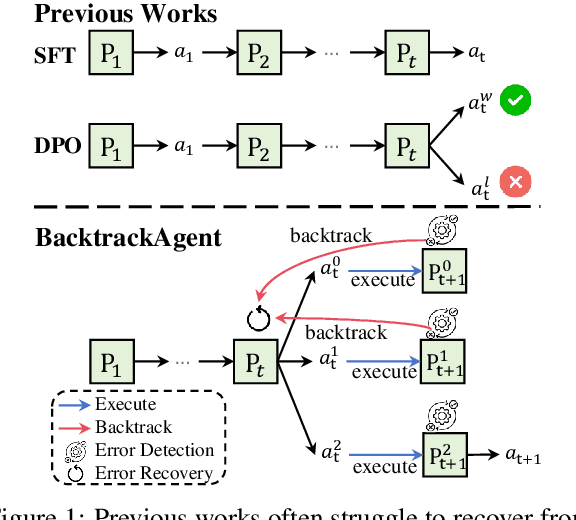
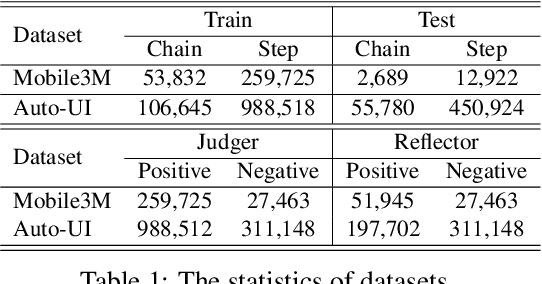
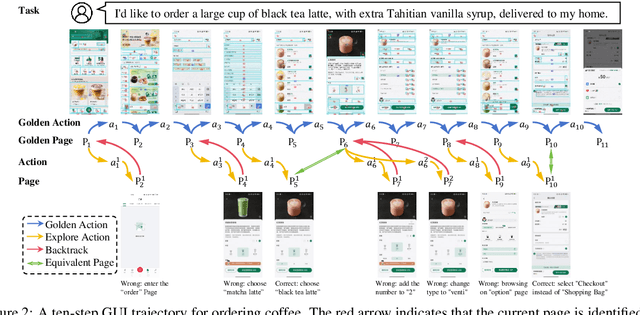
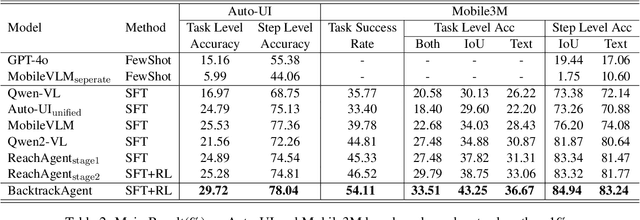
Graphical User Interface (GUI) agents have gained substantial attention due to their impressive capabilities to complete tasks through multiple interactions within GUI environments. However, existing agents primarily focus on enhancing the accuracy of individual actions and often lack effective mechanisms for detecting and recovering from errors. To address these shortcomings, we propose the BacktrackAgent, a robust framework that incorporates a backtracking mechanism to improve task completion efficiency. BacktrackAgent includes verifier, judger, and reflector components as modules for error detection and recovery, while also applying judgment rewards to further enhance the agent's performance. Additionally, we develop a training dataset specifically designed for the backtracking mechanism, which considers the outcome pages after action executions. Experimental results show that BacktrackAgent has achieved performance improvements in both task success rate and step accuracy on Mobile3M and Auto-UI benchmarks. Our data and code will be released upon acceptance.