 Add to Chrome
 Add to Firefox
 Add to Edge
Love Me, Love My Label: Rethinking the Role of Labels in Prompt Retrieval for Visual In-Context Learning
Apr 04, 2026
Visual in-context learning (VICL) enables visual foundation models to handle multiple tasks by steering them with demonstrative prompts. The choice of such prompts largely influences VICL performance, standing out as a key challenge. Prior work has made substantial progress on prompt retrieval and reranking strategies, but mainly focuses on prompt images while overlooking labels. We reveal these approaches sometimes get visually similar but label-inconsistent prompts, which potentially degrade VICL performance. On the other hand, higher label consistency between query and prompts preferably indicates stronger VICL results. Motivated by these findings, we develop a framework named LaPR (Label-aware Prompt Retrieval), which highlights the role of labels in prompt selection. Our framework first designs an image-label joint representation for prompts to incorporate label cues explicitly. Besides, to handle unavailable query labels at test time, we introduce a mixture-of-expert mechanism to the dual encoders with query-adaptive routing. Each expert is expected to capture a specific label mode, while the router infers query-adaptive mixture weights and helps to learn label-aware representation. We carefully design alternative optimization for experts and router, with a VICL performance-guided contrastive loss and a label-guided contrastive loss, respectively. Extensive experiments show promising and consistent improvement of LaPR on in-context segmentation, detection, and colorization tasks. Moreover, LaPR generalizes well across feature extractors and cross-fold scenarios, suggesting the importance of label utilization in prompt retrieval for VICL. Code is available at https://github.com/luotc-why/CVPR26-LaPR.

PromptHub: Enhancing Multi-Prompt Visual In-Context Learning with Locality-Aware Fusion, Concentration and Alignment
Mar 19, 2026Visual In-Context Learning (VICL) aims to complete vision tasks by imitating pixel demonstrations. Recent work pioneered prompt fusion that combines the advantages of various demonstrations, which shows a promising way to extend VICL. Unfortunately, the patch-wise fusion framework and model-agnostic supervision hinder the exploitation of informative cues, thereby limiting performance gains. To overcome this deficiency, we introduce PromptHub, a framework that holistically strengthens multi-prompting through locality-aware fusion, concentration and alignment. PromptHub exploits spatial priors to capture richer contextual information, employs complementary concentration, alignment, and prediction objectives to mutually guide training, and incorporates data augmentation to further reinforce supervision. Extensive experiments on three fundamental vision tasks demonstrate the superiority of PromptHub. Moreover, we validate its universality, transferability, and robustness across out-of-distribution settings, and various retrieval scenarios. This work establishes a reliable locality-aware paradigm for prompt fusion, moving beyond prior patch-wise approaches. Code is available at https://github.com/luotc-why/ICLR26-PromptHub.
From Verbatim to Gist: Distilling Pyramidal Multimodal Memory via Semantic Information Bottleneck for Long-Horizon Video Agents
Mar 02, 2026While multimodal large language models have demonstrated impressive short-term reasoning, they struggle with long-horizon video understanding due to limited context windows and static memory mechanisms that fail to mirror human cognitive efficiency. Existing paradigms typically fall into two extremes: vision-centric methods that incur high latency and redundancy through dense visual accumulation, or text-centric approaches that suffer from detail loss and hallucination via aggressive captioning. To bridge this gap, we propose MM-Mem, a pyramidal multimodal memory architecture grounded in Fuzzy-Trace Theory. MM-Mem structures memory hierarchically into a Sensory Buffer, Episodic Stream, and Symbolic Schema, enabling the progressive distillation of fine-grained perceptual traces (verbatim) into high-level semantic schemas (gist). Furthermore, to govern the dynamic construction of memory, we derive a Semantic Information Bottleneck objective and introduce SIB-GRPO to optimize the trade-off between memory compression and task-relevant information retention. In inference, we design an entropy-driven top-down memory retrieval strategy, which first tries with the abstract Symbolic Schema and progressively "drills down" to the Sensory Buffer and Episodic Stream under high uncertainty. Extensive experiments across 4 benchmarks confirm the effectiveness of MM-Mem on both offline and streaming tasks, demonstrating robust generalization and validating the effectiveness of cognition-inspired memory organization. Code is available at https://github.com/EliSpectre/MM-Mem.
AutoSSVH: Exploring Automated Frame Sampling for Efficient Self-Supervised Video Hashing
Apr 04, 2025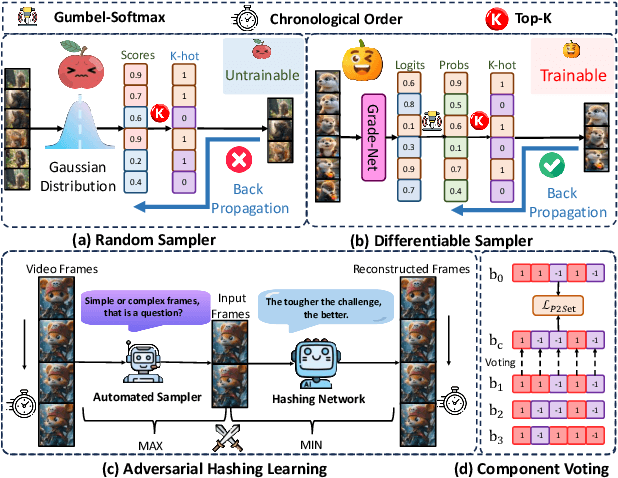
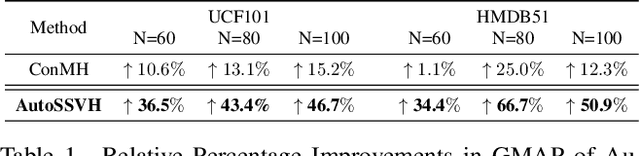
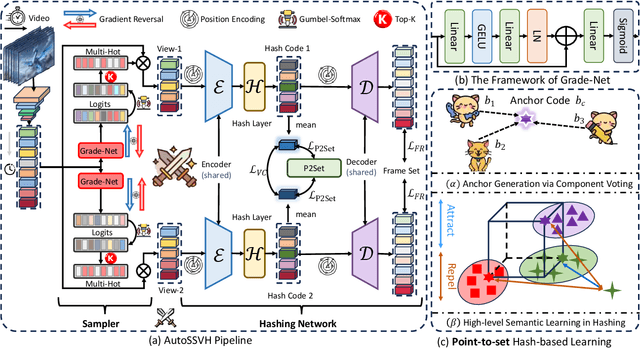
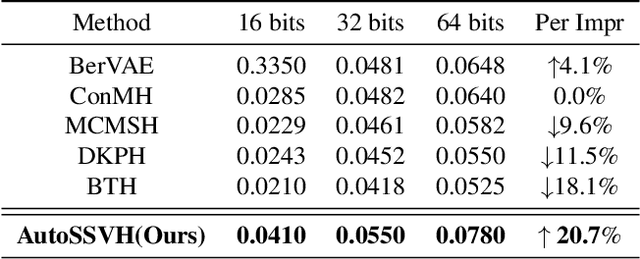
Self-Supervised Video Hashing (SSVH) compresses videos into hash codes for efficient indexing and retrieval using unlabeled training videos. Existing approaches rely on random frame sampling to learn video features and treat all frames equally. This results in suboptimal hash codes, as it ignores frame-specific information density and reconstruction difficulty. To address this limitation, we propose a new framework, termed AutoSSVH, that employs adversarial frame sampling with hash-based contrastive learning. Our adversarial sampling strategy automatically identifies and selects challenging frames with richer information for reconstruction, enhancing encoding capability. Additionally, we introduce a hash component voting strategy and a point-to-set (P2Set) hash-based contrastive objective, which help capture complex inter-video semantic relationships in the Hamming space and improve the discriminability of learned hash codes. Extensive experiments demonstrate that AutoSSVH achieves superior retrieval efficacy and efficiency compared to state-of-the-art approaches. Code is available at https://github.com/EliSpectre/CVPR25-AutoSSVH.
Efficient Self-Supervised Video Hashing with Selective State Spaces
Dec 19, 2024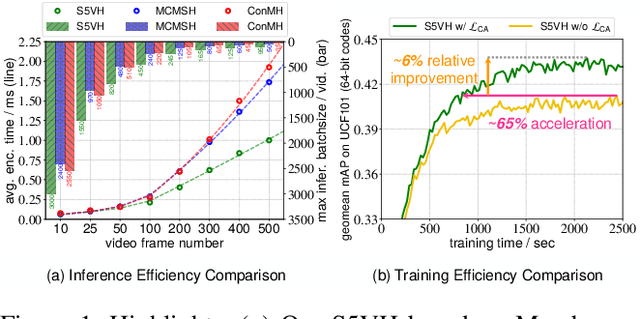


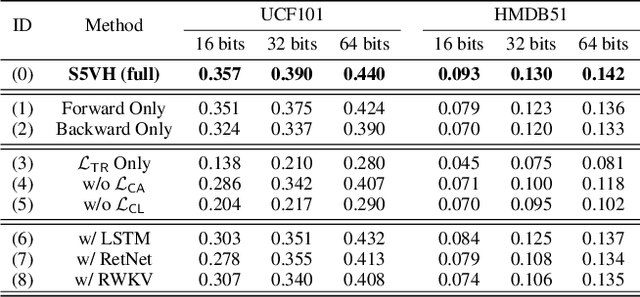
Self-supervised video hashing (SSVH) is a practical task in video indexing and retrieval. Although Transformers are predominant in SSVH for their impressive temporal modeling capabilities, they often suffer from computational and memory inefficiencies. Drawing inspiration from Mamba, an advanced state-space model, we explore its potential in SSVH to achieve a better balance between efficacy and efficiency. We introduce S5VH, a Mamba-based video hashing model with an improved self-supervised learning paradigm. Specifically, we design bidirectional Mamba layers for both the encoder and decoder, which are effective and efficient in capturing temporal relationships thanks to the data-dependent selective scanning mechanism with linear complexity. In our learning strategy, we transform global semantics in the feature space into semantically consistent and discriminative hash centers, followed by a center alignment loss as a global learning signal. Our self-local-global (SLG) paradigm significantly improves learning efficiency, leading to faster and better convergence. Extensive experiments demonstrate S5VH's improvements over state-of-the-art methods, superior transferability, and scalable advantages in inference efficiency. Code is available at https://github.com/gimpong/AAAI25-S5VH.
3D-GP-LMVIC: Learning-based Multi-View Image Coding with 3D Gaussian Geometric Priors
Sep 06, 2024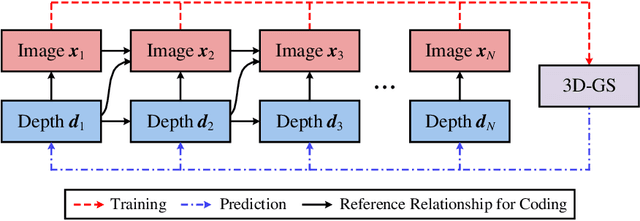


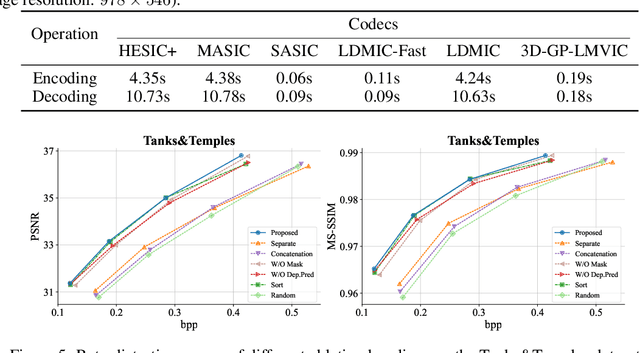
Multi-view image compression is vital for 3D-related applications. To effectively model correlations between views, existing methods typically predict disparity between two views on a 2D plane, which works well for small disparities, such as in stereo images, but struggles with larger disparities caused by significant view changes. To address this, we propose a novel approach: learning-based multi-view image coding with 3D Gaussian geometric priors (3D-GP-LMVIC). Our method leverages 3D Gaussian Splatting to derive geometric priors of the 3D scene, enabling more accurate disparity estimation across views within the compression model. Additionally, we introduce a depth map compression model to reduce redundancy in geometric information between views. A multi-view sequence ordering method is also proposed to enhance correlations between adjacent views. Experimental results demonstrate that 3D-GP-LMVIC surpasses both traditional and learning-based methods in performance, while maintaining fast encoding and decoding speed.