 Add to Chrome
 Add to Firefox
 Add to Edge
UI-Mate: Advancing Open-Weight Foundation GUI Agents with In-Context Demonstrations
Aug 16, 2026
Foundation GUI agents can automate complex digital tasks, but deployment is hindered by scarce and biased training data, ambiguous prompts, and unreliable execution. Routine workflows rely on user-specific tools and tacit conventions, so unstated instructions can produce arbitrary variations across runs. We present UI-Mate, a foundation GUI agent that integrates an environment-grounded training stack with in-context demonstration learning. UI-Mate makes three contributions: A Scalable Environment-Grounded Training Stack: A closed-loop data engine automates task generation, environment construction, rollout, filtering, capability balancing, SFT, and online RL across massively parallel environments via unified task-verifier bundles. In-Context Demonstration Learning: A mechanism that transforms multimodal demonstrations into flexible subtask-level workflows, follows relevant demonstrated steps, and re-plans from the live interface. OSWorkerBench Benchmark and Insights: A benchmark of 100 long-horizon office tasks across 41 applications that supports instruction-only and demonstration-guided evaluation. Its demonstration resources separate a 33-task self-demo setting, built from successful strong-agent rollouts of the same targets, from a 45-task variant-demo setting, built from human recordings of related but non-identical tasks. Experiments show that UI-Mate-27B sets a new open-weight state of the art on general computer-use benchmarks, scoring 77.0% on OSWorld-Verified and 66.2% on WindowsAgentArena. On OSWorkerBench, it reaches 41.0% strict success and 76.9% progress, outperforming its Qwen3.6-27B base by 17.7 and 24.5 points. On the 33-task self-demo subset, one demonstration raises strict success from 17.2% to 35.4% and progress from 67.9% to 81.1%, substantially improving long-horizon reliability. Project page: https://ui-mate.github.io.

DEFINED: A Data-Efficient Computational Framework for Fine-Grained Creativity Assessment in Debate Scenarios
Jun 05, 2026Human creativity has emerged as a critical competency in the era of large language models. Assessing creativity in complex, open-ended environments is a grand challenge in data mining, currently hindered by a reliance on standardized simple tasks and the scarcity of fine-grained expert data. As an ecologically valid assessment context, debate reflects multiple dimensions of creativity, encompassing both divergent thinking and convergent thinking. Moreover, debate is a data-rich domain, with a large volume of publicly accessible materials. Current mainstream automated scoring methods are poorly suited to complex settings such as debate, and therefore still rely on costly human evaluation. To this end, this paper proposes DEFINED, a data-efficient computational framework for fine-grained creativity assessment in debate scenarios. DEFINED operationalizes debate creativity through a hierarchical eight-dimensional metric system, implemented via a pre-trained autoregressive language model with a hierarchical scoring head that supports both fine-grained and coarse-grained evaluation. Statements and their associated expert scores were obtained from authentic debate competitions, and a constrained data augmentation strategy was employed to address the elite bias inherent in the original data. DEFINED adopts a mixed-granularity training strategy enabling robust learning from limited fine-grained supervision annotated by trained graduate experts. To rigorously validate ecological validity beyond synthetic benchmarks, we incorporate an empirical study with debate-naive participants, utilizing these authentic data to serve as a qualitative case study for mid-to-low proficiency populations. Across our evaluation protocol, our scoring model achieves accurate and stable scoring, outperforming prompt-based large language model evaluators and existing debate scoring methods.
DeskCraft: Benchmarking Desktop Agents on Professional Workflows and Human-in-the-Loop Collaboration
Jun 02, 2026Real-world professional desktop workflows in specialized creative and engineering software unfold over long horizons and often require human-in-the-loop coordination, where agents proactively seek necessary information and users provide additional instructions, clarifications, feedback, or corrections as the task progresses. Yet existing desktop GUI benchmarks mostly reduce this setting to short, simplified tasks with all user instructions provided upfront. To address this issue, we introduce DeskCraft, a desktop GUI benchmark targeting long horizon creative and engineering workflows and proactive human-agent collaboration. DeskCraft organizes tasks into a multilevel difficulty taxonomy, with long horizon tasks requiring over 50 execution steps, and covers professional creative software across design, video, audio, and 3D creation. Furthermore, DeskCraft formalizes human-agent collaboration into an interaction protocol covering mid-turn and post-turn exchanges. Mid-turn interaction captures both agent-initiated clarification under uncertainty and user-initiated interruption during execution, while post-turn interaction accommodates user-driven feedback after the agent signals completion, together spanning the full space of realistic collaboration patterns. We evaluate 18 proprietary and open source agents on 538 tasks and find that GPT-5.4 reaches 31.6% on standard tasks and 27.6% on interactive tasks. Further analyses reveal persistent failures in long horizon workflow delivery and proactive clarification. We will open-source all evaluation codes, tasks, and data at https://github.com/mrwwk/DeskCraft.
Measure Twice, Click Once: Co-evolving Proposer and Visual Critic via Reinforcement Learning for GUI Grounding
Apr 23, 2026Graphical User Interface (GUI) grounding requires mapping natural language instructions to precise pixel coordinates. However, due to visually homogeneous elements and dense layouts, models typically grasp semantic intent yet struggle with achieving precise localization. While scaling sampling attempts (Pass@k) reveals potential gains, static self-consistency strategies derived from geometric clustering often yield limited improvements, as the model's predictions tend to be spatially dispersed. In this paper, we propose replacing static consistency strategies with a learnable selection mechanism that selects the optimal target by critiquing its own proposals rendered on the screenshot. Given the significant disparity between the model's grounding and critiquing capabilities, we propose a co-evolving Propose-then-Critic framework. To jointly optimize these, we introduce a maturity-aware adaptive co-evolutionary reinforcement learning paradigm. This approach dynamically balances the training objectives of proposer and critic, where the diversity of the proposer's outputs enhances critic robustness, while the critic's maturing discrimination capability conversely unlocks the proposer's potential for extensive spatial exploration, fostering the mutual reinforcement and co-evolution of both capabilities, thereby ensuring generalizability to adapt to diverse and complex interface layouts. Extensive experiments over 6 benchmarks show that our method significantly enhances both grounding accuracy and critic reliability.
AlphaContext: An Evolutionary Tree-based Psychometric Context Generator for Creativity Assessment
Apr 21, 2026Creativity has become a core competence in the era of LLMs and human-AI collaboration, underpinning innovation in real-world problem solving. Crucially, the systematic improvement of creativity necessitates scientifically valid assessment instruments. Psychometric research recognizes context-based assessment as an effective way to measure creative thinking. However, high-quality expert-designed contexts remain scarce. Existing LLM-based generators often struggle with insufficient assessment cues, weak narrative coherence, limited stylistic diversity, and poor support for creative thinking. To address these challenges, we propose AlphaContext, an evolutionary tree-based psychometric context generator for creativity assessment. First, the HyperTree Outline Planner formalizes expert-designed outlining as a rule-guided hypertree and performs top-down hierarchical planning. The MCTS-based Context Generator fills the outline via MCTS to balance global structure and local quality. Then, the Evolutionary Context Optimizer evolves contexts with MAP-Elites by repeatedly updating niche elites to jointly improve diversity and quality. Finally, the Assessment-Guided Evolution Refiner simulates virtual participants with diverse styles and recycles weak contexts for further evolution. Experiments show that AlphaContext yields an average improvement of 8% over competitive methods across 6 quality metrics.
Cascaded Self-Evaluation Augmented Training for Efficient Multimodal Large Language Models
Jan 10, 2025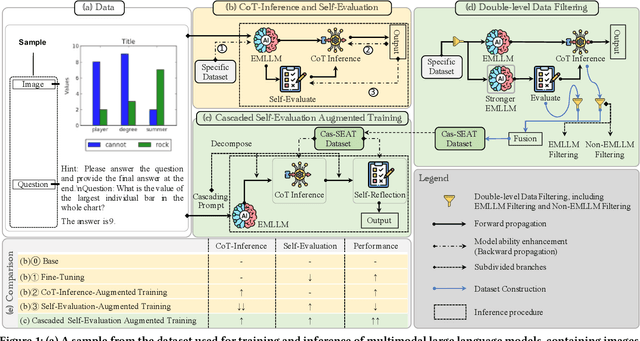
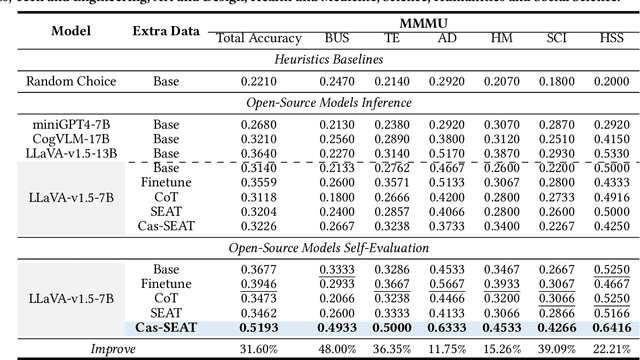
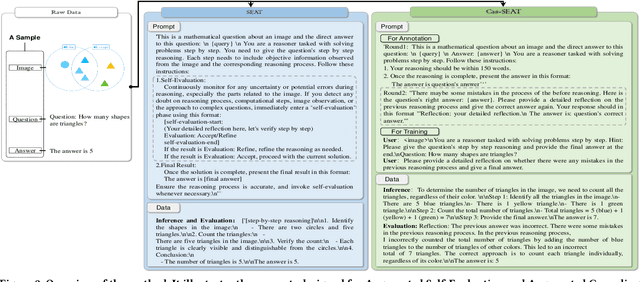

Efficient Multimodal Large Language Models (EMLLMs) have rapidly advanced recently. Incorporating Chain-of-Thought (CoT) reasoning and step-by-step self-evaluation has improved their performance. However, limited parameters often hinder EMLLMs from effectively using self-evaluation during inference. Key challenges include synthesizing evaluation data, determining its quantity, optimizing training and inference strategies, and selecting appropriate prompts. To address these issues, we introduce Self-Evaluation Augmented Training (SEAT). SEAT uses more powerful EMLLMs for CoT reasoning, data selection, and evaluation generation, then trains EMLLMs with the synthesized data. However, handling long prompts and maintaining CoT reasoning quality are problematic. Therefore, we propose Cascaded Self-Evaluation Augmented Training (Cas-SEAT), which breaks down lengthy prompts into shorter, task-specific cascaded prompts and reduces costs for resource-limited settings. During data synthesis, we employ open-source 7B-parameter EMLLMs and annotate a small dataset with short prompts. Experiments demonstrate that Cas-SEAT significantly boosts EMLLMs' self-evaluation abilities, improving performance by 19.68%, 55.57%, and 46.79% on the MathVista, Math-V, and We-Math datasets, respectively. Additionally, our Cas-SEAT Dataset serves as a valuable resource for future research in enhancing EMLLM self-evaluation.
MC-CoT: A Modular Collaborative CoT Framework for Zero-shot Medical-VQA with LLM and MLLM Integration
Oct 06, 2024

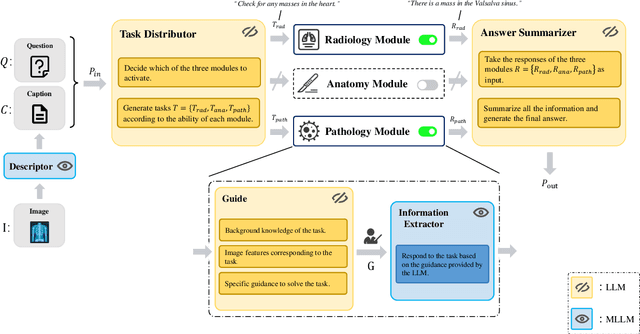

In recent advancements, multimodal large language models (MLLMs) have been fine-tuned on specific medical image datasets to address medical visual question answering (Med-VQA) tasks. However, this common approach of task-specific fine-tuning is costly and necessitates separate models for each downstream task, limiting the exploration of zero-shot capabilities. In this paper, we introduce MC-CoT, a modular cross-modal collaboration Chain-of-Thought (CoT) framework designed to enhance the zero-shot performance of MLLMs in Med-VQA by leveraging large language models (LLMs). MC-CoT improves reasoning and information extraction by integrating medical knowledge and task-specific guidance, where LLM provides various complex medical reasoning chains and MLLM provides various observations of medical images based on instructions of the LLM. Our experiments on datasets such as SLAKE, VQA-RAD, and PATH-VQA show that MC-CoT surpasses standalone MLLMs and various multimodality CoT frameworks in recall rate and accuracy. These findings highlight the importance of incorporating background information and detailed guidance in addressing complex zero-shot Med-VQA tasks.