 Add to Chrome
 Add to Firefox
 Add to Edge
SyncBreaker:Stage-Aware Multimodal Adversarial Attacks on Audio-Driven Talking Head Generation
Apr 09, 2026
Diffusion-based audio-driven talking-head generation enables realistic portrait animation, but also introduces risks of misuse, such as fraud and misinformation. Existing protection methods are largely limited to a single modality, and neither image-only nor audio-only attacks can effectively suppress speech-driven facial dynamics. To address this gap, we propose SyncBreaker, a stage-aware multimodal protection framework that jointly perturbs portrait and audio inputs under modality-specific perceptual constraints. Our key contributions are twofold. First, for the image stream, we introduce nullifying supervision with Multi-Interval Sampling (MIS) across diffusion stages to steer the generation toward the static reference portrait by aggregating guidance from multiple denoising intervals. Second, for the audio stream, we propose Cross-Attention Fooling (CAF), which suppresses interval-specific audio-conditioned cross-attention responses. Both streams are optimized independently and combined at inference time to enable flexible deployment. We evaluate SyncBreaker in a white-box proactive protection setting. Extensive experiments demonstrate that SyncBreaker more effectively degrades lip synchronization and facial dynamics than strong single-modality baselines, while preserving input perceptual quality and remaining robust under purification. Code: https://github.com/kitty384/SyncBreaker.

Intrinsic Lorentz Neural Network
Feb 27, 2026Real-world data frequently exhibit latent hierarchical structures, which can be naturally represented by hyperbolic geometry. Although recent hyperbolic neural networks have demonstrated promising results, many existing architectures remain partially intrinsic, mixing Euclidean operations with hyperbolic ones or relying on extrinsic parameterizations. To address it, we propose the \emph{Intrinsic Lorentz Neural Network} (ILNN), a fully intrinsic hyperbolic architecture that conducts all computations within the Lorentz model. At its core, the network introduces a novel \emph{point-to-hyperplane} fully connected layer (FC), replacing traditional Euclidean affine logits with closed-form hyperbolic distances from features to learned Lorentz hyperplanes, thereby ensuring that the resulting geometric decision functions respect the inherent curvature. Around this fundamental layer, we design intrinsic modules: GyroLBN, a Lorentz batch normalization that couples gyro-centering with gyro-scaling, consistently outperforming both LBN and GyroBN while reducing training time. We additionally proposed a gyro-additive bias for the FC output, a Lorentz patch-concatenation operator that aligns the expected log-radius across feature blocks via a digamma-based scale, and a Lorentz dropout layer. Extensive experiments conducted on CIFAR-10/100 and two genomic benchmarks (TEB and GUE) illustrate that ILNN achieves state-of-the-art performance and computational cost among hyperbolic models and consistently surpasses strong Euclidean baselines. The code is available at \href{https://github.com/Longchentong/ILNN}{\textcolor{magenta}{this url}}.
LIHE: Linguistic Instance-Split Hyperbolic-Euclidean Framework for Generalized Weakly-Supervised Referring Expression Comprehension
Nov 15, 2025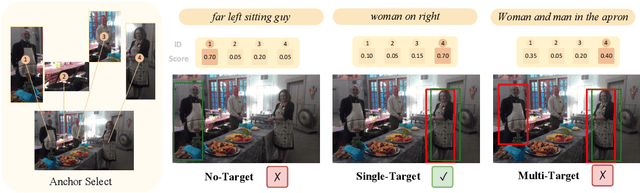
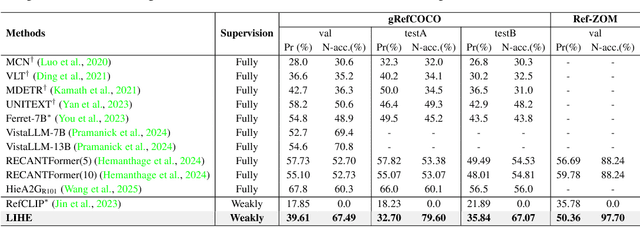
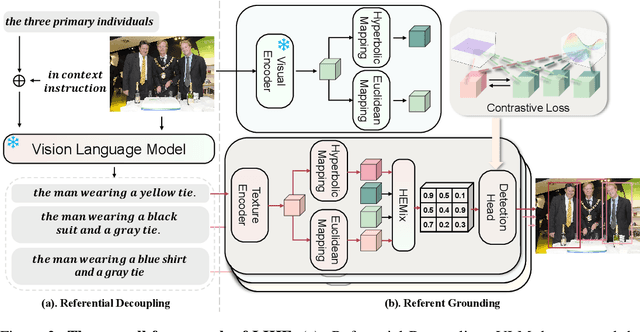
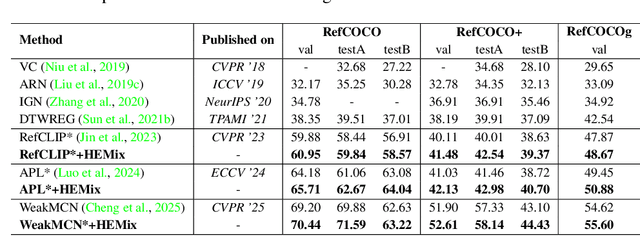
Existing Weakly-Supervised Referring Expression Comprehension (WREC) methods, while effective, are fundamentally limited by a one-to-one mapping assumption, hindering their ability to handle expressions corresponding to zero or multiple targets in realistic scenarios. To bridge this gap, we introduce the Weakly-Supervised Generalized Referring Expression Comprehension task (WGREC), a more practical paradigm that handles expressions with variable numbers of referents. However, extending WREC to WGREC presents two fundamental challenges: supervisory signal ambiguity, where weak image-level supervision is insufficient for training a model to infer the correct number and identity of referents, and semantic representation collapse, where standard Euclidean similarity forces hierarchically-related concepts into non-discriminative clusters, blurring categorical boundaries. To tackle these challenges, we propose a novel WGREC framework named Linguistic Instance-Split Hyperbolic-Euclidean (LIHE), which operates in two stages. The first stage, Referential Decoupling, predicts the number of target objects and decomposes the complex expression into simpler sub-expressions. The second stage, Referent Grounding, then localizes these sub-expressions using HEMix, our innovative hybrid similarity module that synergistically combines the precise alignment capabilities of Euclidean proximity with the hierarchical modeling strengths of hyperbolic geometry. This hybrid approach effectively prevents semantic collapse while preserving fine-grained distinctions between related concepts. Extensive experiments demonstrate LIHE establishes the first effective weakly supervised WGREC baseline on gRefCOCO and Ref-ZOM, while HEMix achieves consistent improvements on standard REC benchmarks, improving IoU@0.5 by up to 2.5\%. The code is available at https://anonymous.4open.science/r/LIHE.
Optimized Biomedical Question-Answering Services with LLM and Multi-BERT Integration
Oct 11, 2024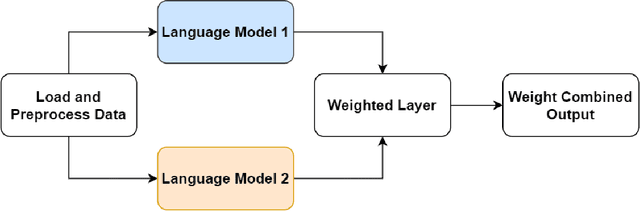
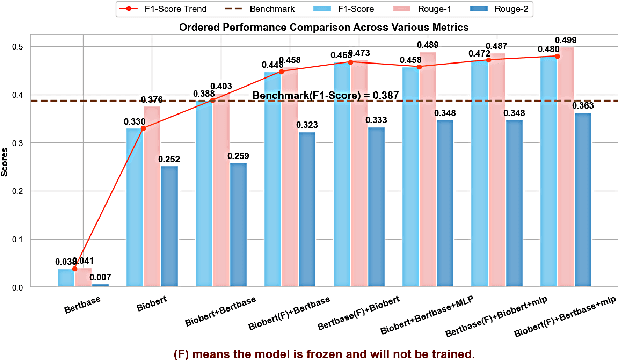
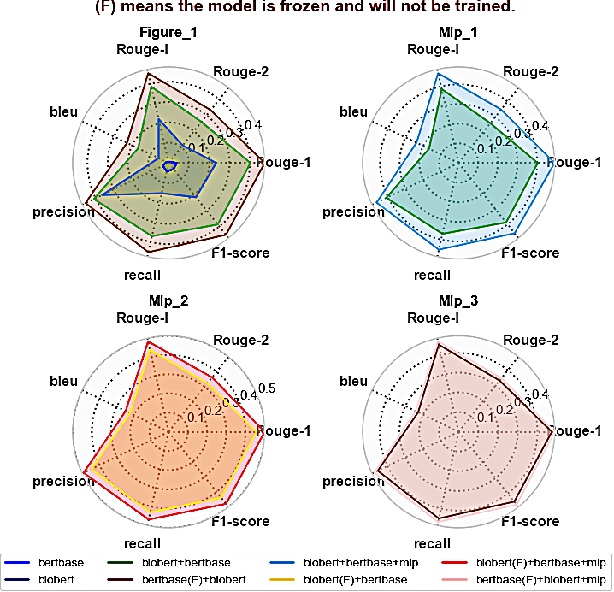
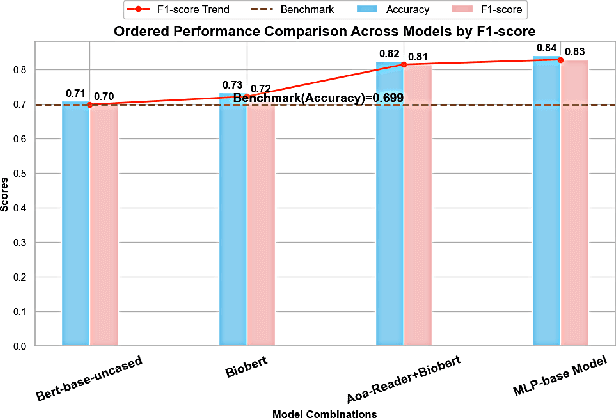
We present a refined approach to biomedical question-answering (QA) services by integrating large language models (LLMs) with Multi-BERT configurations. By enhancing the ability to process and prioritize vast amounts of complex biomedical data, this system aims to support healthcare professionals in delivering better patient outcomes and informed decision-making. Through innovative use of BERT and BioBERT models, combined with a multi-layer perceptron (MLP) layer, we enable more specialized and efficient responses to the growing demands of the healthcare sector. Our approach not only addresses the challenge of overfitting by freezing one BERT model while training another but also improves the overall adaptability of QA services. The use of extensive datasets, such as BioASQ and BioMRC, demonstrates the system's ability to synthesize critical information. This work highlights how advanced language models can make a tangible difference in healthcare, providing reliable and responsive tools for professionals to manage complex information, ultimately serving the broader goal of improved care and data-driven insights.