 Add to Chrome
 Add to Firefox
 Add to Edge
EDITBRIDGE: Towards Faithful and Efficient Ultra-High-Resolution Image Editing
Aug 18, 2026
High-resolution image editing is increasingly demanded in professional workflows, yet existing diffusion-based models remain constrained to resolutions below 1K due to quadratic attention complexity and prohibitive memory requirements. A prevalent workaround employs a two-stage pipeline: editing at low resolution followed by independent super-resolution. However, this approach suffers from two critical issues: information divergence, where hallucinated details contradict the original high-resolution (HR) source, and texture degradation, manifesting as over-smoothed or over-sharpened artifacts. We propose EditBridge, a diffusion bridge framework for efficient ultra high-resolution editing. Unlike conventional diffusion that regenerates from noise, we formulate refinement as structured data-to-data translation from the low-resolution (LR) edited result to its HR counterpart, explicitly conditioned on the original HR source to preserve authentic details. To efficiently incorporate HR source guidance, we introduce a prior-guided block-wise sparse attention mechanism that exploits semantic correspondence from first-stage editing to constrain cross-image interactions to spatially aligned regions, significantly reducing computational overhead. Extensive experiments demonstrate that EditBridge achieves high-fidelity editing with superior perceptual quality at resolutions up to 4K, delivering 3.6--8.4$\times$ speedup at 2K and enabling practical 4K editing in 61 seconds.

DynaForcing: Overcoming Dynamic Collapse in Self-Forcing Distillation for Streaming Avatar Generation
Aug 18, 2026Audio-driven avatar generation requires realistic lip-sync, expressive motion, and real-time streaming. Recent work achieves the latter via self-forcing with Distribution Matching Distillation (DMD), but this paradigm suffers from a critical failure that has not been systematically characterized: dynamic collapse, where the student model converges to a near-static optimum with high perceptual quality but severely suppressed temporal dynamics. We trace this to two causes: the reverse KL objective in DMD, which biases toward low-motion modes, and unanchored self-conditioning, which creates a feedback loop that amplifies collapse. This is especially harmful for avatars, where even subtle motion loss breaks lip-sync and expression. To address this, we propose DynaForcing, a training framework with three complementary strategies applied at different levels. Specifically, Hybrid Forcing anchors rollouts to ground-truth dynamics at the data level to break the feedback loop. Dynamics-Aware Reward Regularization introduces explicit motion rewards via the RL interpretation of DMD to counteract the reverse KL bias at the loss level. Reference Perturbation perturbs reference images to decouple identity from static details, forcing the model to rely on audio for motion at the conditioning level. We further introduce computation graph pruning and gradient replay, reducing the GPU footprint of self-forcing by over an order of magnitude. Experiments show that DynaForcing recovers dynamics to teacher-comparable levels (Dyn-Deg: 0.31 -> 0.73, Sync-C: 7.03 -> 7.68) while improving visual quality, resolving the quality-dynamics trade-off throughout training without early stopping.
LiveAnimate: Stable Long-Form Streaming Human Animation in Real-Time
Aug 12, 2026Pose-driven human animation synthesizes a video of a target person from a single reference image and a driving pose stream. Real-time generation is essential for interactive applications such as live streaming, telepresence, and virtual avatars, yet diffusion-based systems require minutes to hours per clip, precluding responsive interaction. We present LiveAnimate, to our knowledge the first animation system to combine real-time streaming with stable long-form generation at billion scale, built on a 14B-parameter video Diffusion Transformer (DiT). A two-stage training pipeline first adapts a pretrained bidirectional DiT into a block-causal autoregressive generator through Reference-Anchored Teacher-Forcing Adaptation, and then reduces the sampling budget to three steps through Block-wise Self-Forcing Distillation. To preserve appearance over extended streams, we introduce Pose-Retrieval Sink Attention (PR-Sink), a bounded KV-cache mechanism combining a Static Sink that permanently anchors the first generated block, a Dynamic Sink that holds a pose-retrieved historical block, and a three-slot Rolling Window. When a pose recurs, PR-Sink restores the relevant appearance context without retaining the entire sequence, so memory and per-block latency remain constant regardless of stream duration. Together with Ulysses sequence parallelism and operator fusion, these designs enable 19.63\,FPS streaming inference on two NVIDIA H100 GPUs. On a three-minute benchmark, LiveAnimate maintains nearly constant perceptual quality and identity from the first 30 seconds to the final minute (IQA 4.047 vs.\ 4.026), while prior systems degrade substantially or require hours of offline computation for the same rollout. These results establish a new operating point in quality, latency, and duration for interactive full-body animation.
AeroAct: Action-Centered World-Action Models for Language-Conditioned Quadrotor Flight
Jul 16, 2026Language-conditioned quadrotor flight requires a policy to ground semantic goals, anticipate the visual consequences of ego-motion, and output control references that remain smooth and dynamically executable under rapidly changing first-person views. Existing aerial vision-language navigation and vision-language-action methods commonly use discrete actions, high-level waypoints, or instantaneous velocity commands, which provide limited supervision about how flight actions change future observations. We present AeroAct, an action-centered world-action model (WAM) for quadrotor navigation. To the best of our knowledge, AeroAct is the first WAM instantiated and demonstrated for real-world aerial flight. The model adapts a pretrained video diffusion Transformer to predict local trajectory-action chunks from egocentric visual history, proprioception, and language. Future first-person frames are used during training as dense consequence supervision, while deployment directly decodes actions without generating future video. To obtain aligned visual, state, language, and dynamically feasible action data, we build a DiffAero-based pipeline with complementary Isaac Lab and 3D Gaussian splatting renderers. We further introduce a low-cost handheld collection device that couples camera observations with motion estimates to recreate flight-like egocentric trajectories, and a self-guidance procedure that improves temporal consistency across overlapping trajectory chunks. Closed-loop simulation and real-world experiments show that temporal visual context improves target tracking and object-search performance, and that WAM-based policies can be executed on a physical quadrotor.
CollectionLoRA: Collecting 50 Effects in 1 LoRA via Multi-Teacher On-Policy Distillation
May 27, 2026Customized image editing aims to equip pre-trained diffusion models with specific visual effects using limited paired data, typically via Low-Rank Adaptation (LoRA). As the number of desired effects grows, storing and dynamically loading numerous these effect LoRAs significantly increases deployment overhead. Furthermore, current pipelines typically cascade these effect LoRAs with acceleration modules for fast generation, which triggers severe parameter interference and results in concept bleeding and style degradation. We propose CollectionLoRA, a multi-teacher on-policy distillation framework capable of distilling the concepts of up to 50 different effect LoRAs along with few-step generation capabilities into a single LoRA. This fundamentally resolves the feature interference issue and significantly reduces deployment costs. Specifically, the method introduces (i) a Probabilistic Dual-Stream Routing mechanism that enables the model to randomly switch between data sources during training, effectively enhancing its generalization in unseen scenarios; (ii) an Asymmetric Orthogonal Prompting strategy to achieve concept isolation within the prompt space; (iii) a Coarse-to-Fine Distillation Objective to mitigate the distribution gap between the teacher and student models. Extensive evaluations show that CollectionLoRA distills all customized effects and few-step generation into a single LoRA, reducing deployment overhead while achieving concept fidelity comparable to or better than independently trained teacher models. Code: https://github.com/Qwen-Applications/CollectionLoRA
Bind-Your-Avatar: Multi-Talking-Character Video Generation with Dynamic 3D-mask-based Embedding Router
Jun 24, 2025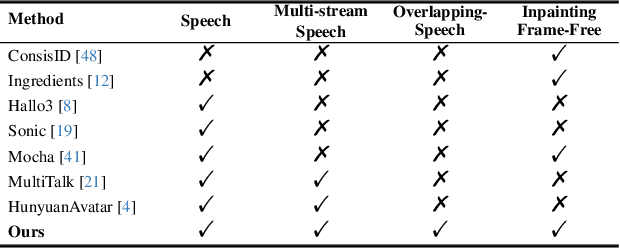
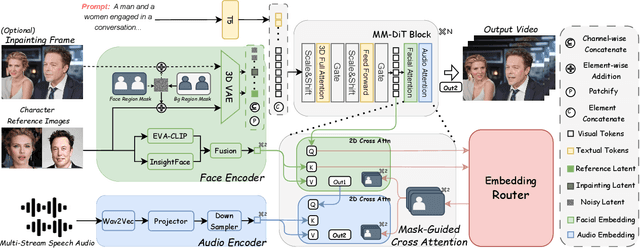
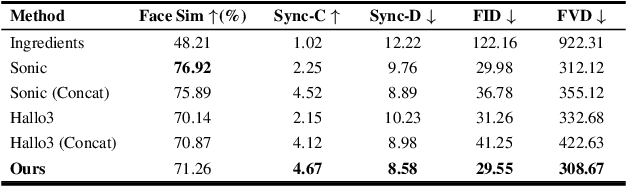
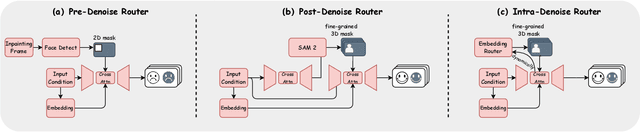
Recent years have witnessed remarkable advances in audio-driven talking head generation. However, existing approaches predominantly focus on single-character scenarios. While some methods can create separate conversation videos between two individuals, the critical challenge of generating unified conversation videos with multiple physically co-present characters sharing the same spatial environment remains largely unaddressed. This setting presents two key challenges: audio-to-character correspondence control and the lack of suitable datasets featuring multi-character talking videos within the same scene. To address these challenges, we introduce Bind-Your-Avatar, an MM-DiT-based model specifically designed for multi-talking-character video generation in the same scene. Specifically, we propose (1) A novel framework incorporating a fine-grained Embedding Router that binds `who' and `speak what' together to address the audio-to-character correspondence control. (2) Two methods for implementing a 3D-mask embedding router that enables frame-wise, fine-grained control of individual characters, with distinct loss functions based on observed geometric priors and a mask refinement strategy to enhance the accuracy and temporal smoothness of the predicted masks. (3) The first dataset, to the best of our knowledge, specifically constructed for multi-talking-character video generation, and accompanied by an open-source data processing pipeline, and (4) A benchmark for the dual-talking-characters video generation, with extensive experiments demonstrating superior performance over multiple state-of-the-art methods.
SWAT: Sliding Window Adversarial Training for Gradual Domain Adaptation
Jan 31, 2025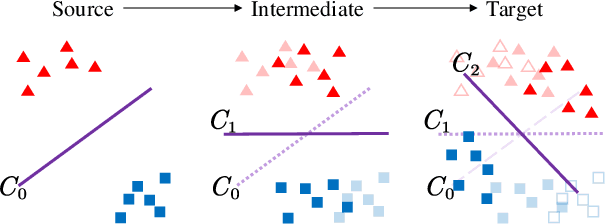

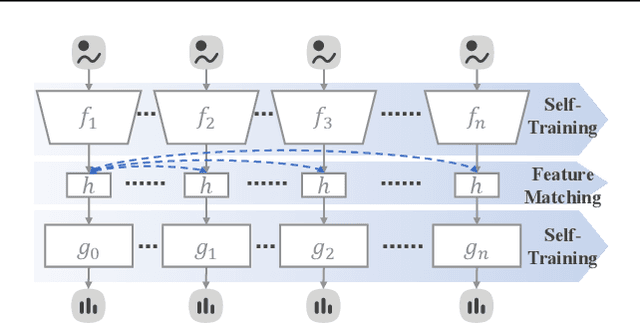

Domain shifts are critical issues that harm the performance of machine learning. Unsupervised Domain Adaptation (UDA) mitigates this issue but suffers when the domain shifts are steep and drastic. Gradual Domain Adaptation (GDA) alleviates this problem in a mild way by gradually adapting from the source to the target domain using multiple intermediate domains. In this paper, we propose Sliding Window Adversarial Training (SWAT) for Gradual Domain Adaptation. SWAT uses the construction of adversarial streams to connect the feature spaces of the source and target domains. In order to gradually narrow the small gap between adjacent intermediate domains, a sliding window paradigm is designed that moves along the adversarial stream. When the window moves to the end of the stream, i.e., the target domain, the domain shift is drastically reduced. Extensive experiments are conducted on public GDA benchmarks, and the results demonstrate that the proposed SWAT significantly outperforms the state-of-the-art approaches. The implementation is available at: https://anonymous.4open.science/r/SWAT-8677.
GDO: Gradual Domain Osmosis
Jan 31, 2025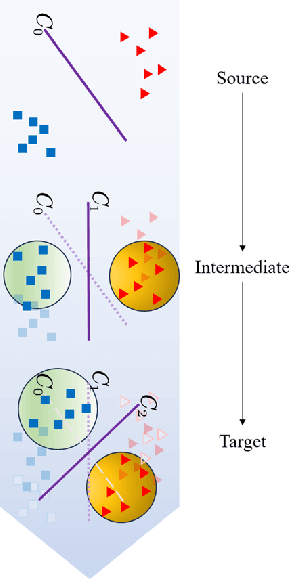
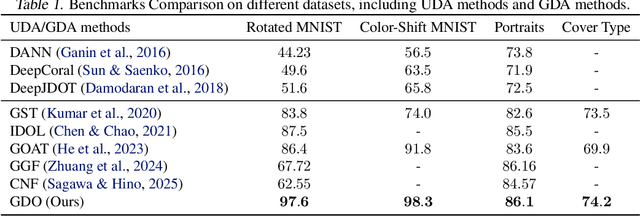
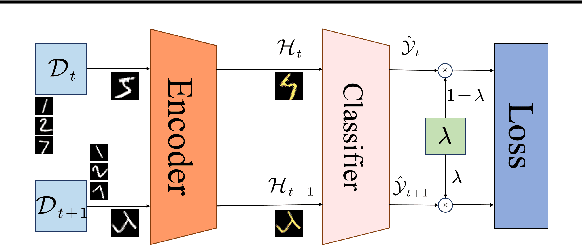
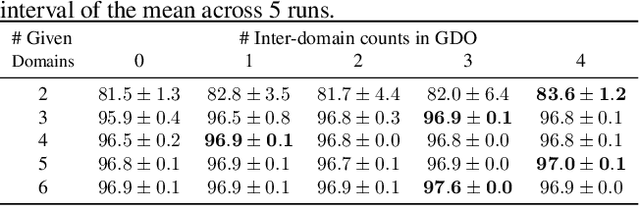
In this paper, we propose a new method called Gradual Domain Osmosis, which aims to solve the problem of smooth knowledge migration from source domain to target domain in Gradual Domain Adaptation (GDA). Traditional Gradual Domain Adaptation methods mitigate domain bias by introducing intermediate domains and self-training strategies, but often face the challenges of inefficient knowledge migration or missing data in intermediate domains. In this paper, we design an optimisation framework based on the hyperparameter $\lambda$ by dynamically balancing the loss weights of the source and target domains, which enables the model to progressively adjust the strength of knowledge migration ($\lambda$ incrementing from 0 to 1) during the training process, thus achieving cross-domain generalisation more efficiently. Specifically, the method incorporates self-training to generate pseudo-labels and iteratively updates the model by minimising a weighted loss function to ensure stability and robustness during progressive adaptation in the intermediate domain. The experimental part validates the effectiveness of the method on rotated MNIST, colour-shifted MNIST, portrait dataset and forest cover type dataset, and the results show that it outperforms existing baseline methods. The paper further analyses the impact of the dynamic tuning strategy of the hyperparameter $\lambda$ on the performance through ablation experiments, confirming the advantages of progressive domain penetration in mitigating the domain bias and enhancing the model generalisation capability. The study provides a theoretical support and practical framework for asymptotic domain adaptation and expands its application potential in dynamic environments.
CausalVE: Face Video Privacy Encryption via Causal Video Prediction
Sep 28, 2024
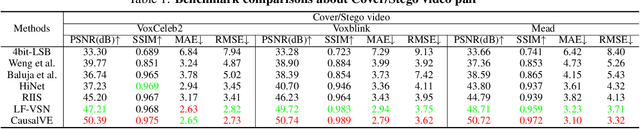


Advanced facial recognition technologies and recommender systems with inadequate privacy technologies and policies for facial interactions increase concerns about bioprivacy violations. With the proliferation of video and live-streaming websites, public-face video distribution and interactions pose greater privacy risks. Existing techniques typically address the risk of sensitive biometric information leakage through various privacy enhancement methods but pose a higher security risk by corrupting the information to be conveyed by the interaction data, or by leaving certain biometric features intact that allow an attacker to infer sensitive biometric information from them. To address these shortcomings, in this paper, we propose a neural network framework, CausalVE. We obtain cover images by adopting a diffusion model to achieve face swapping with face guidance and use the speech sequence features and spatiotemporal sequence features of the secret video for dynamic video inference and prediction to obtain a cover video with the same number of frames as the secret video. In addition, we hide the secret video by using reversible neural networks for video hiding so that the video can also disseminate secret data. Numerous experiments prove that our CausalVE has good security in public video dissemination and outperforms state-of-the-art methods from a qualitative, quantitative, and visual point of view.
LHQ-SVC: Lightweight and High Quality Singing Voice Conversion Modeling
Sep 13, 2024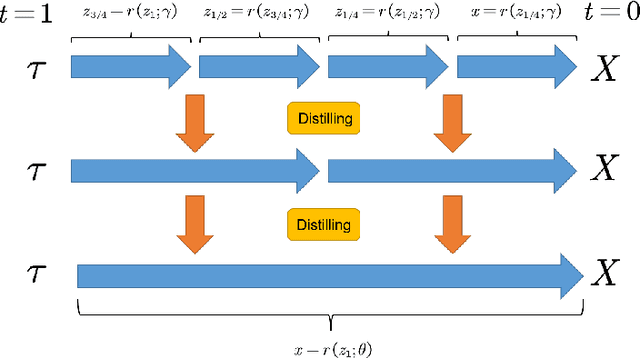
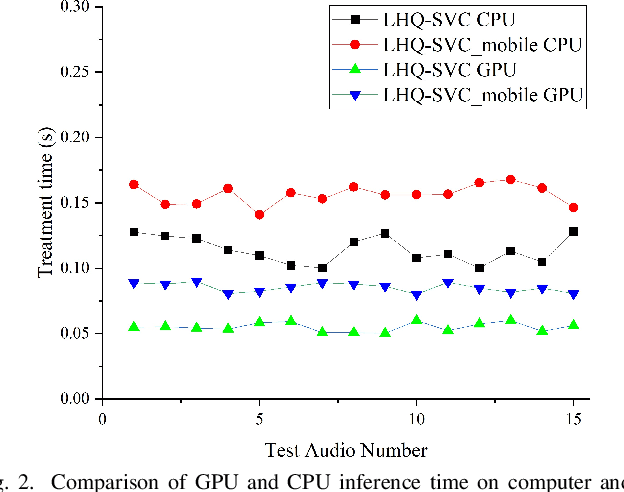
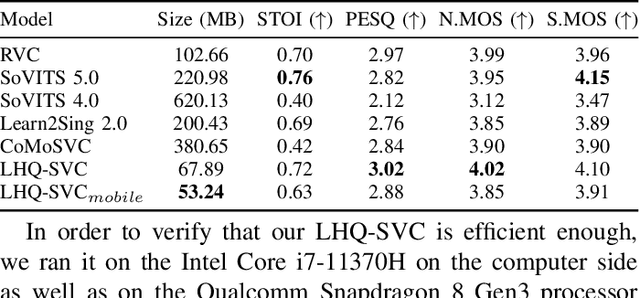
Singing Voice Conversion (SVC) has emerged as a significant subfield of Voice Conversion (VC), enabling the transformation of one singer's voice into another while preserving musical elements such as melody, rhythm, and timbre. Traditional SVC methods have limitations in terms of audio quality, data requirements, and computational complexity. In this paper, we propose LHQ-SVC, a lightweight, CPU-compatible model based on the SVC framework and diffusion model, designed to reduce model size and computational demand without sacrificing performance. We incorporate features to improve inference quality, and optimize for CPU execution by using performance tuning tools and parallel computing frameworks. Our experiments demonstrate that LHQ-SVC maintains competitive performance, with significant improvements in processing speed and efficiency across different devices. The results suggest that LHQ-SVC can meet