 Add to Chrome
 Add to Firefox
 Add to Edge
UniRank: Benchmarking Ranking Models for Unified Sequential Modeling and Feature Interaction
Jul 23, 2026
Ranking is a core stage in online advertising and recommender systems. Modern ranking models increasingly unify sequential modeling and feature interaction, yet many advances rely on proprietary data, closed implementations, and large-scale industrial infrastructure. This setting limits reproducible comparison and hinders academic study of scaling laws, long-sequence modeling, and multi-task ranking. To address these limitations, this paper proposes UniRank, an open benchmark for ranking models that unify sequential modeling and feature interaction. UniRank uses chronological pointwise autoregressive supervision, standardizes evaluation across feedback tasks, and provides a PyTorch toolkit with Distributed Data Parallel training, operator optimization, mixed-precision training, attention optimization, and other efficiency techniques that reduce hardware requirements. We benchmark 15 representative unified ranking models on five large-scale public datasets from short-video, advertising, and e-commerce platforms, with the largest dataset containing over 700 million instances and the longest behavior sequence exceeding 10^5 interactions. UniRank provides a reproducible basis for comparing unified ranking models, studying scaling laws under limited compute, and narrowing the gap between academic and industrial ranking research. We believe UniRank benefits researchers, practitioners, and beginners through reproducible experiments, production-oriented evaluation, and accessible implementations. Code and data are available at https://github.com/salmon1802/UniRank.

SocraticPO: Policy Optimization via Interactive Guidance
Jun 03, 2026Reinforcement learning (RL) for large language models usually supervises reasoning with scalar outcome rewards, such as binary correctness. Such rewards provide an optimization direction but rarely explain how a model should revise its mistaken reasoning, which can encourage shortcut learning and brittle policies. We propose \textbf{SocraticPO} (Socratic Policy Optimization), a policy-optimization framework that augments RL rollouts with Socratic-style natural-language guidance. During rollout, the student first answers independently; if the answer is incorrect, a teacher diagnoses the attempt and provides concise corrective guidance, after which the student continues under the expanded context. Crucially, this guidance is paired with reward decay: correct answers obtained after teacher intervention only receive decayed rewards, preventing the policy from treating teacher help as a free path to reward. Since SocraticPO only modifies the rollout process while leaving the standard expected-reward objective intact, it can be plugged into existing policy-gradient backends such as Reinforce++. Moreover, because the teacher provides only text-level guidance, SocraticPO can leverage stronger black-box teacher models without requiring access to logits or distribution matching. On undergraduate-level scientific reasoning benchmarks from SciKnowEval, SocraticPO improves over strong RL and self-distillation baselines. Ablations show that both targeted guidance and reward decay are necessary, with reward decay mitigating reliance on assisted correction.
From Fact Overwriting to Knowledge Evolution: Causal Editing via On-Policy Self-Distillation
May 27, 2026While Knowledge Editing (KE) enables efficient updates, its dominant Static Fact Overwriting paradigm treats LLMs as discrete databases, forcibly injecting isolated facts. Fracturing pre-trained logical topologies, this triggers Epistemic Dissonance -- a pathology where un-evolved legacy priors force the model to explicitly negate the injected update. Idealized interventions reveal that this is an inherent structural flaw rather than mere algorithmic noise, with a zero-distortion proxy yielding a catastrophic 95.6% self-refutation rate. Given the causally driven nature of real-world knowledge, grounding updates in explicit causal narratives effectively collapses this conflict rate to just 6.6%, underscoring the imperative for a paradigm shift toward Causal Editing. To internalize this evolution, we propose CODE (Causal On-policy Distillation for Editing). By coupling causal bootstrapping with asymmetric on-policy distillation, CODE engraves causal transition logic directly into parametric memory. Experiments on LLaMA-3.1 and Qwen-2.5 show CODE drastically suppresses self-refutation to 1.8% while securing robust multi-hop accuracy (up to 83.5%), seamlessly transforming discrete fact injection into coherent knowledge evolution. Code is available at https://github.com/CrashBugger/CODE.
Tango: Taming Visual Signals for Efficient Video Large Language Models
Apr 13, 2026Token pruning has emerged as a mainstream approach for developing efficient Video Large Language Models (Video LLMs). This work revisits and advances the two predominant token-pruning paradigms: attention-based selection and similarity-based clustering. Our study reveals two critical limitations in existing methods: (1) conventional top-k selection strategies fail to fully account for the attention distribution, which is often spatially multi-modal and long-tailed in magnitude; and (2) direct similarity-based clustering frequently generates fragmented clusters, resulting in distorted representations after pooling. To address these bottlenecks, we propose Tango, a novel framework designed to optimize the utilization of visual signals. Tango integrates a diversity-driven strategy to enhance attention-based token selection, and introduces Spatio-temporal Rotary Position Embedding (ST-RoPE) to preserve geometric structure via locality priors. Comprehensive experiments across various Video LLMs and video understanding benchmarks demonstrate the effectiveness and generalizability of our approach. Notably, when retaining only 10% of the video tokens, Tango preserves 98.9% of the original performance on LLaVA-OV while delivering a 1.88$\times$ inference speedup.
FairFS: Addressing Deep Feature Selection Biases for Recommender System
Feb 23, 2026Large-scale online marketplaces and recommender systems serve as critical technological support for e-commerce development. In industrial recommender systems, features play vital roles as they carry information for downstream models. Accurate feature importance estimation is critical because it helps identify the most useful feature subsets from thousands of feature candidates for online services. Such selection enables improved online performance while reducing computational cost. To address feature selection problems in deep learning, trainable gate-based and sensitivity-based methods have been proposed and proven effective in industrial practice. However, through the analysis of real-world cases, we identified three bias issues that cause feature importance estimation to rely on partial model layers, samples, or gradients, ultimately leading to inaccurate importance estimation. We refer to these as layer bias, baseline bias, and approximation bias. To mitigate these issues, we propose FairFS, a fair and accurate feature selection algorithm. FairFS regularizes feature importance estimated across all nonlinear transformation layers to address layer bias. It also introduces a smooth baseline feature close to the classifier decision boundary and adopts an aggregated approximation method to alleviate baseline and approximation biases. Extensive experiments demonstrate that FairFS effectively mitigates these biases and achieves state-of-the-art feature selection performance.
Towards Stable and Structured Time Series Generation with Perturbation-Aware Flow Matching
Nov 18, 2025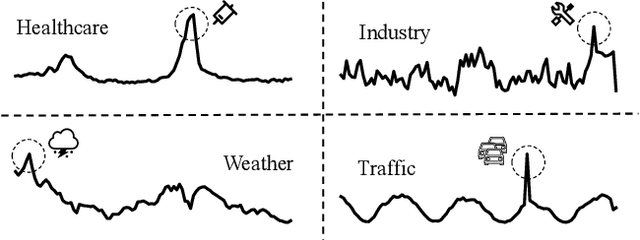
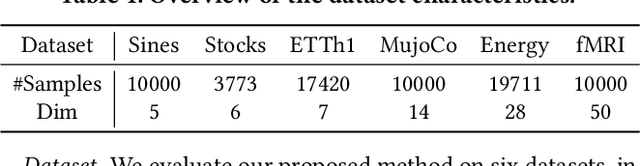
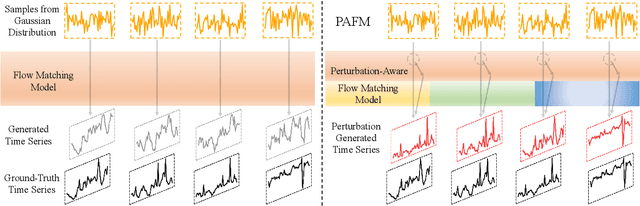
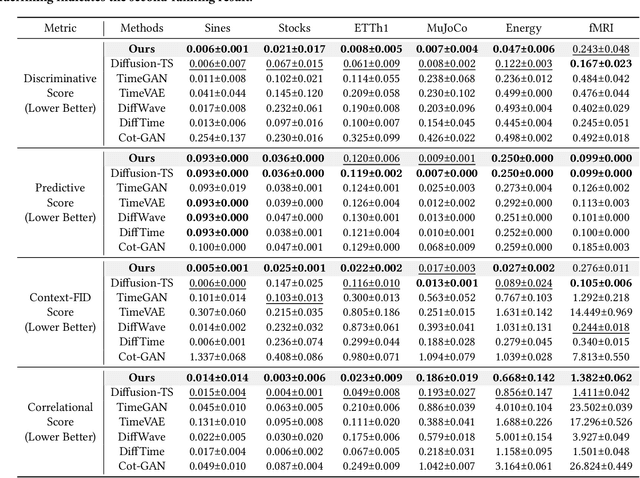
Time series generation is critical for a wide range of applications, which greatly supports downstream analytical and decision-making tasks. However, the inherent temporal heterogeneous induced by localized perturbations present significant challenges for generating structurally consistent time series. While flow matching provides a promising paradigm by modeling temporal dynamics through trajectory-level supervision, it fails to adequately capture abrupt transitions in perturbed time series, as the use of globally shared parameters constrains the velocity field to a unified representation. To address these limitations, we introduce \textbf{PAFM}, a \textbf{P}erturbation-\textbf{A}ware \textbf{F}low \textbf{M}atching framework that models perturbed trajectories to ensure stable and structurally consistent time series generation. The framework incorporates perturbation-guided training to simulate localized disturbances and leverages a dual-path velocity field to capture trajectory deviations under perturbation, enabling refined modeling of perturbed behavior to enhance the structural coherence. In order to further improve sensitivity to trajectory perturbations while enhancing expressiveness, a mixture-of-experts decoder with flow routing dynamically allocates modeling capacity in response to different trajectory dynamics. Extensive experiments on both unconditional and conditional generation tasks demonstrate that PAFM consistently outperforms strong baselines. Code is available at https://anonymous.4open.science/r/PAFM-03B2.
Bridging the Last Mile of Prediction: Enhancing Time Series Forecasting with Conditional Guided Flow Matching
Jul 09, 2025Diffusion models, a type of generative model, have shown promise in time series forecasting. But they face limitations like rigid source distributions and limited sampling paths, which hinder their performance. Flow matching offers faster generation, higher-quality outputs, and greater flexibility, while also possessing the ability to utilize valuable information from the prediction errors of prior models, which were previously inaccessible yet critically important. To address these challenges and fully unlock the untapped potential of flow matching, we propose Conditional Guided Flow Matching (CGFM). CGFM extends flow matching by incorporating the outputs of an auxiliary model, enabling a previously unattainable capability in the field: learning from the errors of the auxiliary model. For time series forecasting tasks, it integrates historical data as conditions and guidance, constructs two-sided conditional probability paths, and uses a general affine path to expand the space of probability paths, ultimately leading to improved predictions. Extensive experiments show that CGFM consistently enhances and outperforms state-of-the-art models, highlighting its effectiveness in advancing forecasting methods.
A Comprehensive Survey on Cross-Domain Recommendation: Taxonomy, Progress, and Prospects
Mar 18, 2025Recommender systems (RS) have become crucial tools for information filtering in various real world scenarios. And cross domain recommendation (CDR) has been widely explored in recent years in order to provide better recommendation results in the target domain with the help of other domains. The CDR technology has developed rapidly, yet there is a lack of a comprehensive survey summarizing recent works. Therefore, in this paper, we will summarize the progress and prospects based on the main procedure of CDR, including Cross Domain Relevance, Cross Domain Interaction, Cross Domain Representation Enhancement and Model Optimization. To help researchers better understand and engage in this field, we also organize the applications and resources, and highlight several current important challenges and future directions of CDR. More details of the survey articles are available at https://github.com/USTCAGI/Awesome-Cross-Domain Recommendation-Papers-and-Resources.