 Add to Chrome
 Add to Firefox
 Add to Edge
ActiveMem: Distributed Active Memory for Long-Horizon LLM Reasoning
Jun 09, 2026
Memory is essential for enabling large language model (LLM) agents to handle long-horizon reasoning tasks. Existing memory mechanisms are largely centralized, typically organizing retrieved information and interaction history within a single model context. This design imposes a fundamental trade-off: scaling reasoning trajectories risks context overload, whereas aggressive content pruning may result in irreversible information loss. Seeking a better trade-off, we draw inspiration from human cognitive systems, especially the functional complementarity between the prefrontal cortex (executive control) and the hippocampus (memory management), suggesting that such a trade-off need not be inherent, but may instead stem from centralized memory organization. To this end, we propose ActiveMem, a heterogeneous framework that decouples agent memory from the core reasoning process. Specifically, a high-level Planner utilizes distilled semantic gists to execute reasoning, while a lightweight, distributed memory system operates in parallel to actively accumulate and consolidate these gists throughout the task. Experiments on BrowseComp-Plus and GAIA show that ActiveMem achieves state-of-the-art accuracy with significantly reduced overhead, demonstrating the effectiveness of distributed active memory for long-horizon reasoning.

Intrinsic Lorentz Neural Network
Feb 27, 2026Real-world data frequently exhibit latent hierarchical structures, which can be naturally represented by hyperbolic geometry. Although recent hyperbolic neural networks have demonstrated promising results, many existing architectures remain partially intrinsic, mixing Euclidean operations with hyperbolic ones or relying on extrinsic parameterizations. To address it, we propose the \emph{Intrinsic Lorentz Neural Network} (ILNN), a fully intrinsic hyperbolic architecture that conducts all computations within the Lorentz model. At its core, the network introduces a novel \emph{point-to-hyperplane} fully connected layer (FC), replacing traditional Euclidean affine logits with closed-form hyperbolic distances from features to learned Lorentz hyperplanes, thereby ensuring that the resulting geometric decision functions respect the inherent curvature. Around this fundamental layer, we design intrinsic modules: GyroLBN, a Lorentz batch normalization that couples gyro-centering with gyro-scaling, consistently outperforming both LBN and GyroBN while reducing training time. We additionally proposed a gyro-additive bias for the FC output, a Lorentz patch-concatenation operator that aligns the expected log-radius across feature blocks via a digamma-based scale, and a Lorentz dropout layer. Extensive experiments conducted on CIFAR-10/100 and two genomic benchmarks (TEB and GUE) illustrate that ILNN achieves state-of-the-art performance and computational cost among hyperbolic models and consistently surpasses strong Euclidean baselines. The code is available at \href{https://github.com/Longchentong/ILNN}{\textcolor{magenta}{this url}}.
LIHE: Linguistic Instance-Split Hyperbolic-Euclidean Framework for Generalized Weakly-Supervised Referring Expression Comprehension
Nov 15, 2025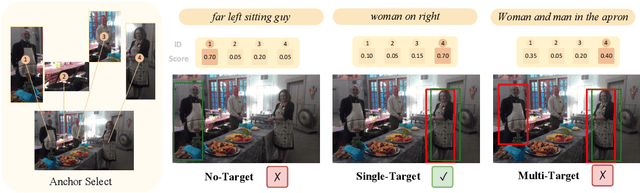
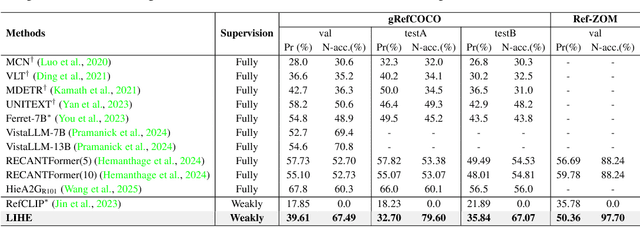
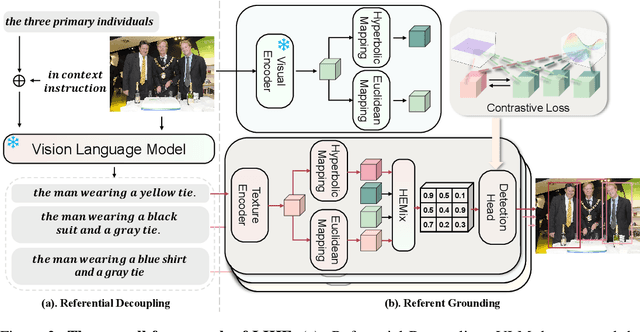
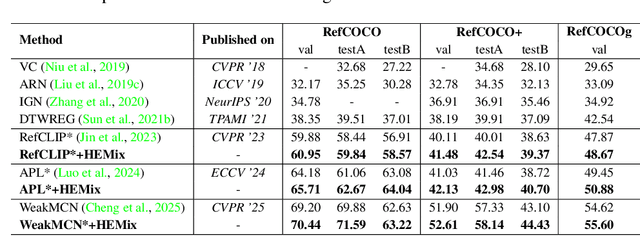
Existing Weakly-Supervised Referring Expression Comprehension (WREC) methods, while effective, are fundamentally limited by a one-to-one mapping assumption, hindering their ability to handle expressions corresponding to zero or multiple targets in realistic scenarios. To bridge this gap, we introduce the Weakly-Supervised Generalized Referring Expression Comprehension task (WGREC), a more practical paradigm that handles expressions with variable numbers of referents. However, extending WREC to WGREC presents two fundamental challenges: supervisory signal ambiguity, where weak image-level supervision is insufficient for training a model to infer the correct number and identity of referents, and semantic representation collapse, where standard Euclidean similarity forces hierarchically-related concepts into non-discriminative clusters, blurring categorical boundaries. To tackle these challenges, we propose a novel WGREC framework named Linguistic Instance-Split Hyperbolic-Euclidean (LIHE), which operates in two stages. The first stage, Referential Decoupling, predicts the number of target objects and decomposes the complex expression into simpler sub-expressions. The second stage, Referent Grounding, then localizes these sub-expressions using HEMix, our innovative hybrid similarity module that synergistically combines the precise alignment capabilities of Euclidean proximity with the hierarchical modeling strengths of hyperbolic geometry. This hybrid approach effectively prevents semantic collapse while preserving fine-grained distinctions between related concepts. Extensive experiments demonstrate LIHE establishes the first effective weakly supervised WGREC baseline on gRefCOCO and Ref-ZOM, while HEMix achieves consistent improvements on standard REC benchmarks, improving IoU@0.5 by up to 2.5\%. The code is available at https://anonymous.4open.science/r/LIHE.