 Add to Chrome
 Add to Firefox
 Add to Edge
FTA-Mem: Fact-Time-Affect Anchored Memory for Low-Density Long-Term Dialogue
Aug 17, 2026
Long-term emotional-support agents require memory mechanisms for personalized understanding across sessions. However, emotional-support dialogue is often low-density: turns are incomplete, evidence is scattered, and user states evolve over time. Existing memory methods usually rely on fixed units, such as turn-level notes or session summaries, which may lose details or introduce redundant noise. We propose FTA-Mem, a structured memory framework for low-density long-term dialogue. FTA-Mem uses Boundary-preserving Window Segmentation (BWS) to form coherent situation fragments, and constructs Fact-Time-Affect Memory Units (FTA Units) that jointly encode factual content, temporal grounding, and affective context. Retrieved units are then synthesized into structured context for answer generation. Experiments on ES-MemEval and LoCoMo show that FTA-Mem improves overall long-term memory question answering across benchmarks with different information-density characteristics. On ES-MemEval, FTA-Mem achieves 0.3871 F1 and 0.6668 BERTScore. Further analysis shows that situation-level FTA construction better balances evidence preservation and construction cost than coarse session-level or overly fine-grained turn-pair construction, providing an effective granularity trade-off for long-term dialogue memory.

FORCE: Efficient VLA Reinforcement Fine-Tuning via Value-Calibrated Warm-up and Self-Distillation
Jun 24, 2026Vision-Language-Action (VLA) models are often constrained by the imitation ceiling imposed by sub-optimal data. While Reinforcement Learning (RL) fine-tuning can surpass this limit, it is notoriously sample inefficient. This challenge arises from two core issues: (1) catastrophic initial unlearning due to an unstable Q-function and (2) inefficient policy updates caused by low-quality exploration data, often forcing a reliance on costly human interventions. We introduce FORCE, a 3-stage framework that stabilizes fine-tuning by tackling both issues. FORCE first incorporates a Value-Calibrated Warm-Up phase, utilizing on-policy rollouts to mitigate the distributional shift of the Q-function. Subsequently, during the online stage, this calibrated Q-function acts as a filter for both the policy's own action proposals and expert data, ensuring only high-value actions are used for the policy update. We evaluate FORCE on various simulation and real-world tasks, and the result shows that FORCE achieves a 79% absolute improvement in success rates and outperform prior RL methods by 10%, while accelerating training by 32.5%. Critically, it mitigates the common success rate drop and achieves this robust performance without human intervention, marking a significant step towards deploying capable and autonomous robotic agents.
DMT-CBT: Longitudinal Therapeutic State Modeling for CBT Counseling
Jun 02, 2026Large language models (LLMs) have shown growing potential for Cognitive Behavioral Therapy (CBT) counseling. However, most existing approaches still formulate counseling as a local response generation problem, focusing on empathetic replies within short, text-only, or single-session interactions. We argue that this formulation fundamentally mismatches the nature of real psychotherapy. In clinical CBT, therapy is a longitudinal process in which therapists continuously infer, update, and intervene on evolving therapeutic states across sessions. Realistic CBT further involves multimodal inference and delayed cross-session intervention effects, requiring models to capture longitudinal therapeutic state evolution under partial observability. We propose DMT-CBT, a framework for Dynamic Modeling of evolving Therapeutic states in CBT counseling. DMT-CBT maintains structured therapeutic states across sessions while incorporating multimodal behavioral grounding and tool-augmented intervention to support adaptive therapeutic reasoning. Based on this framework, we construct DMTCorpus, a synthetic multi-session multimodal CBT counseling dataset featuring evolving therapeutic states, image-grounded client behaviors, and cross-session intervention continuity. Experimental results show that DMT-CBT improves counseling fidelity and therapeutic alliance, produces more favorable longitudinal affective trajectories, and preserves therapeutic states more faithfully than post-hoc extraction approaches.
OneVLA: A Unified Framework for Embodied Tasks
May 31, 2026Navigation and manipulation are fundamental capabilities of embodied intelligence, enabling robots to interpret natural language commands and interact physically with their surroundings. However, current Vision-Language-Action (VLA) models remain constrained by task-specific architectures, specializing in either navigation or manipulation, which hinders the development of general-purpose robotic agents. To bridge this gap, we introduce OneVLA, a unified architecture that integrates these distinct tasks into a single, cohesive framework. Specifically, we design a unified action head capable of generating both navigation and manipulation actions without requiring task-specific variants. Furthermore, we propose a multi stage progressive training strategy-incorporating curated data construction and Chain-of-Thought (CoT) fine-tuning that facilitates strong positive transfer and mutual reinforcement between the two domains. Extensive experiments in both simulated and real-world environments demonstrate that OneVLA achieves state-of-the-art performance, significantly outperforming both specialized single-task and existing cross-task models. By unifying these core capabilities, OneVLA paves the way for truly general-purpose robotic systems. The model and source code will be publicly released.
The AI Hippocampus: How Far are We From Human Memory?
Jan 14, 2026Memory plays a foundational role in augmenting the reasoning, adaptability, and contextual fidelity of modern Large Language Models and Multi-Modal LLMs. As these models transition from static predictors to interactive systems capable of continual learning and personalized inference, the incorporation of memory mechanisms has emerged as a central theme in their architectural and functional evolution. This survey presents a comprehensive and structured synthesis of memory in LLMs and MLLMs, organizing the literature into a cohesive taxonomy comprising implicit, explicit, and agentic memory paradigms. Specifically, the survey delineates three primary memory frameworks. Implicit memory refers to the knowledge embedded within the internal parameters of pre-trained transformers, encompassing their capacity for memorization, associative retrieval, and contextual reasoning. Recent work has explored methods to interpret, manipulate, and reconfigure this latent memory. Explicit memory involves external storage and retrieval components designed to augment model outputs with dynamic, queryable knowledge representations, such as textual corpora, dense vectors, and graph-based structures, thereby enabling scalable and updatable interaction with information sources. Agentic memory introduces persistent, temporally extended memory structures within autonomous agents, facilitating long-term planning, self-consistency, and collaborative behavior in multi-agent systems, with relevance to embodied and interactive AI. Extending beyond text, the survey examines the integration of memory within multi-modal settings, where coherence across vision, language, audio, and action modalities is essential. Key architectural advances, benchmark tasks, and open challenges are discussed, including issues related to memory capacity, alignment, factual consistency, and cross-system interoperability.
Native Parallel Reasoner: Reasoning in Parallelism via Self-Distilled Reinforcement Learning
Dec 19, 2025We introduce Native Parallel Reasoner (NPR), a teacher-free framework that enables Large Language Models (LLMs) to self-evolve genuine parallel reasoning capabilities. NPR transforms the model from sequential emulation to native parallel cognition through three key innovations: 1) a self-distilled progressive training paradigm that transitions from ``cold-start'' format discovery to strict topological constraints without external supervision; 2) a novel Parallel-Aware Policy Optimization (PAPO) algorithm that optimizes branching policies directly within the execution graph, allowing the model to learn adaptive decomposition via trial and error; and 3) a robust NPR Engine that refactors memory management and flow control of SGLang to enable stable, large-scale parallel RL training. Across eight reasoning benchmarks, NPR trained on Qwen3-4B achieves performance gains of up to 24.5% and inference speedups up to 4.6x. Unlike prior baselines that often fall back to autoregressive decoding, NPR demonstrates 100% genuine parallel execution, establishing a new standard for self-evolving, efficient, and scalable agentic reasoning.
Interpretable Reward Model via Sparse Autoencoder
Aug 12, 2025Large language models (LLMs) have been widely deployed across numerous fields. Reinforcement Learning from Human Feedback (RLHF) leverages reward models (RMs) as proxies for human preferences to align LLM behaviors with human values, making the accuracy, reliability, and interpretability of RMs critical for effective alignment. However, traditional RMs lack interpretability, offer limited insight into the reasoning behind reward assignments, and are inflexible toward user preference shifts. While recent multidimensional RMs aim for improved interpretability, they often fail to provide feature-level attribution and require costly annotations. To overcome these limitations, we introduce the Sparse Autoencoder-enhanced Reward Model (\textbf{SARM}), a novel architecture that integrates a pretrained Sparse Autoencoder (SAE) into a reward model. SARM maps the hidden activations of LLM-based RM into an interpretable, sparse, and monosemantic feature space, from which a scalar head aggregates feature activations to produce transparent and conceptually meaningful reward scores. Empirical evaluations demonstrate that SARM facilitates direct feature-level attribution of reward assignments, allows dynamic adjustment to preference shifts, and achieves superior alignment performance compared to conventional reward models. Our code is available at https://github.com/schrieffer-z/sarm.
Marine Chlorophyll Prediction and Driver Analysis based on LSTM-RF Hybrid Models
Aug 07, 2025Marine chlorophyll concentration is an important indicator of ecosystem health and carbon cycle strength, and its accurate prediction is crucial for red tide warning and ecological response. In this paper, we propose a LSTM-RF hybrid model that combines the advantages of LSTM and RF, which solves the deficiencies of a single model in time-series modelling and nonlinear feature portrayal. Trained with multi-source ocean data(temperature, salinity, dissolved oxygen, etc.), the experimental results show that the LSTM-RF model has an R^2 of 0.5386, an MSE of 0.005806, and an MAE of 0.057147 on the test set, which is significantly better than using LSTM (R^2 = 0.0208) and RF (R^2 =0.4934) alone , respectively. The standardised treatment and sliding window approach improved the prediction accuracy of the model and provided an innovative solution for high-frequency prediction of marine ecological variables.
A Context-Aware Dual-Metric Framework for Confidence Estimation in Large Language Models
Aug 01, 2025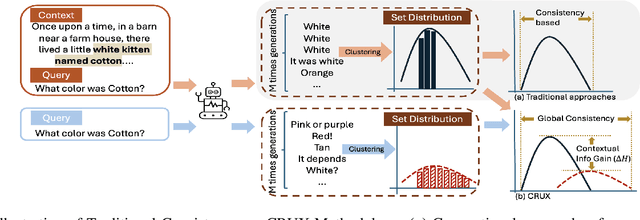
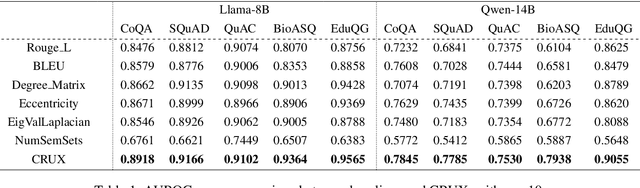

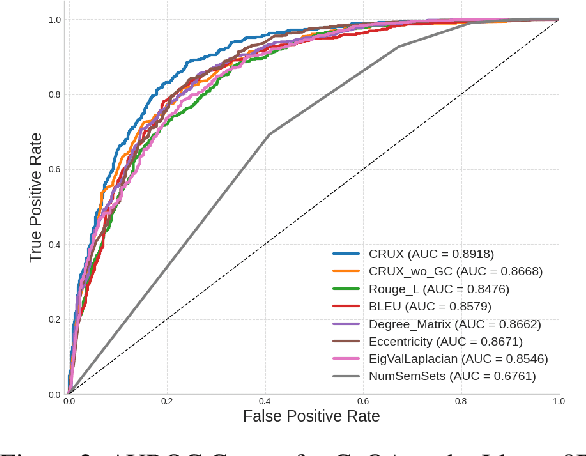
Accurate confidence estimation is essential for trustworthy large language models (LLMs) systems, as it empowers the user to determine when to trust outputs and enables reliable deployment in safety-critical applications. Current confidence estimation methods for LLMs neglect the relevance between responses and contextual information, a crucial factor in output quality evaluation, particularly in scenarios where background knowledge is provided. To bridge this gap, we propose CRUX (Context-aware entropy Reduction and Unified consistency eXamination), the first framework that integrates context faithfulness and consistency for confidence estimation via two novel metrics. First, contextual entropy reduction represents data uncertainty with the information gain through contrastive sampling with and without context. Second, unified consistency examination captures potential model uncertainty through the global consistency of the generated answers with and without context. Experiments across three benchmark datasets (CoQA, SQuAD, QuAC) and two domain-specific datasets (BioASQ, EduQG) demonstrate CRUX's effectiveness, achieving the highest AUROC than existing baselines.
RoboBrain 2.0 Technical Report
Jul 02, 2025We introduce RoboBrain 2.0, our latest generation of embodied vision-language foundation models, designed to unify perception, reasoning, and planning for complex embodied tasks in physical environments. It comes in two variants: a lightweight 7B model and a full-scale 32B model, featuring a heterogeneous architecture with a vision encoder and a language model. Despite its compact size, RoboBrain 2.0 achieves strong performance across a wide spectrum of embodied reasoning tasks. On both spatial and temporal benchmarks, the 32B variant achieves leading results, surpassing prior open-source and proprietary models. In particular, it supports key real-world embodied AI capabilities, including spatial understanding (e.g., affordance prediction, spatial referring, trajectory forecasting) and temporal decision-making (e.g., closed-loop interaction, multi-agent long-horizon planning, and scene graph updating). This report details the model architecture, data construction, multi-stage training strategies, infrastructure and practical applications. We hope RoboBrain 2.0 advances embodied AI research and serves as a practical step toward building generalist embodied agents. The code, checkpoint and benchmark are available at https://superrobobrain.github.io.