 Add to Chrome
 Add to Firefox
 Add to Edge
Prototype Memory-Guided Training-Free Anomaly Classification and Localization in Prenatal Ultrasound
Jul 01, 2026
Prenatal anomaly classification and localization is of critical importance for fetal health and pregnancy management. Although ultrasound (US) is the primary modality for prenatal screening, accurate diagnosis remains challenging due to the low prevalence and high heterogeneity of anomalies. Existing deep learning methods for prenatal tasks rely on large-scale annotated datasets, which are difficult to obtain in practice. Although few-shot learning alleviates data scarcity, it typically requires fine-tuning for new categories, limiting its practicality in resource-limited clinical settings. To address these challenges, we propose a training-free framework for multi-class prenatal US anomaly classification and localization that operates with only a few reference images per class, representing the first exploration of this setting. Our framework comprises three key components: (1) a memory bank with multi-granular prototypes that explicitly models both class-level semantics and anomaly characteristics; (2) a prototype-driven soft merging mechanism that aggregates discriminative features to detect the anomaly region; and (3) a class-aware refinement strategy that leverages prototype consistency to improve category prediction. Extensively validated on a multi-center prenatal US dataset containing 1,149 cases, with a total of 2,357 images and 9 categories, our proposed method outperforms the competitors.

Foundation Model-driven Key Anatomy Frame Selection for Blind-sweep Ultrasound Fetal Birth Weight Estimation
Jul 01, 2026Accurate fetal birth weight (FBW) estimation shortly before delivery is clinically valuable yet challenging due to its reliance on operator expertise, particularly in low-resource settings. To reduce this reliance, we study near-term birth-weight regression from blind-sweep ultrasound (US) videos acquired within 48 hours prior to delivery, with post-delivery weighing as ground truth. Accordingly, we propose a foundation model-driven key anatomy frame selection framework that enables accurate FBW regression despite the absence of plane constraints in blind sweeps. Our highlights are as follows: (1) We believe this is the first work to estimate FBW using blind-sweep US videos, enabling operator-independent assessment. (2) An Anatomy-Guided Frame Selection module equipped with a vision-language foundation model is proposed for keyframe collection in unconstrained sweeps. (3) A Redundancy-Aware Feature Compression module is designed to compress frame features while preserving task-relevant information, alleviating temporal redundancy. Extensively validated on prospectively collected data from 839 patients, our method achieves an MAE of 161.3 g, with 90.23% and 100% of cases falling within 10% and 15% absolute percentage error, outperforming typical Hadlock estimation and strong competitors. Codes are available at https://github.com/ouleoule/BlindSweep-EBW.
Medical-Knowledge Driven Multiple Instance Learning for Classifying Severe Abdominal Anomalies on Prenatal Ultrasound
Jul 02, 2025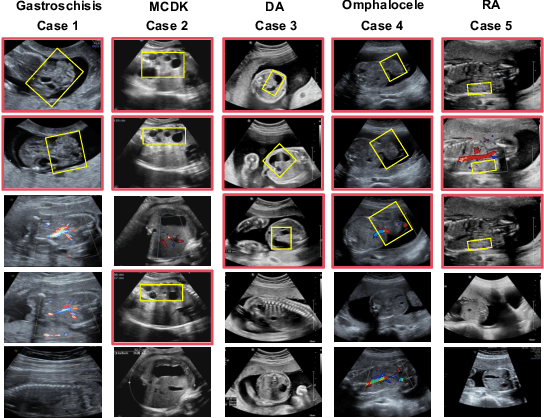
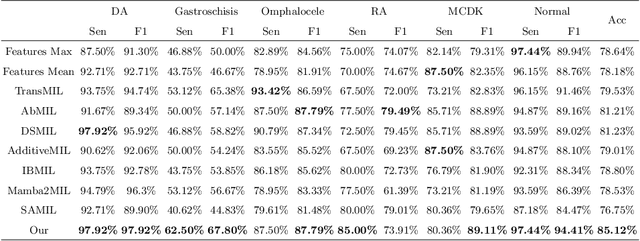
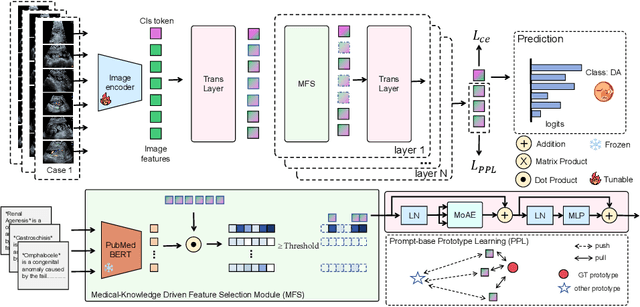

Fetal abdominal malformations are serious congenital anomalies that require accurate diagnosis to guide pregnancy management and reduce mortality. Although AI has demonstrated significant potential in medical diagnosis, its application to prenatal abdominal anomalies remains limited. Most existing studies focus on image-level classification and rely on standard plane localization, placing less emphasis on case-level diagnosis. In this paper, we develop a case-level multiple instance learning (MIL)-based method, free of standard plane localization, for classifying fetal abdominal anomalies in prenatal ultrasound. Our contribution is three-fold. First, we adopt a mixture-of-attention-experts module (MoAE) to weight different attention heads for various planes. Secondly, we propose a medical-knowledge-driven feature selection module (MFS) to align image features with medical knowledge, performing self-supervised image token selection at the case-level. Finally, we propose a prompt-based prototype learning (PPL) to enhance the MFS. Extensively validated on a large prenatal abdominal ultrasound dataset containing 2,419 cases, with a total of 24,748 images and 6 categories, our proposed method outperforms the state-of-the-art competitors. Codes are available at:https://github.com/LL-AC/AAcls.