 Add to Chrome
 Add to Firefox
 Add to Edge
PFAvatar: Pose-Fusion 3D Personalized Avatar Reconstruction from Real-World Outfit-of-the-Day Photos
Nov 18, 2025
We propose PFAvatar (Pose-Fusion Avatar), a new method that reconstructs high-quality 3D avatars from Outfit of the Day(OOTD) photos, which exhibit diverse poses, occlusions, and complex backgrounds. Our method consists of two stages: (1) fine-tuning a pose-aware diffusion model from few-shot OOTD examples and (2) distilling a 3D avatar represented by a neural radiance field (NeRF). In the first stage, unlike previous methods that segment images into assets (e.g., garments, accessories) for 3D assembly, which is prone to inconsistency, we avoid decomposition and directly model the full-body appearance. By integrating a pre-trained ControlNet for pose estimation and a novel Condition Prior Preservation Loss (CPPL), our method enables end-to-end learning of fine details while mitigating language drift in few-shot training. Our method completes personalization in just 5 minutes, achieving a 48x speed-up compared to previous approaches. In the second stage, we introduce a NeRF-based avatar representation optimized by canonical SMPL-X space sampling and Multi-Resolution 3D-SDS. Compared to mesh-based representations that suffer from resolution-dependent discretization and erroneous occluded geometry, our continuous radiance field can preserve high-frequency textures (e.g., hair) and handle occlusions correctly through transmittance. Experiments demonstrate that PFAvatar outperforms state-of-the-art methods in terms of reconstruction fidelity, detail preservation, and robustness to occlusions/truncations, advancing practical 3D avatar generation from real-world OOTD albums. In addition, the reconstructed 3D avatar supports downstream applications such as virtual try-on, animation, and human video reenactment, further demonstrating the versatility and practical value of our approach.

A 24-GHz CMOS Transformer-Based Three-Tline Series Doherty Power Amplifier Achieving 39% PAE
Nov 15, 2025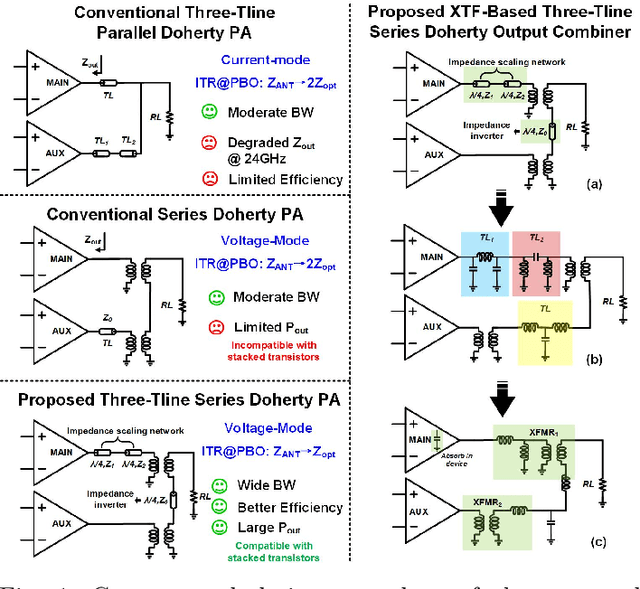
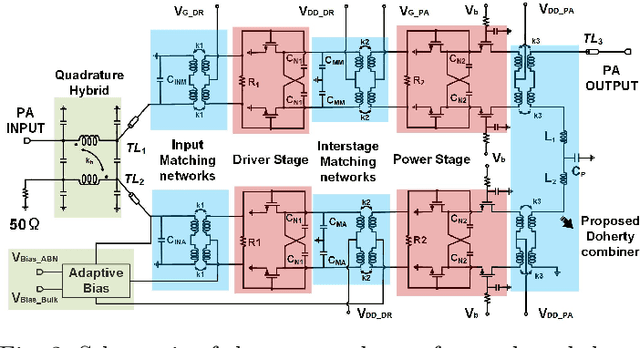
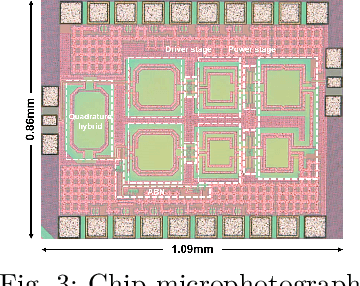
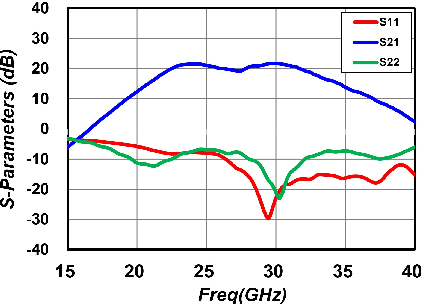
This paper presents a transformer-based three- transmission-line (Tline) series Doherty power amplifier (PA) implemented in 65-nm CMOS, targeting broadband K/Ka-band applications. By integrating an impedance-scaling network into the output matching structure, the design enables effective load modulation and reduced impedance transformation ratio (ITR) at power back-off when employing stacked cascode transistors. The PA demonstrates a -3-dB small-signal gain bandwidth from 22 to 32.5 GHz, a saturated output power (Psat) of 21.6 dBm, and a peak power-added efficiency (PAE) of 39%. At 6dB back-off, the PAE remains above 24%, validating its suitability for high- efficiency mm-wave phased-array transmitters in next-generation wireless systems.
Calibrated Adversarial Sampling: Multi-Armed Bandit-Guided Generalization Against Unforeseen Attacks
Nov 15, 2025Deep Neural Networks (DNNs) are known to be vulnerable to various adversarial perturbations. To address the safety concerns arising from these vulnerabilities, adversarial training (AT) has emerged as one of the most effective paradigms for enhancing the robustness of DNNs. However, existing AT frameworks primarily focus on a single or a limited set of attack types, leaving DNNs still exposed to attack types that may be encountered in practice but not addressed during training. In this paper, we propose an efficient fine-tuning method called Calibrated Adversarial Sampling (CAS) to address these issues. From the optimization perspective within the multi-armed bandit framework, it dynamically designs rewards and balances exploration and exploitation by considering the dynamic and interdependent characteristics of multiple robustness dimensions. Experiments on benchmark datasets show that CAS achieves superior overall robustness while maintaining high clean accuracy, providing a new paradigm for robust generalization of DNNs.
TiS-TSL: Image-Label Supervised Surgical Video Stereo Matching via Time-Switchable Teacher-Student Learning
Nov 12, 2025Stereo matching in minimally invasive surgery (MIS) is essential for next-generation navigation and augmented reality. Yet, dense disparity supervision is nearly impossible due to anatomical constraints, typically limiting annotations to only a few image-level labels acquired before the endoscope enters deep body cavities. Teacher-Student Learning (TSL) offers a promising solution by leveraging a teacher trained on sparse labels to generate pseudo labels and associated confidence maps from abundant unlabeled surgical videos. However, existing TSL methods are confined to image-level supervision, providing only spatial confidence and lacking temporal consistency estimation. This absence of spatio-temporal reliability results in unstable disparity predictions and severe flickering artifacts across video frames. To overcome these challenges, we propose TiS-TSL, a novel time-switchable teacher-student learning framework for video stereo matching under minimal supervision. At its core is a unified model that operates in three distinct modes: Image-Prediction (IP), Forward Video-Prediction (FVP), and Backward Video-Prediction (BVP), enabling flexible temporal modeling within a single architecture. Enabled by this unified model, TiS-TSL adopts a two-stage learning strategy. The Image-to-Video (I2V) stage transfers sparse image-level knowledge to initialize temporal modeling. The subsequent Video-to-Video (V2V) stage refines temporal disparity predictions by comparing forward and backward predictions to calculate bidirectional spatio-temporal consistency. This consistency identifies unreliable regions across frames, filters noisy video-level pseudo labels, and enforces temporal coherence. Experimental results on two public datasets demonstrate that TiS-TSL exceeds other image-based state-of-the-arts by improving TEPE and EPE by at least 2.11% and 4.54%, respectively.
Doubly Debiased Test-Time Prompt Tuning for Vision-Language Models
Nov 12, 2025Test-time prompt tuning for vision-language models has demonstrated impressive generalization capabilities under zero-shot settings. However, tuning the learnable prompts solely based on unlabeled test data may induce prompt optimization bias, ultimately leading to suboptimal performance on downstream tasks. In this work, we analyze the underlying causes of prompt optimization bias from both the model and data perspectives. In terms of the model, the entropy minimization objective typically focuses on reducing the entropy of model predictions while overlooking their correctness. This can result in overconfident yet incorrect outputs, thereby compromising the quality of prompt optimization. On the data side, prompts affected by optimization bias can introduce misalignment between visual and textual modalities, which further aggravates the prompt optimization bias. To this end, we propose a Doubly Debiased Test-Time Prompt Tuning method. Specifically, we first introduce a dynamic retrieval-augmented modulation module that retrieves high-confidence knowledge from a dynamic knowledge base using the test image feature as a query, and uses the retrieved knowledge to modulate the predictions. Guided by the refined predictions, we further develop a reliability-aware prompt optimization module that incorporates a confidence-based weighted ensemble and cross-modal consistency distillation to impose regularization constraints during prompt tuning. Extensive experiments across 15 benchmark datasets involving both natural distribution shifts and cross-datasets generalization demonstrate that our method outperforms baselines, validating its effectiveness in mitigating prompt optimization bias.
LPPG-RL: Lexicographically Projected Policy Gradient Reinforcement Learning with Subproblem Exploration
Nov 11, 2025Lexicographic multi-objective problems, which consist of multiple conflicting subtasks with explicit priorities, are common in real-world applications. Despite the advantages of Reinforcement Learning (RL) in single tasks, extending conventional RL methods to prioritized multiple objectives remains challenging. In particular, traditional Safe RL and Multi-Objective RL (MORL) methods have difficulty enforcing priority orderings efficiently. Therefore, Lexicographic Multi-Objective RL (LMORL) methods have been developed to address these challenges. However, existing LMORL methods either rely on heuristic threshold tuning with prior knowledge or are restricted to discrete domains. To overcome these limitations, we propose Lexicographically Projected Policy Gradient RL (LPPG-RL), a novel LMORL framework which leverages sequential gradient projections to identify feasible policy update directions, thereby enabling LPPG-RL broadly compatible with all policy gradient algorithms in continuous spaces. LPPG-RL reformulates the projection step as an optimization problem, and utilizes Dykstra's projection rather than generic solvers to deliver great speedups, especially for small- to medium-scale instances. In addition, LPPG-RL introduces Subproblem Exploration (SE) to prevent gradient vanishing, accelerate convergence and enhance stability. We provide theoretical guarantees for convergence and establish a lower bound on policy improvement. Finally, through extensive experiments in a 2D navigation environment, we demonstrate the effectiveness of LPPG-RL, showing that it outperforms existing state-of-the-art continuous LMORL methods.
AiEDA: An Open-Source AI-Aided Design Library for Design-to-Vector
Nov 08, 2025Recent research has demonstrated that artificial intelligence (AI) can assist electronic design automation (EDA) in improving both the quality and efficiency of chip design. But current AI for EDA (AI-EDA) infrastructures remain fragmented, lacking comprehensive solutions for the entire data pipeline from design execution to AI integration. Key challenges include fragmented flow engines that generate raw data, heterogeneous file formats for data exchange, non-standardized data extraction methods, and poorly organized data storage. This work introduces a unified open-source library for EDA (AiEDA) that addresses these issues. AiEDA integrates multiple design-to-vector data representation techniques that transform diverse chip design data into universal multi-level vector representations, establishing an AI-aided design (AAD) paradigm optimized for AI-EDA workflows. AiEDA provides complete physical design flows with programmatic data extraction and standardized Python interfaces bridging EDA datasets and AI frameworks. Leveraging the AiEDA library, we generate iDATA, a 600GB dataset of structured data derived from 50 real chip designs (28nm), and validate its effectiveness through seven representative AAD tasks spanning prediction, generation, optimization and analysis. The code is publicly available at https://github.com/OSCC-Project/AiEDA, while the full iDATA dataset is being prepared for public release, providing a foundation for future AI-EDA research.
Revisiting Generative Infrared and Visible Image Fusion Based on Human Cognitive Laws
Oct 30, 2025Existing infrared and visible image fusion methods often face the dilemma of balancing modal information. Generative fusion methods reconstruct fused images by learning from data distributions, but their generative capabilities remain limited. Moreover, the lack of interpretability in modal information selection further affects the reliability and consistency of fusion results in complex scenarios. This manuscript revisits the essence of generative image fusion under the inspiration of human cognitive laws and proposes a novel infrared and visible image fusion method, termed HCLFuse. First, HCLFuse investigates the quantification theory of information mapping in unsupervised fusion networks, which leads to the design of a multi-scale mask-regulated variational bottleneck encoder. This encoder applies posterior probability modeling and information decomposition to extract accurate and concise low-level modal information, thereby supporting the generation of high-fidelity structural details. Furthermore, the probabilistic generative capability of the diffusion model is integrated with physical laws, forming a time-varying physical guidance mechanism that adaptively regulates the generation process at different stages, thereby enhancing the ability of the model to perceive the intrinsic structure of data and reducing dependence on data quality. Experimental results show that the proposed method achieves state-of-the-art fusion performance in qualitative and quantitative evaluations across multiple datasets and significantly improves semantic segmentation metrics. This fully demonstrates the advantages of this generative image fusion method, drawing inspiration from human cognition, in enhancing structural consistency and detail quality.
Explore to Evolve: Scaling Evolved Aggregation Logic via Proactive Online Exploration for Deep Research Agents
Oct 16, 2025Deep research web agents not only retrieve information from diverse sources such as web environments, files, and multimodal inputs, but more importantly, they need to rigorously analyze and aggregate knowledge for insightful research. However, existing open-source deep research agents predominantly focus on enhancing information-seeking capabilities of web agents to locate specific information, while overlooking the essential need for information aggregation, which would limit their ability to support in-depth research. We propose an Explore to Evolve paradigm to scalably construct verifiable training data for web agents. Begins with proactive online exploration, an agent sources grounded information by exploring the real web. Using the collected evidence, the agent then self-evolves an aggregation program by selecting, composing, and refining operations from 12 high-level logical types to synthesize a verifiable QA pair. This evolution from high-level guidance to concrete operations allowed us to scalably produce WebAggregatorQA, a dataset of 10K samples across 50K websites and 11 domains. Based on an open-source agent framework, SmolAgents, we collect supervised fine-tuning trajectories to develop a series of foundation models, WebAggregator. WebAggregator-8B matches the performance of GPT-4.1, while the 32B variant surpasses GPT-4.1 by more than 10% on GAIA-text and closely approaches Claude-3.7-sonnet. Moreover, given the limited availability of benchmarks that evaluate web agents' information aggregation abilities, we construct a human-annotated evaluation split of WebAggregatorQA as a challenging test set. On this benchmark, Claude-3.7-sonnet only achieves 28%, and GPT-4.1 scores 25.8%. Even when agents manage to retrieve all references, they still struggle on WebAggregatorQA, highlighting the need to strengthen the information aggregation capabilities of web agent foundations.
WithAnyone: Towards Controllable and ID Consistent Image Generation
Oct 16, 2025Identity-consistent generation has become an important focus in text-to-image research, with recent models achieving notable success in producing images aligned with a reference identity. Yet, the scarcity of large-scale paired datasets containing multiple images of the same individual forces most approaches to adopt reconstruction-based training. This reliance often leads to a failure mode we term copy-paste, where the model directly replicates the reference face rather than preserving identity across natural variations in pose, expression, or lighting. Such over-similarity undermines controllability and limits the expressive power of generation. To address these limitations, we (1) construct a large-scale paired dataset MultiID-2M, tailored for multi-person scenarios, providing diverse references for each identity; (2) introduce a benchmark that quantifies both copy-paste artifacts and the trade-off between identity fidelity and variation; and (3) propose a novel training paradigm with a contrastive identity loss that leverages paired data to balance fidelity with diversity. These contributions culminate in WithAnyone, a diffusion-based model that effectively mitigates copy-paste while preserving high identity similarity. Extensive qualitative and quantitative experiments demonstrate that WithAnyone significantly reduces copy-paste artifacts, improves controllability over pose and expression, and maintains strong perceptual quality. User studies further validate that our method achieves high identity fidelity while enabling expressive controllable generation.