 Add to Chrome
 Add to Firefox
 Add to Edge
FlexComposer: Unified Video Compositing from Images to Dynamic Footage with Flexible Trajectory Control
Jul 31, 2026
Generative video compositing, which involves inserting external assets seamlessly into existing video sequences, is essential for content creation and visual effects. However, existing approaches suffer from a control-fidelity trade-off: they either hallucinate motion from static images, failing to preserve the dynamics of pre-animated assets, or lack fine-grained spatial control for precise asset placement along user-defined trajectories. We propose FlexComposer, a unified framework that standardizes video compositing as a trajectory-guided conditional generation task, enabling the seamless integration of both static images and dynamic footage. Our approach introduces three key designs: (1) a Unified Canonical Foreground Representation that decouples an object's intrinsic motion from its global displacement, standardizing heterogeneous inputs into a stabilized, centered latent space; (2) a Spatial-Aware Latent Injection strategy that exploits the translation equivariance of VAE latent spaces to transport canonical features onto target trajectories via a parameter-free mechanism; and (3) a Hybrid Dataset and Synthetic-to-Real Curriculum that synergizes procedural simulation, real-world cinematic footage, and generative data to implicitly learn physically plausible illumination and shadow harmonization. This unified design handles diverse inputs from product photos to dynamic subjects achieving high-fidelity motion control and environmental integration without the need for explicit 3D reconstruction or auxiliary learnable adapters. Extensive experiments demonstrate that FlexComposer outperforms state-of-the-art methods in visual quality, temporal consistency, and trajectory adherence.

MagicPrompt: Ultra-Lightweight Prompt Tuning for Video Generation
Jul 16, 2026Large-scale video diffusion models (VDMs) deliver strong generation performance, but full fine-tuning for downstream tasks incurs prohibitive computational costs. Existing parameter-efficient fine-tuning (PEFT) methods have two critical flaws on billion-scale models: they still require substantial trainable parameters, and reward-based training suffers from noise-induced optimization instability in condition-guided tasks. We propose MagicPrompt, a lightweight framework that achieves extreme parameter efficiency and stable reward optimization. It first adopts Attention-Embedded Prompt Tuning, which steers generation via lightweight soft prompts with orders of magnitude fewer parameters while preserving pre-trained knowledge. It further introduces Dual-Space Reward Feedback Optimization, which uses self-supervised latent objectives to improve condition-guided reward training. Experiments show MagicPrompt reaches competitive performance with less than 1\% trainable parameters and notably reduces training costs.
Video-MME-Logical: A Controlled Diagnostic Benchmark for Video Temporal-Logical Reasoning
Jun 26, 2026Recent interest in multimodal large language models (MLLMs) raises a central question: can they reason over dynamic visual evidence rather than merely recognize objects or events in individual frames? This ability, which we refer to as video temporal-logical reasoning, requires models to maintain, update, and compose evidence as visual states evolve across frames. Existing video benchmarks often conflate this capability with scene complexity, static recognition, or uncontrolled temporal variation. To isolate this capability, we introduce Video-MME-Logical, a controlled benchmark organized around five temporal-logical operations: state tracking, sequential counting, temporal ordering, dynamic spatiality, and structural composition. The benchmark contains 25 fine-grained task categories generated with controlled object states, transitions, temporal dependencies, and logical compositions. It enables difficulty-controlled final-answer evaluation by varying temporal horizon and reasoning complexity, and supports intermediate-state diagnostics by verifying whether models recover the required logical reasoning trace before producing the final answer. Experiments with state-of-the-art MLLMs reveal a substantial human-model gap, especially as temporal-logical complexity increases. Supervised fine-tuning on up to 500K generated samples improves performance but remains insufficient to close the reasoning gap, positioning Video-MME-Logical as a scalable testbed for analyzing and improving temporal-logical reasoning in MLLMs.
Pseudo-Unification: Entropy Probing Reveals Divergent Information Patterns in Unified Multimodal Models
Apr 13, 2026Unified multimodal models (UMMs) were designed to combine the reasoning ability of large language models (LLMs) with the generation capability of vision models. In practice, however, this synergy remains elusive: UMMs fail to transfer LLM-like reasoning to image synthesis and exhibit divergent response behaviors. We term this phenomenon pseudo-unification. Diagnosing its internal causes is important, but existing probing methods either lack model-internal insight or ignore prompt-response dependencies. To address these limitations, we propose an information-theoretic probing framework that jointly analyzes how UMMs encode inputs and generate outputs. Applied to ten representative UMMs, our framework reveals that pseudo-unification stems from a dual divergence: (i) Modality-Asymmetric Encoding, where vision and language follow different entropy trajectories, and (ii) Pattern-Split Response, where text generation exhibits high-entropy creativity while image synthesis enforces low-entropy fidelity. Only models that unify both sides (e.g., via contextual prediction) achieve more genuine unification, enabling stronger reasoning-based text-to-image generation even with fewer parameters. Our work provides the first model-internal probing of unification, demonstrating that real multimodal synergy requires consistency in information flow, not just shared parameters.
Astrolabe: Steering Forward-Process Reinforcement Learning for Distilled Autoregressive Video Models
Mar 17, 2026Distilled autoregressive (AR) video models enable efficient streaming generation but frequently misalign with human visual preferences. Existing reinforcement learning (RL) frameworks are not naturally suited to these architectures, typically requiring either expensive re-distillation or solver-coupled reverse-process optimization that introduces considerable memory and computational overhead. We present Astrolabe, an efficient online RL framework tailored for distilled AR models. To overcome existing bottlenecks, we introduce a forward-process RL formulation based on negative-aware fine-tuning. By contrasting positive and negative samples directly at inference endpoints, this approach establishes an implicit policy improvement direction without requiring reverse-process unrolling. To scale this alignment to long videos, we propose a streaming training scheme that generates sequences progressively via a rolling KV-cache, applying RL updates exclusively to local clip windows while conditioning on prior context to ensure long-range coherence. Finally, to mitigate reward hacking, we integrate a multi-reward objective stabilized by uncertainty-aware selective regularization and dynamic reference updates. Extensive experiments demonstrate that our method consistently enhances generation quality across multiple distilled AR video models, serving as a robust and scalable alignment solution.
ShotVerse: Advancing Cinematic Camera Control for Text-Driven Multi-Shot Video Creation
Mar 12, 2026Text-driven video generation has democratized film creation, but camera control in cinematic multi-shot scenarios remains a significant block. Implicit textual prompts lack precision, while explicit trajectory conditioning imposes prohibitive manual overhead and often triggers execution failures in current models. To overcome this bottleneck, we propose a data-centric paradigm shift, positing that aligned (Caption, Trajectory, Video) triplets form an inherent joint distribution that can connect automated plotting and precise execution. Guided by this insight, we present ShotVerse, a "Plan-then-Control" framework that decouples generation into two collaborative agents: a VLM (Vision-Language Model)-based Planner that leverages spatial priors to obtain cinematic, globally aligned trajectories from text, and a Controller that renders these trajectories into multi-shot video content via a camera adapter. Central to our approach is the construction of a data foundation: we design an automated multi-shot camera calibration pipeline aligns disjoint single-shot trajectories into a unified global coordinate system. This facilitates the curation of ShotVerse-Bench, a high-fidelity cinematic dataset with a three-track evaluation protocol that serves as the bedrock for our framework. Extensive experiments demonstrate that ShotVerse effectively bridges the gap between unreliable textual control and labor-intensive manual plotting, achieving superior cinematic aesthetics and generating multi-shot videos that are both camera-accurate and cross-shot consistent.
SesaHand: Enhancing 3D Hand Reconstruction via Controllable Generation with Semantic and Structural Alignment
Feb 28, 2026Recent studies on 3D hand reconstruction have demonstrated the effectiveness of synthetic training data to improve estimation performance. However, most methods rely on game engines to synthesize hand images, which often lack diversity in textures and environments, and fail to include crucial components like arms or interacting objects. Generative models are promising alternatives to generate diverse hand images, but still suffer from misalignment issues. In this paper, we present SesaHand, which enhances controllable hand image generation from both semantic and structural alignment perspectives for 3D hand reconstruction. Specifically, for semantic alignment, we propose a pipeline with Chain-of-Thought inference to extract human behavior semantics from image captions generated by the Vision-Language Model. This semantics suppresses human-irrelevant environmental details and ensures sufficient human-centric contexts for hand image generation. For structural alignment, we introduce hierarchical structural fusion to integrate structural information with different granularity for feature refinement to better align the hand and the overall human body in generated images. We further propose a hand structure attention enhancement method to efficiently enhance the model's attention on hand regions. Experiments demonstrate that our method not only outperforms prior work in generation performance but also improves 3D hand reconstruction with the generated hand images.
Composing Concepts from Images and Videos via Concept-prompt Binding
Dec 10, 2025Visual concept composition, which aims to integrate different elements from images and videos into a single, coherent visual output, still falls short in accurately extracting complex concepts from visual inputs and flexibly combining concepts from both images and videos. We introduce Bind & Compose, a one-shot method that enables flexible visual concept composition by binding visual concepts with corresponding prompt tokens and composing the target prompt with bound tokens from various sources. It adopts a hierarchical binder structure for cross-attention conditioning in Diffusion Transformers to encode visual concepts into corresponding prompt tokens for accurate decomposition of complex visual concepts. To improve concept-token binding accuracy, we design a Diversify-and-Absorb Mechanism that uses an extra absorbent token to eliminate the impact of concept-irrelevant details when training with diversified prompts. To enhance the compatibility between image and video concepts, we present a Temporal Disentanglement Strategy that decouples the training process of video concepts into two stages with a dual-branch binder structure for temporal modeling. Evaluations demonstrate that our method achieves superior concept consistency, prompt fidelity, and motion quality over existing approaches, opening up new possibilities for visual creativity.
Taming Flow-based I2V Models for Creative Video Editing
Sep 26, 2025Although image editing techniques have advanced significantly, video editing, which aims to manipulate videos according to user intent, remains an emerging challenge. Most existing image-conditioned video editing methods either require inversion with model-specific design or need extensive optimization, limiting their capability of leveraging up-to-date image-to-video (I2V) models to transfer the editing capability of image editing models to the video domain. To this end, we propose IF-V2V, an Inversion-Free method that can adapt off-the-shelf flow-matching-based I2V models for video editing without significant computational overhead. To circumvent inversion, we devise Vector Field Rectification with Sample Deviation to incorporate information from the source video into the denoising process by introducing a deviation term into the denoising vector field. To further ensure consistency with the source video in a model-agnostic way, we introduce Structure-and-Motion-Preserving Initialization to generate motion-aware temporally correlated noise with structural information embedded. We also present a Deviation Caching mechanism to minimize the additional computational cost for denoising vector rectification without significantly impacting editing quality. Evaluations demonstrate that our method achieves superior editing quality and consistency over existing approaches, offering a lightweight plug-and-play solution to realize visual creativity.
ProFashion: Prototype-guided Fashion Video Generation with Multiple Reference Images
May 10, 2025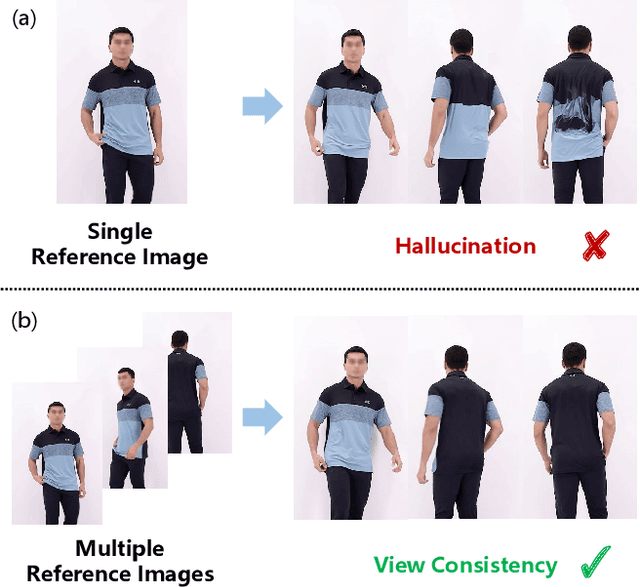
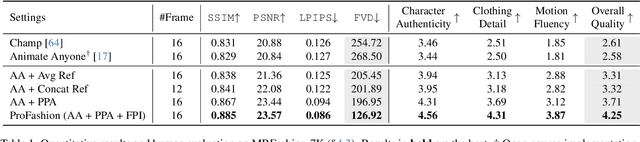
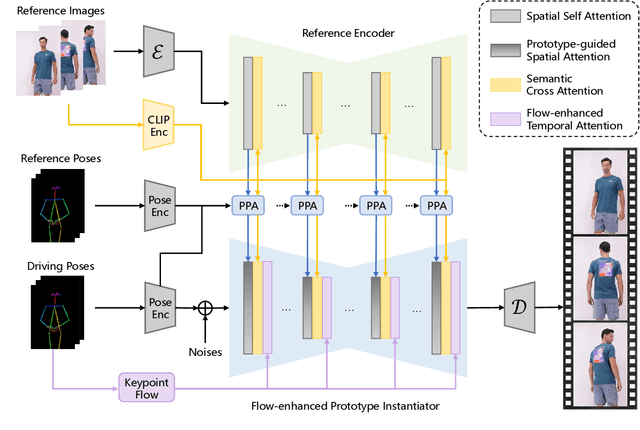
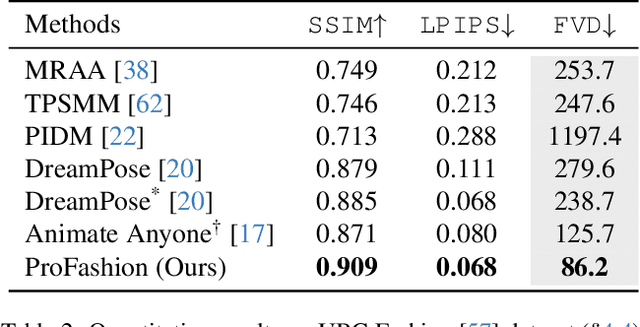
Fashion video generation aims to synthesize temporally consistent videos from reference images of a designated character. Despite significant progress, existing diffusion-based methods only support a single reference image as input, severely limiting their capability to generate view-consistent fashion videos, especially when there are different patterns on the clothes from different perspectives. Moreover, the widely adopted motion module does not sufficiently model human body movement, leading to sub-optimal spatiotemporal consistency. To address these issues, we propose ProFashion, a fashion video generation framework leveraging multiple reference images to achieve improved view consistency and temporal coherency. To effectively leverage features from multiple reference images while maintaining a reasonable computational cost, we devise a Pose-aware Prototype Aggregator, which selects and aggregates global and fine-grained reference features according to pose information to form frame-wise prototypes, which serve as guidance in the denoising process. To further enhance motion consistency, we introduce a Flow-enhanced Prototype Instantiator, which exploits the human keypoint motion flow to guide an extra spatiotemporal attention process in the denoiser. To demonstrate the effectiveness of ProFashion, we extensively evaluate our method on the MRFashion-7K dataset we collected from the Internet. ProFashion also outperforms previous methods on the UBC Fashion dataset.