 Add to Chrome
 Add to Firefox
 Add to Edge
Towards Precision Therapy in Hepatocellular Carcinoma: A Clinical-Reasoning LLM for Risk Stratification and Treatment Guidance
Jul 09, 2026
Hepatocellular carcinoma (HCC) is a common malignancy and a leading cause of cancer-related mortality. Current guidelines and staging systems provide coarse categories, but often miss within-stage heterogeneity and the clinical context in electronic medical records (EMRs). We present HCC-STAR (Hepatocellular Carcinoma Staging, Treatment And pRognosis), a clinically aligned large language model that reads routine EMR narratives and jointly outputs risk score-based staging, ranked guideline-consistent treatments with evidence-based rationales, and individualized survival estimates. We curated about 30,000 HCC cases from SEER and expanded them into EMR-style narrative training data using a clinician-validated, prompt-based augmentation workflow. On this corpus, we developed a knowledge-aligned reasoning framework optimized with a step-verifiable composite reward, moving beyond text-level memorization of clinical guidelines. In a multi-center cohort of 6,668 patients from 12 hospitals in China, HCC-STAR achieved state-of-the-art performance in treatment recommendation and risk stratification compared with clinical guidelines and competitive models, including GPT-5 and Gemini-2.5 Pro. Hypothetical overall-survival analysis showed a median survival of 51 months under adherence to HCC-STAR recommendations, compared with 29 and 32 months under BCLC and CNLC. In clinician-centric evaluations, blinded hepatobiliary specialists rated HCC-STAR's reasoning and evidence-based justifications as trustworthy. The model surpassed resident and attending physicians in treatment accuracy and helped physicians make more accurate decisions faster when used as an assistant. These findings support HCC-STAR as a reliable and verifiable decision-support system for risk stratification and precision therapy in HCC.

A Comprehensive Survey and Systematic Real-World Evaluation of Embodied Vision-and-Language Navigation
Jul 09, 2026Navigation is a fundamental capability of autonomous systems, yet most existing approaches rely on highly structured models and strong prior assumptions, limiting their robustness in open and uncertain real-world environments. Vision-and-Language Navigation (VLN) offers a promising direction by enabling robots to integrate natural language understanding with visual perception in a data-driven manner. Although VLN has attracted increasing research attention, systematic methodological taxonomy and real-world validation remain limited. This survey presents a comprehensive review of VLN research. Specifically, state-of-the-art methods are organized along two orthogonal dimensions: action paradigms, including hierarchical and monolithic frameworks, and model paradigms, including discriminative and generative approaches. A critical analysis of their respective strengths and limitations is provided. Additionally, we conduct a systematic real-world evaluation of representative VLN system configurations on a physical robotic platform. Experiments across ten diverse real-world scenes show a substantial performance gap between simulation and real-world deployment under the tested configurations: a representative monolithic RGB-only method achieves 61% success in simulation but drops to 22% in real-world deployment, while a hierarchical framework achieves a higher real-world success rate of 51%, suggesting stronger robustness in our evaluation setting. Finally, we highlight key challenges in perception, decision-making, and control that must be addressed in future research.
P2DNav: Panorama-to-Downview Reasoning for Zero-shot Vision-and-Language Navigation
May 19, 2026Vision-and-language navigation (VLN) requires an embodied agent to ground natural-language instructions into executable navigation actions in unseen environments. Existing zero-shot methods typically rely on additional waypoint prediction modules, which often entangle high-level directional reasoning with fine-grained local grounding, leading to error-prone and unstable decisions. In this paper, we propose P2DNav, a hierarchical framework for zero-shot vision-and-language navigation. P2DNav consists of three core components: Panorama-to-Downview (P2D), Sliding-Window Dialogue Memory (SDM), and Reflective Reorientation Mechanism (RRM). P2D explicitly decomposes navigation decision-making into two stages: panoramic direction selection and downview local grounding. It first selects the instruction-relevant direction from a 360° panorama, and then predicts a pixel-level target point from the downview RGB observation in that direction. In addition, SDM organizes navigation history as a multi-turn dialogue context and maintains recent visual observations within a sliding window to support long-horizon navigation. RRM further enables reflective reorientation by assessing the reliability of local grounding based on the downview observation and returning to panoramic direction selection when necessary. Experiments on the R2R-CE benchmark show that P2DNav achieves strong performance among zero-shot methods. In particular, compared with the state-of-the-art (SOTA) zero-shot waypoint-based and waypoint-free methods, P2DNav achieves SR gains of 146.6% and 58.9%, respectively, demonstrating the effectiveness of P2D, SDM, and RRM for zero-shot VLN. Code will be released for public use.
Adaptive Negative Scheduling for Graph Contrastive Learning
May 04, 2026Graph contrastive learning (GCL) has become a central paradigm for self-supervised representation learning in computational intelligence, with applications spanning recommendation, anomaly detection, and personalization. A key limitation of existing methods is their reliance on static negative sampling, which fails to account for the dynamic informativeness and computational cost of negatives during training. We propose AdNGCL, an adaptive negative scheduling framework with a hardness-aware scheduler (HANS) that formulates negative selection as a loss-gated, budget-constrained process across hard, intermediate, and easy strata. The scheduler dynamically adjusts step sizes based on contrastive loss trends under both global and per-category budgets, while periodically refreshing samples to maintain diversity without exceeding compute constraints. Experiments on nine benchmark graph datasets demonstrate that AdNGCL consistently advances state-of-the-art performance, achieving the best accuracy on seven datasets and second-best on the remaining two, while offering explicit control over computational cost. These results highlight the value of budget-aware, loss-sensitive scheduling as a general strategy for improving the robustness and efficiency of representation learning in emerging computational intelligence applications.
Plug-and-Play Consistency Models for MIMO Channel Estimation
Apr 26, 2026Consistency models (CMs) learn a consistent mapping from multiple noise levels to the data endpoint and can therefore perform generative inference in one or a few steps. This property makes them attractive as learned priors for low-latency inverse problems. Multiple-input multiple-output (MIMO) channel estimation under limited pilot overhead can be formulated as a high-dimensional linear inverse problem with an explicit measurement matrix, where data consistency alone is often insufficient for stable angular-domain channel recovery. This paper applies the plug-and-play consistency model (PnP-CM) framework to pilot-aided MIMO channel estimation. The PnP-CM inference procedure enforces the pilot observation model in the data-consistency update and invokes a pretrained CM denoiser in the prior update, thereby recovering the angular-domain channel vector within a small number of outer iterations. Preliminary experiments validate the feasibility of using CMs as low-latency channel-estimation priors and show that adaptive parameter scheduling and cross-scenario robustness remain important directions for further improvement.
OneVL: One-Step Latent Reasoning and Planning with Vision-Language Explanation
Apr 20, 2026Chain-of-Thought (CoT) reasoning has become a powerful driver of trajectory prediction in VLA-based autonomous driving, yet its autoregressive nature imposes a latency cost that is prohibitive for real-time deployment. Latent CoT methods attempt to close this gap by compressing reasoning into continuous hidden states, but consistently fall short of their explicit counterparts. We suggest that this is due to purely linguistic latent representations compressing a symbolic abstraction of the world, rather than the causal dynamics that actually govern driving. Thus, we present OneVL (One-step latent reasoning and planning with Vision-Language explanations), a unified VLA and World Model framework that routes reasoning through compact latent tokens supervised by dual auxiliary decoders. Alongside a language decoder that reconstructs text CoT, we introduce a visual world model decoder that predicts future-frame tokens, forcing the latent space to internalize the causal dynamics of road geometry, agent motion, and environmental change. A three-stage training pipeline progressively aligns these latents with trajectory, language, and visual objectives, ensuring stable joint optimization. At inference, the auxiliary decoders are discarded and all latent tokens are prefilled in a single parallel pass, matching the speed of answer-only prediction. Across four benchmarks, OneVL becomes the first latent CoT method to surpass explicit CoT, delivering state-of-the-art accuracy at answer-only latency, and providing direct evidence that tighter compression, when guided in both language and world-model supervision, produces more generalizable representations than verbose token-by-token reasoning. Project Page: https://xiaomi-embodied-intelligence.github.io/OneVL
NTIRE 2026 Challenge on Single Image Reflection Removal in the Wild: Datasets, Results, and Methods
Apr 11, 2026In this paper, we review the NTIRE 2026 challenge on single-image reflection removal (SIRR) in the Wild. SIRR is a fundamental task in image restoration. Despite progress in academic research, most methods are tested on synthetic images or limited real-world images, creating a gap in real-world applications. In this challenge, we provide participants with the OpenRR-5k dataset, which requires them to process real-world images that cover a range of reflection scenarios and intensities, with the goal of generating clean images without reflections. The challenge attracted more than 100 registrations, with 11 of them participating in the final testing phase. The top-ranked methods advanced the state-of-the-art reflection removal performance and earned unanimous recognition from the five experts in the field. The proposed OpenRR-5k dataset is available at https://huggingface.co/datasets/qiuzhangTiTi/OpenRR-5k, and the homepage of this challenge is at https://github.com/caijie0620/OpenRR-5k. Due to page limitations, this article only presents partial content; the full report and detailed analyses are available in the extended arXiv version.
ClawArena: Benchmarking AI Agents in Evolving Information Environments
Apr 05, 2026AI agents deployed as persistent assistants must maintain correct beliefs as their information environment evolves. In practice, evidence is scattered across heterogeneous sources that often contradict one another, new information can invalidate earlier conclusions, and user preferences surface through corrections rather than explicit instructions. Existing benchmarks largely assume static, single-authority settings and do not evaluate whether agents can keep up with this complexity. We introduce ClawArena, a benchmark for evaluating AI agents in evolving information environments. Each scenario maintains a complete hidden ground truth while exposing the agent only to noisy, partial, and sometimes contradictory traces across multi-channel sessions, workspace files, and staged updates. Evaluation is organized around three coupled challenges: multi-source conflict reasoning, dynamic belief revision, and implicit personalization, whose interactions yield a 14-category question taxonomy. Two question formats, multi-choice (set-selection) and shell-based executable checks, test both reasoning and workspace grounding. The current release contains 64 scenarios across 8 professional domains, totaling 1{,}879 evaluation rounds and 365 dynamic updates. Experiments on five agent frameworks and five language models show that both model capability (15.4% range) and framework design (9.2%) substantially affect performance, that self-evolving skill frameworks can partially close model-capability gaps, and that belief revision difficulty is determined by update design strategy rather than the mere presence of updates. Code is available at https://github.com/aiming-lab/ClawArena.
Token Reduction via Local and Global Contexts Optimization for Efficient Video Large Language Models
Mar 02, 2026Video Large Language Models (VLLMs) demonstrate strong video understanding but suffer from inefficiency due to redundant visual tokens. Existing pruning primary targets intra-frame spatial redundancy or prunes inside the LLM with shallow-layer overhead, yielding suboptimal spatiotemporal reduction and underutilizing long-context compressibility. All of them often discard subtle yet informative context from merged or pruned tokens. In this paper, we propose a new perspective that elaborates token \textbf{A}nchors within intra-frame and inter-frame to comprehensively aggregate the informative contexts via local-global \textbf{O}ptimal \textbf{T}ransport (\textbf{AOT}). Specifically, we first establish local- and global-aware token anchors within each frame under the attention guidance, which then optimal transport aggregates the informative contexts from pruned tokens, constructing intra-frame token anchors. Then, building on the temporal frame clips, the first frame within each clip will be considered as the keyframe anchors to ensemble similar information from consecutive frames through optimal transport, while keeping distinct tokens to represent temporal dynamics, leading to efficient token reduction in a training-free manner. Extensive evaluations show that our proposed AOT obtains competitive performances across various short- and long-video benchmarks on leading video LLMs, obtaining substantial computational efficiency while preserving temporal and visual fidelity. Project webpage: \href{https://tyroneli.github.io/AOT}{AOT}.
RADAR: Accelerating Large Language Model Inference With RL-Based Dynamic Draft Trees
Dec 16, 2025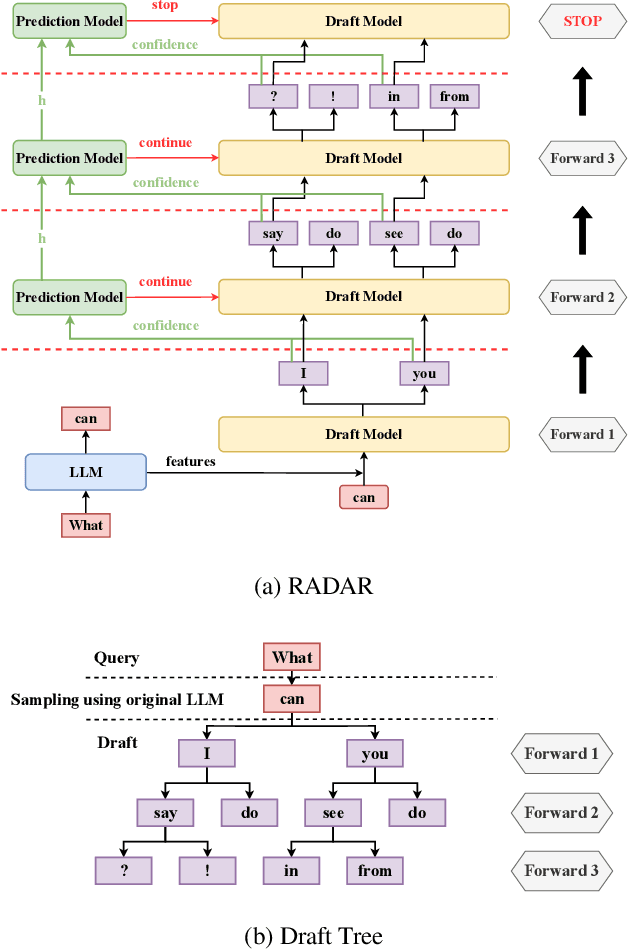
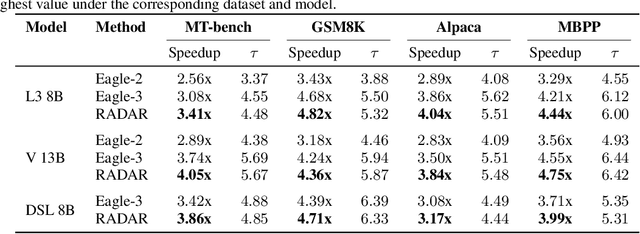
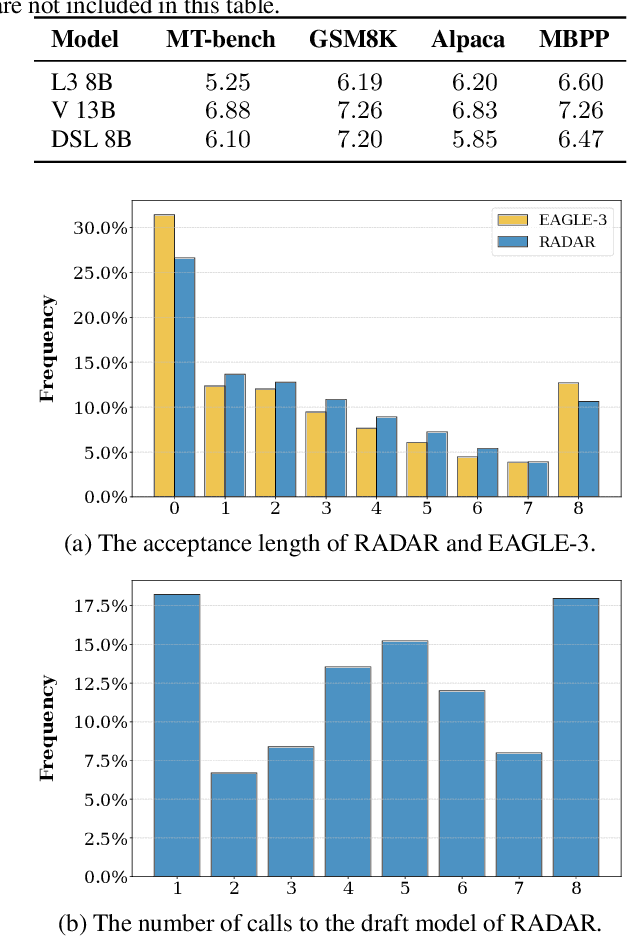
Inference with modern Large Language Models (LLMs) is expensive and slow, and speculative sampling has emerged as an effective solution to this problem, however, the number of the calls to the draft model for generating candidate tokens in speculative sampling is a preset hyperparameter, lacking flexibility. To generate and utilize the candidate tokens more effectively, we propose RADAR, a novel speculative sampling method with RL-based dynamic draft trees. RADAR formulates the draft tree generation process as a Markov Decision Process (MDP) and employs offline reinforcement learning to train a prediction model, which enables real-time decision on the calls to the draft model, reducing redundant computations and further accelerating inference. Evaluations across three LLMs and four tasks show that RADAR achieves a speedup of 3.17x-4.82x over the auto-regressive decoding baseline. The code is available at https://github.com/minaduki-sora/RADAR.