 Add to Chrome
 Add to Firefox
 Add to Edge
Anatomy-Guided Residual Motion Diffusion for Controllable 4D Cardiac MRI Synthesis
Jun 25, 2026
Developing robust artificial intelligence models for 4D (3D + time) medical imaging is constrained by limited annotated data, inter-device domain shifts, and privacy restrictions. To address this, we propose a 4D controllable generative framework for anatomically consistent data augmentation. A semi-supervised variational autoencoder learns a compact latent representation of anatomical volumes while jointly predicting aligned segmentation masks in a unified framework. Anatomical structure is then disentangled from temporal dynamics through a cascaded latent diffusion model (LDM). A static LDM generates subject-specific anatomy conditioned on clinical priors (diagnosis and volumes measures) and a subsequent motion LDM estimates residual latent motions, ensuring strict temporal coherence across the 4D sequence. The proposed approach was evaluated on cine cardiac MRI as a representative 4D imaging application. Experiments across multiple datasets demonstrate high controllability of static anatomy (Pearson r > 0.8) and strong temporal coherence (FVD = 288.08). In cross-vendor generalization experiments, augmenting training sets with synthetic 4D sequences significantly improves downstream segmentation performance. Using nnU-Net, the proposed augmentation strategy improves the average Dice score by 1.4% and reduces the Hausdorff Distance by 3.0mm compared to training on real data alone, for the left ventricle, Dice improves by 2.8% with a 5.4mm reduction in boundary error. Overall, this framework provides a scalable and controllable solution for 4D medical image synthesis, supporting the development of more robust models with limited annotations and cross-vendor variability. Code available on https://github.com/cyiheng/4DCardiacMRISynthesis.

Voxtral TTS
Mar 26, 2026We introduce Voxtral TTS, an expressive multilingual text-to-speech model that generates natural speech from as little as 3 seconds of reference audio. Voxtral TTS adopts a hybrid architecture that combines auto-regressive generation of semantic speech tokens with flow-matching for acoustic tokens. These tokens are encoded and decoded with Voxtral Codec, a speech tokenizer trained from scratch with a hybrid VQ-FSQ quantization scheme. In human evaluations conducted by native speakers, Voxtral TTS is preferred for multilingual voice cloning due to its naturalness and expressivity, achieving a 68.4\% win rate over ElevenLabs Flash v2.5. We release the model weights under a CC BY-NC license.
Bridging the Know-Act Gap via Task-Level Autoregressive Reasoning
Mar 23, 2026LLMs often generate seemingly valid answers to flawed or ill-posed inputs. This is not due to missing knowledge: under discriminative prompting, the same models can mostly identify such issues, yet fail to reflect this in standard generative responses. This reveals a fundamental know-act gap between discriminative recognition and generative behavior. Prior work largely characterizes this issue in narrow settings, such as math word problems or question answering, with limited focus on how to integrate these two modes. In this work, we present a comprehensive analysis using FaultyScience, a newly constructed large-scale, cross-disciplinary benchmark of faulty scientific questions. We show that the gap is pervasive and stems from token-level autoregression, which entangles task selection (validate vs. answer) with content generation, preventing discriminative knowledge from being utilized. To address this, we propose DeIllusionLLM, a task-level autoregressive framework that explicitly models this decision. Through self-distillation, the model unifies discriminative judgment and generative reasoning within a single backbone. Empirically, DeIllusionLLM substantially reduces answer-despite-error failures under natural prompting while maintaining general reasoning performance, demonstrating that self-distillation is an effective and scalable solution for bridging the discriminative-generative know-act gap
Voxtral Realtime
Feb 11, 2026We introduce Voxtral Realtime, a natively streaming automatic speech recognition model that matches offline transcription quality at sub-second latency. Unlike approaches that adapt offline models through chunking or sliding windows, Voxtral Realtime is trained end-to-end for streaming, with explicit alignment between audio and text streams. Our architecture builds on the Delayed Streams Modeling framework, introducing a new causal audio encoder and Ada RMS-Norm for improved delay conditioning. We scale pretraining to a large-scale dataset spanning 13 languages. At a delay of 480ms, Voxtral Realtime achieves performance on par with Whisper, the most widely deployed offline transcription system. We release the model weights under the Apache 2.0 license.
Ministral 3
Jan 13, 2026We introduce the Ministral 3 series, a family of parameter-efficient dense language models designed for compute and memory constrained applications, available in three model sizes: 3B, 8B, and 14B parameters. For each model size, we release three variants: a pretrained base model for general-purpose use, an instruction finetuned, and a reasoning model for complex problem-solving. In addition, we present our recipe to derive the Ministral 3 models through Cascade Distillation, an iterative pruning and continued training with distillation technique. Each model comes with image understanding capabilities, all under the Apache 2.0 license.
Enabling Disaggregated Multi-Stage MLLM Inference via GPU-Internal Scheduling and Resource Sharing
Dec 19, 2025Multimodal large language models (MLLMs) extend LLMs with visual understanding through a three-stage pipeline: multimodal preprocessing, vision encoding, and LLM inference. While these stages enhance capability, they introduce significant system bottlenecks. First, multimodal preprocessing-especially video decoding-often dominates Time-to-First-Token (TTFT). Most systems rely on CPU-based decoding, which severely limits throughput, while existing GPU-based approaches prioritize throughput-oriented parallelism and fail to meet the latency-sensitive requirements of MLLM inference. Second, the vision encoder is a standalone, compute-intensive stage that produces visual embeddings and cannot be co-batched with LLM prefill or decoding. This heterogeneity forces inter-stage blocking and increases token-generation latency. Even when deployed on separate GPUs, these stages underutilize available compute and memory resources, reducing overall utilization and constraining system throughput. To address these challenges, we present FlashCodec and UnifiedServe, two complementary designs that jointly optimize the end-to-end MLLM pipeline. FlashCodec accelerates the multimodal preprocessing stage through collaborative multi-GPU video decoding, reducing decoding latency while preserving high throughput. UnifiedServe optimizes the vision-to-text and inference stages using a logically decoupled their execution to eliminate inter-stage blocking, yet physically sharing GPU resources to maximize GPU system utilization. By carefully orchestrating execution across stages and minimizing interference, UnifiedServe Together, our proposed framework forms an end-to-end optimized stack that can serve up to 3.0$\times$ more requests or enforce 1.5$\times$ tighter SLOs, while achieving up to 4.4$\times$ higher throughput compared to state-of-the-art systems.
Voxtral
Jul 17, 2025We present Voxtral Mini and Voxtral Small, two multimodal audio chat models. Voxtral is trained to comprehend both spoken audio and text documents, achieving state-of-the-art performance across a diverse range of audio benchmarks, while preserving strong text capabilities. Voxtral Small outperforms a number of closed-source models, while being small enough to run locally. A 32K context window enables the model to handle audio files up to 40 minutes in duration and long multi-turn conversations. We also contribute three benchmarks for evaluating speech understanding models on knowledge and trivia. Both Voxtral models are released under Apache 2.0 license.
Magistral
Jun 12, 2025


We introduce Magistral, Mistral's first reasoning model and our own scalable reinforcement learning (RL) pipeline. Instead of relying on existing implementations and RL traces distilled from prior models, we follow a ground up approach, relying solely on our own models and infrastructure. Notably, we demonstrate a stack that enabled us to explore the limits of pure RL training of LLMs, present a simple method to force the reasoning language of the model, and show that RL on text data alone maintains most of the initial checkpoint's capabilities. We find that RL on text maintains or improves multimodal understanding, instruction following and function calling. We present Magistral Medium, trained for reasoning on top of Mistral Medium 3 with RL alone, and we open-source Magistral Small (Apache 2.0) which further includes cold-start data from Magistral Medium.
Chain of Draft: Thinking Faster by Writing Less
Feb 25, 2025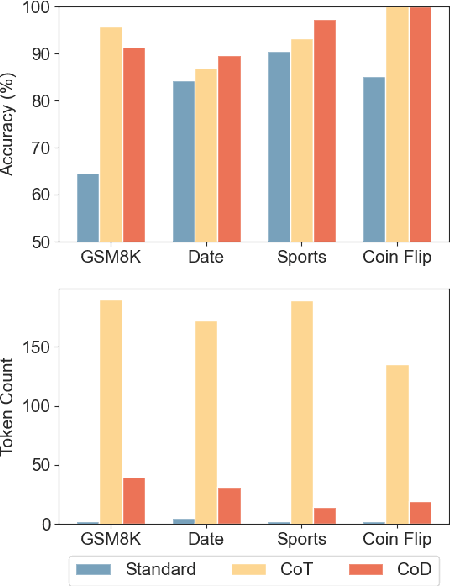
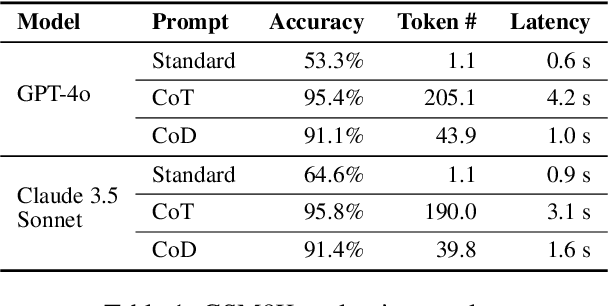
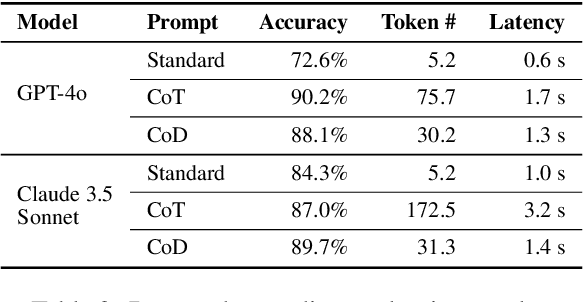
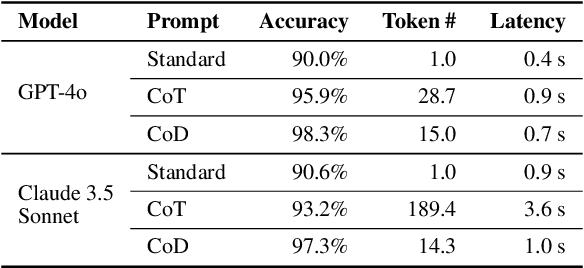
Large Language Models (LLMs) have demonstrated remarkable performance in solving complex reasoning tasks through mechanisms like Chain-of-Thought (CoT) prompting, which emphasizes verbose, step-by-step reasoning. However, humans typically employ a more efficient strategy: drafting concise intermediate thoughts that capture only essential information. In this work, we propose Chain of Draft (CoD), a novel paradigm inspired by human cognitive processes, where LLMs generate minimalistic yet informative intermediate reasoning outputs while solving tasks. By reducing verbosity and focusing on critical insights, CoD matches or surpasses CoT in accuracy while using as little as only 7.6% of the tokens, significantly reducing cost and latency across various reasoning tasks.
T-REG: Preference Optimization with Token-Level Reward Regularization
Dec 03, 2024Reinforcement learning from human feedback (RLHF) has been crucial in aligning large language models (LLMs) with human values. Traditionally, RLHF involves generating responses to a query and using a reward model to assign a reward to the entire response. However, this approach faces challenges due to its reliance on a single, sparse reward, which makes it challenging for the model to identify which parts of the sequence contribute most significantly to the final reward. Recent methods have attempted to address this limitation by introducing token-level rewards. However, these methods often rely on either a trained credit assignment model or AI annotators, raising concerns about the quality and reliability of the rewards. In this paper, we propose token-level reward regularization (T-REG), a novel approach that leverages both sequence-level and token-level rewards for preference optimization. Harnessing the self-refinement capabilities of LLMs, our method uses contrastive prompting to enable LLMs to self-generate token-level rewards. These self-generated rewards then act as reward regularization, guiding the model to more effectively distribute sequence-level rewards across tokens. This facilitates better token-level credit assignment and enhances alignment performance. Experiments on the instruction following benchmarks, including Alpaca Eval 2 and Arena-Hard, show that our method consistently outperforms baseline methods by up to 3.8% and 4.4%, respectively. We will release the code and models at https://github.com/wzhouad/T-REG.