 Add to Chrome
 Add to Firefox
 Add to Edge
Language Model Beats Diffusion -- Tokenizer is Key to Visual Generation
Oct 09, 2023
While Large Language Models (LLMs) are the dominant models for generative tasks in language, they do not perform as well as diffusion models on image and video generation. To effectively use LLMs for visual generation, one crucial component is the visual tokenizer that maps pixel-space inputs to discrete tokens appropriate for LLM learning. In this paper, we introduce MAGVIT-v2, a video tokenizer designed to generate concise and expressive tokens for both videos and images using a common token vocabulary. Equipped with this new tokenizer, we show that LLMs outperform diffusion models on standard image and video generation benchmarks including ImageNet and Kinetics. In addition, we demonstrate that our tokenizer surpasses the previously top-performing video tokenizer on two more tasks: (1) video compression comparable to the next-generation video codec (VCC) according to human evaluations, and (2) learning effective representations for action recognition tasks.

Module-wise Adaptive Distillation for Multimodality Foundation Models
Oct 06, 2023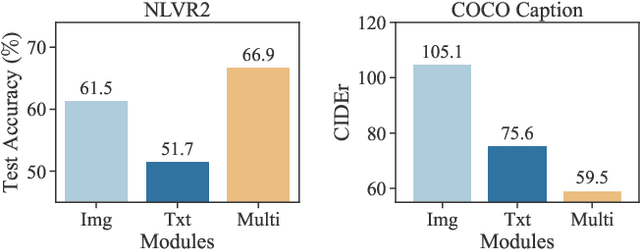
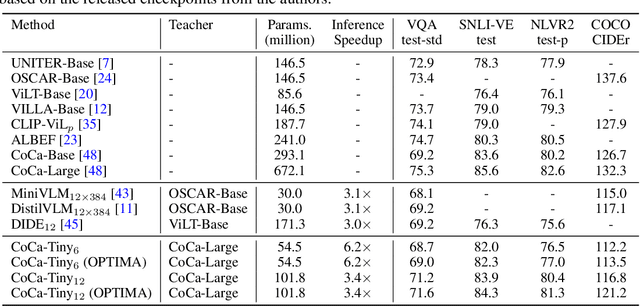
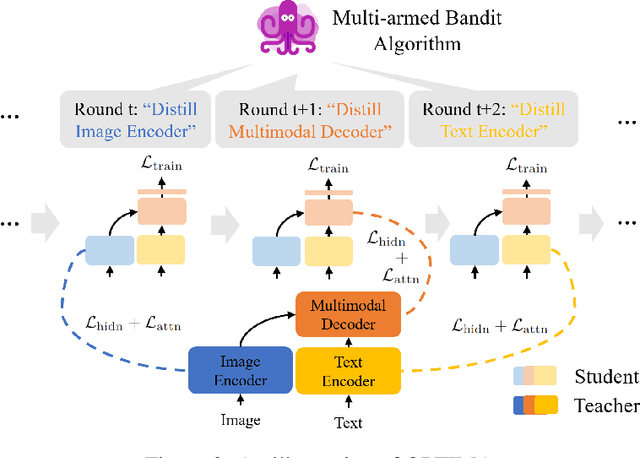
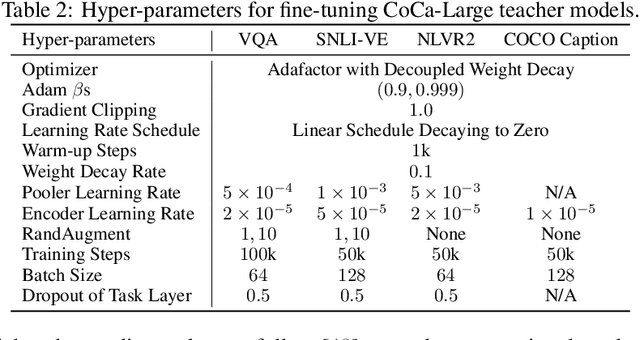
Pre-trained multimodal foundation models have demonstrated remarkable generalizability but pose challenges for deployment due to their large sizes. One effective approach to reducing their sizes is layerwise distillation, wherein small student models are trained to match the hidden representations of large teacher models at each layer. Motivated by our observation that certain architecture components, referred to as modules, contribute more significantly to the student's performance than others, we propose to track the contributions of individual modules by recording the loss decrement after distillation each module and choose the module with a greater contribution to distill more frequently. Such an approach can be naturally formulated as a multi-armed bandit (MAB) problem, where modules and loss decrements are considered as arms and rewards, respectively. We then develop a modified-Thompson sampling algorithm named OPTIMA to address the nonstationarity of module contributions resulting from model updating. Specifically, we leverage the observed contributions in recent history to estimate the changing contribution of each module and select modules based on these estimations to maximize the cumulative contribution. We evaluate the effectiveness of OPTIMA through distillation experiments on various multimodal understanding and image captioning tasks, using the CoCa-Large model (Yu et al., 2022) as the teacher model.
Video Timeline Modeling For News Story Understanding
Sep 23, 2023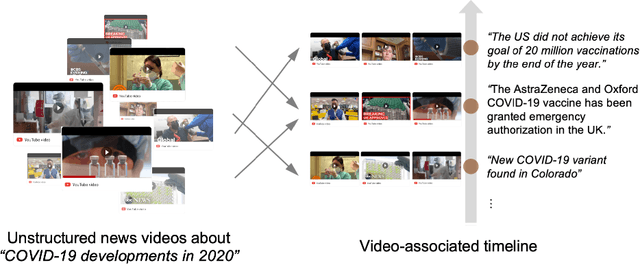
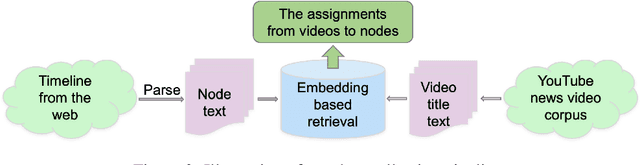

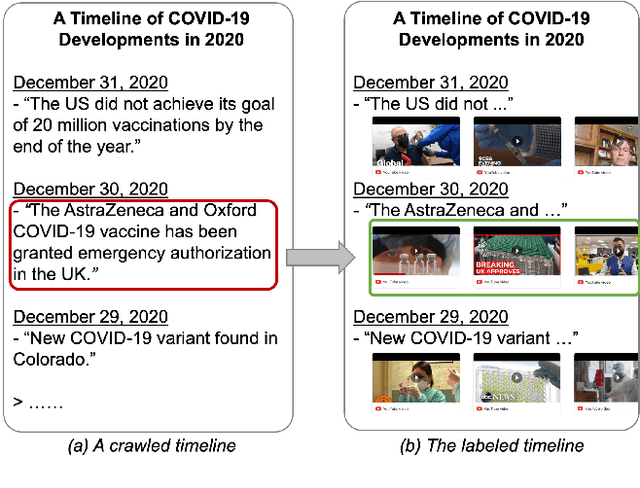
In this paper, we present a novel problem, namely video timeline modeling. Our objective is to create a video-associated timeline from a set of videos related to a specific topic, thereby facilitating the content and structure understanding of the story being told. This problem has significant potential in various real-world applications, such as news story summarization. To bootstrap research in this area, we curate a realistic benchmark dataset, YouTube-News-Timeline, consisting of over $12$k timelines and $300$k YouTube news videos. Additionally, we propose a set of quantitative metrics as the protocol to comprehensively evaluate and compare methodologies. With such a testbed, we further develop and benchmark exploratory deep learning approaches to tackle this problem. We anticipate that this exploratory work will pave the way for further research in video timeline modeling. The assets are available via https://github.com/google-research/google-research/tree/master/video_timeline_modeling.
SAMPLING: Scene-adaptive Hierarchical Multiplane Images Representation for Novel View Synthesis from a Single Image
Sep 13, 2023Recent novel view synthesis methods obtain promising results for relatively small scenes, e.g., indoor environments and scenes with a few objects, but tend to fail for unbounded outdoor scenes with a single image as input. In this paper, we introduce SAMPLING, a Scene-adaptive Hierarchical Multiplane Images Representation for Novel View Synthesis from a Single Image based on improved multiplane images (MPI). Observing that depth distribution varies significantly for unbounded outdoor scenes, we employ an adaptive-bins strategy for MPI to arrange planes in accordance with each scene image. To represent intricate geometry and multi-scale details, we further introduce a hierarchical refinement branch, which results in high-quality synthesized novel views. Our method demonstrates considerable performance gains in synthesizing large-scale unbounded outdoor scenes using a single image on the KITTI dataset and generalizes well to the unseen Tanks and Temples dataset.The code and models will soon be made available.
Text-driven Editing of 3D Scenes without Retraining
Sep 10, 2023
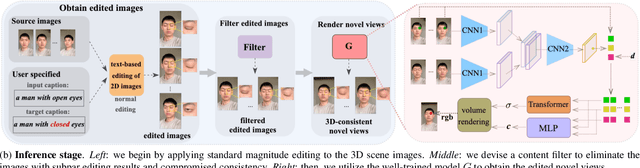
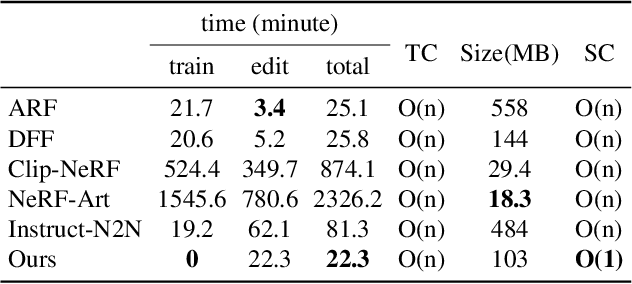
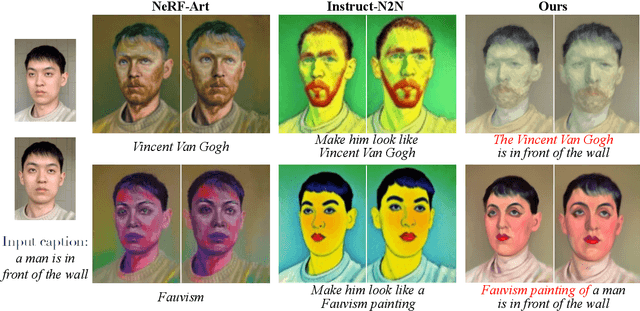
Numerous diffusion models have recently been applied to image synthesis and editing. However, editing 3D scenes is still in its early stages. It poses various challenges, such as the requirement to design specific methods for different editing types, retraining new models for various 3D scenes, and the absence of convenient human interaction during editing. To tackle these issues, we introduce a text-driven editing method, termed DN2N, which allows for the direct acquisition of a NeRF model with universal editing capabilities, eliminating the requirement for retraining. Our method employs off-the-shelf text-based editing models of 2D images to modify the 3D scene images, followed by a filtering process to discard poorly edited images that disrupt 3D consistency. We then consider the remaining inconsistency as a problem of removing noise perturbation, which can be solved by generating training data with similar perturbation characteristics for training. We further propose cross-view regularization terms to help the generalized NeRF model mitigate these perturbations. Our text-driven method allows users to edit a 3D scene with their desired description, which is more friendly, intuitive, and practical than prior works. Empirical results show that our method achieves multiple editing types, including but not limited to appearance editing, weather transition, material changing, and style transfer. Most importantly, our method generalizes well with editing abilities shared among a set of model parameters without requiring a customized editing model for some specific scenes, thus inferring novel views with editing effects directly from user input. The project website is available at http://sk-fun.fun/DN2N
CiteTracker: Correlating Image and Text for Visual Tracking
Aug 22, 2023
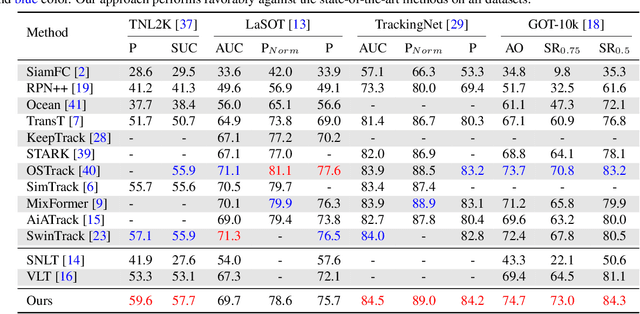
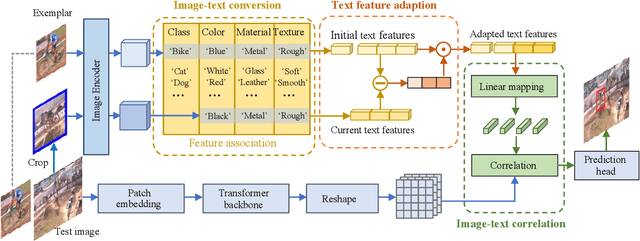
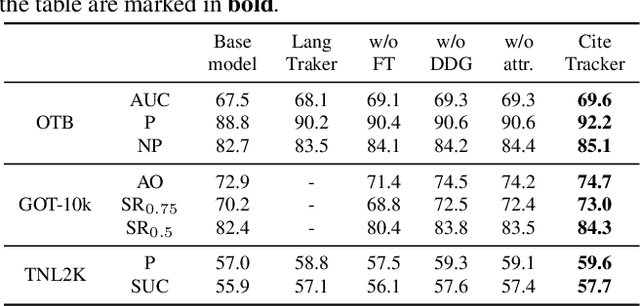
Existing visual tracking methods typically take an image patch as the reference of the target to perform tracking. However, a single image patch cannot provide a complete and precise concept of the target object as images are limited in their ability to abstract and can be ambiguous, which makes it difficult to track targets with drastic variations. In this paper, we propose the CiteTracker to enhance target modeling and inference in visual tracking by connecting images and text. Specifically, we develop a text generation module to convert the target image patch into a descriptive text containing its class and attribute information, providing a comprehensive reference point for the target. In addition, a dynamic description module is designed to adapt to target variations for more effective target representation. We then associate the target description and the search image using an attention-based correlation module to generate the correlated features for target state reference. Extensive experiments on five diverse datasets are conducted to evaluate the proposed algorithm and the favorable performance against the state-of-the-art methods demonstrates the effectiveness of the proposed tracking method.
Delving into Motion-Aware Matching for Monocular 3D Object Tracking
Aug 22, 2023Recent advances of monocular 3D object detection facilitate the 3D multi-object tracking task based on low-cost camera sensors. In this paper, we find that the motion cue of objects along different time frames is critical in 3D multi-object tracking, which is less explored in existing monocular-based approaches. In this paper, we propose a motion-aware framework for monocular 3D MOT. To this end, we propose MoMA-M3T, a framework that mainly consists of three motion-aware components. First, we represent the possible movement of an object related to all object tracklets in the feature space as its motion features. Then, we further model the historical object tracklet along the time frame in a spatial-temporal perspective via a motion transformer. Finally, we propose a motion-aware matching module to associate historical object tracklets and current observations as final tracking results. We conduct extensive experiments on the nuScenes and KITTI datasets to demonstrate that our MoMA-M3T achieves competitive performance against state-of-the-art methods. Moreover, the proposed tracker is flexible and can be easily plugged into existing image-based 3D object detectors without re-training. Code and models are available at https://github.com/kuanchihhuang/MoMA-M3T.
Dual Associated Encoder for Face Restoration
Aug 14, 2023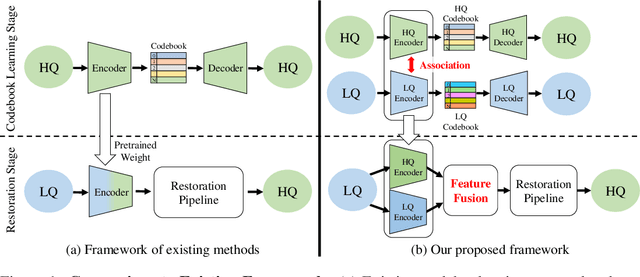
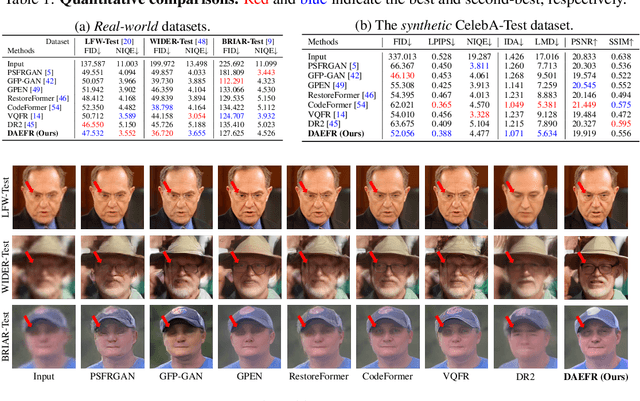
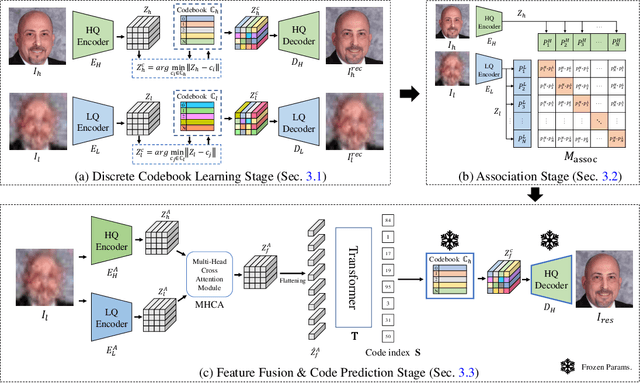

Restoring facial details from low-quality (LQ) images has remained a challenging problem due to its ill-posedness induced by various degradations in the wild. The existing codebook prior mitigates the ill-posedness by leveraging an autoencoder and learned codebook of high-quality (HQ) features, achieving remarkable quality. However, existing approaches in this paradigm frequently depend on a single encoder pre-trained on HQ data for restoring HQ images, disregarding the domain gap between LQ and HQ images. As a result, the encoding of LQ inputs may be insufficient, resulting in suboptimal performance. To tackle this problem, we propose a novel dual-branch framework named DAEFR. Our method introduces an auxiliary LQ branch that extracts crucial information from the LQ inputs. Additionally, we incorporate association training to promote effective synergy between the two branches, enhancing code prediction and output quality. We evaluate the effectiveness of DAEFR on both synthetic and real-world datasets, demonstrating its superior performance in restoring facial details.
Foundational Models Defining a New Era in Vision: A Survey and Outlook
Jul 25, 2023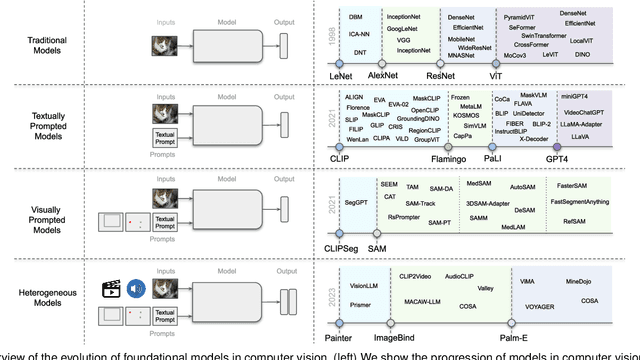
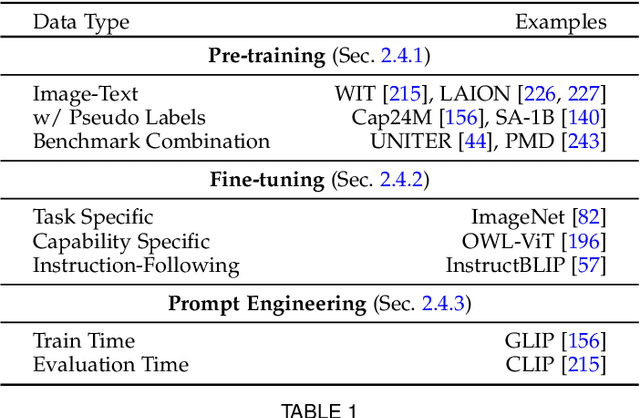

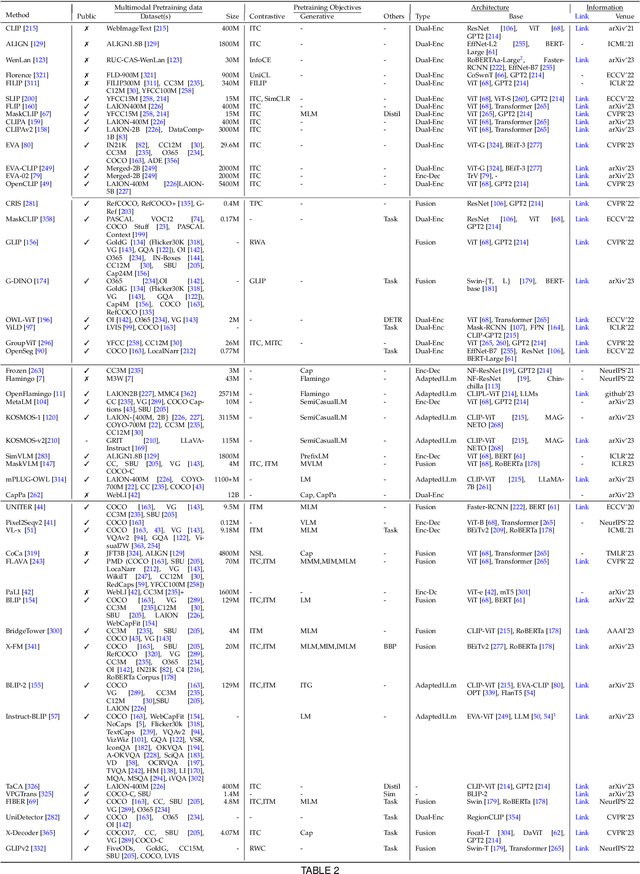
Vision systems to see and reason about the compositional nature of visual scenes are fundamental to understanding our world. The complex relations between objects and their locations, ambiguities, and variations in the real-world environment can be better described in human language, naturally governed by grammatical rules and other modalities such as audio and depth. The models learned to bridge the gap between such modalities coupled with large-scale training data facilitate contextual reasoning, generalization, and prompt capabilities at test time. These models are referred to as foundational models. The output of such models can be modified through human-provided prompts without retraining, e.g., segmenting a particular object by providing a bounding box, having interactive dialogues by asking questions about an image or video scene or manipulating the robot's behavior through language instructions. In this survey, we provide a comprehensive review of such emerging foundational models, including typical architecture designs to combine different modalities (vision, text, audio, etc), training objectives (contrastive, generative), pre-training datasets, fine-tuning mechanisms, and the common prompting patterns; textual, visual, and heterogeneous. We discuss the open challenges and research directions for foundational models in computer vision, including difficulties in their evaluations and benchmarking, gaps in their real-world understanding, limitations of their contextual understanding, biases, vulnerability to adversarial attacks, and interpretability issues. We review recent developments in this field, covering a wide range of applications of foundation models systematically and comprehensively. A comprehensive list of foundational models studied in this work is available at \url{https://github.com/awaisrauf/Awesome-CV-Foundational-Models}.
CLR: Channel-wise Lightweight Reprogramming for Continual Learning
Jul 21, 2023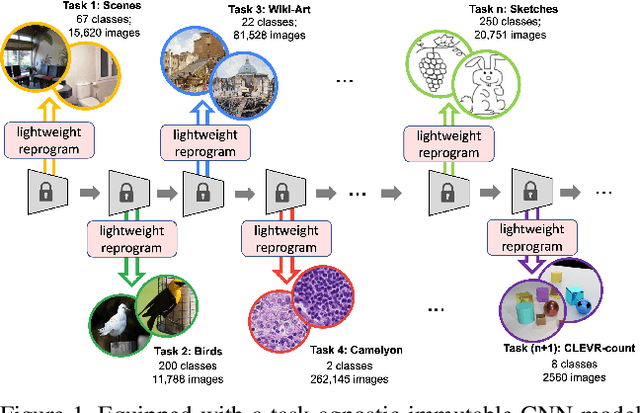

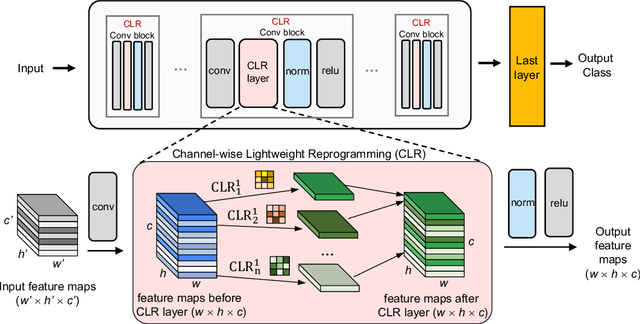
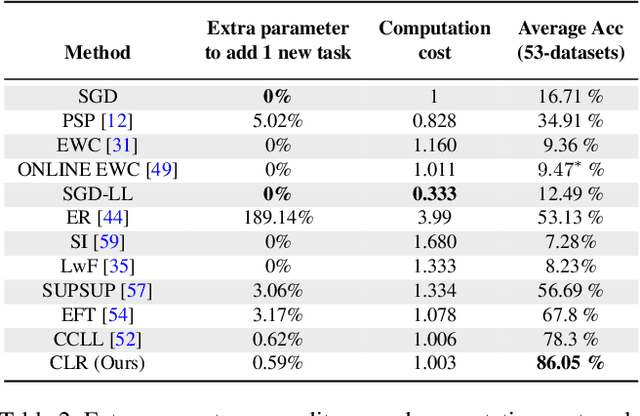
Continual learning aims to emulate the human ability to continually accumulate knowledge over sequential tasks. The main challenge is to maintain performance on previously learned tasks after learning new tasks, i.e., to avoid catastrophic forgetting. We propose a Channel-wise Lightweight Reprogramming (CLR) approach that helps convolutional neural networks (CNNs) overcome catastrophic forgetting during continual learning. We show that a CNN model trained on an old task (or self-supervised proxy task) could be ``reprogrammed" to solve a new task by using our proposed lightweight (very cheap) reprogramming parameter. With the help of CLR, we have a better stability-plasticity trade-off to solve continual learning problems: To maintain stability and retain previous task ability, we use a common task-agnostic immutable part as the shared ``anchor" parameter set. We then add task-specific lightweight reprogramming parameters to reinterpret the outputs of the immutable parts, to enable plasticity and integrate new knowledge. To learn sequential tasks, we only train the lightweight reprogramming parameters to learn each new task. Reprogramming parameters are task-specific and exclusive to each task, which makes our method immune to catastrophic forgetting. To minimize the parameter requirement of reprogramming to learn new tasks, we make reprogramming lightweight by only adjusting essential kernels and learning channel-wise linear mappings from anchor parameters to task-specific domain knowledge. We show that, for general CNNs, the CLR parameter increase is less than 0.6\% for any new task. Our method outperforms 13 state-of-the-art continual learning baselines on a new challenging sequence of 53 image classification datasets. Code and data are available at https://github.com/gyhandy/Channel-wise-Lightweight-Reprogramming