 Add to Chrome
 Add to Firefox
 Add to Edge
Decomposing Staleness in Recommender Systems: A Dual-Filter Framework for Supersession and Decay
Aug 16, 2026
Stale recommendations are a pervasive challenge and a leading source of user complaints on large-scale content platforms. Items lose relevance through two primary mechanisms: supersession, where emerging updates render prior coverage stale, and relevance decay, where an item's informational value naturally diminishes over its lifecycle. Traditional countermeasures serve as crude proxies: age cutoffs poorly reflect actual relevance loss, while engagement heuristics rely on lagging signals, broadly exposing users to stale content before the system adapts. We present SDF (Supersession-Decay Filtering), a staleness filtering system fully deployed in Google Discover, a personalized recommendation feed with hundreds of millions of daily and billions of monthly active users. SDF targets both mechanisms with complementary filters, each powered by a learned model: a relational staleness model that detects supersession between item pairs, and a predicted traffic ratio (PTR) model that forecasts relevance decay from the item's content, trained on lifetime visit traffic. Applied via disjunction upstream of the ranking stage, SDF prunes stale candidates, measurably reducing downstream serving costs. Online experiments demonstrate that these filters significantly reduce the prevalence of stale content while improving user engagement. Over a two-year production deployment, user-filed staleness reports (in-product user feedback) declined by 54.9% relative to the pre-deployment baseline, establishing SDF as a robust and scalable paradigm for resolving content staleness at industrial scale.

Data Standards for Humanoid Robotics: The Missing Infrastructure for Physical AI
Jun 18, 2026The scalability of humanoid robots will depend not only on models and hardware, but also on whether physical experience can accumulate across robots, tasks, organizations, and time. Drawing on the authors' work in developing ISO/WD 26264-1, Humanoid robot datasets -- Part 1: General requirements, within ISO/TC 299/WG 16, this article argues that data standards are becoming foundational infrastructure for Physical AI. We develop three insights. First, humanoid robot data is embodied interaction data, not a collection of isolated digital samples; a useful dataset must preserve the relationship among robot body, action, task, scene, execution trace, and outcome. Second, its value depends on physical coherence: multimodal streams are reusable only when timing, coordinate frames, calibration, kinematics, units, and synchronization assumptions remain inspectable. Third, the main bottleneck is not only data scarcity, but non-cumulative data caused by high collection costs, data silos, and inconsistent evaluation. We argue that humanoid robot data standards address these bottlenecks by making embodied experience interpretable, shareable, traceable, and reusable. A general standard should provide horizontal infrastructure for lifecycle management, metadata, provenance, quality, versioning, and traceability, while capability-specific parts should define domain grammar for manipulation, locomotion, human-robot interaction, cognition, and future humanoid capabilities. As AI moves from screens into bodies, data standards must evolve from organizing digital information to structuring physical interaction.
Spend Your Rollouts Where It Counts: Rollout Allocation for Group-Based RL Post-Training
May 26, 2026Reinforcement learning (RL) is the dominant paradigm for post-training large language models. However, in the online, on-policy setting, rollout generation dominates the computational cost of training. Group-based policy optimization methods compute advantages from multiple rollouts per prompt, yet they indiscriminately allocate budget to prompts with collapsed reward distributions, wasting expensive rollouts on negligible learning signals. We demonstrate that group-based updates are most effective in regimes of high reward variance. Since the policy evolves throughout training, prompt informativeness must be estimated online rather than precomputed, but exhaustively evaluating every prompt is computationally prohibitive. We introduce Pilot-Commit, a budget-aware rollout allocation framework for group-based RL post-training. Pilot-Commit decouples prompt evaluation from exploitation: a pilot stage estimates per-prompt informativeness using a fraction of the budget, and the remaining rollouts are allocated to high-leverage prompts while low-signal prompts are skipped. Across multiple math reasoning benchmarks and model scales from 1.5B to 14B parameters, Pilot-Commit matches baseline accuracy with significantly lower sampling costs, reaching target accuracy up to $1.9\times$ faster than GRPO and $4.0\times$ faster than DAPO in cumulative rollouts.
KARL: Knowledge Agents via Reinforcement Learning
Mar 05, 2026We present a system for training enterprise search agents via reinforcement learning that achieves state-of-the-art performance across a diverse suite of hard-to-verify agentic search tasks. Our work makes four core contributions. First, we introduce KARLBench, a multi-capability evaluation suite spanning six distinct search regimes, including constraint-driven entity search, cross-document report synthesis, tabular numerical reasoning, exhaustive entity retrieval, procedural reasoning over technical documentation, and fact aggregation over internal enterprise notes. Second, we show that models trained across heterogeneous search behaviors generalize substantially better than those optimized for any single benchmark. Third, we develop an agentic synthesis pipeline that employs long-horizon reasoning and tool use to generate diverse, grounded, and high-quality training data, with iterative bootstrapping from increasingly capable models. Fourth, we propose a new post-training paradigm based on iterative large-batch off-policy RL that is sample efficient, robust to train-inference engine discrepancies, and naturally extends to multi-task training with out-of-distribution generalization. Compared to Claude 4.6 and GPT 5.2, KARL is Pareto-optimal on KARLBench across cost-quality and latency-quality trade-offs, including tasks that were out-of-distribution during training. With sufficient test-time compute, it surpasses the strongest closed models. These results show that tailored synthetic data in combination with multi-task reinforcement learning enables cost-efficient and high-performing knowledge agents for grounded reasoning.
Multilingual Fine-Grained News Headline Hallucination Detection
Jul 22, 2024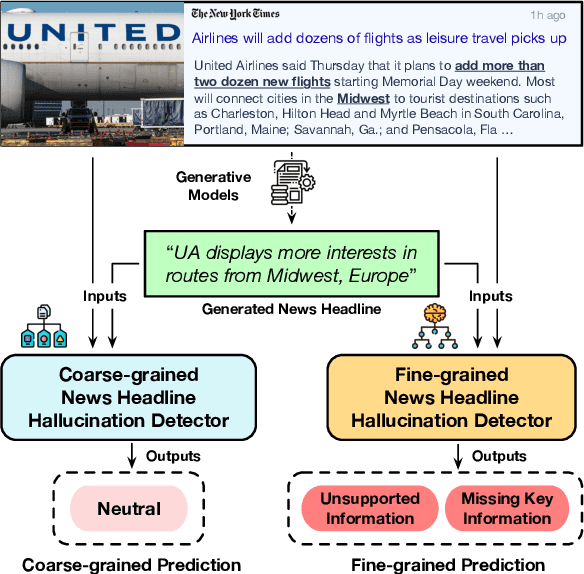
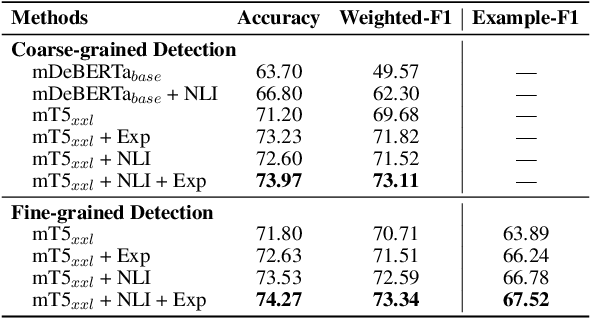
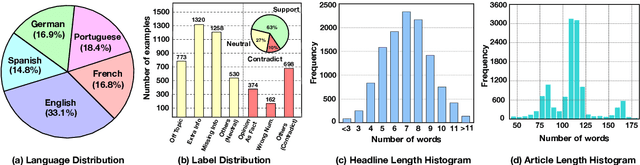
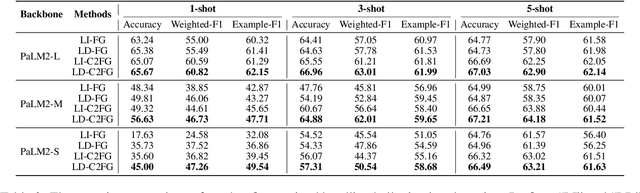
The popularity of automated news headline generation has surged with advancements in pre-trained language models. However, these models often suffer from the ``hallucination'' problem, where the generated headline is not fully supported by its source article. Efforts to address this issue have predominantly focused on English, using over-simplistic classification schemes that overlook nuanced hallucination types. In this study, we introduce the first multilingual, fine-grained news headline hallucination detection dataset that contains over 11 thousand pairs in 5 languages, each annotated with detailed hallucination types by experts. We conduct extensive experiments on this dataset under two settings. First, we implement several supervised fine-tuning approaches as preparatory solutions and demonstrate this dataset's challenges and utilities. Second, we test various large language models' in-context learning abilities and propose two novel techniques, language-dependent demonstration selection and coarse-to-fine prompting, to boost the few-shot hallucination detection performance in terms of the example-F1 metric. We release this dataset to foster further research in multilingual, fine-grained headline hallucination detection.
PLaD: Preference-based Large Language Model Distillation with Pseudo-Preference Pairs
Jun 06, 2024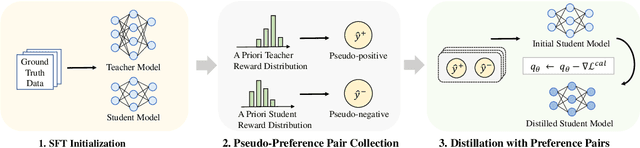
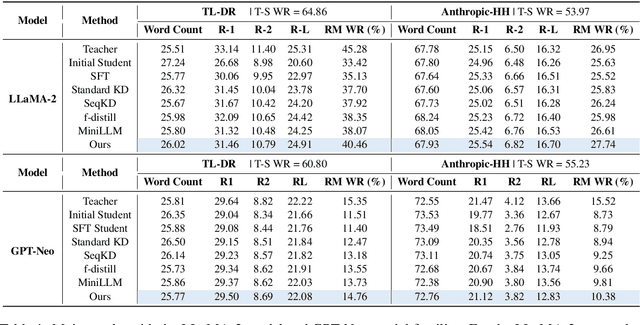
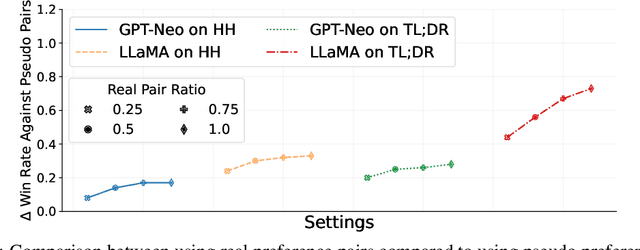
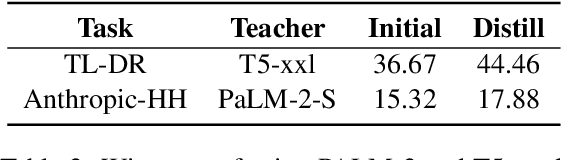
Large Language Models (LLMs) have exhibited impressive capabilities in various tasks, yet their vast parameter sizes restrict their applicability in resource-constrained settings. Knowledge distillation (KD) offers a viable solution by transferring expertise from large teacher models to compact student models. However, traditional KD techniques face specific challenges when applied to LLMs, including restricted access to LLM outputs, significant teacher-student capacity gaps, and the inherited mis-calibration issue. In this work, we present PLaD, a novel preference-based LLM distillation framework. PLaD exploits the teacher-student capacity discrepancy to generate pseudo-preference pairs where teacher outputs are preferred over student outputs. Then, PLaD leverages a ranking loss to re-calibrate student's estimation of sequence likelihood, which steers the student's focus towards understanding the relative quality of outputs instead of simply imitating the teacher. PLaD bypasses the need for access to teacher LLM's internal states, tackles the student's expressivity limitations, and mitigates the student mis-calibration issue. Through extensive experiments on two sequence generation tasks and with various LLMs, we demonstrate the effectiveness of our proposed PLaD framework.
LiPO: Listwise Preference Optimization through Learning-to-Rank
Feb 02, 2024


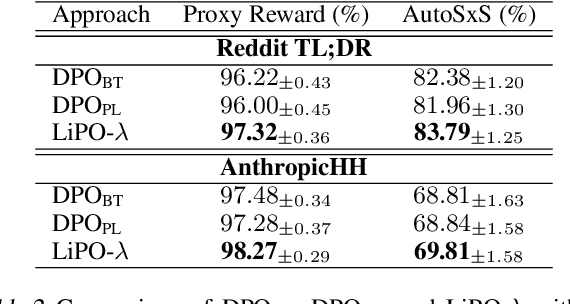
Aligning language models (LMs) with curated human feedback is critical to control their behaviors in real-world applications. Several recent policy optimization methods, such as DPO and SLiC, serve as promising alternatives to the traditional Reinforcement Learning from Human Feedback (RLHF) approach. In practice, human feedback often comes in a format of a ranked list over multiple responses to amortize the cost of reading prompt. Multiple responses can also be ranked by reward models or AI feedback. There lacks such a study on directly fitting upon a list of responses. In this work, we formulate the LM alignment as a listwise ranking problem and describe the Listwise Preference Optimization (LiPO) framework, where the policy can potentially learn more effectively from a ranked list of plausible responses given the prompt. This view draws an explicit connection to Learning-to-Rank (LTR), where most existing preference optimization work can be mapped to existing ranking objectives, especially pairwise ones. Following this connection, we provide an examination of ranking objectives that are not well studied for LM alignment withDPO and SLiC as special cases when list size is two. In particular, we highlight a specific method, LiPO-{\lambda}, which leverages a state-of-the-art listwise ranking objective and weights each preference pair in a more advanced manner. We show that LiPO-{\lambda} can outperform DPO and SLiC by a clear margin on two preference alignment tasks.
Benchmarking the CoW with the TopCoW Challenge: Topology-Aware Anatomical Segmentation of the Circle of Willis for CTA and MRA
Dec 29, 2023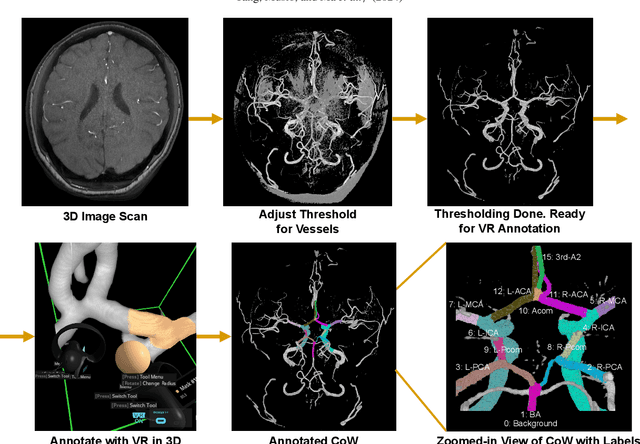
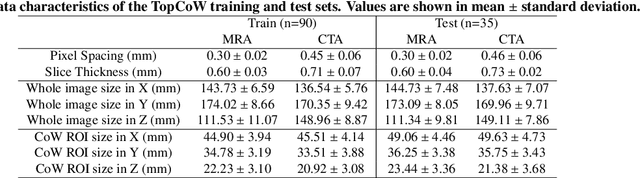
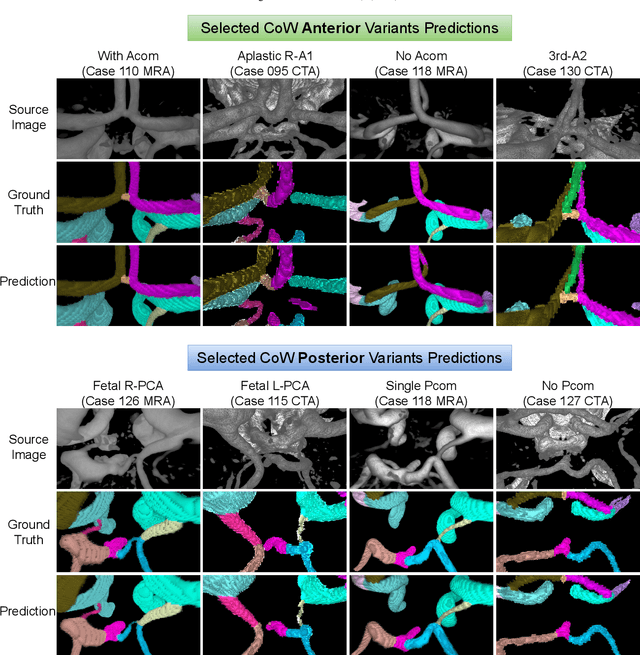
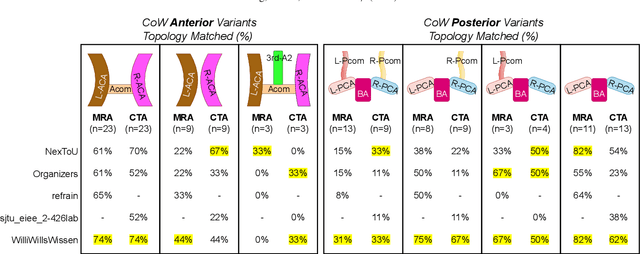
The Circle of Willis (CoW) is an important network of arteries connecting major circulations of the brain. Its vascular architecture is believed to affect the risk, severity, and clinical outcome of serious neuro-vascular diseases. However, characterizing the highly variable CoW anatomy is still a manual and time-consuming expert task. The CoW is usually imaged by two angiographic imaging modalities, magnetic resonance angiography (MRA) and computed tomography angiography (CTA), but there exist limited public datasets with annotations on CoW anatomy, especially for CTA. Therefore we organized the TopCoW Challenge in 2023 with the release of an annotated CoW dataset and invited submissions worldwide for the CoW segmentation task, which attracted over 140 registered participants from four continents. TopCoW dataset was the first public dataset with voxel-level annotations for CoW's 13 vessel components, made possible by virtual-reality (VR) technology. It was also the first dataset with paired MRA and CTA from the same patients. TopCoW challenge aimed to tackle the CoW characterization problem as a multiclass anatomical segmentation task with an emphasis on topological metrics. The top performing teams managed to segment many CoW components to Dice scores around 90%, but with lower scores for communicating arteries and rare variants. There were also topological mistakes for predictions with high Dice scores. Additional topological analysis revealed further areas for improvement in detecting certain CoW components and matching CoW variant's topology accurately. TopCoW represented a first attempt at benchmarking the CoW anatomical segmentation task for MRA and CTA, both morphologically and topologically.
Video Summarization: Towards Entity-Aware Captions
Dec 01, 2023
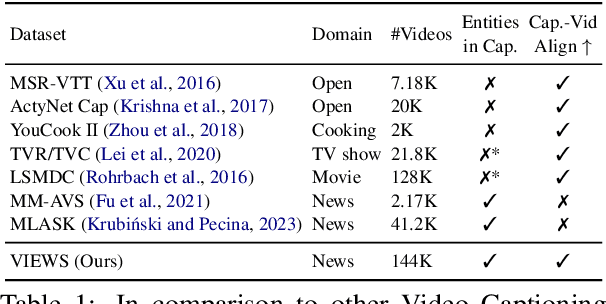


Existing popular video captioning benchmarks and models deal with generic captions devoid of specific person, place or organization named entities. In contrast, news videos present a challenging setting where the caption requires such named entities for meaningful summarization. As such, we propose the task of summarizing news video directly to entity-aware captions. We also release a large-scale dataset, VIEWS (VIdeo NEWS), to support research on this task. Further, we propose a method that augments visual information from videos with context retrieved from external world knowledge to generate entity-aware captions. We demonstrate the effectiveness of our approach on three video captioning models. We also show that our approach generalizes to existing news image captions dataset. With all the extensive experiments and insights, we believe we establish a solid basis for future research on this challenging task.
On What Basis? Predicting Text Preference Via Structured Comparative Reasoning
Nov 14, 2023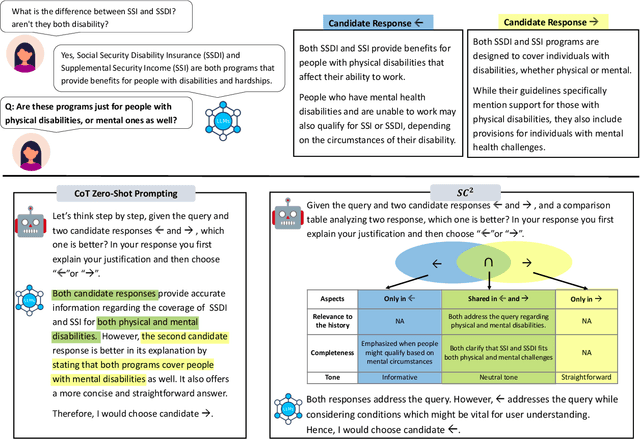


Comparative reasoning plays a crucial role in text preference prediction; however, large language models (LLMs) often demonstrate inconsistencies in their reasoning. While approaches like Chain-of-Thought improve accuracy in many other settings, they struggle to consistently distinguish the similarities and differences of complex texts. We introduce SC, a prompting approach that predicts text preferences by generating structured intermediate comparisons. SC begins by proposing aspects of comparison, followed by generating textual comparisons under each aspect. We select consistent comparisons with a pairwise consistency comparator that ensures each aspect's comparisons clearly distinguish differences between texts, significantly reducing hallucination and improving consistency. Our comprehensive evaluations across various NLP tasks, including summarization, retrieval, and automatic rating, demonstrate that SC equips LLMs to achieve state-of-the-art performance in text preference prediction.