 Add to Chrome
 Add to Firefox
 Add to Edge
LLM-Based User Personas for Recommendations at Scale
Jun 10, 2026
Large Language Models (LLMs) offer unprecedented potential for enhancing recommendation systems through their world knowledge and reasoning capabilities. However, existing approaches often rely on structured IDs or offline processing, limiting semantic richness, real-time adaptability, and user-facing interpretability. In this paper, we introduce a novel framework that enables real-time generation of LLM-based user interest personas for a large-scale commercial video recommendation platform. Our method generates natural-language user interest personas that address the exploitation-exploration trade-off by combining the summarization of existing interests with novel topics, directly during serving. To overcome the computational challenges of online LLM inference at a billion-user scale, we design a cost-efficient architecture leveraging knowledge distillation, asynchronous inference, and input optimization via semantically clustered video representations. Extensive offline evaluations, user studies, and live A/B tests demonstrate significant improvements in viewer value. This work bridges the gap between high-level semantic understanding and industrial-scale recommendation, paving the way for more dynamic, explainable, and satisfying personalized experiences.

Video Timeline Modeling For News Story Understanding
Sep 23, 2023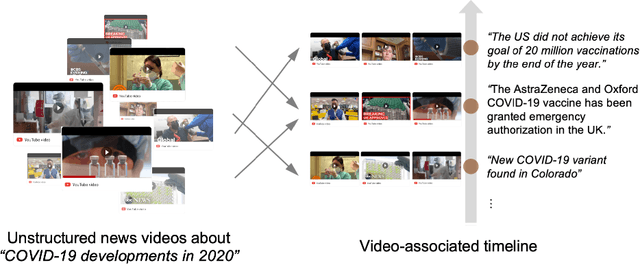
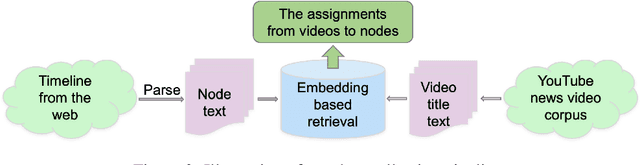

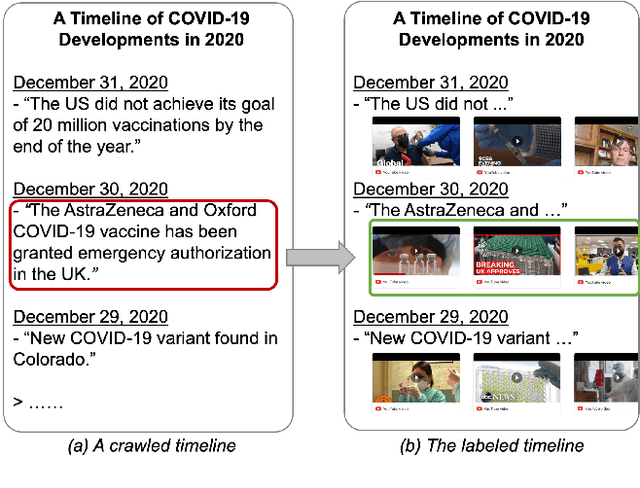
In this paper, we present a novel problem, namely video timeline modeling. Our objective is to create a video-associated timeline from a set of videos related to a specific topic, thereby facilitating the content and structure understanding of the story being told. This problem has significant potential in various real-world applications, such as news story summarization. To bootstrap research in this area, we curate a realistic benchmark dataset, YouTube-News-Timeline, consisting of over $12$k timelines and $300$k YouTube news videos. Additionally, we propose a set of quantitative metrics as the protocol to comprehensively evaluate and compare methodologies. With such a testbed, we further develop and benchmark exploratory deep learning approaches to tackle this problem. We anticipate that this exploratory work will pave the way for further research in video timeline modeling. The assets are available via https://github.com/google-research/google-research/tree/master/video_timeline_modeling.