 Add to Chrome
 Add to Firefox
 Add to Edge
Inter3D: A Benchmark and Strong Baseline for Human-Interactive 3D Object Reconstruction
Feb 19, 2025
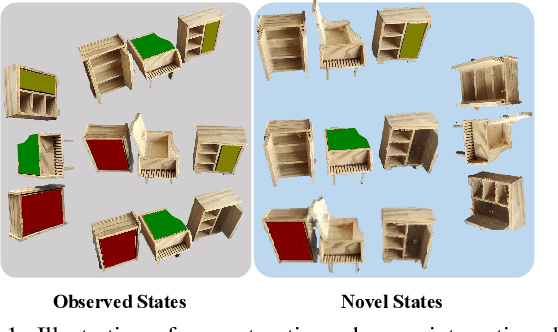

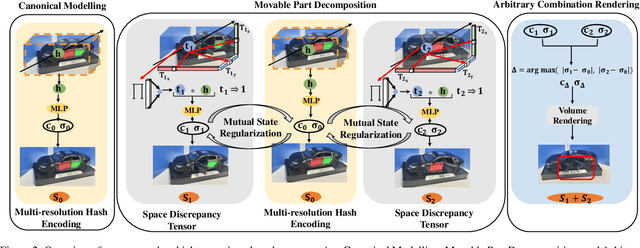
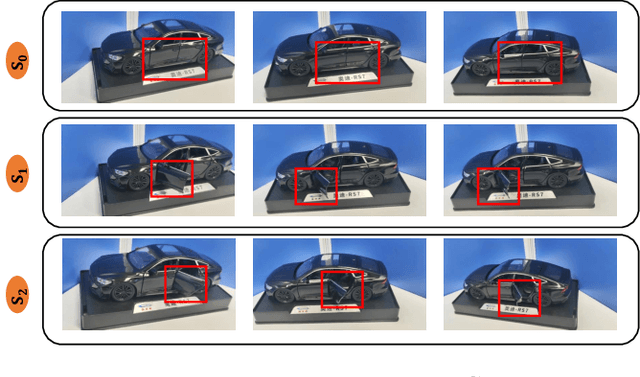
Recent advancements in implicit 3D reconstruction methods, e.g., neural rendering fields and Gaussian splatting, have primarily focused on novel view synthesis of static or dynamic objects with continuous motion states. However, these approaches struggle to efficiently model a human-interactive object with n movable parts, requiring 2^n separate models to represent all discrete states. To overcome this limitation, we propose Inter3D, a new benchmark and approach for novel state synthesis of human-interactive objects. We introduce a self-collected dataset featuring commonly encountered interactive objects and a new evaluation pipeline, where only individual part states are observed during training, while part combination states remain unseen. We also propose a strong baseline approach that leverages Space Discrepancy Tensors to efficiently modelling all states of an object. To alleviate the impractical constraints on camera trajectories across training states, we propose a Mutual State Regularization mechanism to enhance the spatial density consistency of movable parts. In addition, we explore two occupancy grid sampling strategies to facilitate training efficiency. We conduct extensive experiments on the proposed benchmark, showcasing the challenges of the task and the superiority of our approach.

Self-Enhanced Reasoning Training: Activating Latent Reasoning in Small Models for Enhanced Reasoning Distillation
Feb 18, 2025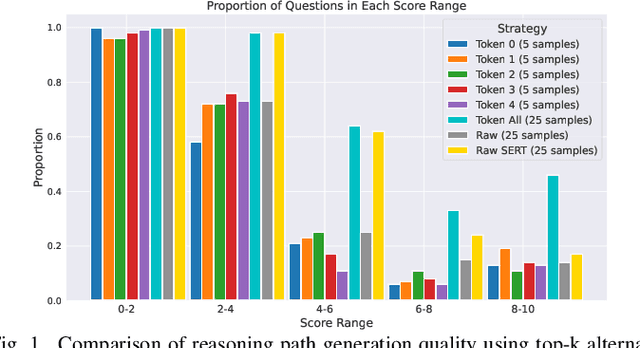
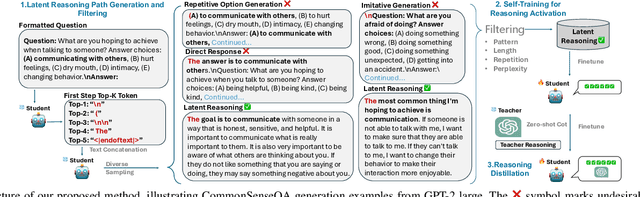
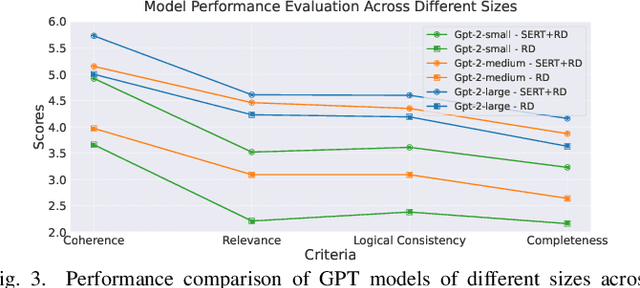
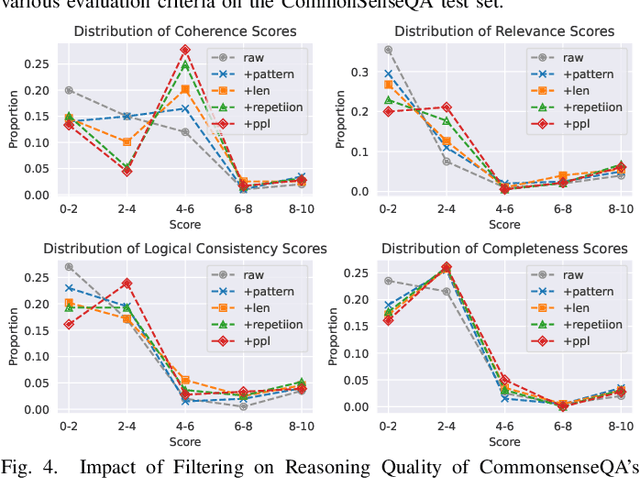
The rapid advancement of large language models (LLMs) has significantly enhanced their reasoning abilities, enabling increasingly complex tasks. However, these capabilities often diminish in smaller, more computationally efficient models like GPT-2. Recent research shows that reasoning distillation can help small models acquire reasoning capabilities, but most existing methods focus primarily on improving teacher-generated reasoning paths. Our observations reveal that small models can generate high-quality reasoning paths during sampling, even without chain-of-thought prompting, though these paths are often latent due to their low probability under standard decoding strategies. To address this, we propose Self-Enhanced Reasoning Training (SERT), which activates and leverages latent reasoning capabilities in small models through self-training on filtered, self-generated reasoning paths under zero-shot conditions. Experiments using OpenAI's GPT-3.5 as the teacher model and GPT-2 models as the student models demonstrate that SERT enhances the reasoning abilities of small models, improving their performance in reasoning distillation.
Step-Audio: Unified Understanding and Generation in Intelligent Speech Interaction
Feb 18, 2025Real-time speech interaction, serving as a fundamental interface for human-machine collaboration, holds immense potential. However, current open-source models face limitations such as high costs in voice data collection, weakness in dynamic control, and limited intelligence. To address these challenges, this paper introduces Step-Audio, the first production-ready open-source solution. Key contributions include: 1) a 130B-parameter unified speech-text multi-modal model that achieves unified understanding and generation, with the Step-Audio-Chat version open-sourced; 2) a generative speech data engine that establishes an affordable voice cloning framework and produces the open-sourced lightweight Step-Audio-TTS-3B model through distillation; 3) an instruction-driven fine control system enabling dynamic adjustments across dialects, emotions, singing, and RAP; 4) an enhanced cognitive architecture augmented with tool calling and role-playing abilities to manage complex tasks effectively. Based on our new StepEval-Audio-360 evaluation benchmark, Step-Audio achieves state-of-the-art performance in human evaluations, especially in terms of instruction following. On open-source benchmarks like LLaMA Question, shows 9.3% average performance improvement, demonstrating our commitment to advancing the development of open-source multi-modal language technologies. Our code and models are available at https://github.com/stepfun-ai/Step-Audio.
Text2World: Benchmarking Large Language Models for Symbolic World Model Generation
Feb 18, 2025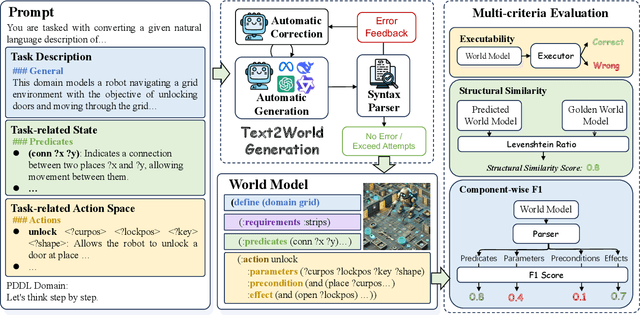
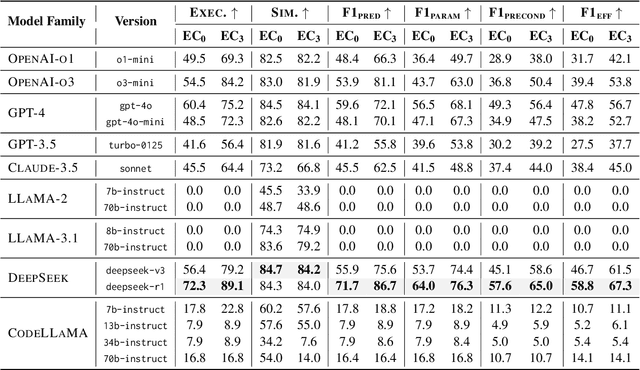
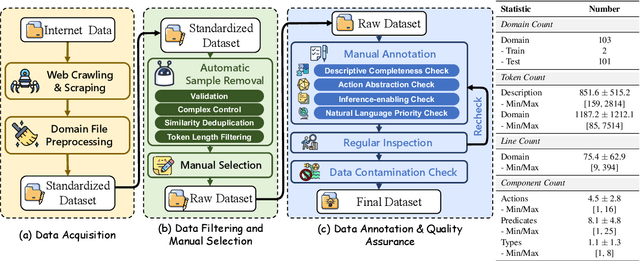
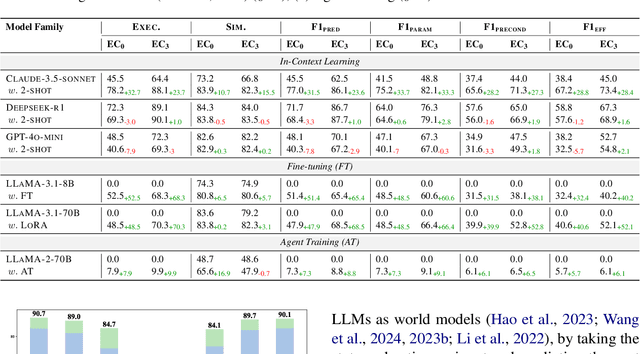
Recently, there has been growing interest in leveraging large language models (LLMs) to generate symbolic world models from textual descriptions. Although LLMs have been extensively explored in the context of world modeling, prior studies encountered several challenges, including evaluation randomness, dependence on indirect metrics, and a limited domain scope. To address these limitations, we introduce a novel benchmark, Text2World, based on planning domain definition language (PDDL), featuring hundreds of diverse domains and employing multi-criteria, execution-based metrics for a more robust evaluation. We benchmark current LLMs using Text2World and find that reasoning models trained with large-scale reinforcement learning outperform others. However, even the best-performing model still demonstrates limited capabilities in world modeling. Building on these insights, we examine several promising strategies to enhance the world modeling capabilities of LLMs, including test-time scaling, agent training, and more. We hope that Text2World can serve as a crucial resource, laying the groundwork for future research in leveraging LLMs as world models. The project page is available at https://text-to-world.github.io/.
Out-of-Distribution Detection on Graphs: A Survey
Feb 12, 2025Graph machine learning has witnessed rapid growth, driving advancements across diverse domains. However, the in-distribution assumption, where training and testing data share the same distribution, often breaks in real-world scenarios, leading to degraded model performance under distribution shifts. This challenge has catalyzed interest in graph out-of-distribution (GOOD) detection, which focuses on identifying graph data that deviates from the distribution seen during training, thereby enhancing model robustness. In this paper, we provide a rigorous definition of GOOD detection and systematically categorize existing methods into four types: enhancement-based, reconstruction-based, information propagation-based, and classification-based approaches. We analyze the principles and mechanisms of each approach and clarify the distinctions between GOOD detection and related fields, such as graph anomaly detection, outlier detection, and GOOD generalization. Beyond methodology, we discuss practical applications and theoretical foundations, highlighting the unique challenges posed by graph data. Finally, we discuss the primary challenges and propose future directions to advance this emerging field. The repository of this survey is available at https://github.com/ca1man-2022/Awesome-GOOD-Detection.
Generative Adversarial Networks Bridging Art and Machine Intelligence
Feb 09, 2025

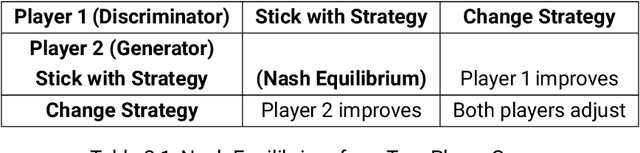

Generative Adversarial Networks (GAN) have greatly influenced the development of computer vision and artificial intelligence in the past decade and also connected art and machine intelligence together. This book begins with a detailed introduction to the fundamental principles and historical development of GANs, contrasting them with traditional generative models and elucidating the core adversarial mechanisms through illustrative Python examples. The text systematically addresses the mathematical and theoretical underpinnings including probability theory, statistics, and game theory providing a solid framework for understanding the objectives, loss functions, and optimisation challenges inherent to GAN training. Subsequent chapters review classic variants such as Conditional GANs, DCGANs, InfoGAN, and LAPGAN before progressing to advanced training methodologies like Wasserstein GANs, GANs with gradient penalty, least squares GANs, and spectral normalisation techniques. The book further examines architectural enhancements and task-specific adaptations in generators and discriminators, showcasing practical implementations in high resolution image generation, artistic style transfer, video synthesis, text to image generation and other multimedia applications. The concluding sections offer insights into emerging research trends, including self-attention mechanisms, transformer-based generative models, and a comparative analysis with diffusion models, thus charting promising directions for future developments in both academic and applied settings.
Zero-shot Video Moment Retrieval via Off-the-shelf Multimodal Large Language Models
Jan 14, 2025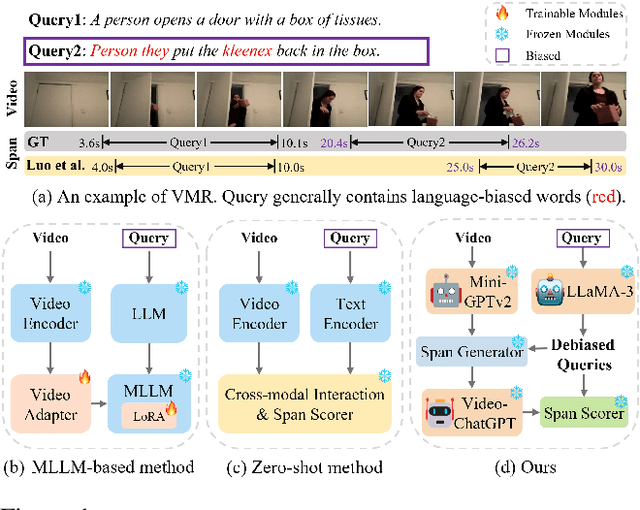

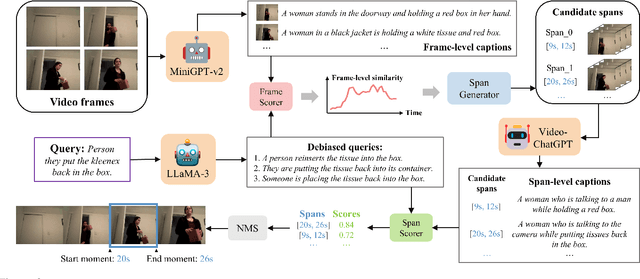

The target of video moment retrieval (VMR) is predicting temporal spans within a video that semantically match a given linguistic query. Existing VMR methods based on multimodal large language models (MLLMs) overly rely on expensive high-quality datasets and time-consuming fine-tuning. Although some recent studies introduce a zero-shot setting to avoid fine-tuning, they overlook inherent language bias in the query, leading to erroneous localization. To tackle the aforementioned challenges, this paper proposes Moment-GPT, a tuning-free pipeline for zero-shot VMR utilizing frozen MLLMs. Specifically, we first employ LLaMA-3 to correct and rephrase the query to mitigate language bias. Subsequently, we design a span generator combined with MiniGPT-v2 to produce candidate spans adaptively. Finally, to leverage the video comprehension capabilities of MLLMs, we apply VideoChatGPT and span scorer to select the most appropriate spans. Our proposed method substantially outperforms the state-ofthe-art MLLM-based and zero-shot models on several public datasets, including QVHighlights, ActivityNet-Captions, and Charades-STA.
Target Detection in OFDM-ISAC Systems: A Multipath Exploitation Approach
Jan 14, 2025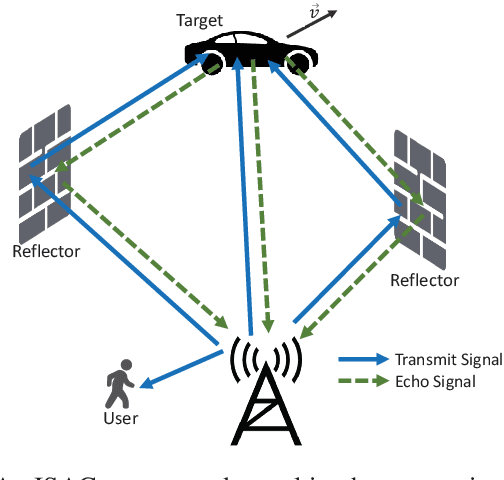
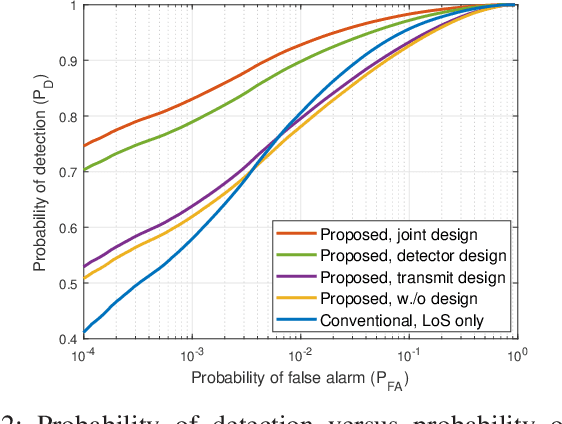
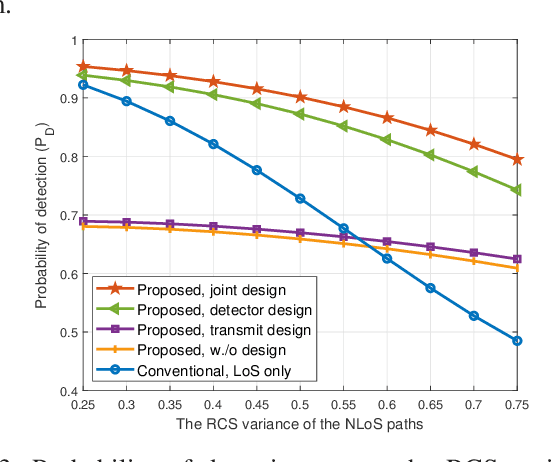
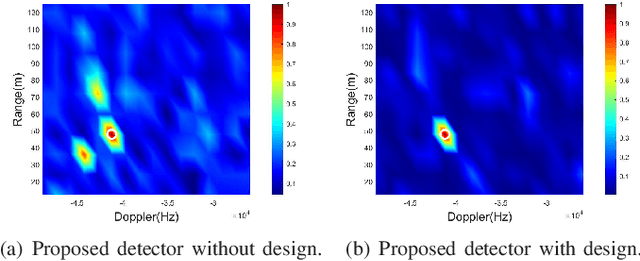
This paper investigates the potential of multipath exploitation for enhancing target detection in orthogonal frequency division multiplexing (OFDM)-based integrated sensing and communication (ISAC) systems. The study aims to improve target detection performance by harnessing the diversity gain in the delay-Doppler domain. We propose a weighted generalized likelihood ratio test (GLRT) detector that effectively leverages the multipath propagation between the base station (BS) and the target. To further enhance detection accuracy, a joint optimization framework is developed for subcarrier power allocation at the transmitter and weight coefficients of the GLRT detector. The objective is to maximize the probability of target detection while satisfying constraints on total transmit power and the communication receiver's signal-to-noise ratio (SNR). An iterative algorithm based on the majorization-minimization (MM) method is employed to address the resulting non-convex optimization problem. Simulation results demonstrate the efficacy of the proposed algorithm and confirm the benefits of multipath exploitation for target detection in OFDM-ISAC systems under multipath-rich environments.
Target Detection in ISAC Systems with Active RISs: A Multi-Perspective Observation Approach
Jan 11, 2025


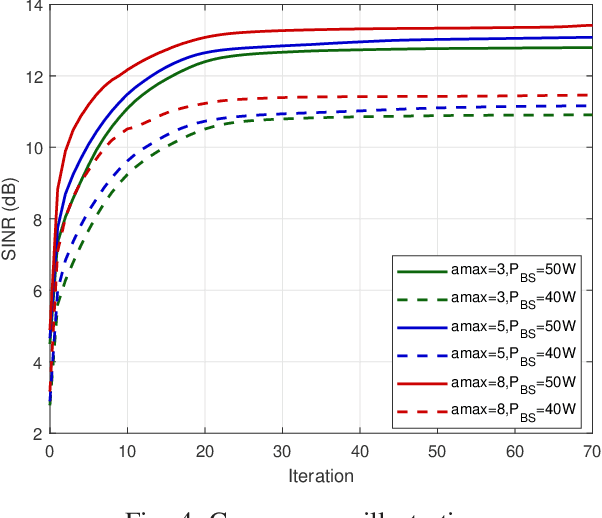
Integrated sensing and communication (ISAC) has emerged as a transformative technology for 6G networks, enabling the seamless integration of communication and sensing functionalities. Reconfigurable intelligent surfaces (RIS), with their capability to adaptively reconfigure the radio environment, have shown significant potential in enhancing communication quality and enabling advanced cooperative sensing. This paper investigates a multi-RIS-assisted ISAC system and introduces a novel multi-perspective observation framework that leverages the diversity of multiple observation paths, each exhibiting distinct spatial, delay, and Doppler characteristics for both target and clutter. The proposed framework integrates symbol-level precoding (SLP) and space-time adaptive processing (STAP) to fully exploit the benefits of multi-perspective observations, enabling superior target-clutter separation and significantly improving detection accuracy. The objective is to jointly design the transmit waveform, reflection coefficients of multiple active RISs, and spatial-temporal receive filters to maximize the radar output signal-to-clutter-plus-noise ratio (SCNR) for target detection, while ensuring the quality-of-service (QoS) requirements of communication users. To address the resulting non-convex optimization problem, an effective iterative algorithm is developed, combining fractional programming (FP), majorization-minimization (MM), and the alternating direction method of multipliers (ADMM). Extensive simulation results validate the effectiveness of the proposed multi-perspective observation strategy, demonstrating its advantages in improving target detection performance in challenging environments.
Repeat-bias-aware Optimization of Beyond-accuracy Metrics for Next Basket Recommendation
Jan 10, 2025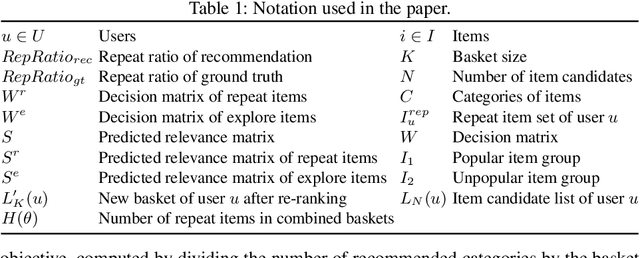
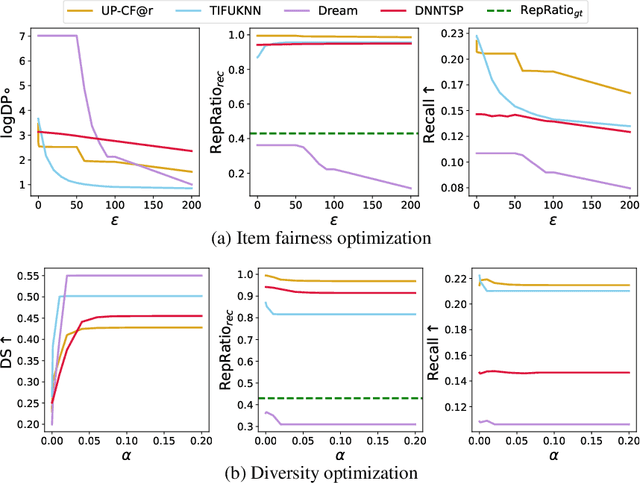
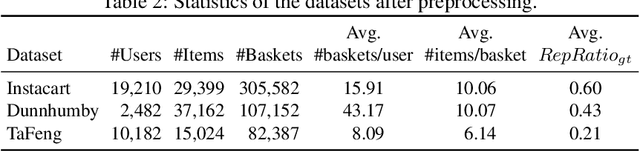
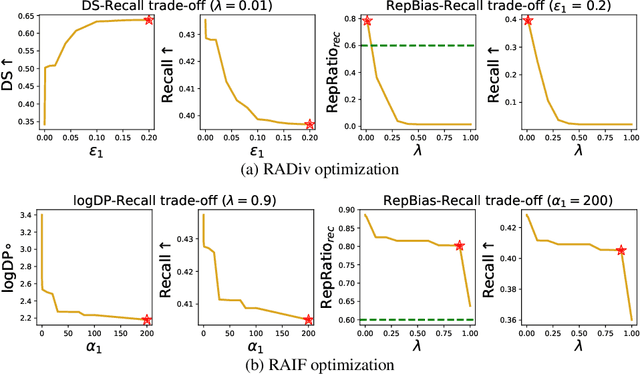
In next basket recommendation (NBR) a set of items is recommended to users based on their historical basket sequences. In many domains, the recommended baskets consist of both repeat items and explore items. Some state-of-the-art NBR methods are heavily biased to recommend repeat items so as to maximize utility. The evaluation and optimization of beyond-accuracy objectives for NBR, such as item fairness and diversity, has attracted increasing attention. How can such beyond-accuracy objectives be pursued in the presence of heavy repeat bias? We find that only optimizing diversity or item fairness without considering repeat bias may cause NBR algorithms to recommend more repeat items. To solve this problem, we propose a model-agnostic repeat-bias-aware optimization algorithm to post-process the recommended results obtained from NBR methods with the objective of mitigating repeat bias when optimizing diversity or item fairness. We consider multiple variations of our optimization algorithm to cater to multiple NBR methods. Experiments on three real-world grocery shopping datasets show that the proposed algorithms can effectively improve diversity and item fairness, and mitigate repeat bias at acceptable Recall loss.