 Add to Chrome
 Add to Firefox
 Add to Edge
Mamba-VMR: Multimodal Query Augmentation via Generated Videos for Precise Temporal Grounding
Mar 23, 2026
Text-driven video moment retrieval (VMR) remains challenging due to limited capture of hidden temporal dynamics in untrimmed videos, leading to imprecise grounding in long sequences. Traditional methods rely on natural language queries (NLQs) or static image augmentations, overlooking motion sequences and suffering from high computational costs in Transformer-based architectures. Existing approaches fail to integrate subtitle contexts and generated temporal priors effectively, we therefore propose a novel two-stage framework for enhanced temporal grounding. In the first stage, LLM-guided subtitle matching identifies relevant textual cues from video subtitles, fused with the query to generate auxiliary short videos via text-to-video models, capturing implicit motion information as temporal priors. In the second stage, augmented queries are processed through a multi-modal controlled Mamba network, extending text-controlled selection with video-guided gating for efficient fusion of generated priors and long sequences while filtering noise. Our framework is agnostic to base retrieval models and widely applicable for multimodal VMR. Experimental evaluations on the TVR benchmark demonstrate significant improvements over state-of-the-art methods, including reduced computational overhead and higher recall in long-sequence grounding.

Zero-shot Video Moment Retrieval via Off-the-shelf Multimodal Large Language Models
Jan 14, 2025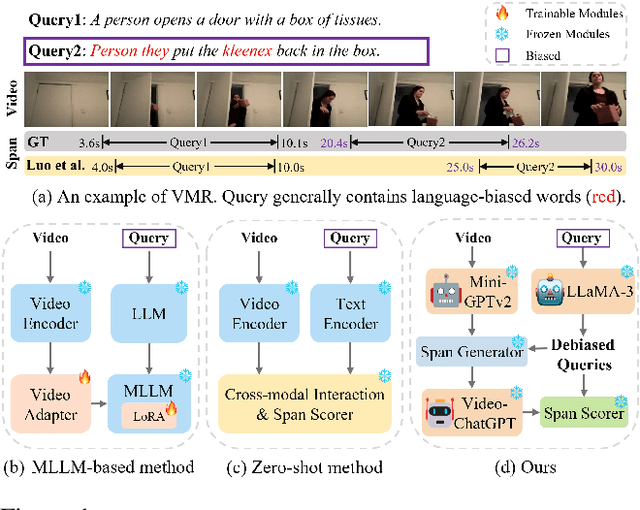

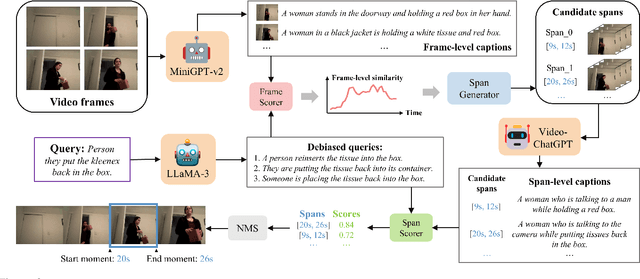

The target of video moment retrieval (VMR) is predicting temporal spans within a video that semantically match a given linguistic query. Existing VMR methods based on multimodal large language models (MLLMs) overly rely on expensive high-quality datasets and time-consuming fine-tuning. Although some recent studies introduce a zero-shot setting to avoid fine-tuning, they overlook inherent language bias in the query, leading to erroneous localization. To tackle the aforementioned challenges, this paper proposes Moment-GPT, a tuning-free pipeline for zero-shot VMR utilizing frozen MLLMs. Specifically, we first employ LLaMA-3 to correct and rephrase the query to mitigate language bias. Subsequently, we design a span generator combined with MiniGPT-v2 to produce candidate spans adaptively. Finally, to leverage the video comprehension capabilities of MLLMs, we apply VideoChatGPT and span scorer to select the most appropriate spans. Our proposed method substantially outperforms the state-ofthe-art MLLM-based and zero-shot models on several public datasets, including QVHighlights, ActivityNet-Captions, and Charades-STA.
Hawkes based Representation Learning for Reasoning over Scale-free Community-structured Temporal Knowledge Graphs
Dec 28, 2024Temporal knowledge graph (TKG) reasoning has become a hot topic due to its great value in many practical tasks. The key to TKG reasoning is modeling the structural information and evolutional patterns of the TKGs. While great efforts have been devoted to TKG reasoning, the structural and evolutional characteristics of real-world networks have not been considered. In the aspect of structure, real-world networks usually exhibit clear community structure and scale-free (long-tailed distribution) properties. In the aspect of evolution, the impact of an event decays with the time elapsing. In this paper, we propose a novel TKG reasoning model called Hawkes process-based Evolutional Representation Learning Network (HERLN), which learns structural information and evolutional patterns of a TKG simultaneously, considering the characteristics of real-world networks: community structure, scale-free and temporal decaying. First, we find communities in the input TKG to make the encoding get more similar intra-community embeddings. Second, we design a Hawkes process-based relational graph convolutional network to cope with the event impact-decaying phenomenon. Third, we design a conditional decoding method to alleviate biases towards frequent entities caused by long-tailed distribution. Experimental results show that HERLN achieves significant improvements over the state-of-the-art models.